Ten of the Best – Women of the West

Over a decade ago (it really doesn’t seem that long… ) I posted a list of western actors. I followed that up with a post on western directors, film noir directors, and film noir stars. The latter included a mix of male and female stars and it has long been my intention to put up a list that would balance that first entry by turning the spotlight on the women who made significant contributions to the western. I’m not sure why I’ve left it so long, I guess other things just kept getting in the way and it got shunted off for another day. There are those who would say the western is an inherently masculine genre, but I don’t feel that’s a fair or just assessment. The western was and remains one of the greatest of all cinema genres precisely because it was so malleable, was so dependent on absorbing myriad influences, and drew highly creditable work from such a wide range of personnel. So, let’s cut to the chase and have a look at ten actresses who added immeasurably to my my enjoyment of my favorite genre.

Felicia Farr
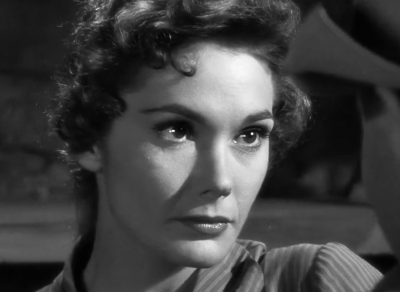
I can’t imagine opening this list with anyone else. Felicia Farr’s part in 3:10 to Yuma is comparatively small yet it’s a pivotal one. Those short scenes she shares with Glenn Ford’s outlaw are memorable and powerfully touching, adding another layer of yearning and regret to an already poignant movie. Director Delmer Daves also used Farr in two other fine westerns, The Last Wagon and Jubal, while George Sherman cast her to good effect in Hell Bent for Leather and Reprisal.

Virginia Mayo
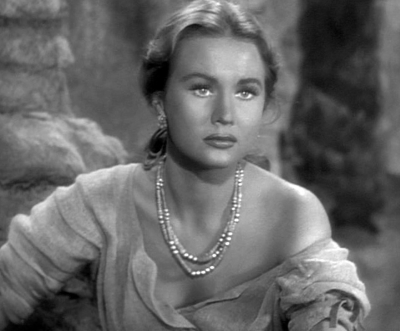
Making her western debut in Colorado Territory, Raoul Walsh’s remake of his own High Sierra, Mayo impressed herself on the genre right away. I won’t go into spoilers here for those who haven’t seen it but the climax of that film is as tragic as it is poetic, and Mayo’s actions give it its power. Walsh would cast her again in the underrated Along the Great Divide while she had other good parts in The Proud Ones, Great Day in the Morning and  Fort Dobbs to name just a few.

Dorothy Malone
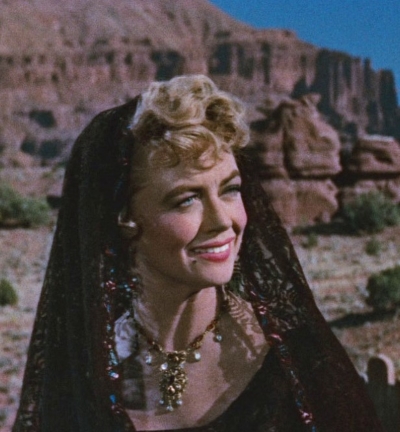
While Virginia Mayo was the passionate, beating heart of Colorado Territory, her rival for the affections of Joel McCrea’s doomed outlaw was a coquettish and calculating Dorothy Malone. She would take on some terrific roles throughout the 50s, including some very respectable films noir as well as a couple of plum parts for Douglas Sirk – the superlative The Tarnished Angels and an Oscar winning performance in Written on the Wind – and of course plenty of westerns. Among the highlights are At Gunpoint (why has this movie never had a decent release anywhere?), Pillars of the Sky, Quantez, The Last Sunset and Warlock.

Barbara Stanwyck

One of cinema’s great actresses, Stanwyck made  couple of westerns in the 1930s and 1940s (Annie Oakley, Union Pacific and California) but it was in the 50s that she made her mark on the genre, and fell in love with it in the process. Starting off with the emotionally charged and wondrously melodramatic The Furies for Anthony Mann, she would regularly return to the west. Some of those films were only partially successful, but a movie like The Violent Men has much to recommend it and Samuel Fuller’s Forty Guns is an enduring classic in my opinion.

Vera Miles

Anyone who worked with John Ford, and was cast in major roles in his films has to be worthy of consideration here. Vera Miles had started out in the genre with a part in The Charge at Feather River and in Jacques Tourneur’s Wichita. These are fine movies by any standard yet a top role in The Searchers, which is arguably the best western of all time, and one of the best films of any kind, lifted her into a different league. The fact Ford cast her again in The Man Who Shot Liberty Valance, one of the key films marking the close of the classic western era cements her place for me.

Maureen O’Hara

The Ford connection is strong with the next entry on the list, even if their western collaboration was limited. The fiery Irish redhead had already made Comanche Territory when Ford used her opposite John Wayne in Rio Grande, unfairly regarded by some as the least of the director’s Cavalry Trilogy. She would work memorably with Ford and Wayne again in other genres and went on to make good westerns such as War Arrow (George Sherman) and The Deadly Companions (Sam Peckinpah’s debut feature).

Claire Trevor

Sticking with Ford (and indeed Wayne) for the present, we now come to Claire Trevor. It’s hardly too much to say that Stagecoach was instrumental in boosting the status of the western, lifting it firmly and decisively into the A class where it would continue to hold a dominant position for the next quarter of a century. Trevor’s turn as Dallas, the “fallen woman” driven out of polite society only to find love, respect and a future with Wayne’s Ringo Kid, is a superb piece of work. Perhaps her subsequent westerns didn’t offer the same scope for her abilities – Texas, Dark Command (Raoul Walsh), The Desperadoes, The Stranger Wore a Gun – but she was a regular visitor to the cinematic west, and that ride on the Lordsburg stage counts for a lot.

Katy Jurado

The Mexican actress with maybe the most soulful pair of eyes in the business. The wistful look she bestows on Gary Cooper as he stands alone in an empty street in High Noon is as good a way to announce one’s arrival in the genre as I can think of. She brought her unique quality to such movies as Broken Lance, Man from Del Rio and The Badlanders throughout the 1950s. Her appearances in westerns tailed off after that, One-Eyed Jacks with Brando in the next decade and then a small but hugely affecting part in Sam Peckinpah’s Pat Garrett and Billy the Kid.

Julie Adams

Anyone familiar with my writing over the years will be aware of how much I enjoy the output of Universal-International, and the westerns that studio produced are among my favorites. Sometimes it feels as though it’s impossible to watch a U-I western and not see her. Budd Boetticher frequently used her in his movies for the studio – Wings of the Hawk, Horizons West, The Man from the Alamo – and she had good roles for Anthony Mann in Bend of the River and Raoul Walsh in The Lawless Breed and then later on in Joseph M Newman’s The Gunfight at Dodge City.

Debra Paget

Starting out with some small roles in notable films noir (House of Strangers, Cry of the City), Paget struck western gold in the influential Broken Arrow for Delmer Daves. In a sense, one could say she became typecast in westerns, finding herself playing yet again a Native American in White Feather (scripted by Daves) and the powerful and visceral The Last Hunt for Richard Brooks. Typecast or not, she brought a great deal of dignity to those parts and the western genre would be poorer without her performances.

So there it is, my list of ten actresses who have enriched the western over the years. I had to indulge in a bit of ruthless trimming to keep it down to ten, but that’s to be expected and I also anticipate that my picks aren’t going to satisfy everyone. Well, that’s the nature of lists and half the fun is hearing others point out who they would have included instead. Feel free to disagree in the comments section below.

The Badlanders

It seems like everybody around here is stealing from everybody else.

A good heist movie is hard to beat in my opinion, there’s considerable potential for suspense and tension in the execution of a complicated robbery, and the aftermath or outcome is generally rife with possibilities too. The heist is typically used as a plot element in contemporary crime movies, both the serious and more lighthearted varieties, but it’s flexible enough to be applied to other genres as well. There’s arguably no more flexible type of film than the western, the setting being able to absorb and adapt aspects almost at will. The Badlanders (1958) is a remake of John Huston’s The Asphalt Jungle, adapted from the W R Burnett novel, moving the action back half a century and shifting from the urban milieu to the dusty Arizona landscape.

In the dying days of the 19th century two men are released from the prison at Yuma, one because his time has been served in full and the other earning early parole because he prevented the former from assaulting a guard. In fact, these two men, Peter Van Hoek (Alan Ladd) & John McBain (Ernest Borgnine) have quite a lot in common: both ended up behind bars either  directly or indirectly due to the treachery of others, and both hail from a similar part of Arizona. While they set off on apparently different paths they’re fated to meet again as their desire to right some of the wrongs of the past lead them to the small town of Bascom. The settlement is the center of a gold mining operation, beneath the land once owned by McBain before he was cheated out of it, and places have a way of calling men back even if they have no logical reason for returning. Van Hoek was a mining engineer and geologist, cheated in a different way, framed for a robbery and keen to get something back for the time he lost when he was wrongly incarcerated. Everything boils down to a plan to blast a rich vein of ore from an abandoned shaft and sell it back to the current owner, Cyril Lounsberry (Kent Smith). You might wonder why a man would buy what rightfully belongs to him – well Lounsberry is only nominally in charge as the mine is actually in his wife’s name, and he’s a man with a wandering and faithless eye. Such a man is obviously going to be drawn to the idea of an independent source of wealth. On the surface, the key to the whole operation is timing and disciplined organization, but there’s also the intangible element to be factored in, as tends to be the case in the affairs of man, and in this instance it’s the question of trust.

Anyone familiar with The Asphalt Jungle will know how things play out on screen, but there are significant enough differences to set the two films apart. Aside from the altered location, there’s the variation in tone and overall mood of the film. Huston’s film was a classic piece of fatalistic noir, where bad luck and the character flaws of the principals led to the ultimate unraveling of the best laid plans. In The Badlanders, however, the weaknesses of the leads in the earlier version are actually transformed into their strengths, and the resolution is upbeat and positive. I think a good deal of that is down to the director; Delmer Daves made films that mainly emphasized the positive characteristics and leanings of people, and you generally come away from his work with an enhanced appreciation of the inherent decency of humanity. If I were to draw direct comparisons between Daves’ and Huston’s take on the source material, something I’m reluctant to do as it seems s bit of a pointless exercise, then I’d have to say The Asphalt Jungle is clearly the superior film. Still, The Badlanders does have certain points in its favor, and those are mainly the touches which bear the characteristic fingerprints of Daves. There’s some strong cinematography from John Seitz too, especially the interiors but also the outdoors location work in Arizona and Old Tucson.

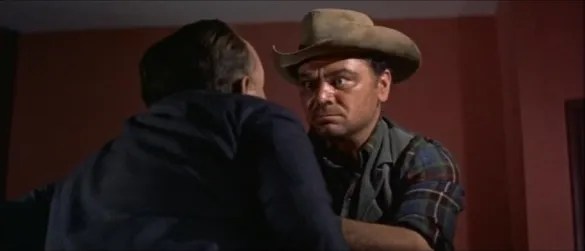
Alan Ladd underwent a noticeable physical decline in his last years, but that hadn’t really set in when he made The Badlanders. He was still vital and looked in reasonably good shape at that point. His role isn’t an especially complex one, there’s the back story of his being fitted up to provide motivation of course but it’s never expanded upon to any extent. While Ladd is the headline star the most memorable performances come from those billed below him, notably Ernest Borgnine and Katy Jurado. Borgnine was typically a powerful physical presence in movies and got to show off that aspect in a number of scenes, yet it’s another side of the man which has the greatest impact. He had a certain innocence below the surface, although this wasn’t always exploited. The character of McBain is remarkable for the way this vague social naiveté is woven into the plot. And the ever soulful charms of Katy Jurado are ideal for drawing out and playing off that. Despite the fact the heist, which it has to be said is filmed with some style, is the main focus of the plot, the tender and sensitive relationship which develops between Borgnine and Jurado is the living heart of it all. In support Kent Smith, Nehemiah Persoff, Robert Emhardt and Anthony Caruso do all that could be expected of them in their limited roles.

The Badlanders has been released on DVD in the US as part of the Warner Archive MOD program, and there are European editions available in France (non-anamorphic, I think), Spain and Italy. The Spanish copy I viewed presents the movie in the correct 2.35:1 CinemaScope ratio and the transfer is perfectly satisfactory – colors look accurate and the print is quite clean. There are no extra features included and the Spanish subtitles can be disabled from the setup menu. Speaking as a fan of Delmer Daves’ work, I would say this is a weaker film when stacked up alongside his other westerns. However, just to qualify that evaluation, it’s worth bearing in mind that his westerns rank among the finest produced in the 50s. As such, I think this film deserves to be seen, and is of interest as a rare western heist movie, a remake of The Asphalt Jungle, and finally as a worthwhile frontier drama in its own right.

Broken Lance

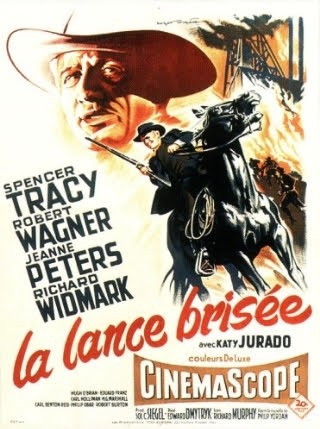
Remakes have popped up here from time to time in the past and they often divide opinion among movie fans, not only based on their relative merits but also on whether there’s any point in producing them at all. For me, the best remakes, or at least the more interesting ones, try to do something different with the material. For example, the casting may radically alter perspective, or the source material (say, a novel which has been adapted) might be adhered to more faithfully. Shifting from one genre to another – which I feel was successfully achieved with High Sierra and Colorado Territory – is another potentially fruitful option. And this leads me to Broken Lance (1954), which essentially recycles Philip Yordan’s screenplay for House of Strangers and transposes the action from New York to the old west.

Newly released from prison, Joe Devereaux (Robert Wagner) is “invited” to the governor’s office in town to be presented with a proposition. His three brothers – Ben, Mike and Denny (Richard Widmark, Hugh O’Brian and Earl Holliman) – aren’t exactly thrilled to meet him and instead offer a ranch in Oregon and $10,000 in cash, on condition he catches the next train out of town. At  this stage it’s unclear to the viewer why Joe’s siblings are so keen to see the back of him, or why he so contemptuously deposits the proffered money in a spittoon. It’s only after a ride across the vast, open country to the now abandoned family home that the pieces begin to fall into place. As Joe stands amid the dust-choked remnants of his old life, staring at the huge portrait of his now deceased father, his thoughts drift back to earlier days. We see Matt Devereaux (Spencer Tracy), the gruff Irish patriarch who has tamed a land and is now doing his level best to tame his four sons. Joe is the youngest and his favorite, born of his Indian wife (Katy Jurado), while the others are the product of an earlier marriage. That Mike and Denny are bad apples is immediately apparent when they’re caught attempting to rustle cattle from their own ranch, and Ben’s resentment is seen to be simmering close to the surface as well. The main theme – although it’s by no means the only one – is that of fractured family relations. As the boys have grown into men and the frontier is similarly maturing, the cracks within the Devereaux clan are starting to show. The old man, while not without charm, is of that hard, pioneering breed accustomed to enforcing their will with a six-gun, a whip or a rope. However, times move on and priorities alter along with them. Ben feels that progress requires a change in the way the family business is run, yet he lacks the courage to face down his father directly to effect that change. So there’s tension in the air, but it really only comes to a head when pollution leaking from the local copper workings leads Matt into violent confrontation with the miners. Sadly, from the aging rancher’s perspective, frontier justice has no place in this new world where corporate interests are beginning to assert themselves. With the prospect of a lengthy prison term for his father looming, Joe offers to shoulder the blame as his brothers shirk the responsibility one by one. What ought to have been a nominal sentence turns into a long stretch though as Ben flat refuses to pay the hefty compensation demanded. The result is the exposure of all the old wounds and ultimately the disintegration of a family.

Edward Dmytryk couldn’t be said to be a western specialist yet he made a couple of very strong entries with this one and Warlock. One thing that’s apparent right from the opening credits is the director’s comfort with the wide CinemaScope ratio. Dmytryk’s use of the wide lens (though cameraman Joe MacDonald deserves credit here too) to capture the sense of enormous, uncluttered spaces is quite awe-inspiring at times; it contrasts nicely with the packed interior scenes in town, and neatly highlights the restrictive nature of the advance of progress. This aspect is further highlighted during the trial sequence, where Matt Devereaux, formerly at ease and supremely confident out on the range, alternately squirms and blusters on the stand. Of course it’s also a tribute to Tracy’s acting skills that this works so well. He was arguably the greatest of all naturalistic performers, reacting as opposed to acting. His irascible bravado has an undercurrent of twitchy nervousness, he moves uncomfortably in his chair under the disapproving glare of prosecutor and judge, and is in sharp relief to his earlier scenes where he’s “holding court” in his own home. What we have is a man out of time, or almost, becoming increasingly limited by both the law and his own physical frailty, just as the frontier itself is slowly withering in the face of encroaching civilization.

In a sense, westerns represent an opportunity to dip into the past, to catch a glimpse of an era now gone and existing as no more than a memory. Broken Lance actually mirrors this within its narrative structure, by means of the long central flashback. As viewers we’re invited to take a trip to yesteryear via images on a screen, and Joe Devereaux does something very similar before our eyes; as he gazes upon the imposing portrait of his late father he finds himself transported back to the days and weeks leading up to his imprisonment. Characters pass comment on how much Joe has changed after his incarceration, and I feel Wagner did highly creditable work in the movie. There is a noticeable difference in both his bearing and attitude in the contemporary bookend sequences and the flashback. Wagner isn’t often praised for his acting but I reckon he quite successfully makes the transition from fresh-faced enthusiasm to bitter maturity over the course of the film’s 90 minutes. No doubt the fact he was up against such heavyweights as Tracy and Widmark helped him up his game. Widmark though seems to have little to do for long stretches, really only coming into his own in the final third. His discontented elder sibling is always there as a brooding sideline presence, but the full effects of the denial of parental trust and affection only break through gradually. When the explosion finally comes we’re treated to vintage Widmark – all snarling hatred and half-repressed racism.

The racial matter is never entirely to the fore in the film, although it is of significance and always lurks just below the surface. The difficult legal position in which Matt Devereaux finds himself is at least partly exacerbated by his marriage to an Indian, and then there’s the prejudice the Governor (E G Marshall) cannot overcome at the thought of his daughter’s (Jean Peters)  involvement with a half-breed. The casting of Katy Jurado, the cinematic epitome of soulful dignity, really hammers home the anti-racist message for me. As her family first squabbles and then tears itself apart in an orgy of greed and ambition, she remains the one calm, loving and forgiving constant, surrounded by a sea of pettiness and jealousy. It’s interesting too that following her husband’s death, she moves back to her own people while the three sons of the first marriage relocate to the town and luxury – the ranch lying abandoned, the most positive figure reverting to traditional ways and the negative ones embracing the brave new world of progress. As such, I think this film earns a slot in what we sometimes refer to as the pro-Indian cycle of westerns. Aside from Jean Peters as the spirited love interest for Wagner, most of the others in the fairly big cast are subsidiary characters. E G Marshall gets to indulge in a bit of stiff self-reproach, but Hugh O’Brian and Earl Holliman have little else to do other than skulk around in Widmark’s sneering wake.

Broken Lance is widely available on DVD nowadays – it’s out on Blu-ray in France although I suspect that edition will have forced subtitles, and the Spanish version is reportedly a BD-R. I have the old UK release from about 10 years ago, which is still a very strong disc. The image is very sharp and clean and does a fine job of showing off the widescreen cinematography. Unfortunately, for such a rich movie, there are no extra features whatsoever offered. As remakes go, Broken Lance is one of the very best in my opinion. House of Strangers (which can itself be taken as a spin on King Lear) is a fine film in its own right but I feel the story is actually improved upon in this instance. By moving the location and turning it into a western, a number of other themes are more productively (or maybe more interestingly) explored  – anyway, it’s sufficiently different and worthwhile to be judged on its own terms rather than comparatively. The characterization is complex, the writing smart, and the direction and cinematography are first class, with what looks a lot like a nod to Anthony Mann in the climactic scene high among the rocks – a highly recommended western that stands out even in the crowded field of 50s classics.

One-Eyed Jacks

poster42_zps79a84e63

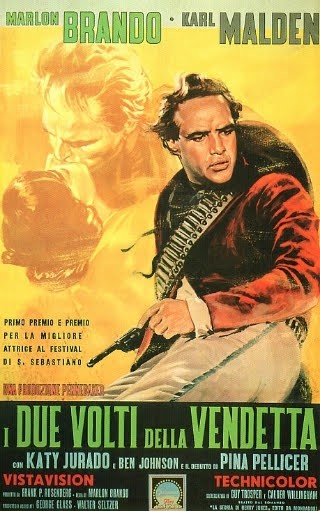
Some films can be extraordinarily difficult to write about; they may be overly complex or annoyingly abstract, their essence forever dancing tantalizingly beyond your grasp. Alternatively, there may be other factors involved, some quality which draws and fascinates you, making them easy to admire yet hard to truly love. That’s the position I find myself in when it comes to One-Eyed Jacks (1961), Brando’s one and only shot at directing. The visuals and theme appeal to me, and certain passages are beautifully realized. Still, when I look at it overall, I could never include it as one of my favorites.

The story (based on the novel The Authentic Death of Hendry Jones) is very loosely based on Billy the Kid. It concerns two men – Rio (Marlon Brando) and Dad Longworth (Karl Malden) – bank robbers plying their trade in Sonora in Mexico. Running from the army and carrying the proceeds of their latest hold-up, Longworth sets off to find fresh mounts for both of them. However, his inherent greed gets the better of him and he leaves Rio stranded. Leaping forward five years, we see the younger man breaking out of his Mexican prison. And he has but one thought in mind, revenge. His search eventually takes him across the border to Monterey, where Longworth has built a respectable new life for himself. The former outlaw has gained a wife and stepdaughter (Katy Jurado and Pina Pellicer respectively) and got himself elected sheriff. As the title suggests, both men only reveal a little of themselves to those around them. In Longworth’s case his law-breaking past is common knowledge, but his fear and sadism are carefully concealed beneath a veneer of bluff amiability. Rio too is adept at playing his cards close to his chest, and lulls his old partner into thinking that he bears no grudges. For all that, the animosity on side and distrust on the other cannot remain buried for long. The catalyst comes in the form of Longworth’s stepdaughter, and the passion she arouses in Rio. While his initial seduction of her seems primarily motivated by a desire to strike at Longworth’s cozy domestic set-up, it’s clear enough that his true feelings run deeper. Either way, it sets in motion a series of events that will inevitably lead to a violent and final confrontation between the two adversaries.

The film’s path to the cinema screen was a long and complicated one – Sam Peckinpah worked on the first draft of the script before being removed, and Stanley Kubrick was down to direct it until he too was replaced. So it fell to Brando, and his fingerprints are all over what we now have. Intensity is a word that’s frequently bandied around when this man’s name is spoken, and One-Eyed Jacks has some of that, a sort of relentless quality in its storytelling. But, and this is part of the issue I have with the film, there’s a labored feel about parts of it too. It’s said that Brando had accumulated over five hours of footage when he finished shooting, and the form we have today is still fairly lengthy. Charles Lang was the cinematographer and there’s no question of the beauty of some of the images – the Mexican and Californian locations look simply breathtaking at times. Still, Brando allows it to drift too much for my taste. The long period of recovery at the coast, after Longworth humiliates Rio and mutilates his gun hand, feels drawn out. Sure it allows time for the character of Rio to adjust to new circumstances and offers him the opportunity to reevaluate his plans, but it also slows the pace.

I’m going to be honest here and admit that, for one reason or another, Brando is an actor I’ve never warmed to. I guess a lot of it comes down to the fact that method acting often presents me with a problem. There is, by definition, something studied about it, a lack of spontaneity perhaps. All the preparation and internal reflection seems, to me at least, to steal a little of the honesty from a performance, especially where emotions are involved. There can be no question about Brando’s screen presence, and there are times when he is powerfully effective – he absolutely nails the simmering rage and indignation, and the scene on the veranda as he shares a tequila with Malden, and they smoothly tell each other lies, is played to perfection. Yet it’s the moments of truth which ring slightly hollow for me; Rio’s admission of deceit as he reclines on the beach with Louisa, and his later reaction to the news that he’s to become a father. These are key character moments, scenes where genuine, heartfelt honesty is required, and I’m not sure it’s achieved.

Malden, on the other hand, comes away better. This may be partly down to his role being more complex; he’s clearly a villain, and a deeply unpleasant one at that, but there are all kinds of undercurrents. Dad Longworth is a master of deception – a professional in the art in comparison to Rio’s half-hearted hoodwinking of gullible women – a pompous, jealous sadist masking his rotten core with a facade of bonhomie. And underpinning all that is his fear and cowardice. Malden conveys all of this quite effortlessly and by the end of the movie you feel that you know something of the real man. Of the supporting cast, three figures stand out – Katy Jurado, Slim Pickens (Peckinpah would use these two in one of the most heartrendingly beautiful scenes a decade later in the flawed yet magnificent Pat Garrett and Billy the Kid) and Ben Johnson. Jurado was blessed with a pair of the most soulful and expressive eyes you could hope to find, and she was able to evoke pride, dignity, pain and any emotion called for with consummate ease. He role as Malden’s wife afforded the opportunity to do just that and she seized it. Pickens always had that unpolished air about him that was ideal for down to earth types but could be equally effective, as is the case in this film, in portraying vaguely sinister yokels. And of course Johnson (like Pickens) was a natural cowboy who never gave a bad performance. Flitting in and out of the picture, all too briefly in most cases, are such notable character actors as Elisha Cook Jr, John Dierkes, Ray Teal and Timothy Carey.

One-Eyed Jacks has long been a staple of the cheap public domain DVD, and there have been some extremely ropey presentations over the years. I’m not sure if there’s been what you might call a definitive edition released yet but some are clearly superior to others. I have the Spanish DVD released a few years back by Sony/Impulso and it’s not bad in my opinion. The film is presented 1.85:1 anamorphic and looks pretty good. I’ve seen other widescreen editions (mostly derived from the old Laserdisc transfer, I think) where the colors were washed out and weak. My Spanish disc is acceptably sharp and the colors generally look richer. Released in the 60s but with more than a little 50s flavor about it, not least in the redemptive curve undertaken by Brando’s character, One-Eyed Jacks is something of an enigmatic movie. I’ve never been able to fully make my mind up about it, and that hasn’t changed. Love it, loathe it, or anything in between, western fans owe it to themselves to check it out and see if they can decide.


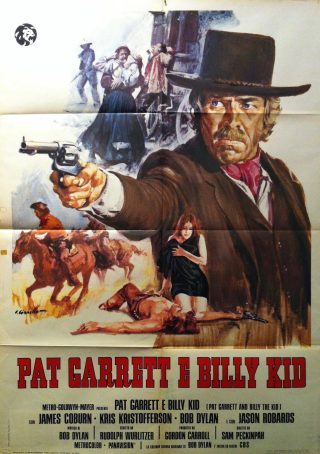
Pat Garrett and Billy the Kid

When I started this series of reviews about a month ago I mentioned that one of the reasons why I’d avoided doing it for a time was the variable quality of the films involved. Being aware that you’re going to have to sit through and then try to express your thoughts on movies that you already know are mediocre can be a little discouraging. What I didn’t mention, however, was the fact that the opposite is also true. When a film has a particularly strong critical reputation it’s equally daunting, though for different reasons of course. You instinctively wonder whether it’s possible to say anything that hasn’t been said before, and probably been said better. In the case of Pat Garrett and Billy the Kid (1973), Sam Peckinpah’s last western, I don’t promise to offer any startling insights but I do hope that I manage to at least express my own personal appreciation of this flawed masterpiece.

The film can, and I think should, be viewed as the death dream of Pat Garrett as he relives the defining events of his life, even as that life is slipping away. I ought to say right now that this view is dependent on the version of the film that’s watched – I’ll explain what I mean later, but for now I will simply say that it does have an impact on the way viewers approach the story. It’s 1909 and an aging and testy Garrett (James Coburn) is riding a wagon through New Mexico. His terse, snappish conversation with his companions is violently interrupted by the crack of a rifle shot. No sooner has the first bullet struck home than Garrett’s escort proceed to empty their own weapons into his mortally wounded body. As the old lawman tumbles towards the earth for the last time the scene is intercut with events of almost 30 years before, in 1881, when we see Billy the Kid (Kris Kristofferson) getting in a bit of target practice by shooting the heads off live chickens. What follows sets up the mood of the rest of the film and explains the motives for the characters subsequent actions. Garrett has sensed that the wind has changed and is pragmatic enough to know that he must go with it or be swept away. He’s thrown in his lot with a shadowy collection of big cattle men and business interests, and has been appointed sheriff. The Kid, on the other hand, resolutely refuses to bow to the march of progress and is bent on continuing as he’s always done. Garrett points out that part of his remit is to ensure the removal, by whatever means are deemed necessary, of the Kid from the territory. This is one of the few times both men share the screen until their final fateful meeting in Fort Sumner, but the movie charts the movements of both as circumstances inexorably draw them to their predetermined positions. That early scene in the cantina where Garrett and the Kid lay their cards on the table and both are aware that they will have to face off sooner or later is full of the melancholy that dominates the picture, and it’s pure Peckinpah. From this point the hunt is on. Garrett brings the Kid in after a bloody shootout at an isolated shack and has him locked up in Lincoln to await execution. This leads to a wonderfully realized sequence in the stark jail room where the Kid’s flippant disregard for authority (both earthly and divine) goads his manic, evangelical guard Ollinger (R G Armstrong) into taunting and threatening him – again depending on which version you watch there’s a killer line that may be missed. When the Kid effects his escape after blasting Ollinger apart with his own shotgun there’s a very human side of him revealed. He swaggers along the main street and orders up a horse to take him out of town. What he’s presented with is a wild animal that promptly bucks him clear and lands him square on his ass. Instead of avenging his bruised dignity on the old Mexican who embarrassed him by offering a horse he couldn’t ride, he simply smiles ruefully, steals another and rides coolly off as befits a legend.

In truth, the whole film could be viewed as a series of memorable scenes. That’s not to say, of course, that there’s a lack of narrative structure; the story follows a very definite line and draws to a completely natural conclusion. What I’m trying to say is that there are certain characteristics that mark it out as a western that transcends the run-of-the-mill and elevate it to something grander. A prime example is the segment with Slim Pickens and Katy Jurado – it moves things forward by showing how Garrett’s pursuit is progressing but that’s not really the point. If anything, like one of Ford’s grace notes, the scene exists for the sake of its own beauty and and poignancy. I’m not going to spoil things for anyone who has yet to see the movie but I will say that it’s gut wrenching stuff and I’ve still never been able to watch it without a lump in my throat. The characters grow and develop as we move along too, especially Garrett. His cynicism and self-loathing increase the closer he comes to his quarry and the further he moves from the man he once was. By the end of the movie he has sold himself completely and his disgust at what he has become is a painful thing to witness. It’s also interesting to compare the portrayal of Garrett’s principal backer, Chisum (Barry Sullivan), to the one John Wayne offered a few years before. This is no heroic defender of the common man, instead he’s a coldly dedicated businessman who feels no sentimental attachment to those who worked for him in the past. This Chisum regards Billy as nothing more than a liability, both financially and politically, who needs to be exterminated. Those hands in his employ are shown to be similarly heartless, and it’s surely clear to Garrett that he’s only being tolerated so long as he has a role to play in Chisum’s schemes. In contrast to Garrett, the character of the Kid undergoes less of a change, perhaps because he’s the one who clings more firmly to the old ways. He starts out grinning, nonchalant and oozing self-confidence, and meets his fate with that attitude virtually intact. However, for all his free spirited charm there’s a hard edge there too. The first time I saw the film I was slightly shocked at the outcome of the duel that the Kid and Alamosa Bill (Jack Elam) are unable to avoid. Having said that, I’ve grown to appreciate that little scene more and more for showing that shootouts in the old west were rarely the kind of honourable and noble standoffs that they’re traditionally portrayed as.

As I stated earlier, this was to be Peckinpah’s last western and it’s another of his ruminations on the passing of the old west and the dawn of the modern era. It was a troubled production, not least because of the director’s increasingly wayward behaviour, and the end product reflects that in the multiple cuts of the movie down the years. For all that though, it remains very much a Peckinpah film. It’s tempting to think that Sam saw something of himself in both the title characters: the Kid as the wild, anti-establishment figure that he encouraged others to see him as, and Garrett as the disillusioned independent trying to strike some kind of working balance between corporate interests and a free soul that was probably closer to the truth. As such, I think it’s Coburn’s performance as Garrett that drives the film and gives it much of its power. In terms of realism or accuracy he was too old for the part, but in terms of characterization he was perfect. He was of an age where you can easily understand a man’s need to seek out some form of security, that point when you realize that the recklessness of the past is no longer a viable option yet a part of you still yearns for it and rails against the advance of time and the compromises that are involved. Coburn’s lived-in features and grey hair help to get the point across, and the expressive eyes that could flash cold steel one minute and sardonic humour the next see that it strikes home. In contrast, Kristofferson plays the Kid as a devil may care adventurer, but one with a deep sense of fatalism. Even in that early scene in the cantina the twinkle in the eyes cannot disguise the fact that the Kid knows there and then, as surely as the grim faced Garrett does, that there can only be one outcome. Awareness is one thing of course, but the real fatalism is evident in the way the Kid only half-heartedly tries to elude his old friend. He heads for Mexico and safety but it’s clear enough that in so doing he’s hoping to find some excuse to return and play that one last card whatever the consequences. The supporting cast is something like a wish list of western character players and it’s another of the film’s great strengths. I don’t know how this works for those who come to the film without a familiarity with the genre, but for someone like myself it’s akin to meeting up again with a group of old acquaintances and simply revelling in their company. It would be impossible to go through all the people who drift in and out of the story and enrich it with their presence but, as I noted earlier, a special mention must be given to Slim Pickens and Katy Jurado who contribute to one of the finest moments in this picture, or any other for that matter. The only casting decision that doesn’t really work for me is the inclusion of Bob Dylan. I love the way his music blends in and complements the images on screen but his appearance as a character in the story is unnecessary in my opinion and is just too conspicuous.

The DVD release of Pat Garrett and Billy the Kid, not unlike the production itself, has become a source of controversy. Ever since Peckinpah’s clashes with MGM boss James Aubrey led to the movie being taken away from him and hacked down into a theatrical version that he hated there has been no real director’s cut available. The closest thing is the Turner Preview version, derived from Peckinpah’s workprint. The 2-disc DVD from Warners includes both the Turner version and a new 2005 Special Edition that claims to come closer to the director’s wishes. Now the problem is that the 2005 cut adds some material but, most damagingly, removes or alters key scenes and lines of dialogue from the Turner version – the exact changes can easily be found by running an internet search or just sitting down and watching the two cuts to compare for yourself. The fact that both versions are available is good of course, but it should be mentioned that the Turner cut has not undergone restoration whereas the 2005 one has. My own preference is for the Turner version for a variety of reasons, but the strongest one is the fact that the bookending of the story remains intact. Others will have to decide for themselves. Aside from the restoration, or lack of it, the DVD set contains a plethora of supplementary material that’s most welcome. As for the movie, I hope it’s clear that I hold it in high regard. It’s not only a compelling story, but it’s also a study of fading dreams, vanished innocence and bitter regrets. It’s one of Peckinpah’s best and should rate high in any list of top westerns. Very highly recommended.