How the West Might Have Been Won

While my previous post arguably brought up the matter of the parameters one applies to the notion of the western, it was a few comments leading on from that which added some impetus and got me thinking a bit more. I guess I have my own idiosyncratic criteria which I wouldn’t expect to satisfy everyone. So be it, but that wasn’t the direction I now found my thoughts running in anyway. What I ended up contemplating was the course that the western as a genre charted after it had peaked in the late 1950s and on into the early 1960s. Reaching a peak means that some form of change is inevitable, but the path the genre adopted led to a sustained decline. That path essentially operated on two levels: one the one hand, there was that slightly desperate and ultimately unsatisfying effort to ape the nihilism at the heart of the spaghetti western, while on the other hand, there grew up a fruitless attempt to cling to the tropes of the classic form, one rendered stale by the crucial absence of thematic richness. Somehow these twin approaches converged at the artistic quagmire that came to be referred to as the revisionist western, where the myth was not merely deconstructed but practically obliterated. Yet what if an entirely different approach had been pursued instead, one which filmmakers had flirted with and dabbled in but failed to fully embrace?
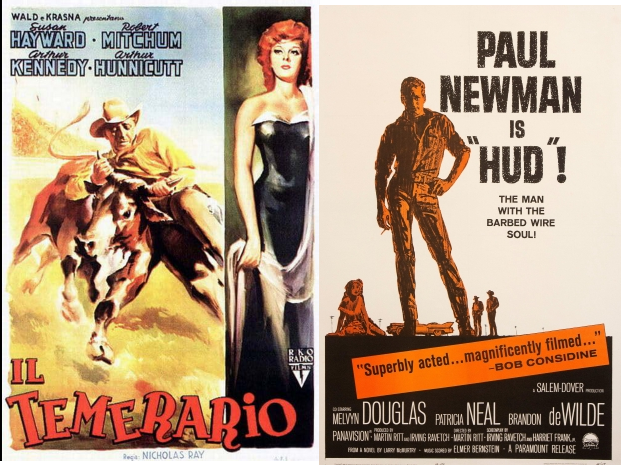
I’m speaking here of what is sometimes called the modern or contemporary western, and I’m also well aware that there will be those who struggle to accept that such movies are “real” westerns at all. While I can’t say I share such reservations, I do understand them. Fairly recently, I happened to revisit a couple of movies that fall into this category, The Lusty Men (1952) and Hud (1963), with a view to maybe writing them up separately. Nevertheless, it now seems apposite to fold them into this piece on what I’ve been toying with for a while now, namely that the western might have been better served  in the long run had filmmakers made a clean break and gone a different way. I guess it’s always easy to spot missteps when one has the benefit of hindsight to frame it all, but looking back at so many less than satisfactory westerns that were made from the mid-1960s on does create the impression of people trying to recapture lightning in a bottle. Instead of reaching for the unattainable, I can’t help but wonder if the people making westerns wouldn’t have been better off acknowledging that the way to secure the future of a genre so strongly rooted in the past was to allow it to naturally evolve into a recognizably modern form which still retained something of the spirit that made it great in the first place.
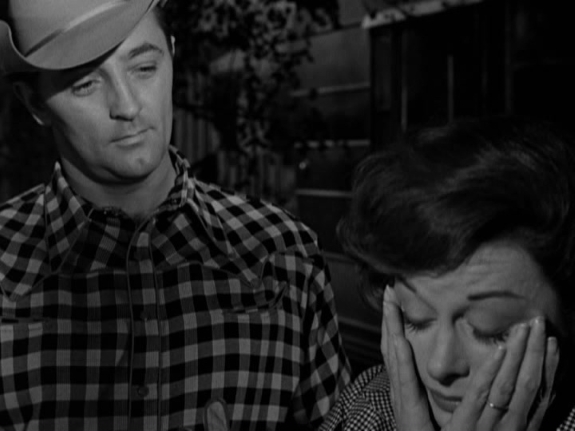
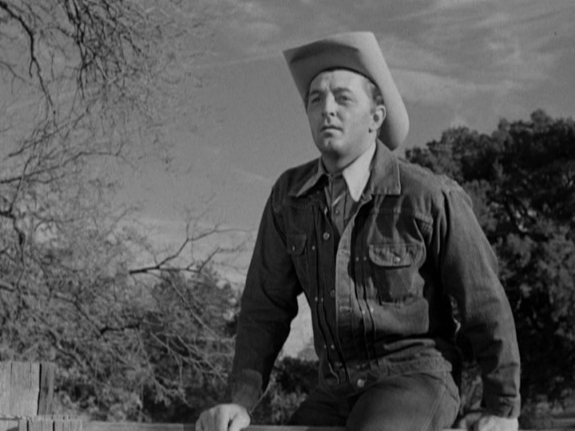
In The Lusty Men Nicholas Ray stirs together the doomed romanticism of Jeff McCloud (Robert Mitchum), a dwindling band of itinerant rodeo performers and one of his characteristically uneasy relationships. From the moment a limping and broken McCloud gazes with the kind of melancholic longing only Mitchum could impart so effortlessly at his childhood home, it’s clear he is meant to represent some bridge between a lost idyll and a world where skills once carefully acquired to tame the land itself are now of use primarily for display and entertainment. Wes Merritt (Arthur Kennedy), his protege, sees this the other way round – that the shows and spectacle may be a way to reconnect with the land. The whole movie traces McCloud’s slow reconciliation with the man he has now become, of the fact the world no longer holds a place for him. It also charts Merritt’s concurrent but bumpy journey back to his origins, aided by the tough earthiness of his wife (Susan Hayward) and by McCloud’s sacrifice. The world of Ray’s The Lusty Men is very much a contemporary one, and never tries to suggest otherwise, but by the time those still standing take stock of the lessons learnt and head back to the land which spawned them they are strengthened by their experience. The viewer too is fortified by the time spent tagging along on their journey, and that’s in no small part down to the way the essence of the classic western is transferred to the mid 20th century setting.
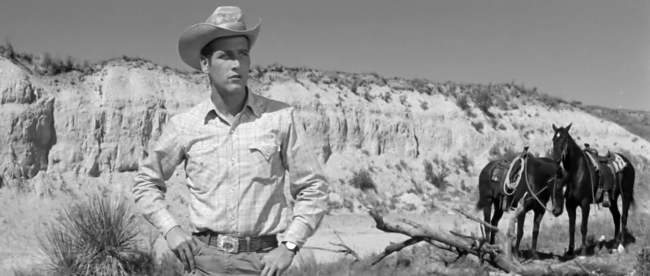
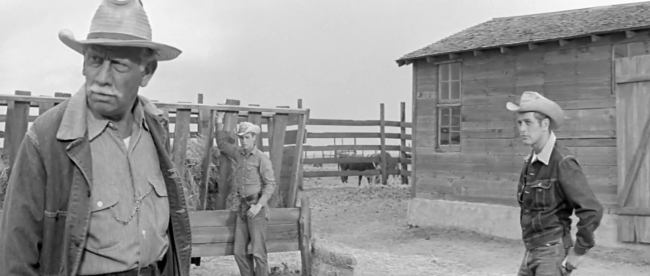
Martin Ritt’s Hud, adapted from a Larry McMurtry novel, came along a decade later and is a darker affair all told. It’s a film about change and passing, about a fractured family dealing with the notion of passing, of guilt and blame and principle. Paul Newman’s titular character is the new face of the west, amoral and self-absorbed, straining against ties to the past as represented by his father (Melvyn Douglas) and casually dismissive of a future hinted at by his nephew Lonnie (Brandon deWilde). Buoyed by two superb Oscar winning performances from Patricia Neal and Douglas, the former touching on a marvelous sense of resignation and regret, while the latter simply exudes pain and dignity, it scratches away at the mythology of the west. The culling of the herd is sobering in its matter of fact coldness, and Douglas’ subsequent putting down of his prized Longhorns, the last of the breed, is deeply symbolic and even more traumatic on a personal level – the hurt of the man is palpable. There is a bleakness to all this, yet the ending also looks to the resilience of the genre. If Hud’s shutting out of the modern world is indicative of a dead-end insularity, then Lonnie’s rejection of his uncle’s negativity and his striking out alone in the world looks toward a different horizon, an approach the genre itself is built upon.
While what I’m going to call ‘regular’ westerns made from the middle of the 1960s onward are very much a mixed bag for me – with far too many misses weighing down the hits – I don’t think I’ve seen a ‘modern’ western that actually disappointed me. The form continues to be made, and quite successfully too if TV shows such as Yellowstone are any kind of guide, but it still feels as though it is only visited from time to time. Admittedly, I’m doing no more than musing and hypothesizing here, spitballing something I’ve not yet reached a conclusion on myself. Increasingly though, I think Hollywood may have missed a trick by not abandoning the traditional western at some point in the late 60s, or at least by the 1970s, and turned the genre away from the static form it devolved into. Had this happened, had it become a contemporary rather than a historical form, perhaps we would be talking about the western in entirely different terms today, as a still thriving genre.
Home from the Hill

“Home is the sailor, home from sea,
And the hunter home from the hill.”

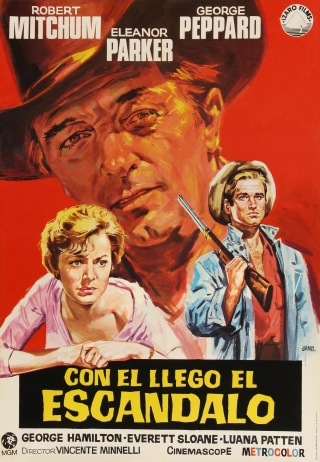
Those lines, the final two of Robert Louis Stevenson’s poem Requiem, introduce the movie featured today. The image of the hunter has long been a romantic one. In mythology Orion was not only renowned for his skills as a huntsman but also for his amorous exploits – in addition to his attractiveness, it is said that he fathered up to fifty offspring by as many different mothers. It is therefore apt that the protagonist in Vincente Minnelli’s Home from the Hill (1960) should also embody these characteristics. And as this hunter moves inexorably towards that repose alluded to in Stevenson’s short poem those features are repeatedly highlighted. In telling this story, Minnelli creates one of his grand melodramas, assembling from constituent parts which are at once discrete and also united in their focus on the deceptions that people lock themselves into in their quest to achieve contentment. How is that to be achieved? Through three interdependent actions: confronting the past, acknowledging the present, and securing the future.

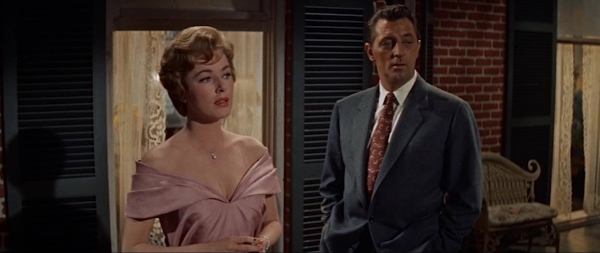
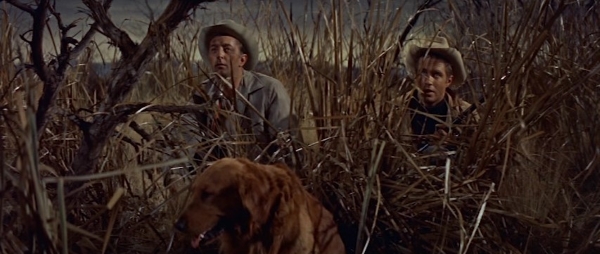
Small town America, the ultimate paradox in some ways, that curious blend of the idyllic and the deeply unattractive. There is something comforting, reassuring, even downright alluring about the sense of orderliness and stability that small, close-knit communities seem to exude. There is a security attached to everybody knowing everybody else, but of course the flip side of that is the preponderance of gossip, of long memories of a malicious type, a type which fosters and breeds grudges. Wade Hunnicutt (Robert Mitchum) is the town’s leading citizen – everybody calls him Captain, adding another layer of deference – wealthy, influential, a noted sportsman, and an infamous womanizer. The opening scene among the bulrushes in the middle of a duck shoot cements all these qualities, the latter one in particular being driven home with some force when Wade finds himself marked as prey by a desperate and indignant husband who has been wearing the horns of a cuckold. That Wade narrowly evades death at his hands is down to the sharp reactions of Rafe Copley (George Peppard) in knocking him just out of harm’s way at the critical moment. By and by, it becomes apparent that Rafe is his illegitimate son, a fact which irreparably soured his marriage to Hannah (Eleanor Parker) and led to her forbidding him to have any involvement in the raising of Theron (George Hamilton), their son who was born in wedlock. That all changes though when Wade comes to realize Theron has reached an age where he needs to learn some lessons that will see him graduate to manhood.

Manhood, however, entails a good deal more than being adept at hunting and the use of firearms, the sowing of wild oats, or even the kind of rugged individualism that Wade Hunnicutt espouses. Those are mere trappings, the panoply of masculinity that one may or may not need to adopt in certain situations, but the characteristics of a man are more nuanced, they run deeper and ask more of the individual than that. This of course forms the core of the movie, the processes, experiences and trials that one must pass through and absorb on the road that leads a boy to grow into a man. That road may be circuitous, forked, ill-defined or uncharted depending on the person who treads it and the destination won’t be the same for everyone yet it’s a journey none can avoid. Maybe more than anything it is the bumps and hollows encountered, and how they are navigated, that ultimately mark the man. For better or worse Wade Hunnicutt has grown into the man he is, and the meat of the tale is to be found in the trajectories followed by Rafe and Theron. The former moving through the roles of tutor, guide and confessor, creating an illusion of being the finished article while he’s really still only part way along on life’s learning curve. Theron is starting further back, having been cocooned in the cotton wool of innocence, his path to maturity seems more dramatic and raw as a consequence. His growing awareness of his father’s legacy, the galling revelations this exposes with regard to the family he thought he knew, and his rejection of a potentially redeeming love see him cast out, his full maturity if not denied then at least deferred.

There is a degree of mirroring with regard to the behavior of the characters. Theron’s disgust at the hypocrisy he discovers at the heart of his family drives him away. He has already proved his physical courage in the wild boar hunt and then his loss of innocence sees him strike out alone seeking independence from his parents and thus indirectly fulfilling another of his father’s wishes. Still, his immaturity and callowness lingers and he ends up, through fear of both himself and his family’s history, abandoning storekeeper’s daughter Libby (Luana Patten), who he has left pregnant. Despite himself, he has acted as his own father did with Rafe’s mother. While Theron is fated to recycle the sins of the father, Rafe is afforded the opportunity to forestall some of the prejudice and rejection he suffered. The past throws long shadows though, especially in these small towns, and even the best intentions can be ambushed by small minded parochialism. Rafe’s selflessness and essential good nature is undermined by cheap gossip and leads to yet more tragedy, though perhaps one whose foundations had been laid long before.

The screenplay for Home from the Hill came via Harriet Frank Jr and Irving Ravetch, adapting a novel by William Humphrey. The writing couple had come off two tricky William Faulkner adaptations directed by Martin Ritt, the rather fine The Long, Hot Summer and the less good but still worthwhile The Sound and the Fury. Now I’ve not read Humphrey’s novel but a quick bit of research suggests the screenplay made a number of changes to the story and characters, and I think the original tale must have been quite different as a consequence. What we get though forms the basis of a fine melodrama, the type of material that was ideally suited to Minnelli’s talents and vision. Perhaps it is a touch more subdued than some of his other melodramas, the palette chosen reflecting this to some extent. There is an earthiness on display in the soft green and brown hues which predominate. However, there are flashes of those vivid shades often found in Minnelli’s pictures at key moments – the crimson dress worn by Luana Patten in the waterside scene where she entrances Theron, the rich burgundy upholstery in Wade’s den where the affairs of men are raised and settled, and then the blood red tombstone in the final scene that is somehow triumphant, sedate and reassuring all at once. These are all instances of great passion and those varied tones of red capture the mood of the scenes perfectly. It’s noteworthy too that the site of Theron’s climactic revenge is backed by an acrid yellow, the noxious gases rising off the swamp matching the bitterness on show.

Robert Mitchum catches all the shades of his character, the arrogance born of privilege often to the fore and, in his more private moments, a hint of humility creeping through whenever he’s reminded of his personal failings. The scene which offered him the most to work with occurs during the barbecue arranged in the wake of the boar hunt. Sharing the screen with a pensive Eleanor Parker, both of them are on the porch overlooking the revelers on the front lawn. Mitchum starts out gently, reminiscing and quietly romancing the woman who has spurned him for so long. He seems to be making headway, gradually softening her with his talk of bygone and better days. And then just as he seems to have victory in sight, she slams the door, telling him in no uncertain terms that he’ll never have her. The wounded pride and the hurt of rejection, that sudden, sour realization that it’s all been for nothing flash across Mitchum’s features for no more than an instant yet he accomplishes it all so effortlessly. Fine acting.

Eleanor Parker is all frozen dignity and has a hugely influential role, her character’s actions motivating and coloring the lives of those around her. The strained marriage to Mitchum has led to her overprotecting her son and the decay that characterizes that union ends up blighting the latter’s life. George Hamilton gets the sullen immaturity of Theron across quite successfully and Minnelli would use him again, albeit less satisfactorily, in Two Weeks in Another Town a couple of years later. George Peppard, in just his third feature role, is excellent as Rafe. His character may have been denied a name and left unacknowledged but he carries himself more easily than Theron. While there is resentment inside, he covers it with a veneer of assurance and gets to play some of the most memorable scenes in the picture: the interlude in the cabin with Theron after the truth of his identity has been brought out into the open, his stepping up to the plate with the distraught and desperate Libby, and his tenderness after the marriage. The film is all about the attainment of manhood and the contentment that this brings and Rafe’s progression towards that goal is an immensely satisfying one to follow. Theron only gets to take the first faltering steps before being sidetracked by upheaval, but Rafe reaches his destination and gets there in some style.

The movie features two cemetery scenes and I guess there is some quality about that spot none of us can avoid which draws forth honesty and strips away the pretense. Both scenes involve Peppard and Parker, the first is wistful and touching as Rafe carefully tends the plot on “reprobate’s field” where his mother reposes. He’s come to terms with his regrets and there is a sense of a young man who has made his peace with who he is and his place in the world, while Hannah sees the beginnings of a thaw warming her heart. It’s all very understated and very effective. Then reminiscent of the final glorious scene in Some Came Running, Home From the Hill draws to a close in another cemetery. All at once memories and loss shed their sorrow, fusing instead into something rich and positive. The point where we witness resentment chase briefly across Rafe’s face before being banished permanently leads to a moment of catharsis and truth, the healing of a wound long suffered by both himself and Hannah achieved through an instance of shared decency and unity. A homecoming lent greater significance and value by being so hard-earned.

Perhaps I’ve rambled on a little too much about this movie, but it’s one I have always admired and it has stuck with me since I first caught a broadcast on TV by chance some forty years ago. It’s a strong addition to that wonderful run of melodramas that Minnelli embarked on in the 1950s and the early 1960s. I have spent a fair bit of time here on some of the performances and a handful of key scenes, but I’d also like to take the opportunity to mention the score by Bronislau Kaper. It is a marvelously evocative piece of work, those lush soaring strings backed by melancholic horns, plaintive as a hunter wearied by the chase. I’d just like to sign off on this piece with his main title theme to the movie.

The Angry Hills

If I were to offer the choice of a movie with a thin plot stretched beyond the point of endurance or one so crowded and packed with incident that breathing space is at a premium, which one would you choose? Well, the wise viewer would most likely pick neither and instead plump for something more balanced. As one whose curiosity typically allows wisdom to be elbowed aside, I would probably try the overloaded option. I mean, that one ought to be pacier and potentially more exciting, right? Not necessarily. The Angry Hills (1959) is a movie that has some weighty themes baked into it, but there is frankly too much going on, too many plot developments and too many characters drifting in and out of proceedings. In the end, it loses focus, simultaneously reducing the entertainment value and blurring or trivializing the more serious points it might have made.

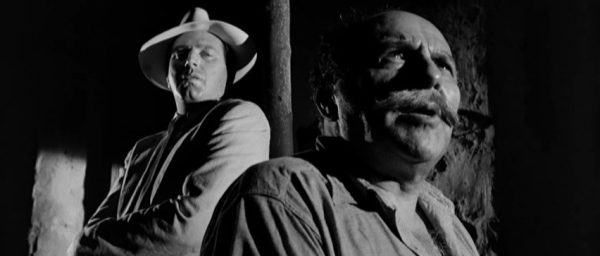
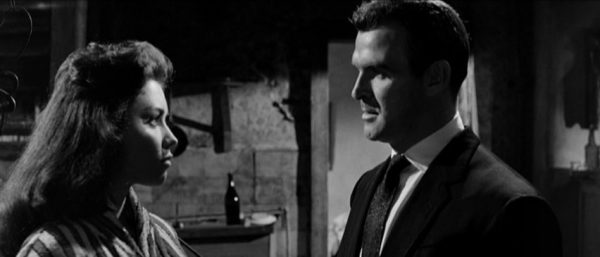
The Angry Hills takes place in 1941, on the eve of and then in the period just following the German invasion of Greece. It starts with the arrival in Athens of  journalist Mike Morrison.The situation in the city could charitably be described as fluid and he’s keen to move on as soon as possible, or as soon as he’s had the opportunity to clean up and sample some of the local night life at least. Journalists get to know all kinds of people in the course of their work and an old acquaintance of Morrison’s passes on a list of Greeks who will be able to filter information through to British Intelligence in the months and years ahead. The idea is that a pressman will be in a better position to smuggle such a list out of the country before the city is occupied. Morrison frankly wants no part of this but he gets stuck with the list nonetheless. As a result, the movie develops into what is essentially a long chase back and forth across the country with the Germans, and those who would collaborate with them, in hot pursuit of the reluctant courier. As Morrison tries to dodge the Gestapo commanded by the enigmatic Conrad Heisler (Stanley Baker), he is plunged into the interior of the country where he becomes involved with the fledgling partisans trying to organize resistance and has a brief and tragic romance with a peasant girl (Gia Scala). By the by, he ends up back in Athens, still hunted by Heisler and his local stooge Dimitrios Tassos (Theodore Bikel), still looking for a way out and still endangering all those who cross his path.

Director Robert Aldrich was apparently unhappy with the film being recut by producer Raymond Stross, losing 10 minutes or more of footage. He felt it unbalanced the movie, which may be so but I’m not sure it really needed additional scenes. While I can’t claim to know exactly what was trimmed, I suspect it was material that related to Morrison’s first exit from Athens, a section that is papered over somewhat via a voiceover and a few brief shots indicating a longer journey. I do think the film is a little disjointed and there is a clumsiness to the narrative, but more footage in that sequence wouldn’t fix any of those problems. I’d actually go so far as to say the entire in country section with Gia Scala and the partisans could have been excised and not have really harmed the movie. In fact, it might have tightened it up considerably. There are themes touching on betrayal and trust, on the lengths people will go to for the sake of those they love which appear at various points, indeed the whole climactic sequence hangs on just this premise. However, a movie that uses the mechanism of the chase to power its narrative needs to keep moving, and preferably in one direction. What happens in The Angry Hills is that Morrison flees Athens with his enemies in hot pursuit, gets chased through the mountains, and then doubles back to the capital to essentially finish up where he started. It’s all too circular and means that too much happens to too many people for too long and to increasingly little effect. The story is an adaptation, by A I Bezzerides, of a Leon Uris novel; I’ve never read any of the man’s work so I can’t say if that contributes to the general muddle and torpor of it all, but I do know that screen versions of his books tended to be pretty lengthy affairs. Exodus is worthy but that running time of three and a half hours is incredibly taxing, while Topaz remains, in my opinion, by far the dullest and least involving of Alfred Hitchcock’s movies.

While there is no escaping the fact that there are problems with the scripting and structure, the movie does have positives. A glance at the cast list alone ought to attest to that. Robert Mitchum tops the bill as the newsman who claims to believe in little, to have seen too much, yet who experiences something of a spiritual or ethical reawakening. The seeds of a compelling character arc are certainly present but, once again, it’s never given the attention it ought to have received. Mitchum only seems truly involved emotionally in the latter stages, when the effects of the relationship with Gia Scala and the subsequent turn of events become clear. It arrives late and I’m not convinced it’s fully earned. While Gia Scala herself is fine as the village girl who gets under his skin, the romance that grows up between them is a half-hearted one at best. That entire section of the movie should provide the emotional core that supports the final act but the combination of the slowing down of the plot and that slightly lackluster romance weakens it.

A starring role for Mitchum is always a draw, even when it’s not all it could be. Something similar could be said for Stanley Baker, who gets a nice meaty part as the conflicted Gestapo chief. It is the type of role that one would expect to be pretty one-dimensional yet it is far from that. Baker had great presence and he could add layers of menace with the most subtle of glances and gestures, but he could also use that finely modulated voice to inject a quiet authority, a hint of warped civility in this case that makes his character all the more fascinating. His Heisler is easily the most interesting character on show, a potentially cartoonish villain invested with much needed depth. Elizabeth Muller is the woman who connects Mitchum and Baker and as such it’s a pivotal role, but neither the writing nor the performance really exploits that. In support, Theodore Bikel is marvelously sinister and corrupt, willing even to use the charms of his sister to further his aims. As that sister, Jocelyn Lane is stunningly attractive and it’s a pity her part wasn’t expanded. Marius Goring flits in and out of the picture  as an effete but dangerous German officer. There are small parts too for both Sebastian Cabot and the recently departed Leslie Phillips, the latter clearly enjoying his view of a surprising (taking into account the era in which the movie was made) and earthily energetic topless cabaret performance by Marita Constantinou.

The Angry Hills has been released on DVD via the Warner Archives in a very  attractive anamorphic ‘Scope transfer. Both the cast and the setting caught my attention initially and, as someone who has lived for many years in Athens, I welcomed the fact that the location shooting offered a glimpse of the changes that have occurred to the look of the city over time. The movie overall is a decidedly mixed bag, an odd blend of overcrowded plot with too much incident yet not enough character development to allow the viewer to properly engage or empathize. In short, the cast and location work ensure it remains watchable despite the structural flaws.

The Locket

Ask any movie fan to compile a list of film noir characteristics and the chances are that it will include a femme fatale, a trenchcoat-clad private eye, a rain slick sidewalk, a cheap room sporadically lit by a flickering neon sign, a world-weary and almost insolent voiceover, and maybe a flashback sequence. Actually, the latter is such a classic device, not one which is by any means exclusive to films noir but, even so, one which was frequently exploited successfully by those filmmakers exploring cinema’s kingdom of shadows. There is something inherently noir about the flashback, its underlining of the ease with which the past impinges on the present, that fatalistic allusion to mistakes forever stalking the protagonists, only ever a heartbeat away from the here and now. The Locket (1946) employs a succession of these nested dissolves to lead the viewer back and forwards through the tortured and occasionally bewildering experiences of its characters.

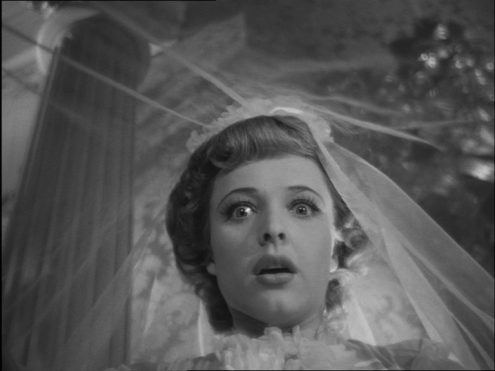
A bright and sunny day, what could be more conventional and thoroughly positive than the sight of a highly polished car drawing up before a well-appointed residence in order to deposit its highly polished and well-heeled occupants (Reginald Denny & Nella Walker) on the sidewalk with no more on their minds than a bit of idle chatter as the navigate their way through the waiting reporters and pass on inside to attend their nephew’s wedding? Everything smacks of sophistication, order and happiness as the groom (Gene Raymond) welcomes his guests. Yet within minutes a summons to have a word with a mysterious guest will create an unmistakable and possibly irreparable crack in this facade, figuratively elbowing the bride, Nancy (Laraine Day), aside and instead ushering in the dark clouds of chaos and disorder, an unexpected and unwelcome storm bringing with it theft, deception and murder. The interloper is Harry Blair (Brian Aherne), a psychiatrist who has a tale to tell about the bride to be. As we delve into the past via the first of multiple flashbacks it becomes clear that Nancy is not a soul at peace. Bit by bit, we are drawn back to her childhood, growing up as the daughter of a servant and suffering a telling psychologial trauma, being presented with a valuable locket only to have it snatched back and then later being falsely accused of stealing it. This proves to be the catalyst for the deeply disturbed life she will go on to lead. It alters her relationship with the world at large, twisting her sense of morality and even her perception of reality. The consequences of all this are her destructive marriages, both to the thoughtful and urbane Dr Blair and the more elemental artist Norman Clyde (Robert Mitchum), and her ambivalence to if not downright disregard of the law and the sanctity of human life itself.

The 1940s saw the production of a number of movies with plotlines based loosely and often fancifully on then fashionable Freudian approaches to psychoanalysis. Hitchcock explored this area with Spellbound while Robert Siodmak incorporated it into The Dark Mirror. John Brahm was another arrival from Europe and with The Locket he too turned his attention to the  dramatic possibilities stemming from stories of abnormal psychology, something he was not unfamiliar with having already made the rarely mentioned Guest in the House as well as the Gothic chillers Hangover Square and The Lodger. Sheridan Gibney’s screenplay, featuring layers of flashbacks to rival Michael Curtiz’s wartime thriller Passage to Marseille, with its suggestion that even innocent misunderstandings in the past have the malign power to reach forward, haunting characters in the present and leaving them doomed or damned, is powerfully bleak. Factor in Nicholas Musuraca’s gift for conjuring up gloriously evocative shadows around pools of shimmering light and the ingredients for a classic film noir are all in place.

Looked at today, the name that jumps out of the credits is that of Robert Mitchum. Nevertheless, he didn’t receive top billing in 1946 and while his stock was on the rise in Hollywood, it would be the following year when he made the seemingly unloved Desire Me alongside Pursued, Crossfire and the seminal noir Out of the Past before he’d rate a higher position. While his role is a significant one and pivotal in the development and progression of the story he remains the second lead. That said, it’s always a pleasure to see the man working on screen, to watch how effortless he made it all look, and of course his departure from the action is not only memorable but genuinely arresting.

There is something smooth and reassuring about Brian Aherne, his is a quiet screen presence that commands the attention yet never seems to demand it. Whenever he’s around there’s a sense that even though bad things may happen, and they most certainly do, it will all come right in the end. It is this quality which adds punch to the arc his character describes over the course of the movie. We see him move from the calm complacency of one who feels confident of his place in the world towards the dawning of some dreadful suspicion, and on to a kind of frenzied rejection of reality before finally reaching a form of reconciliation with the disbelief he is surrounded by. As Mitchum’s words come back to haunt him his philosophical acknowledgment that he is merely another cog in a dysfunctional cosmic process which appears fated to repeat itself cyclically is a wonderful touch. At the center of this careening emotional vortex is Laraine Day’s Nancy, a psychotic magpie who presents an angelic facade to the world, leaving a trail of devastation in her wake as she flits from one identity to another collecting pretty, shiny things on the way. Day (Foreign Correspondent) is shockingly good at conveying the ethical immaturity of her character by turning on that blank innocence whenever she is confronted with her crimes. In support, Gene Raymond, Helen Thimig, Katherine Emery and Ricardo Cortez drop in and out of the tale, all of them offering telling contributions.

The Locket should be easy enough to obtain as it was released on DVD as part of the Warner Archive in the US and also in the UK by Odeon/Screenbound. I have the latter, but it appears that may be out of print now. This is a visually stylish effort, just as one would expect from any project with the names of Brahm and Musuraca attached. The noir aesthetic is reflected in the themes too, that notion of an inescapable past being ripe with potential. This is the type of movie I very much enjoy and one I recommend checking out.

Fire Down Below

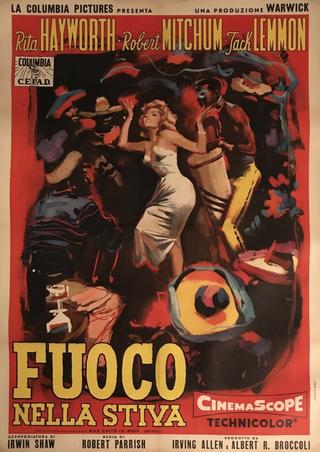
Romance, revenge and renewal – introduce a movie from the mid or late 1950s with those words and the chances are people will think you’re talking about a western. I guess there’s a point that could be made here about those themes being more a reflection of the era than a specific genre, even if that genre seemed to favor them more or treat them with greater sensitivity. Fire Down Below (1957) is certainly not a western – if it’s necessary to find a label, then I suppose it could be called a kind of Caribbean adventure/melodrama – but it does take a good long look at the three words I used as an opening. Of course it also follows the cardinal rule of moviemaking by ensuring this is woven into a consistently entertaining story.

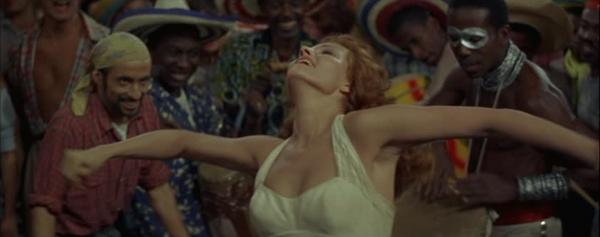
Many a good yarn has originated in a bar, and this one essentially begins there. Tony (Jack Lemmon)  and Felix (Robert Mitchum) are two drifters, the kind of figures who seemed to abound in mid-20th century movies, men who have either lost something in life and are casting around for it, or who have never possessed it in the first place. A combination of curiosity, disillusionment and aimlessness has drawn these two to the Caribbean, and fate has thrown them together as joint owners of a clapped out boat. Their morals are, shall we say, flexible and they’re not overly particular about how they earn a dollar. So it is that Irena (Rita Hayworth) comes into their lives, a stateless person hailing from somewhere in the Baltic and now in need of someone to smuggle her through immigration. While the two men are friends they are very different characters, Tony being a romantic idealist whereas Felix is jaded to the core. The effect on these two of sharing a confined space with an attractive woman is as powerful as one might expect. Enthusiasm, desire, envy and bitterness all make an appearance as the tensions simmer in the tropical heat and eventually boil over into conflict and betrayal. The upshot of it all is that Tony swears vengeance on his former friend, but there will be a further trial to be endured before any form of closure can be achieved.

I don’t  imagine it’s any coincidence that the ship carrying Tony back  for his longed for reckoning is named Ulysses. Just like the hero of Greek mythology, his is a long journey home, not quite a decade perhaps but it certainly develops into a supreme challenge and, as with all fables, there is a lesson to be learnt. Vengeance is a wonderful narrative device, it drives characters toward a confrontation, frequently with their own personal demons, and the better tales leave it in no doubt that it’s an unworthy goal. I think Fire Down Below is one of these better tales and the way the conflict is ultimately resolved lays bare the lie at the heart of the quest for revenge. Personally, I think it’s hugely satisfying that after the great conflagration, both emotional and physical, everything is settled not through violence but with a simple kiss. It’s somehow fitting that it is Irena who emerges Athena-like to restore harmony.

Robert Parrish was in the middle of a very strong run here, and would follow this up with two exceptional westerns, Saddle the Wind with Robert Taylor and The Wonderful Country which reunited him with Mitchum. This was a rich period for the director, blending timeless stories, attractive visuals and the kind of themes that defined an era of filmmaking. The movie looks very good and makes fine use of its locations, as shot by Desmond Dickinson,  but it’s not just a glossy travelogue. Parrish was adept at these stories of intertwined relationships and crises of conscience, and he seemed to raise his game when presented with the right material.

I said at the beginning that the movie could be characterized in three words and it’s also true that it all hinges on three different people. Jack Lemmon had already won himself an Oscar in John Ford’s Mister Roberts, and Fire Down Below was another step on the path to growing stardom. He’s a good choice for the mid-West rover; he had that fresh charm and impishness about him at this stage that made his romanticism believable, as well as the subsequent shattering of illusions and his thirst for revenge. The only point where I felt skepticism taking over was at the notion of him going head to head with a bull like Mitchum in a stand-up brawl. Mitchum is his typical cocksure and swaggering self, looking askance at the follies of the world and, you feel sure, not sparing himself any of that acerbic assessment.

However, everything ultimately depends on Rita Hayworth’s Irena. She provides the motivation for all the drama and passion, and I think the honesty of her performance is a big plus. This was her return to the big screen after an absence of four years and, by all accounts, a truly rotten and abusive marriage to Dick Haymes. She wasn’t yet 40 years old but she had about her the aura of one acquainted with disappointment, a woman grown aware of both the pros and cons attached to her beauty. I’m back with honesty again, but there is a raw frankness to her admission at one stage that she has debased herself in life, and the need this woman has to recapture some sense of self-respect is pivotal. Her great triumph, dramatically and spiritually, is sealed right at the end – one simple action serves to restore her own self-esteem, redeem her lover,  and grant a precious gift to his rival, dignity.

I’ve concentrated a lot on the three main characters here but I think the supporting cast of Bernard Lee, Bonar Colleano, Herbert Lom, Edric Connor, Anthony Newley and Eric Pohlmann deserve a brief mention at the very least.

I have an old DVD of Fire Down Below which was released many years ago and it still looks quite strong with rich colors and an attractive CinemaScope image. I understand it’s recently been included in a keenly priced 12 movie set of Hayworth’s films on Blu-ray via Mill Creek, and I imagine it will look even better in high definition. To date, I don’t believe the film has had an official release in the UK, an omission I would have thought one of the independent labels might seek to correct. Anyway, for the time being, I’ll leave you with Jeri Southern’s rendition of the theme tune:

Man with the Gun

” It doesn’t look nice for a town as small as Sheridan to have a graveyard as big as we’ve got.”

Man with the Gun (1955) is what I think of as a small production. Sure there’s a big name lead, a supporting cast full of classy and familiar faces, and also some fairly big hitters on the other side of the camera. Still, there no location work and the action is all confined to the studio backlot, which indicates a tight budget. So I call it a small production. Even so, as the quote above indicates, there’s a pretty high body count for such a brisk and spare film but the onscreen violence never appears gratuitous, something I always appreciate.

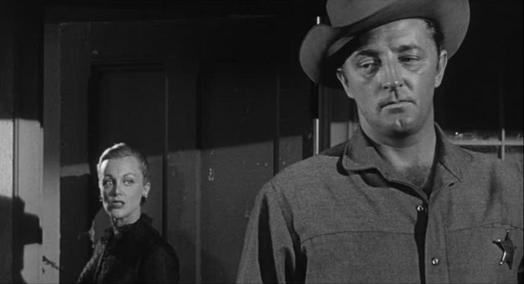
Sheridan City carries a grandiose name for a mean little backwater, a shabby-looking settlement clinging on to the periphery of civilization. The opening moments add mean-spiritedness to the general meanness when a horseman rides along the grim main street, a dog darting out to bark and yap alongside him. And then he simply shoots the animal dead, not for any particular reason – just because. This is Ed Pinchot (Leo Gordon) a troubleshooter for local bigwig Dade Holman. The latter has been tightening his grip on the town itself and land surrounding it, and notions of law, justice or just common decency have been getting correspondingly squeezed. Into this increasingly tense atmosphere comes another rider, a grey clad figure with a fearsome reputation. He’s Clint Tollinger (Robert Mitchum), a professional town tamer who happens to be passing through on an unrelated matter. His business is with Nelly Bain (Jan Sterling), the manager of a group of saloon entertainers, and Tollinger’s former love. This gunman’s services seem to be just what Sheridan City needs and the fact it ties neatly in with his personal affairs is a good enough excuse for him to stop a while.

The town tamer western is a variant that allows for plenty of rumination of the role of justice and the weaknesses of the legal system. These kinds of movies concern themselves with societies where the rule has law has broken down to the point where only the intervention of an outsider can restore a community’s faith in its own ability to endure. The outsider should always be one of those types who live by their wits and their ruthlessness, a man with a gun. The role of the outsider always appeared a good fit for Robert Mitchum, a man who, despite his star status, forever gave the impression of not really being an insider. There was that wry detachment about the man which made parts like this ideal, and he does look the real deal as he struts purposefully around and lays waste to the string of largely ineffectual semi-hard men the local land baron sends his way.

Still, a movie needs a stronger hook than that to grab and maintain our attention. Drama requires an emotional core if it’s to raise itself above the level of juvenile thrill-seeking. In Man with the Gun that comes courtesy of the subplot involving Jan Sterling and her previous relationship with Mitchum. Right from the beginning there is a strong sense of sadness and regret floating around these two grim and austere people; they circle one another cautiously and Sterling is the one who ensures contact is withheld and distance remains constant. I’m not going to go into the details back of it all as I think it amounts to a spoiler for those who haven’t seen the movie. What I will say though is it offers a layer of depth and when the big revelation comes it triggers the films main set piece, the huge conflagration Mitchum sets off to cauterize both his and the town’s wounds.

As I mentioned at the very beginning, this film has an enviable cast of familiar faces on show. Karen Sharpe gets a substantial role as a young girl both drawn to and vaguely repelled by Tollinger’s frank acknowledgement of the persuasive power of violence. It’s a nicely judged performance and benefits from not having to navigate the emotional heat inherent in Sterling’s part, allowing the viewer to sample a different, less charged perspective. There’s also good work from Emile Meyer, in sympathetic mode for a change, and from Henry Hull, who seemed to be channeling Walter Brennan as the cautious marshal. You can usually tell the quality of a movie by the caliber of its villains and anything that features a lineup with Ted de Corsia, Leo Gordon and Claude Akins positively demands one’s attention. I could go on listing names here but if I limit myself to saying that there’s an early appearance by Angie Dickinson well down the cast, the depth of talent involved ought to be apparent.

A word now for those behind the camera. Director Richard Wilson might have a comparatively brief list of credits as the man in charge but his work under and alongside Orson Welles is significant, and no man who spent that time around such a cinematic titan could come away the poorer. And what can one say about Lee Garmes? Here was a man whose experience stretched back to Hollywood’s pioneering days and who was responsible for shooting some of the most visually attractive and remarkable works committed to film – Josef von Sternberg’s Shanghai Express being just one example.While Man with the Gun doesn’t have that kind of baroque richness there are flashes of Garmes’ flair, notably that set piece fire scene I referred to earlier. Finally, I’d like to make a brief comment on Alex North’s appropriately spare score and the fact that there’s a wonderfully melancholy quality to the tag he employs for Mitchum’s character.

For a time Man with the Gun was only available on DVD in an open-matte transfer. In truth, aspect ratio aside,  it wasn’t bad in terms of picture quality. Now there are DVDs and Blu-rays available in the US (Kino) and Europe (via Koch in Germany) so good quality presentations are relatively easy to access. I don’t suppose too many people will claim this is a great western but I quite like it, and a lot of that is down to the tone achieved by the accomplished playing of Mitchum and Sterling. Try it, if you get the opportunity.

Five Card Stud

On a number of occasions this blog has cast a critical eye over that curious phenomenon that is the 60s western, and how it behaved as the decade wore on. Challenged from within and without, internationally by the Spaghettis and other Euro varieties, and nationally by a society in flux as well as the continued pressure from the small screen, the genre was not only threshing around in search of direction it was also seeking to redefine its very identity. While figures like Peckinpah and Hellman were exploring more radical avenues of development, others like A C Lyles’ production unit were trying (unsuccessfully, to my mind) to tap into the nostalgia market. Anyone familiar with the western will attest to its malleable quality, its almost unique ability to adapt itself to changing tastes and situations and both absorb and reflect new ideas or themes. This can only come about through experimentation and although I’ve mentioned two diverging paths being followed at the time that left a center ground where other options could be explored. And it’s in that area we find a movie like Five Card Stud (1968), something of a hybrid beast where the trappings and attitudes of the western are blended with the plotting of the classic mystery. Does it work? Well, let’s see…

The title alludes to poker and so the film opens with a game of cards, and one of those tropes so common to the western – an allegation of cheating and the hot-headed response that typically prompts. While professional gambler Van Morgan (Dean Martin) is away from the table trouble erupts and a stranger is accused of being a card sharp. Spurred by the vicious and vindictive Nick Evers (Roddy McDowall), the other players determine to lynch the cheat. Morgan is appalled by this overreaction and sets off in pursuit, hoping to avert a tragedy. However, his protestations are ignored and he’s casually clubbed down before the vigilantes mete out their punishment. Morgan decides this shocking event signals as good a time as any to move on and see how the tables are playing elsewhere. When word reaches him of the sudden and violently gruesome deaths of two of the men involved in the hanging he finds himself drawn back. In his absence, a gold strike has attracted miners and also a new preacher, Jonathan Rudd (Robert Mitchum), but the main point of interest remains the apparent determination of someone to ensure that a form of rough justice is served, and to that end those present at that fateful card game and its aftermath are being relentlessly picked off.

Revenge, retribution or a reckoning are often found at or near the heart of the western. Of course we’re usually aware of who is the instrument, the man (or woman) with his finger on the trigger. If Five Card Stud can’t quite be said to subvert this, it does at least play with it a little by bringing Christie to the frontier and inviting the audience to see if they could figure out who among the suspects and potential victims was the guilty party before there were, in fact, none. So, as I asked above – does it work? I guess the fair answer to that is to say it’s a partial success. The mystery of who is doing the killing isn’t that hard to work out in itself and while it contains something of a twist that is arguably revealed a bit too soon. As a straight western, as a whodunit, as a piece of cinema from Henry Hathaway, Five Card Stud remains essentially unremarkable. Yet I do feel it’s one of those cases where the eventual sum is actually greater than its components – the finished film is quite entertaining, almost in spite of itself. It is by no means a great western, it is not a great mystery, and it is not a great Henry Hathaway film. For all that, it adds up to a rather enjoyable mystery western directed by Hathaway.

Last time I posted here I commented on some slightly unconventional casting in westerns. And by complete coincidence I find myself continuing in a similar vein here. Roddy McDowall was an actor I always liked, he came across as a very likeable guy throughout his long career in film and television, and could generally be relied on to deliver a good performance. But he never struck me as a natural for westerns; even though he did make a handful of them he had that refined, urbane air that felt at odds with the usual frontier drama. The fact is he does cut an incongruous figure when he first appears yet, though he never completely loses this, he does grow into his role as the movie proceeds.

On the other hand, the two leads were comfortable genre fits. Mitchum, in a part that feels almost like a parody of his memorable work in The Night of the Hunter, eases his way through a setting he knew like the back of his hand. Dean Martin came to serious westerns (yes, I know he’d already spoofed the genre a few years before with Jerry Lewis) with Rio Bravo and clearly took to it. He’s arguably too relaxed in Five Card Stud but that’s no bad thing with a “big” persona like Mitchum present. In support there is strong work from Yaphet Kotto as well as smaller parts for  the likes of Denver Pyle,  Whit Bissell, Ted de Corsia and John Anderson. The female roles, it has to be said, are pretty weak and less than memorable, especially the part (one of her last as it happens) handed to the tragic Inger Stevens.

Five Card Stud was put out on DVD many years ago by Paramount and the transfer looks a bit aged now. The film is presented 16:9 and looks reasonably clean but it also appears quite faded and insipid in places. While it could stand an upgrade, I’m not sure how much of a market there is for it and therefore whether the expense would be justified. This is another of those 60s westerns which doesn’t fully satisfy – still, it avoids the pessimism that was a significant flaw in some of its contemporaries and at least has the confidence to try something different. There’s enough in the casting and plotting to hold the attention of both western and mystery fans but it’s unlikely to win any converts. As such, I think it just about earns itself a qualified recommendation.

Cape Fear

Recently, I wrote about Brainstorm, commenting on its connections to classic film noir. Another movie from the same decade, albeit a few years earlier, with an arguably stronger affiliation to the world of noir is Cape Fear (1962). Sourced from the hard-boiled, pulpy writing of John D MacDonald, the film is a merciless examination of some of the darkest areas of human nature. While almost all the varied aspects of the filmmaking process, and the artists and craftsmen involved, blend together to produce the finished product, much of its power derives from the central performance of Robert Mitchum. For a man who initially didn’t want to do the picture, Mitchum fully inhabits his part and brings a level of feral brutality to the character that makes Max Cady one of the most memorable and formidable villains the screen has known.

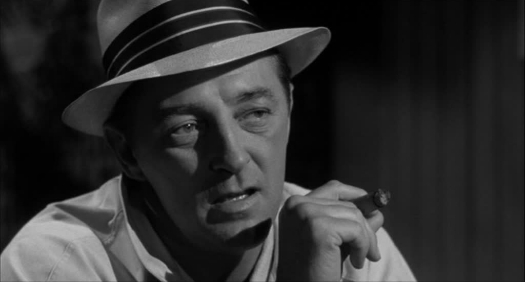
The story is a relatively simple tale of revenge and retribution, a face-off not only between the principal characters but between the law and justice too. Sam Bowden (Gregory Peck) is a successful lawyer, married with a teenage daughter and living in some comfort. A typical noir scenario frequently sees the protagonist cornered by circumstance, and what better way to achieve that than to have the past come crashing violently into the present. In Sam Bowden’s case the unwelcome past is represented by the swaggering, cigar-chomping figure of Max Cady (Robert Mitchum), a man who’s spent eight years in prison on the basis of Bowden’s testimony against him. The question of his own guilt doesn’t occur to Cady, he simply regards himself as a victim of Bowden’s meddling and is thus intent on exacting vengeance for what he considers a life denied him. From his first encounter with Bowden outside the courthouse, a mock affability barely concealing his threats, Cady becomes omnipresent in the attorney’s life. Everywhere he goes, his arrogant nemesis seems to follow, and the veiled intimidation is gradually cranked up with each successive meeting. With the danger to his family becoming ever more apparent, Bowden turns to his friends in the police department in the hopes of using his establishment connections to rid himself of Cady. However, if he thinks he can bend the law to his benefit, he soon finds out how mistaken that assumption is – Cady is clever, cunning and more than capable of turning the tools of Bowden’s trade back on him. Bit by bit, the lawyer is drawn, through mounting desperation, towards that fine line between legality and criminality. Ultimately, Cady’s goading will lead him right up to the rim of the moral abyss and dare him to take that final fateful step.

J Lee Thompson had begun his directing career in British cinema a decade earlier and had made a number of films which showed he had a talent for both action and suspense. While working on The Guns of Navarone, he so impressed star Gregory Peck that he was promptly asked to take charge of this film. There are action sequences in Cape Fear, particularly during the harrowing climax, but it’s primarily a suspense picture, a dread infused journey of terror and moral compromise. As Bernard Herrmann’s ominous score pounds away, Thompson smoothly dials up the tension in tantalizing increments  – clever cutting and camera setups lending an air of danger to such mundane and traditionally secure settings as the family home and the daughter’s school. And cameraman Sam Leavitt plays his part too, alternating between the sun drenched Savannah locations where Sam Bowden walks tall and proud as a leading citizen, and the inky shadows of his home and later the river as his thoughts turn to subverting the law which he serves in order to protect his family.

I said at the start that Cape Fear is a film which benefits from fine work all round. Peck was always good at portraying upright, heroic types. The role of Sam Bowden was a comfortable fit for him, and he catches the slight stiffness that makes the character ever so vaguely unlikable very well; Peck had the ability to convey a kind of prim smugness at times, a quality which fits in nicely in the early stages when he’s calling in favors from Martin Balsam’s accommodating police chief in an effort to run Cady out of town. I found it interesting that Lee Server’s biography claims Mitchum regarded the Peck character as the bad guy until the brutality of the second half of the film clarifies matters. Actually, it not so hard to see where he was coming from with that theory as the story has the establishment figures closing ranks against the outsider in the early stages. Of course the full extent of Cady’s depravity and ruthlessness is starkly revealed as the story unfolds, but that faint touch of ambiguity at the beginning adds further interest to my mind.

Regardless of the solid work from Peck, Polly Bergen, Telly Savalas, Lori Martin, Barrie Chase et al, it’s really Mitchum’s show all the way. He’d proved how well he could take on villainous roles in Charles Laughton’s dreamy and magical The Night of the Hunter but I feel playing Max Cady saw him step up to another level altogether. He’s genuinely electrifying every time he appears on screen, strutting and swaggering and dominating every frame with his sheer physicality. To refer again to the Server biography, it’s said that he invested himself in the role so deeply that he terrified Barrie Chase – something that’s clearly visible in the movie itself – and almost had to be restrained during the climactic assaults on both Bergen and Peck. The film was remade 30 years later by Martin Scorsese, with Robert De Niro as Cady, and featuring cameos by both Mitchum and Peck, but it didn’t work anywhere near as well for me. That remake, despite attempts to add some intriguing new aspects to the characters’ relationships, suffers badly from a cartoonish performance by De Niro that pales before the raw dynamism of Mitchum’s work – the sheer primal power of the man burns itself into your memory.

I just recently watched the film again on Blu-ray, which I picked up bundled with the remake for a very good price, and it benefits from the increased resolution but not in any startling way. If Cape Fear isn’t generally referred to as film noir, then it comes awfully close as far as I’m concerned. It’s dark, brooding and tough – the ending does see justice prevail, just, but it comes at a heavy price and nobody really walks away unscathed. For anyone laboring under the illusion that Mitchum tended to phone in his performances, or that J Lee Thompson was simply Cannon fodder, Cape Fear ought to put those myths permanently to rest.

Angel Face

 I don’t pretend to know what goes on behind that pretty little face of yours; I don’t want to. But I learned one thing very early. Never be the innocent bystander; that’s the guy that always gets hurt.

The femme fatale, the deadly woman, the one whose duplicity, self-interest and machinations lure the protagonist towards danger and doom is widely considered to be a staple of film noir. I’ve even seen some argue that such a figure is an essential element of this style of filmmaking, though I wouldn’t go as far as that myself. And yet she is an important figure, one who has achieved iconic status and entered the everyday vocabulary of even casual film fans. There have been outstanding examples of the femme fatale committed to film: Barbara Stanwyck in Double Indemnity, Jane Greer in Out of the Past, Ava Gardner in The Killers and Yvonne De Carlo in Criss Cross to name just a handful of notables. Those women were all devious, alluring and lethal, and all of them were entirely conscious of their inherent malice. But what of those characters who fall almost accidentally into the category of the fatal woman? What if a woman, by her actions, becomes a femme fatale while her motivations and psychological profile are wholly different? As far as I can see, Angel Face (1952) provides an example of just such a case – a dangerously attractive female of deadly intent who’s also a mass of complexities and contradictions.

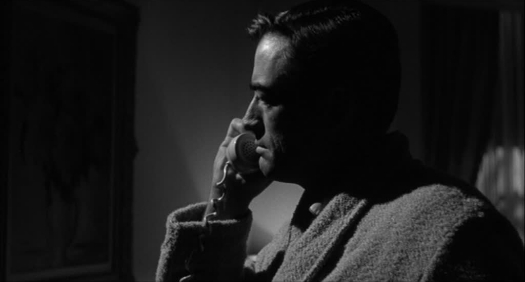
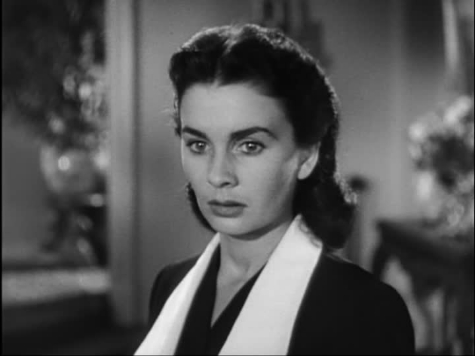
An ambulance is called to a Beverly Hills mansion late at night. Catherine Tremayne (Barbara O’Neil), the owner, has almost died in a gas-filled bedroom. It might have been an attempted suicide or an attempted murder, but in the end everyone seems satisfied that it was probably just one of those unfortunate accidents that occur in the home. With the emergency apparently over and people about to head home, Frank Jessup (Robert Mitchum), one of the ambulance drivers, pauses in the hallway, his attention caught by the figure of a girl at the piano in the drawing-room. This is Diane Tremayne (Jean Simmons), the owner’s stepdaughter. As Frank stops to offer a word of reassurance, we get a glimpse of the fragile instability of the girl; she’s edgy and prone to hysterics. But more than that, there’s an impulsive, neurotic side to  her. The former is immediately apparent when she follows Frank and essentially picks him up as he ends his shift. The latter, the neurosis, is revealed more gradually as she sets about seducing Frank and drawing him ever deeper into the complicated affairs of the Tremayne household. Diane’s father (Herbert Marshall) is – or rather was – a celebrated writer who has let his talents go to seed, mostly as a result of the pampered lifestyle brought on by a comfortable marriage. In Diane’s eyes her father is, and always will be, her whole world. As such, Catherine is the enemy, the cause of her father’s creative decline and her own consequent dissatisfaction. Almost every noir scenario revolves around the weakness of the protagonists, often their inability to accept responsibility for their own situation in life. And so it is with Diane, everything could be hauled back onto an even keel if only Catherine weren’t there: her father would recover his desire to write and she would be free to make a life with Frank. However, fate has an unfortunate tendency to throw a big awkward spanner in the works and even the best laid plans can go disastrously awry.

It’s very often the case that the most compelling movies had a troubled production history. I don’t know whether it’s down to behind the scenes tensions lending an air of urgency to events on the screen or the people involved becoming more focused on their task. Either way, there are plenty of examples of a poisonous atmosphere bringing about a fine movie. With Howard Hughes in charge of RKO there always seemed to be ample opportunity for discord on the set. Angel Face was essentially a film born of pettiness. Hughes wanted Jean Simmons but she’d recently married Stewart Granger and was having none of it. The upshot of all this was Simmons struck a deal to make a handful of films quickly and thus get out of an unpleasant contract. Her dislike of Hughes and his unwelcome attention was so great that she even chopped off her hair crudely and so was forced to play her role in the film with a slightly odd-looking wig. On top of all that, there were issues with director Otto Preminger. Simmons’ first scene in the picture involved her descending into hysterics and Mitchum bringing her out of it with the application of that cinematic staple, the open-handed slap. Well Preminger apparently didn’t like the way Mitchum pulled the blow, claiming it was going to look phony in close-up. So he had him do it again, and again, and again. With Simmons in tears and Preminger relentless, Mitchum apparently turned on the director and either gave him some of the same treatment or threatened to do so – for more on the tumultuous production, see Robert Mitchum: Baby, I Don’t Care by Lee Server pp 288-291. Maybe nobody was having a particularly good time on the set but the end result was the taut, highly strung atmosphere of the Tremayne house and that feels completely authentic.

Angel Face is Jean Simmons’ picture all the way, and gave her one of her most interesting and complex roles. As I said in the introduction, she’s unquestionably the femme fatale of the film, her actions causing chaos, death and misery. Yet she brings an emotional immaturity and insecurity to the part that sets Diane Tremayne apart from the classic interpretation of the femme fatale. If her behavior is seen as selfish, then it’s only a childish form of selfishness. Her hatred for her stepmother only exists as a result of her love and devotion for her father, and her ultimate destruction of Frank is an unwanted side-effect – there’s no malicious calculation involved. Where Simmons really excelled was in her portrayal of the brittleness of the character; her every gesture is suggestive of a young woman tiptoeing around the rim of a moral abyss. Mitchum of course was a past master by this stage at playing the kind of weary types who had bid farewell to hope long ago. The deceptive sleepiness and detachment he’s often accused of perfectly suits the character here – a disillusioned veteran half adrift in a world that he only thinks he’s got a handle on. The supporting cast all do fine work too, the highlights being: Herbert Marshall’s dissipated joviality, Barbara O’Neil’s cool take on the society matron, and Leon Ames as the twisty, unctuous lawyer.

Angel Face is available on DVD via Warner Brothers in the US, and the disc sports a very nice transfer. Everything’s crisp and clean and Harry Stradling’s cinematography always looks good. The DVD also carries a commentary by noir specialist Eddie Muller. Otto Preminger’s noir films are all worthwhile, classy efforts. This one may have had something of a sour background but what we see on screen is hard to fault. For me, the performance of Jean Simmons in a difficult and demanding role is the best thing about it all, but that’s just the icing on the cake. I reckon it’s a must see film noir.

Ten of the Best – Noir Stars

Seeing as 2012 is drawing to a rapid close, this is likely going to be my last article of the year. It’s been the first full year blogging on the new site and I have to say it’s all turned out far better than I could have anticipated. I consider myself very fortunate to have built up a loyal little band of followers and the feedback that I’ve been consistently receiving is both gratifying and informative. My last entry, on western stars, offers ample evidence of that, turning out to be the most popular piece I’ve posted by some considerable margin. I’d mentioned that I was intending to do something similar on my other great cinematic passion, film noir, and so it’s time to make good on that. Again, I’ve deliberately restricted myself to ten stars who made an impact on cinema’s shadowlands. Film noir isn’t a genre like the western; it’s a more nebulous form where the convergence of melodrama, crime and fate all become bound up in the creation of a cinematic demimonde that defies definition yet is immediately recognizable. To be honest, I had a hard time deciding on only ten men and women who portrayed so many memorable cops and private eyes, grifters and chiselers, dames on the make and hoods. Anyway, here’s my selection.

Robert Mitchum


Mitchum’s omission from my western list sparked a good deal of comment. He started out playing cowboys, and there’s a case to be made that his western roles are by and large superior to his noir ones. A number of his noirs are weak or flawed productions, particularly those made when Howard Hughes was running the show. However, even when a film was less than successful, it would be difficult to single Mitchum’s performance out for criticism. Besides that, he took the lead in two of the finest noirs: as the classic dupe in Tourneur’s Out of the Past, and as the evil killer in the oneiric The Night of the Hunter.

Burt Lancaster


Lancaster made his debut in what I reckon is one of the top three film noirs, Robert Siodmak’s The Killers. This flashback reconstruction of what led one man to lie in a darkened room, calmly awaiting those who have come to murder him showed that Lancaster had the kind of soulfulness and sensitivity that can be used to such great effect in film noir. He would return to the dark cinema frequently, producing fine work in the likes of Criss Cross and Sweet Smell of Success.

Barbara Stanwyck


One of the best known features of film noir is the figure of the femme fatale. Not every picture has one, but if you asked the average film fan to list the characteristics of noir you’d likely hear the name. Barbara Stanwyck has the distinction of playing arguably the greatest deadly woman of them all in Billy Wilder’s Double Indemnity. She did a lot of work in noir, and I’m very fond of her turn as the panicked and bedridden heiress in Sorry, Wrong Number, Anatole Litvak’s study in mounting paranoia.

Edward G Robinson


This mild and cultured man made his name in the early 1930s in Warner Brothers gangster pictures, most notably as Rico in Little Caesar. He worked successfully in a variety of genres throughout that decade but really hit his stride in the 40s with two films for Fritz Lang (The Woman in the Window and Scarlet Street) and one for Wilder (Double Indemnity). While those three roles are quite different, they do share one common feature – Robinson was playing men who, in one way or another, are trying to close off their minds to unpleasant realities, and all of them are ultimately tragic figures. This actor was among the best Hollywood ever produced, and his efforts in the world of noir are highly significant.

Robert Ryan


With some actors, it’s fairly easy to pick their best work. When it comes to Robert Ryan though, I find myself so spoiled for choice that it’s nearly impossible. His 40s and 50s output is peppered with excellent performances in noir pictures made for Dmytryk, Renoir, Wise and Ray. Even a piece of flummery like Beware, My Lovely benefits from Ryan’s intense presence. However, I’m going to single out Robert Wise’s tight and economical The Set-Up for attention. Ryan’s portrayal of a washed up fighter (he was once a boxer himself) determined to bow out with dignity, even if it kills him, gave him a break from playing the heavies he’s so often remembered for.

Gloria Grahame


Gloria Grahame has always been a favorite with noir fans, her unique brand of sexuality managing to blend quirkiness and vulnerability with a hint of inner steel. Perhaps her part as the good time girl deformed by an enraged Lee Marvin in Fritz Lang’s The Big Heat sums up that aspect of the actress best. She also brought something special to her role in Nicholas Ray’s In a Lonely Place, opposite a fiery and abusive Humphrey Bogart – I’ve heard it said that the relationship depicted had parallels with her marriage to Ray at the time.

Glenn Ford


Another guy who had strong claims for inclusion on my recent western list, Glenn Ford started out strong in film noir playing off Rita Hayworth in Gilda. Ford had that everyman quality and, as I’ve remarked when discussing some of his roles on other occasions, a vague sense of discomfort with himself that was ideal for noir pictures. I think Lang brought out the best in him in The Big Heat; his avenging cop is almost a force of nature and his barely contained rage is something to behold in a film that’s got a real mean streak running through it.

Dana Andrews


A little like Ford, Dana Andrews was another actor with whom you could almost see the wheels going round just below the surface. He too seemed to exude some of that inner dissatisfaction that translated into fatalism and disillusionment on the screen. His series of movies with Otto Preminger in the 1940s represent his noir work best. Laura may well be the best known, but Where the Sidewalk Ends offered him a meatier part and stretched him more as an actor. That movie, along with The Big Heat and On Dangerous Ground would make an interesting triple bill on violently unstable lawmen.

Marie Windsor


The queen of the B noirs, Marie Windsor had good roles in both Force of Evil and The Narrow Margin. She had a real knack for playing the cheap schemer better than anyone else I’ve seen, and her role in Kubrick’s The Killing was a perfect fit. As Sherry, the wife of everybody’s favorite sap and loser Elisha Cook Jr, her greed sees her trying to play everybody off against each other and is instrumental in bringing a tragic end to the heist.

Humphrey Bogart


And so I come to the last, but by no means the least, of this brief selection. After a long apprenticeship in supporting roles, High Sierra and The Maltese Falcon saw Bogart define the noir lead for the next decade and a half. Tough, chain-smoking and moody, he seemed to encapsulate all the weary cynicism that the war and its aftermath ushered in. His portrayal of Sam Spade was, and remains, hugely influential, and then he went one further and truly nailed the essence of the private detective in The Big Sleep. In fact, I find it impossible to read Chandler’s text now without hearing Bogart’s distinctive delivery in my mind.

So there we have it. When I made that western list I made the point that I wasn’t claiming it as any kind of definitive one. I’ll say the same again here – these are just the ten names that I feel offered something of worth and value to film noir over the short span of its classic period. In their different ways, I think these people helped sum up what noir was all about and shaped its development. I’ll admit I struggled to decide on ten actors for westerns, and this was actually tougher. The fact that I included both actors and actresses meant that my options were increased while the overall parameters remained the same. Of course I could easily have split this into two sections, or expanded it to twenty. However, in the end, I decided to stick to ten as it forced me to apply a more ruthless approach, and give it all a lot more consideration, than I might otherwise have done. Once again, all comments, arguments and protests are most welcome.