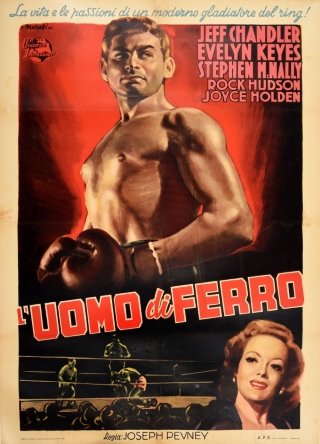
Iron Man

Everybody loves a winner, right? Well actually they don’t, there are those whose behavior draws crowds in the hope they are going to see them get a licking. It’s not just winning, rather it’s how a person wins and perhaps also why they win or even want to. Once upon a time, success in sports, and indeed life itself, was predicated not only on the results achieved or the prizes attained but also on the manner in which the game was played. Is boxing the ultimate sport? Perhaps it was at one point, or perhaps it only appeared to be so for a brief moment in time before sliding into a seemingly unrepentant morass of glitz and trash-talking. Still and all, there is at the heart of it all the seeds of nobility, and I think Iron Man (1951) attempts to tap into some of that. There is something about the image of two men pitting themselves against one another in a formalized setting, mathematically bounded spatially and in terms of timing, equipped with nothing but their guts, guile and sense of fair play. It appeals on an almost atavistic level, but that appeal is heavily dependent on both parties adhering to the rules, the rules of the game and by extension of humanity. It’s only when those rules are bent or warped either by the antagonists or those observing them that some of the purity is lost.
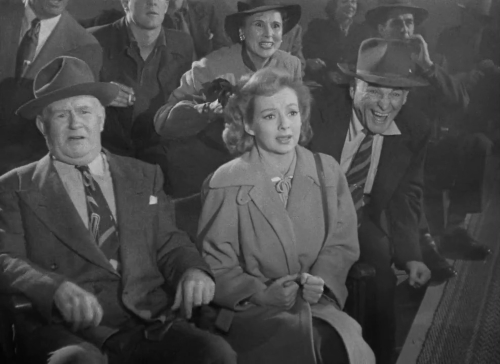
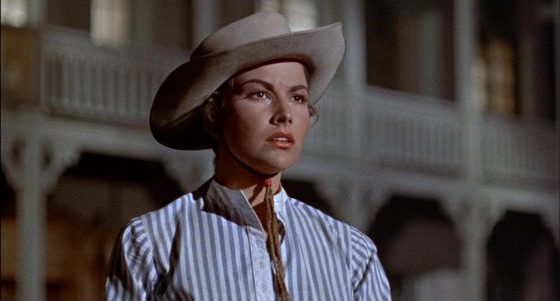
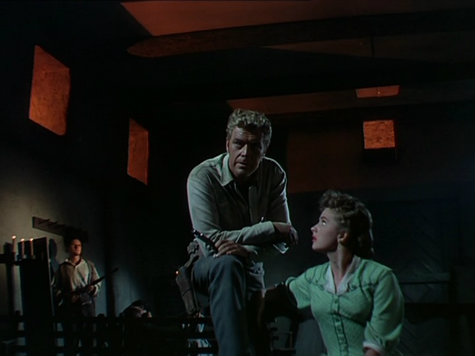
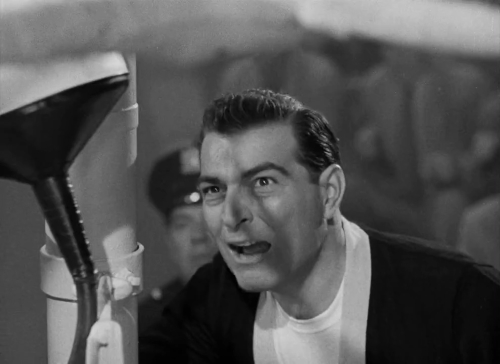
If the duel promises a contest of honor, the same quality cannot always be said to be evident among those watching it. One hears about the roar of the crowd, but what lies behind that?  Look at the eyes and listen, especially listen. All the passion that is embodied in the strained faces, the anxiety, the fear, the trepidation and for some the blood lust. And this is amplified in the sound, cheers and jeers, and if the latter dominates then what? This is the scene presented at the beginning of Iron Man – the announcer holding sway in the center of the ring, barking into the suspended microphone as the arc lights cast their harsh gaze, heralding the start of a world championship fight, calling out the names of the contenders. As the reigning champion steps up the voice of the thousands banked around the roped off area rises not in celebration but in reprobation. Coke Mason (Jeff Chandler) is the focus of this disapproval and he appears to drink it all in dispassionately, feeding off the negativity surrounding him. The view shifts to the spectators, one woman in particular. This is Rose (Evelyn Keyes), Mason’s estranged wife and she sits detached from the screams and boos, thinking back to how these circumstances came to be and of her own role in bringing them forth. We dissolve into a long flashback as Rose leads us back to the coal mines of Pennsylvania, to the man Coke Mason once was before he set out on the path that has led him to fortune and infamy. So we follow Mason as he embarks on the journey out of the grime and hazards of the mines, facing off against mindless prejudice from a belligerent co-worker, finding himself practically reborn after the trauma of a cave-in, on towards his early days as a rough and ready prize fighter egged on by Rose and his ambitious brother George (Stephen McNally). Right from the off Mason is a slugger without technique and, more crucially, without a true sense of why he is fighting. Maybe it would be more accurate to say, he does know why he’s fighting – for the money of course, but also as a reaction against his own deep personal insecurity – it’s just that he is incapable of controlling the fires in his soul. This is what drives him, the internal rages which once ignited are virtually unstoppable and threaten both his opponents and himself.
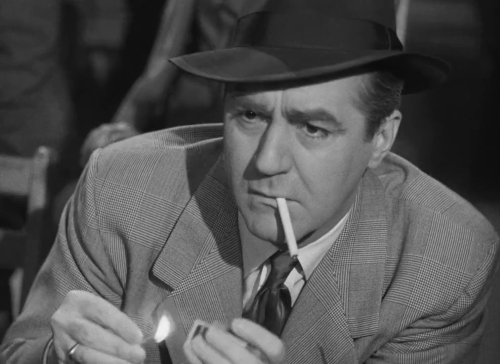
Iron Man boasts a George Zuckerman/Borden Chase screenplay from a novel by W R Burnett. Those are pretty impressive credentials right there and the movie moves smoothly through its hour and twenty minute run time to a conclusion that some might see as predictable but which  is deeply satisfying for its redemptive and restorative qualities. Director Joseph Pevney keeps it fluid and scenes are generally well paced. It’s the type of material that suited the talents of Pevney and the team around him and cinematographer Carl Guthrie creates some fine images, especially the early stuff below ground in the mine and then later in the fight sequences. Pevney and Guthrie shoot and cut expertly here, making use of starkly lit close-ups alternating with wider pans to draw the viewer into the fight and heighten the tension. The outcome might not be in serious doubt yet the stylish way it is presented is a pleasure to watch, and the emotional and thematic payoff is undoubtedly worth it.
Jeff Chandler handles the conflicted aspects of his character as well as one would expect. The reluctant fighter who is simultaneously motivated and frightened by what he carries around inside offers him plenty to play around with. He reportedly put in a fair bit of work on the practical physical aspects of the role and the fight scenes benefit from that. He never displays much grace in those moments, but that’s the part he’s portraying, a fundamentally awkward man who powers his way to dominance without bothering about the style. Rock Hudson is fine too, albeit in a lighter role as Chandler’s friend who moves from second in the corner to rival in the ring. Stephen McNally was never less than versatile and his flashy turn as the brother who rarely lets a scruple stand in the way of a fast buck is up to his typically high standard. His realization of the harm he has caused, alongside Evelyn Keyes’ similar conversion, is central to the resolution. Keyes cultivates her character nicely as the movie develops and her move from opportunism to remorse feels very natural. Jim Backus drifts in and out of proceedings as a reporter who ends up moonlighting as a promoter. It feels like an odd progression at first but it’s another key role and makes sense as the story unfolds.
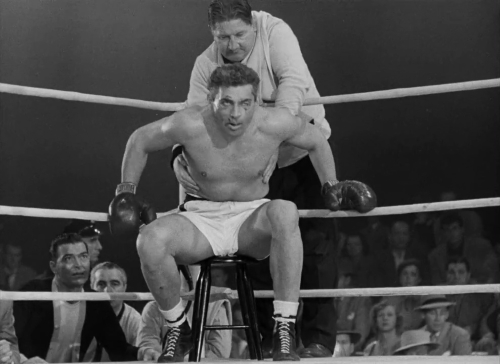
Iron Man is another of those Universal-International titles which Kino have scrubbed up and marketed on Blu-ray in their impressive film noir line. The movie does undoubtedly highlight moral ambiguity and explores some dark places in the soul, and it’s a boxing film. Even so, I’m not sure I’d class it as film noir – others may see it differently and I can’t say labeling it or categorizing it in this way bothers me much one way or the other. It pleases me to see this film available in good shape and that’s really all that counts. In the final analysis, this is a good movie with the cast and crew all turning out very creditable work.

The Man from Bitter Ridge

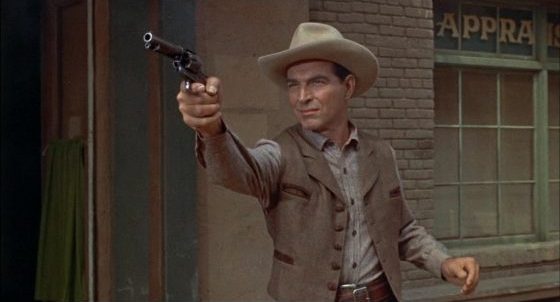
Treading well worn paths is a practice that tends to be looked on with a certain disdain with regard to any artistic endeavor, and with good reason. If familiarity does not necessarily have breed contempt, it can surely sap the enthusiasm and interest of the viewer. While that may be broadly true, it should also be acknowledged that watching movies is not an activity we indulge in for only one reason. As a rule, the better the film, the greater the challenge or stimulation offered, but that is not to say that  work providing the comfort and reassurance of the familiar has no worth. The Man from Bitter Ridge (1955) breaks no new ground, the situations and characters are all recognizable “types” that even casual western watchers will have seen on countless occasions. For all that though, it is the kind of movie that is hard to actively dislike.

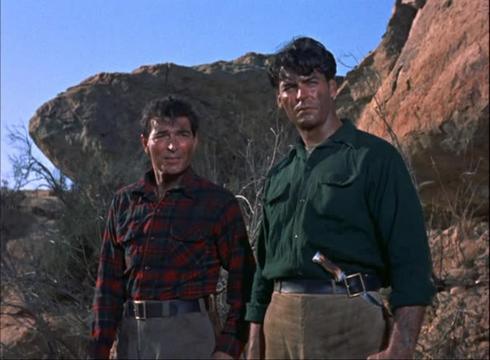
The story begins with something of a bang, namely the explosion that brings down a tree and blocks the trail of a stagecoach. The purpose is to facilitate a robbery, one carried out with precision and ruthlessness. A man ends up dead for noticing more than he ought to and the thieves make their escape. Perhaps it would be more accurate to say all but one of the thieves. A passing stranger suffers the misfortune of being held up by one of the fugitives who finds himself in need of a mount as his own horse has gone lame. This stranger is Jeff Carr (Lex Barker) and his ill-starred encounter means he almost winds up being lynched in error.  All of this happens in the first five minutes or so and a lot of plot detail is packed in here,  not least the fact the stage has been robbed by those working for Rance Jackman (John Dehner), local bigwig and candidate for sheriff in the upcoming election. To further complicate matters, the posse members who were so keen on stringing up Carr in a hurry are headed up by Jackman’s younger brother Linc (Warren Stevens). There’s probably enough story right there but the script is arguably overloaded as the idea of a corrupt man seeking ever greater power and influence is mixed in with a simmering feud between cattlemen and sheep herders, the latter group represented by Alec Black (Stephen McNally). Of course no yarn can be truly complete without some love interest, ideally involving conflict. That comes courtesy of a romantic triangle, the points of which are Carr, Black and Holly Kenton (Mara Corday), another of the sheep herders. As such, we have a decidedly tangled skein on our hands, although it is all unraveled (via brawls, gunfights, fire and fury) in a largely satisfactory manner by the time the credits roll about an hour and a quarter later.

Mention the name of Jack Arnold to movie fans and the chances are you’ll hear comments about such Sci-Fi classics such as It Came from Outer Space, The Incredible Shrinking Man or The Creature from the Black Lagoon. Nevertheless, as was the case with most directors of the time, he worked in a range of genres and turned out some fine pictures in all of them. Among his movies are a handful of westerns; Red Sundown and No Name on the Bullet are right out of the top drawer and are highly recommended. The Man from Bitter Ridge is, without question, a lesser effort. I prefer to look at a movie in terms of what it is and what it aims for as opposed to what it isn’t or doesn’t aspire to be. Still, there’s no denying that there’s not much depth to this one. I may be using the wrong label here, but I tend to think of films like this as matinee movies – straightforward, no-frills, unpretentious pictures that tell their stories in a pacy and entertaining way, no more and no less. Taken on those terms, it’s fine and does what it says on the tin. Another bonus is that “look” which is to be found in most Universal-International westerns, the visual aesthetic is appealing and (again) familiar, the very least one might expect from a cinematographer as talented as Russell Metty.

As for the performances, Lex Barker followed up his stint as Tarzan with a number of western roles and he would do further work in the genre when he later moved to Europe, especially in Germany. His role here is of a type – an undercover operative for the stagecoach company – that Randolph Scott played on more than one occasion. Of course Barker had previously been cast opposite Scott a couple of years before in the more interesting Thunder Over the Plains for André De Toth. He cuts a heroic figure and acquits himself just fine in the action scenes, of which there is no shortage, but he’s probably a bit too sunny and upbeat. Stephen McNally is his typically sharp self, assured and polished and enjoying his time as one of the good guys.

Mara Corday is an actress I am always happy to see and she is very appealing as the pistol-packing sheep farmer who finds her affections trapped betwixt and between McNally and Barker . She was in the middle of a run of generally good movies at this point, although I have to say she had a far more absorbing part in Joseph Pevney’s Foxfire that same year. With regard to villainy, it’s difficult to go far wrong when there is a solid lineup composed of John Dehner, Ray Teal, Myron Healey and Warren Stevens available. Their characters are all entirely one-dimensional, but most entertainingly so.

The Man from Bitter Ridge was released on a handsome DVD some time ago by Koch Media in Germany, but I think that may have drifted out of print now and it appears to have been replaced by a Blu-ray from the same company. The older disc looks pretty good, offering a colorful widescreen presentation of this brisk and undemanding western. I know Jack Arnold made better and more original movies and The Man From Bitter Ridge shouldn’t be seen as representative of his work in general, but it is a relaxing and mostly fun watch, and sometimes that’s good enough.

A Bullet Is Waiting

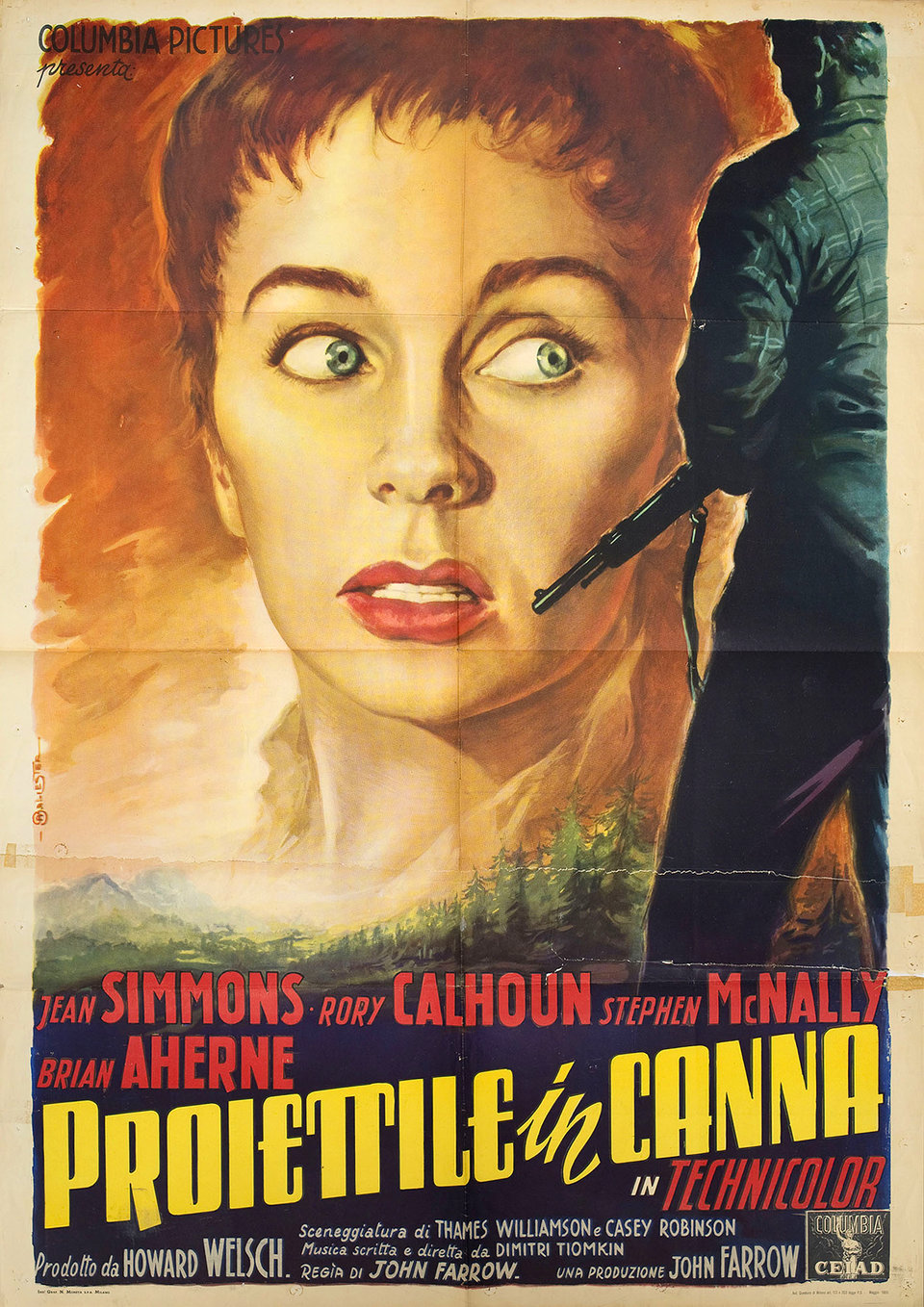
I’ve spoken of the importance of titles before, and I do like to see a punchy and enticing one used. A Bullet Is Waiting (1954) has a lot going for it: it promises suspense, danger and action, it raises questions in one’s mind and attracts the attention. Is it perhaps more than a little misleading though? In a sense it’s not, as it does allude to a very real fear motivating one of the leads. On the other hand, I know that when I first heard of it I had mental images of a western or a noir-shaded thriller. Yet that’s not really what ends up presented on the screen as it’s essentially a rustic melodrama with action/thriller elements backing up a tale of romance and renewal.

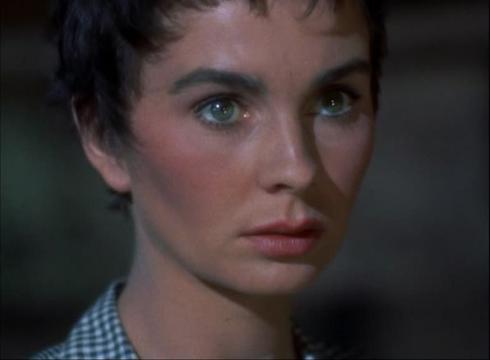
Openings that fling the viewer unapologetically into the very heart of the story can be hugely effective, and that’s what occurs with A Bullet Is Waiting. The first image is of boiling, surging waters, waves driven relentlessly by their own turmoil onto hard and unyielding rocks; this, backed by a characteristically muscular and dominant Dimitri Tiomkin score, signals an affair of heightened passions. As the camera moves around the detached wheel of a plane is visible at the edge of the swirling tide, and the tracking shot back inland reveals more wreckage and debris littering the shore, seguing gradually into footprints gouged frantically in the sand. And then, at the crest of a hillock, two figures loom into view struggling against and pummeling each other in desperation. They are Ed Stone (Rory Calhoun) and Frank Munson (Stephen McNally), fugitive and pursuer respectively, quite literally locked in combat since they are shackled together at this point. Stone gains the upper hand, releases himself and sets off alone. It’s a temporary separation though and these two antagonists are soon to be reunited when they stumble  onto private property. Cally Canham (Jean Simmons) is a young woman who has been living an isolated existence with only her reclusive father (Brian Aherne), and her loyal sheepdog, for company. With her father away for a few days, neither Cally nor the two survivors of the plane wreck particularly want to be holed up together in her cabin. However, a prolonged and dramatic storm leads to flooding that cuts off all possible escape routes, and forces these disparate characters to contemplate those timeless adversaries: retribution or redemption. By the time Cally’s father returns a number of truths will have been laid bare and paths chosen.

Now this is by no means a perfect movie, there are weaknesses which I’ll address later, but it has quite a lot going for it. Director John Farrow starts out with that wonderfully cinematic opening sequence I’ve spoken about and manages to steer a fairly even course throughout, avoiding the trap of letting it get too talky, even when the plot drifts toward some philosophical musing. That philosophy – espoused on screen by Aherne and represented by his withdrawal from a modern world he sees as increasingly dominated by confusion and conflict – is actually dealt with more subtly within the framework of the plot.  Personally, I see it as a variation on the classic redemption theme by focusing on the restorative powers of nature. From the primal power of the storm to Franz Planer’s beautiful photography of the pastoral scenes, and on to the soothing effect of the sheepdog and the lamb on the frayed emotions of the characters, the influence of nature and its ability to effect renewal is never far below the surface.

As I noted though, there are weaknesses here, which ought to be mentioned. Firstly, I see the redemptive strand having  a dual focus, on the characters of both Calhoun and McNally, the need for its application to the latter emerging only gradually. By the end this is seen to have been achieved, but in one case it was never in serious doubt anyway whereas in the other something is lost, in my view at least, by the abruptness with which it occurs. Any picture that embraces the concept of redemption and/or renewal is always welcome with me but I have to say I prefer it when the road which leads there feels a little longer, or when the battle is harder fought; in A Bullet Is Waiting it, and indeed the ending itself, arrives with something approaching alacrity. I’ve talked a lot about both Calhoun and McNally on this site in the past so I’ll simply say that both men turn in typically strong work, with the former’s innate likeability and the latter’s knack for tapping into ambiguity to the fore. Brian Aherne’s presence is felt from early on through his influence on his daughter’s thinking and character but he only makes an appearance in the final third. He brings a lovely sense of quiet authority and civility to his role. I liked him in Hitchcock’s I Confess and I must try to feature some more of his work in due course.

However, the real star of A Bullet Is Waiting is Jean Simmons. She had a good deal of range, her deranged beauty in Angel Face remains a remarkable piece of screen acting and contrasts with the delicate innocence she displays here. Her slow awakening and realization of the possibilities existing outside her cloistered existence is well done; the image of her sitting in her modest bedroom, leafing through her book on ballet, the little toy ballerina turning pirouettes within its own  protective yet restrictive space, as she tries to find some common ground with Calhoun’s roughneck is just impossibly charming.

A Bullet Is Waiting was put out as a manufactured on demand DVD in the US by Sony and it’s also available in a number of European editions. Generally, the image is pleasing with Planer’s Technicolor cinematography looking particularly fine. I see that the movie is categorized as a film noir by both IMDb and Wikipedia but, even as one who tends toward an inclusive interpretation, I don’t feel that it should be applied in this case. All told, despite a somewhat rushed ending, I found this to be an enjoyable and rewarding watch. It’s one I’ll be returning to.

Rogues’ Regiment

With a variety of matters vying for my time and attention these days, I’m grateful to have this opportunity to put up a piece on another of those relative rarities that Gordon Gates thrives on. So, read on…

Rogues’ Regiment (1948) is one of a number of post WW2 noir dealing with escaped Nazi war criminals. Notorious, Cornered and The Stranger would be several of the more well known.
In this one, Dick Powell is an army intelligence agent on his way to French Indo-China. He is on the trail of a high-ranking SS officer who had escaped the roundup at the end of the war. The trail leads Powell to the French Foreign Legion camp in Saigon. (The French used large numbers of ex-German soldiers in their war with the Viet-Cong).
Powell’s main problem is that there are no known photos of the man he wants. He joins the Legion himself in order to try and identify the swine. Said swine, Stephen McNally, is very careful about his identity and bumps off everyone he thinks is a danger.
Helping Powell out on his case is French Secret Service agent, Marta Toren. Toren poses as a singer in a cabaret frequented by off duty Legion members of the German type. Of course Powell and Toren are soon drawn to each other.
Also in the mix here is Vincent Price as an antique dealer who supplements his income with a little gun running for the Viet-Cong. Philip Ahn and Richard Loo play Viet Cong types who are buying said weaponry from Mister Price.
McNally, who picked Saigon and the Legion thinking it would be the least likely spot to be recognized, finds the opposite true. One of his ex-staff officers, Henry Rowland from Dachau concentration camp happens to be in the same unit. While out on patrol the men become involved in a fire-fight with the Viet-Cong and McNally applies a few rounds to the man’s back. Problem solved.
Not quite it seems. Old Vincent has tumbled to McNally’s identity and figures a bit of blackmail is in order. He knows McNally has a large cache of jewels and gold taken from his camp victims. Price wants most of it. McNally agrees as long as Price can supply him with a passport and some American dollars so he can leave the country.
Both of course plan to double cross the other when the deal is completed. Powell and Toren who have been one step behind finally clue in and quickly pick up their pursuit. The meeting between  Price and McNally needless to say has turned ever so bloody. Who wins?
The director here is Robert Florey. His work included Meet Boston Blackie, Dangerously They Live, The Beast With Five Fingers, Danger Signal, The Crooked Way, and the very under-rated The Face Behind the Mask. He was also the helmsman on hundreds of television episodes.
Screenplay was by one time Oscar nominee, Robert Buckner. He did the story or screenplays for Deported, A Prize of Gold, Yankee Doodle Dandy, Santa Fe Trail, Virginia City, Dodge City and Love Me Tender.
Powell and Toren are okay with their roles, But it is McNally here as the Nazi louse, and Price as the blackmailing snake in the grass who steal the show.
Toren, who died at age 31, managed to work the film noir  Deported, Mystery Submarine, Spy Hunt, Illegal Entry, One Way Street, Paris Assignment and Sirocco into her 4 year Hollywood career. The d of p was Maury Gertsman whose noir included Blonde Alibi, Inside Job, Singapore, One Way Street, The Glass Web and Johnny Stool Pigeon.
Well worth a watch if you can find it. Needless to say it is another UNIVERSAL-INTERNATIONAL Release.
Gordon Gates

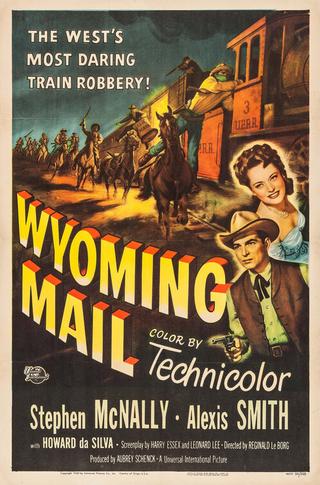
Wyoming Mail

I reckon titles matter. I’ve commented before on how certain titles have grabbed my attention and were directly responsible for my watching those movies. I know, it’s somewhat similar to the old “don’t judge a book by its cover” adage and, momentarily at least, it does make me wonder whether I’m being shallow. If there are titles which can draw me in, the opposite is true to some extent as well and there are those which have actively discouraged me; I’m thinking here of long, cumbersome examples or the generally unappealing variety. This brings me to Wyoming Mail (1950), which is not so much an unattractive title as a terminally prosaic one. Perhaps I’m wrong about this, perhaps it’s just some personal prejudice of my own, but I cannot imagine that one getting too many people excited and keen to see the film. Frankly, I have to wonder what the marketing department at Universal-International were thinking of when this picture was being produced. That aside, let’s see how the movie itself plays out.

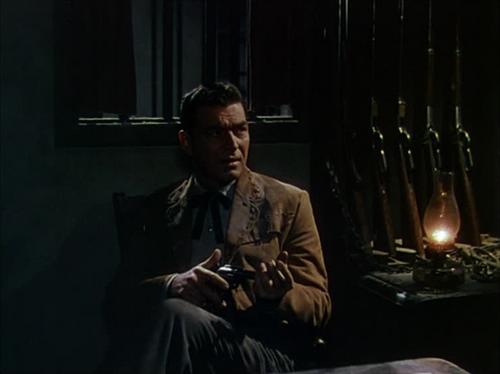
Yes, it’s a story about the mail. To be more specific, this is one of these westerns which adds undercover/spy trappings to a tale of the gradual expansion of civilization in the Old West. The train was pivotal in conquering the frontier, that iron road was the connection from ocean to ocean and allowed for the transport of people and goods almost everywhere at speed. And part of its function was to carry the mail. That’s where the story kicks in, pointing out how the railroad was following on from the early Pony Express and stage lines in this regard, and how it was simultaneously becoming the target of criminal gangs. So what we’re looking at is an exercise in infiltration, where government operative and former soldier turned prize-fighter Steve Davis (Stephen McNally) is tasked with heading west with the aim of tracking down the head of a gang of highly successful raiders. This quest will require his incarceration in the territorial prison, a stint in “the hole” and a subsequent breakout. All the time he’s burrowing ever deeper into the criminal network and picking up new threads to investigate, he’s continually switching identities and the prospect of betrayal is never far off.

While that title is as forgettable as they come and the script, by Harry Essex and Leonard Lee, has no pretensions about offering anything of depth, the movie remains a hugely entertaining. This, I think, is largely down to the pacing and the amount of incident packed into a brisk 80 minute running time. From the opening minutes the story never lets up, barely pausing for breath as robberies, shootings, fights, double-dealing and a touch of romance sprint across the screen in a Technicolor delight shot through the lens of Russell Metty’s camera.

Director Reginald Le Borg is not someone I automatically think  of when westerns are being discussed. Although I do have a copy of War Drums somewhere, he’s most familiar to me for taking charge of a number of Lon Chaney Jr horrors, particularly a clutch of Inner Sanctum titles. I think the last movie of his that I watched was around the turn of the year when I enjoyed Vincent Price in an attractive looking piece of nonsense called Diary of a Madman. This is a handsome production as well and while I certainly wouldn’t like to refer to it as nonsense it is breezy and quite insubstantial. I’m not sure I can say much about Le Borg as a director beyond the fact he brought a welcome sense of urgency to the picture.

Having Russell Metty behind the camera is a big plus for any movie, but the other big selling point for Wyoming Mail is the cast. I like Stephen McNally a lot, he was one of those guys who was equally effective as hero or villain, in the lead or in support. He’s a good choice in this as the Easterner sent to smash the train robbers’ gang and his snappy, quick-talking assurance works a treat. The romance with Alexis Smith is mostly effective and enjoyable to watch, although I imagine it can’t have been much of a chore being asked to play a love scene opposite Ms Smith. One look at the cast ought to tell you you’re going to be in for a pretty entertaining experience. Just take a moment to read: Howard Da Silva, Ed Begley, Richard Jaeckel, James Arness, Richard Egan, Gene Evans, Frank Fenton, Whit Bissell. Granted some of the parts are small and the appearances fleeting but simply seeing these people on the screen is a pleasure in itself. Incidentally, McNally, Smith and Egan would appear together a few years later in Dick Powell’s enjoyable Split Second.

To the best of my knowledge, Wyoming Mail has only had one official DVD release anywhere. That was in France via Sidonis, and it’s one I haven’t bothered to pick up due to the tendency for that company to force subtitles. There aren’t too many Universal-International westerns that remain hard to access these days – unlike their crime and noir pictures – excepting those which seem to have problems with elements or prints in the incorrect aspect ratio. Anything I’ve seen of Wyoming Mail, which pops up online from time to time, suggests that the film is in good shape overall so it’s odd that it’s not been made more widely available. Mind you, I have a hunch the title can’t be helping in that respect…

The Duel at Silver Creek

Pulp, a word that usually ends up being employed in a derogatory way. It suggests the cheap, the disposable, and that sense of something a bit crude and tawdry is never far from the surface. It carries around the sour taste  of intellectual snobbery, a self-aware superiority that drains the  joy from entertainment. But, let’s not forget that entertainment and art are under no obligation to remain stand-offish strangers. Frankly, I like pulp material and always have, long before I became aware of the negative connotations assigned to the term by some, or was even aware of the term itself for that matter. As with so many other forms of artistic expression, it worked its way into my consciousness from an early age, entrancing and enchanting an eager mind. In short, this is where the seeds of my lifelong affection for cinema, literature and countless other art forms was first sown. And so to the The Duel at Silver Creek (1952), a film that is unashamedly and satisfyingly pulpy.

The story is a simple one, telling a tale of claim jumpers, manipulation and revenge. The bulk of the action takes place in and around the titular town of Silver Creek, where the villains have set up an outwardly respectable front. The town is served by a lawman going by the colorful name of “Lightning” Tyrone (Stephen McNally), renowned for his speed with a gun but hampered by an injury following a run-in with the aforementioned criminals. The murder of a friend adds a personal element to the marshal’s motivations, and this hunger for a reckoning is shared by his newly acquired ally, a youthful gambler and gunman known as The Silver Kid (Audie Murphy). The efforts of these two to chase down the claim jumpers forms the basis of the plot but it all gets a little more complicated when a layer of romance and intrigue appears in the shape of Opal Lacy (Faith Domergue), a particularly devious addition to the limited but frequently impressive roster of western femme fatales.

There are a number of things which jump out at you while watching this movie. Firstly, it’s a Universal-International production so it has the distinctive and unmistakable look that can be found in all of the studio’s output of that era. The Technicolor cinematography of Irving Glassberg is quite beautiful at times, and the shadowy nighttime interiors are rendered in an especially attractive and evocative way. It’s in these moments that a film noir flavor is most noticeable, and that aspect is highlighted both by the intermittent voiceover provided by McNally and the calculated and ruthless machinations of Domergue. Then there are the character names – Lightning Tyrone, The Silver Kid, Johnny Sombrero, Dusty Fargo, Tinhorn Burgess, Rat Face Blake, etc – carrying that unreal yet alluring quality of something ripped from a comic strip. Presiding over all this is Don Siegel, a man still learning his trade at this stage – the pacing is a little off in the second act – but already  showing the visual economy that can be found in his best work.

With a plot-driven, action-oriented piece of filmmaking the characterization is always going to come in a very distant second place. Audie Murphy and Stephen McNally were highly capable actors, the former still on the learning curve but growing in confidence all the time while the latter was an experienced and solid second lead/support man. Seeing the names of Murphy or McNally in the credits generally means a movie is worth watching, in my opinion. Neither one is asked to stretch himself particularly here in pretty one-dimensional roles, but they never offer less than good value. Even though I wouldn’t call myself a  great fan of Faith Domergue, I’ll freely admit she did fit the femme fatale mold quite snugly and she vamps very successfully in this part. Susan Cabot is cast in a tomboyish part which, while attractive enough in its own way, feels like a bit of a waste. I think the main weakness though comes from the rather insipid bad guys. While Domergue’s flashiness was always going to overshadow them Gerald Mohr and Eugene Iglesias don’t provide much of a threat to compensate. On the other hand, Lee Marvin does make a definite impression as a loudmouthed townsman in one of his earliest roles.

Looking around at what is available for viewing nowadays, it has to be said that fans of classic westerns have much to grateful for. The vast majority of Audie Murphy’s movies are now accessible in good to excellent quality – a handful are still only viewable via sub-par editions – although it doesn’t seem all that long ago that The Duel at Silver Creek was one of the few that could be picked up easily. I don’t believe it’s been upgraded to Hi-Def but it still looks good to my eyes. If the film isn’t going to offer any new insights, it has to be said it still provides a powerfully enjoyable way to pass an hour and a quarter, which is never a bad thing. That, I feel, is as good a way as any to round off 2019 and to wish everyone a happy, fulfilling and successful 2020.

Tribute to a Bad Man

We’re living in the middle of nowhere. Two hundred miles from any kind of law and order. Except for what I built myself. Ever since I started – and this you don’t know – I’ve been badgered, skunked, bitten out and bushwhacked by thieves from everywhere. And now, one of my men’s been killed. I find my horses, I find the killer. If I find the killer, I hang him.

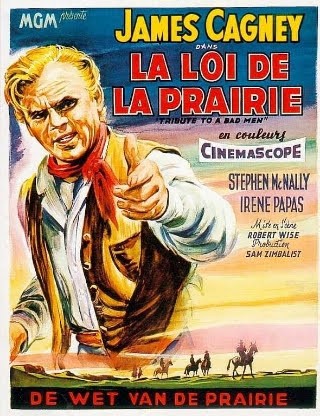
Sometimes little gems pass us by, having escaped our attention for one reason or another. Discovering such films is a genuine pleasure, a reminder that there are always cinematic nuggets to chance upon. Tribute to a Bad Man (1956) is a case in point, a movie I was aware of but had never seen. I’ll readily admit here that this may have been at least partially due to a certain prejudice on my part; neither the stars nor the director are people one automatically associates with the western. I guess my enjoyment of Robert Wise’s two earlier genre efforts, coupled with the recommendations of others, drew me to the film. The presence of James Cagney (who made only three westerns himself) and Irene Papas had me feeling less confident. However, I was delighted to find that any reservations were entirely misplaced – if anything, Tribute to a Bad Man proves how the genre has a tendency to bring the best out of talented performers and filmmakers.

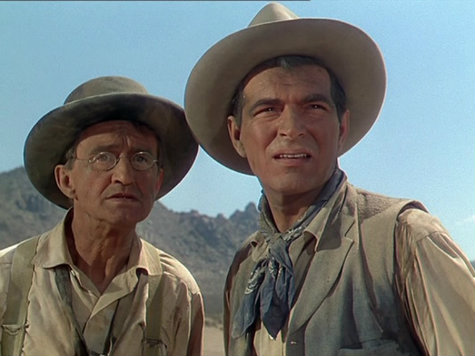
The plot recounts a short episode in the life of a young man, a parable of renewal in the best tradition. Steve Miller (Don Dubbins) is a green easterner, a store clerk from Pennsylvania heading west to carve out a new life. Riding into a lush valley, he stumbles into an ambush in progress. A wounded man is pinned down with only the carcass of his slain horse for cover. Miller’s unexpected appearance on the scene drives off the bushwhackers and earns him the gratitude of the man he’s saved. This is Jeremy Rodock (James Cagney), a prosperous horse rancher and owner of the valley. Miller’s reward is to be taken on as a wrangler, but it also draws him into the harsh and complex world of Rodock. And it is completely his world; Rodock’s wealth and hard-bitten personality have made him the total master of his domain. In a land as yet untouched by the civilizing influence of the law, his authority is absolute and he quite literally holds the power of life and death when any crime takes place. The west at this time was very much a man’s country, with women thin on the ground. Rodock is one of those classic western types who has lived much of his life alone, but there is a woman in his home now. Jocasta Constantine (Irene Papas) is a Greek immigrant he has taken from the Cheyenne saloon where he found her and brought back to his ranch. It’s at this point that the film comes into its own, raising all kinds of questions about trust, suspicion and the way it’s all too easy to hide from and deny one’s true feelings. Rodock has relied on himself and his own instincts for so long that he’s slow to trust. He’s become a hard man, masking a deep insecurity with an uncompromising exterior. There’s a kind of messianic zeal about the way he metes out his brand of justice, hanging any horse thieves who dare raid his stock. But his suspicion of potential criminals extends into his personal life too – he’s consumed with doubt when it comes to Jocasta, fearing the attractions of his head wrangler McNulty (Stephen McNally) and later Miller will be more than she can resist.

Tribute to a Bad Man was adapted from a story by Jack Schaefer, and I’ve yet to see a film derived from his work that’s left me dissatisfied. There’s a timeless quality which I feel comes from the focus on interesting characters and deeply affecting relationships. This isn’t a shoot-em-up western, rather it’s a character study which draws you in gradually. That’s not to say there are no action scenes – there are, but they certainly take second place. Mostly the movie concerns itself with Rodock and his relationship with Jocasta. Even the name Jocasta is highly suggestive, with its allusions to Greek mythology – Jocasta was the mother of Oedipus, who of course unwittingly killed his father and proceeded to marry his mother. I think it’s therefore intended that we see Rodock as a kind of Laius figure, simultaneously in love with Jocasta, deeply suspicious of what it may lead to, and also forever aware of the threat to him posed by younger men. Nevertheless, while an awareness of this aspect can add another layer of appreciation, it’s not an essential reading of the plot. What really matters here is the way an essentially decent man has allowed himself to succumb to cruelty, and how he rediscovers and regains his humanity. In this version Jocasta isn’t the tragic figure but instead represents salvation for Rodock.

I think it’s a pity Robert Wise didn’t make more westerns. All three of his genre efforts are fine movies, although I probably enjoyed Tribute to a Bad Man most. Aside from the rich, classical theme, the movie simply looks great throughout. Filming in CinemaScope, Wise and cameraman Robert Surtees use the wide frame to full effect, and the Colorado locations appear quite spectacular. Furthermore, the interiors are well used too. Wise and Surtees achieve good depth and contrast in those scenes – the grimy, smoky bunkhouse looking particularly authentic. The director’s judgment of the pacing was spot on too, letting scenes play out naturally but never allowing them to overstay their welcome. A polished and professional piece of work all round.

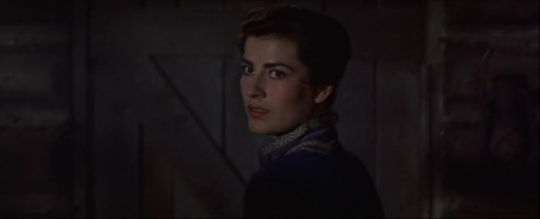
As I said at the beginning, James Cagney simply isn’t someone typically associated with the western – his fast-talking persona seemed to belong to a different period and location. And yet I never once found myself thinking there was anything anachronistic or out of place about his presence in Tribute to a Bad Man – which is a tribute itself to the talent and versatility of the man. Cagney of course wasn’t the first choice for the role of Rodock; Spencer Tracy was initially cast but his reluctance to spend so much time on location led to his leaving MGM and being replaced by Cagney. The character of Rodock wasn’t an easy one to play – he’s not really the bad man the title suggests, at least not  in the formal sense of the word. On their own, the prickliness, uprightness and bursts of cruelty could probably be handled fine by a number of actors. Cagney’s skill though lay in his ability to ensure Rodock never became wholly unlikable at any point; the fundamental honor and decency of the man were never far from the surface and that Irish twinkle would flash in his eyes at just the right moment. Irene Papas is another performer you don’t expect to see in a western – she hasn’t even made that many English language films all told. Once again though we can see this genre encouraging fine performances from people who, on paper anyway, sound like odd choices. Papas was one of only two women in the cast, and her striking Greek features make her stand out even more. This was her Hollywood debut and she carried off the role of Jocasta with style. Her character was at the heart of the story, the one who brings Rodock back to full life, and any weakness would have derailed the whole thing. She got across the right combination of sassiness, allure and soulfulness to make it all entirely believable, and even the significant age difference with Cagney is used to the film’s advantage.

Stephen McNally could play heroes, villains and everything in between with ease. Here he was the villain, a slick opportunist willing to gamble on anything and lacking any real moral sense. Probably his finest moment in the movie comes when he has to endure the sadistic punishment Rodock devises to pay him back for crippling his horses – grueling stuff and well handled by McNally. Don Dubbins was fine as the everyman narrator, ultimately it’s something of a thankless part but he did all that was asked of him. The supporting cast all have smaller roles but Vic Morrow got handed a reasonably meaty part as the embittered son of Cagney’s former partner. The other parts are filled by such familiar faces as Lee Van Cleef. Royal Dano, Jeanette Nolan, Chubby Johnson and James Griffith.

Tribute to a Bad Man is available  from a number of sources on DVD now. There’s a Warner Archive MOD disc out in the US, a Spanish release – which I think is non-anamorphic letterbox – and this Italian edition from A & R Productions which I own. I have a few titles by this company now and I’ve been very satisfied with them so far. The movie is presented in its correct scope ratio and anamorphically enhanced. The print used is crisp, clear and colorful with no significant damage. The film can be viewed either with its original English soundtrack or an Italian dub, and there are no subtitles at all offered. Extras consist of the theatrical trailer and a selection of galleries. All in all, I really enjoyed this film. It’s a first-rate western in my opinion, and ought to have more fans. I can certainly see myself revisiting it and I recommend anyone who hasn’t seen it check it out.

The Stand at Apache River

poster7_zps8995170c

Something I like to do on this site is feature a mix of the better and lesser known films. When it comes to the latter category there’s no shortage of candidates to be found among the output of Universal studios. Second features or programmers are of course a varied bunch in terms of quality, but it has to be said that Universal, of all the Hollywood studios, had a real knack for producing entertaining westerns on the cheap. These small-scale, unpretentious movies had a polish and tight professionalism to them that’s very attractive. There’s no doubt that these films were constrained by their budgets but that was often turned into an advantage in itself. The Stand at Apache River (1953) is a fair example of a western which both exploits its limitations and simultaneously suffers from them too.

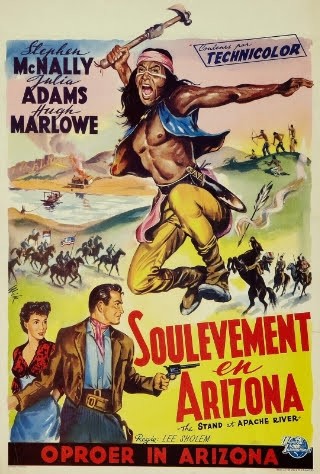
The opening sees a horseman striking out across an expanse of barren country, nervously checking his back trail for signs of pursuit before heading for the rocky high ground and the promise of safety. This man is Greiner (Russell Johnson), a thief and murderer desperate to avoid a date with the hangman. Hot on his heels is Lane Dakota (Stephen McNally), a driven lawman with a personal interest in running down his quarry. When an unexpected skirmish with a couple of Apache leaves Greiner badly wounded, and Dakota without his much needed proof, the sheriff has no option but to seek temporary shelter until the prisoner is well enough to be brought back to face justice. And this brings us to the location where the remainder of the drama will play out – the Apache River ferry station. Dakota’s arrival coincides with that of a stagecoach carrying Valerie Kendrick (Julie Adams) and Colonel Morsby (Hugh Marlowe), the former being an uncertain bride-to-be on her first trip west while the latter is a veteran Indian fighter with a fearsome reputation. No sooner has this little band of travelers gathered at the isolated station than it’s revealed that a group of 50 Apache warriors has broken free from the San Carlos reservation and may be heading their way. This external threat is exacerbated by a number of internal conflicts, among which are Greiner’s eagerness to elude his captor and the friction that arises between Dakota and Morsby over matters of justice and their respective attitudes towards the Apache. When the station finds itself under siege and repeatedly attacked by the Apache all the tensions within are exposed and add to the danger.

While I was watching this movie I found it difficult not to be reminded of Apache Drums for a number of reasons. Firstly, there’s the presence of Stephen McNally in the lead and the fact that the title and credits play over the same footage and images as the earlier film. Additionally, both movies have a similar structure, gradually narrowing in focus and confining themselves to a single set as the story progresses. The Stand at Apache River also tries hard to recapture some of the terrifically claustrophobic atmosphere that characterized and elevated the Lewton/Fregonese film but director Lee Sholem doesn’t quite get there. The lighting and cinematography are similar but the same sense of menace isn’t achieved. Where Lewton and Fregonese kept the Apache largely unseen and thus built them up into frightening bogeyman figures, this movie presents them, or at least their leader, as more rounded characters. While this dissipates the threat somewhat, it does offer the opportunity for some consideration of the nature of the conflict between the settlers and the Apache, deftly highlighting the grievances of and injustices towards the latter group. However, this also feeds into what I see as the main weakness of the movie – essentially there is too much going on. You cannot have drama without conflict but it’s also possible to overdo it. The movie only runs for an hour and a quarter and tries to pack in a siege, commentary on settler/native relations, the problems faced by women in isolated frontier settings, and a love triangle to name just a few. In the end, there are too many themes and too little development – arguably, there’s enough material for a couple of movies here.

Stephen McNally and Julie Adams get the most screen time and both of them turn in perfectly acceptable performances. However, the overstuffed plot which I mentioned does work against them and means that their character development is necessarily limited. This is a shame as both of them have interesting back stories, and the acting chops to take advantage of them, but there’s just not enough time to explore it all further. Hugh Marlowe is fine too as the rigid martinet although his role is fairly one-dimensional. There’s also a nice intense turn by Jaclynne Greene as the frustrated and frightened owner of the river station. Russell Johnson (who passed away just last month) and Hugh O’Brian both play potentially interesting characters, though once again it has to be said they really don’t get the chances to show what they were capable of. The only disappointment for me was Edgar Barrier, who I found pretty unconvincing as the Apache chief.

I guess The Stand at Apache River has to count as a bit of an obscure film these days, and it certainly hasn’t been widely available for home viewing. However, there is a nice DVD out in Spain. Many Universal titles from the 50s seem to be in reasonably good shape and The Stand at Apache River is no exception. The print used isn’t perfect but it’s not at all bad either. While there are a handful of instances of age-related damage, they are few and I wouldn’t refer to them as a particular distraction. Generally, the transfer is smooth, colorful and acceptably sharp. The disc doesn’t offer anything in the way of extras but there’s no problem with subtitles either – there’s the option of French, Spanish or none. All in all, the movie provides plenty of entertainment and excitement. With its short running time it moves along briskly and, leaving aside the matter of the crowded plot, should satisfy those into westerns of this era.


Apache Drums

Filmmakers assigned to B movie projects always faced an uphill struggle at the outset: inflexible and restrictive shooting schedules, budgets pared right down to the bone, and scripts that, as often as not, lacked any spark of originality. Still and all, there were a select few who seemed to thrive under such circumstances, who had the vision or the maybe even the guts to shape something worthwhile out of the modest resources before them. Fans of classic horror are familiar with, and hold in high regard, the name of Val Lewton. This was the man whose specialist unit at RKO managed to produce a series of classy, polished little nightmares that not only transcended their frugal budgets but actually succeeded because there was so little money available. Apache Drums (1951), made at Universal, was Lewton’s last feature as producer before his untimely death from a heart attack. The film is the only western he was involved in, and it’s such an effective and atmospheric little picture that I can’t help but wonder how he might have fared within the genre had his life not ended so prematurely.

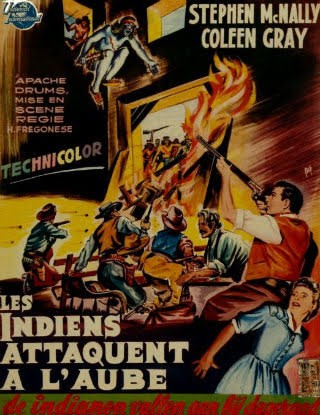
The story is derived from Harry Brown’s Stand at Spanish Boot, and it tells a fairly standard tale. Sam Leeds (Stephen McNally) is a gambler, a seemingly incorrigible ne’er-do-well (he’s even earned himself the unwelcome nickname “Slick”) who quite literally opens proceedings with a bang, shooting dead a rival card player in the stark saloon in the town of Spanish Boot. I found it a particularly nice touch that the shooting takes place off-screen as it immediately lends a sense of ambiguity to Sam’s character. He says it was self-defense and no-one seriously doubts that, still the seeds of suspicion are planted in our minds right from the off. The shooting comes at a bad time from Sam’s perspective: the mayor/blacksmith Joe Madden (Willard Parker) has been talked into a kind of moral crusade by the Welsh (the nationality has some significance later in the movie) parson Griffin (Arthur Shields) and Sam is given his marching orders. The fact that Madden is Sam’s rival for the affections of local girl Sally (Coleen Gray) rubs further salt into his wounds but he has no alternative. The dance hall girls have just been sent packing, and Sam is the next undesirable to be ejected. Thus we have the classic western staple of the outcast, shunned by the decent folk and driven out beyond the bounds of civilization. However, Sam’s exile is a short-lived one; he soon caches up with the wagon of girls, or rather their massacred remains. With his dying breath, the freshly scalped piano player who had been accompanying the spurned ladies tells of a formidable Apache raiding party appearing ghostlike and descending upon them. Sam gives his word to hightail it back to Spanish Boot and warn the solid citizens of the impending attack. The thing is he’s neither welcome nor trusted in his former home, the residents, with the tacit support of Madden, being on the point of riding him out of town on a rail before the arrival of a shot-up stagecoach bears out his words. It’s at this stage that the tension starts to build, as the Apache threat draws ever closer. Eventually, the net closes in to the point where all the survivors are holed up and under siege in the old church. Here, in the latter half of the movie, the camera never leaves the interior of the building and so heightens the feeling of helplessness and suspense, as the drums pound throughout the night and the defenders wait and watch for the Apache to leap howling through the high windows.

In writing about a lot of 50s westerns, one word crops up again and again – redemption. There’s no getting away from it; it quite literally pervades the genre throughout the decade, with even relatively humble and unpretentious efforts like Apache Drums having the concept at their core. All of the three main characters – Sam Leeds, Griffin and Madden – redeem themselves before the final fade out. Madden initially comes across as a vaguely priggish figure, allowing his preconceptions of Sam to colour his judgement and using his authority as means of furthering his own personal desires. But through enforced confinement with the man he regards as his opponent, he’s able to rise above his own inherent pettiness to attain a kind of nobility by the end. Griffin is a moral and religious absolutist, quick to judge and condemn all those who he considers to have strayed from the path of righteousness. Again, the circumstances he’s forced into lead to a reassessment of his former stance. There’s a marvelous little moment during the siege, where the preacher who had previously spoken in the most derogatory and disparaging terms about the Apache scout in their midst, Pedro-Peter (Armando Silvestre), moves across to kneel beside him. With the shadows of death creeping ever nearer, these two men pray to their respective deities side by side. And finally there’s Sam Leeds. He starts out expressing nothing but casual contempt for all those poor saps who slave away trying to earn an honest living and build a community. He’s of the opinion that he’s too smart for all that guff, that his only concern is his own welfare and comfort. Yet, he too (perhaps more than the others) finds that the threat from without carries a lesson for him. By putting aside his selfishness and obsession with self-preservation, he grows visibly as a human being. In their roles, Parker, Shields and McNally all manage to create rounded characters that are believable due to their respective weaknesses and prejudices. When you’re dealing with a low budget production such as this, good characterization, and the performers capable of achieving it, is a huge plus.

While the acting is important if you’re counting the pennies, it’s all likely to come to nothing if the technical expertise isn’t present behind the cameras. As I said in the introduction, producer Val Lewton was a past master at wringing the maximum out of limited resources. His RKO chillers all had a very distinctive look and feel, regarding shadow, darkness and the unseen and unknown as assets rather than obstacles. Such is the case with Apache Drums. Some of the most effective sequences follow on from events that the audience never get to see: both Sam’s deadly gunplay and the massacre of the saloon girls happen off-screen and the viewer only gets to witness the consequences of these events. The final section of the movie, which leaves the audience with no choice other than to view the action from the perspective of the terrified townsfolk means that we share in their sense of helplessness and dread. Of course Lewton was either clever or fortunate enough to work with talented directors on his projects. Between them the producer and director Hugo Fregonese work wonders in this section of the film: the image of garishly painted warriors springing through the high windows, backlit by the flames of the burning town, is like a vision out of hell, and retains a powerful shock value. I made brief mention earlier of the fact that Arthur Shields played a Welsh preacher. The reason for my drawing attention to his character’s nationality relates to a passage which takes place during the climactic siege. As the incessant beating of the war drums outside the walls begins to take its psychological toll on those inside, the decision is made to do something in an attempt to boost morale. Shields, playing a Welshman, leads the defenders in a chorus of Men of Harlech. In itself it’s a nice moment, but it’s also significant in that the scene would be mirrored in Cy Endfield’s Zulu over a decade later.

Apache Drums is a film that seemed quite difficult to see for many years. I caught a television broadcast back when I was a teenager and it stuck in my mind, probably because of the imagery as much as anything. At the moment, there are three DVD editions available: from France, Spain and Germany. From various comments I’ve seen, I get the impression they are all derived from the same source, though the French release will have forced subtitles. I have the Spanish DVD from Llamentol, which presents the film in the correct Academy ratio, and boasts a fine overall transfer – it’s sharp, colourful and well-defined. Subtitles are not an issue and can be turned off on the setup menu. The disc also offers the original theatrical trailer for the film, but that’s it in terms of extra features. I really like the film; it’s pacy, well structured and exciting. Aside from that, it looks good, with the kind of visual flair that’s typical of a Lewton production. A low budget sleeper that I happily recommend.

Hell Bent for Leather

hbl1

You know, the more westerns I watch, and discuss with others, the more convinced I’ve become that the smaller, less ambitious productions actually offer a better representation of the strengths and weaknesses of the genre. The leaner budgets mean that the writing, shooting and performances are more honed, less indulgent, and therefore maybe a little more honest and direct. Hell Bent for Leather (1960) is what is known as a programmer; the B western had disappeared and been absorbed by television, but there was still a place for those movies which weren’t going to open as headline A features. The movie is a fine example of economy filmmaking; it demonstrates the benefits of a simple yet tight plot, a small and experienced cast, and a director capable of making the most of his locations.

The story is a very simple one, a case of mistaken identity leading to a desperate manhunt. At the risk of overselling it, Hell Bent for Leather tells a kind of Kafkaesque tale of senseless persecution, the reasoning behind it all only gradually becoming apparent as the narrative unfolds. It opens starkly, with a lone figure staggering out of the wilderness, clutching a shotgun. It’s clear the man is dehydrated and nearing exhaustion, but salvation is at hand – he spies a horseman who has just stopped to eat and rest. This is Clay Santell (Audie Murphy), a horse dealer travelling on business. No sooner has Santell extended the hand of hospitality to the bedraggled figure who’s stumbled upon his camp than that gesture backfires spectacularly. Finding himself viciously clubbed to the ground and his mount stolen in payment for his kindness, Santell only has time to loose off a single shot, winging his assailant and causing him to drop his distinctive shotgun. Santell is now in a similar fix to the man he foolishly tried to help, forced to make his way on foot to the nearest settlement. After this shock beginning, the plot slowly takes on a surreal, nightmarish quality. That shotgun Santell picked up has a history; it belonged to a notorious outlaw who’s been terrorizing the area, in fact most of the townsfolk are at that moment burying his latest victims. However, descriptions of the wanted man are vague, vague enough to fit a lot of men, someone like Santell for instance. There does remain one hope though, the marshal who’s been on the killer’s trail and knows him by sight. Incredibly though, when this lawman, Deckett (Stephen McNally), turns up, he immediately identifies Santell as his quarry. In the face of such a predicament, Santell takes the only option open to him: he makes a break for it with a local girl, Janet (Felicia Farr), as hostage and heads for the hills. What remains to be seen is whether Santell can stay one step ahead of the relentless posse, convince anyone of his innocence and, crucially, discover what motive lies behind Deckett’s seemingly inexplicable actions.

£2

It’s difficult to watch any western from this period that is shot in and around Lone Pine, featuring a limited central cast and a minimalist plot, and not be reminded of Budd Boetticher. I wouldn’t go so far as to suggest Hell Bent for Leather measures up to the quality of Boetticher at his best (there are issues with the script, which I’ll come back to, preventing such comparisons) but it certainly treads a nearby path. The film was presided over by George Sherman, one of those journeymen directors whose work, in spite of a long and varied career, tends to be glossed over if not wholly neglected. However, a look at his credits for the late 40s and on through into the 50s reveals a number of quality genre pieces. Sherman shot the bulk of this film outdoors on location, and made the most of Lone Pine’s distinctive rock formations. These serve both as the backdrop and also the main stage upon which the drama is played out. Whether the camera was positioned at ground level, the viewers’ gaze straining upwards to pick out the tiny figures scrambling over the sun-baked surface, or high above and aimed down through the narrow gaps with cold objectivity, the primal, treacherous nature of the terrain is always apparent. Also, for a movie that involves comparatively little gunplay, Sherman maintains the sense of danger and menace, both through the expert handling of his locations and by ensuring that the pace is never allowed to flag.

As I mentioned, the biggest problem with this film comes from the writing, or at least one aspect of it. When you look at a Boetticher movie, especially those written by Burt Kennedy, you’re immediately struck by the quality of the characterization. Those films all provide the leads with plausible and relatively full backstories. Now, Hell Bent for Leather is essentially a three-hander, revolving around Santell, Janet and Deckett. The details concerning the latter two are filled in as the story goes along, quite deftly too, but Santell’s background is not. By the end of the movie, we don’t know any more about this man than we did in the opening minutes. As a result, the lead, the man with whom we must sympathize, is left as a kind of cipher, a guy to whom bad things happen just because – very existentialist but not entirely satisfactory.

Given the lack of assistance from the script, it says a lot for Audie Murphy’s abilities that he was able to make the part of Clay Santell work. Murphy rarely gets much credit for his acting, but he could turn in a decent enough performance when the film was of some quality. Even though his part is provided with virtually no background, he still makes Santell a man worth rooting for in Hell Bent for Leather. Being cast in what’s essentially the role of the underdog naturally helps to garner sympathy but he also managed to keep the character real, remaining convincing as he moved from bemusement and disbelief through panic and determination.

£3

Felicia Farr had already shown she could handle the role of a western heroine with some accomplishment in a series of films with Delmer Daves, and continued that trend here. Her character is fleshed out as the movie progresses, and she does come across as a woman with an inner strength that keeps her going in the face of adversity. The best, or most interesting, part in the movie was handed to Stephen McNally, an actor who was always a strong supporting player. He really gets under the skin of the driven, slightly unhinged Deckett. At first, this might appear to be a fairly one-dimensional character, but he develops further towards the end. By the time we reach the climax, there’s been enough revealed about Deckett to explain his actions and even create a touch of pathos.

At the moment, Hell Bent for Leather is available on DVD in three countries: Spain, France and Germany. The German release comes via Koch Media, and it’s another of their strong efforts. The film is presented in anamorphic scope, with good levels of detail and rich colour. As for extras, there’s the theatrical trailer, a gallery and booklet of liner notes in German. The disc offers both the original English soundtrack and a German dub, there are no subtitles at all. It’s also worth mentioning that Pegasus in the UK are rumoured to have this movie lined up for release so, bearing in mind the high quality transfers of Universal titles they have recently put out and their competitive prices, it may be worth holding off on this one for a bit. I feel this film is a superior little programmer that’s well acted and directed, and looks very attractive. It’s one of Audie Murphy’s most enjoyable pictures and also highlights the directorial skills of the underrated George Sherman. All in all, this is a solid, nicely crafted western that represents the genre well and shows what can be achieved with a limited budget and a bit of imagination.