The Doolins of Oklahoma

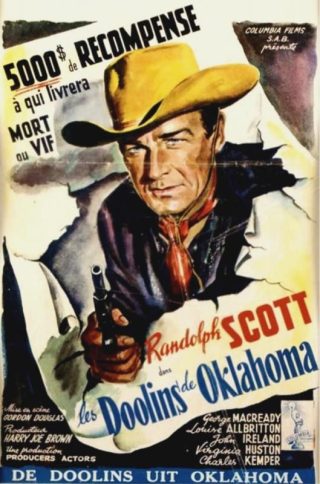
Movies inspired by real life historical people and events can sometimes come in for a bit of stick. It’s common enough to read reviews and see complaints that things didn’t happen as portrayed on the screen. Personally, I have no objection to people pointing out the inaccuracies in such cases, indeed I’ve done so myself on occasion, but I never feel a movie should be judged or criticized too heavily on that score. Ultimately, history is fact and film is art; if the former is a priority, then I feel a well researched history book should be sought out. While I do think film can stimulate an interest in history, and encourage people to dig into the real facts, it fulfills an altogether different function. A movie needs to be evaluated on its own merits, as an artistic endeavor, and granted the license which comes with that. All this is by way of introducing The Doolins of Oklahoma (1949), which uses a set of authentic historical characters, and some events from their lives, to tell a classic western tale. Sure it departs from what is known to have happened but, for me anyway, this doesn’t detract from the quality of the film in the least.

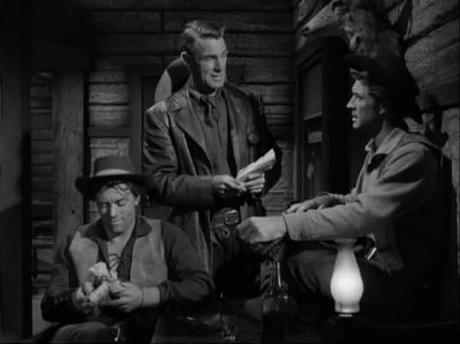
Our story concerns what was known as The Wild Bunch (no, nothing to do with the Peckinpah movie) who raided banks and trains mainly in Kansas and Oklahoma. It all starts with the botched bank robbery in Coffeyville that saw the Dalton gang wiped out, or almost. Bill Doolin (Randolph Scott) was a member of the gang whose horse came up lame, meaning he had to hang back. Having avoided the massacre of his fellow outlaws, Doolin nevertheless gets involved in a shooting that necessitates going on the run. Putting together his own crew, he proceeds to carry on where the ill-fated Daltons left off. However, as the prologue has already stated, this is the last decade of the 19th century and the frontier is closing fast, civilization and the law are spreading and men like Doolin are being squeezed out. Essentially, Doolin and his confederates are men living on borrowed time and they know it – most of the film involves pursuit, and relentless pursuit at that. The posse led by US Marshal Sam Hughes (George Macready) never lets up once they get a handle on Doolin. However, a western of this period has to be about more than mere hold-ups and shootouts, although there are plenty of those on view. Doolin is one of those classic gunmen yearning to leave his violent and lawless past behind him. For a brief period it even looks like he might have managed it too; an attempt to shake off the marshals leads him to a church in the middle of a service and that in turn introduces him to Elaine Burton (Virginia Huston), whom he weds. Doolin adopts a new identity and settles down, but it’s not to be. His old friends turn up and somewhat cruelly expose him to the in-laws, leaving him with little choice but to strap on his guns again and return to banditry. It’s that old familiar theme of the bad man trying to outrun his past and redeem himself. There are no happy Hollywood endings in this movie but, in a sense, he does achieve his goal. Perhaps it’s appropriate for an outlaw like Bill Doolin that he finally gains his desired redemption in an oblique, left-handed fashion.

Gordon Douglas is a director who I think it’s fair to say has a few fans among regular readers of this blog. I’m quite fond of his work myself and the more I see of it, the more I like it. As was usual with the studio professionals of the era, Douglas made movies in each of the major genres and did notable work in all of them. There’s a tendency to downgrade the efforts of many of these directors by dismissively labeling them journeymen. I find that as one looks deeper into the filmography of a man such as Douglas it becomes apparent how well crafted his films were. There are a number of highly accomplished pictures to be found, containing memorable scenes and moments of great sensitivity. The Doolins of Oklahoma features a number of what I’d term “instances of realization”, points at which the characters become aware of the full import of their actions. Lesser filmmakers can either downplay or over-egg such key moments, thus robbing them of their impact on the viewer. Two scenes spring to mind in this film, where Douglas hits just the right note and leaves us in no doubt regarding their significance: there’s the aftermath of the Coffeyville massacre where Doolin guns down the traitor who betrayed his friends and so seals his own fate in the eyes of the law, and later there’s his reluctant acceptance of the need to leave his new bride despite everything inside him wanting to do just the opposite. Those scenes are not overplayed in any way, nor are they brushed aside. The characters on the screen know how important they are, we know how important they are, and we know it because the director wanted it that way.

Aside from Douglas, there were other influential figures at work behind the camera. Yakima Canutt is noted for his stunt and second unit work on a range of pictures during the classic era – John Ford’s Stagecoach being one of the best known – and his hand is in evidence here. The action scenes have the kind of drive, authenticity and heart-stopping quality often associated with the man. In particular, the climactic stampede bears all the hallmarks of Canutt. And then there’s the cinematography of Charles Lawton, a man capable of capturing beautiful images in both black and white and color. The Doolins of Oklahoma makes excellent use of those Lone Pine locations which are a familiar sight to western fans, and the interior scenes are also expressively and atmospherically lit by this experienced and talented cameraman.

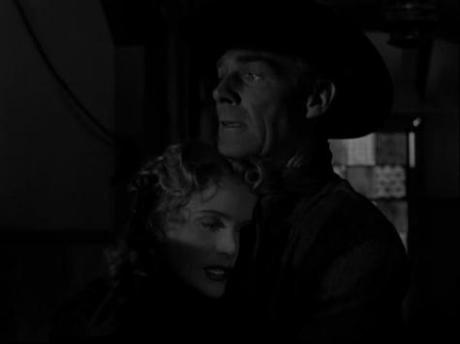
Randolph Scott’s decision to focus almost exclusively on westerns in the post-WWII years was not only a smart career move on his part, but also benefited the genre enormously. Most leading men of the time were capable of playing western characters, and indeed a significant number of them did so. Having said that, Scott was what I’d call the perfect fit for the genre – his slow Southern delivery and lean, leathery looks simply belonged in the west. More important than that though was the personality of the man, which shone through in all his roles, embodying three key ingredients: dignity, decency and resignation. These characteristics meant he was in a position to play the kind of complex figures who made the post-war western such an interesting and rewarding viewing experience. Scott’s heroes were nearly always three-dimensional because the man playing them invested them with that quality. And his anti-heroes, as is the case in The Doolins of Oklahoma, were all the more credible as a result of the subtle little quirks he brought to them. Two scenes in this movie stood out for me as marvelous examples of Scott at his best. The first occurs when Doolin returns to the home he once reluctantly abandoned, in the hopes of laying up there for a time. On arrival, he’s immediately struck by how well-kept the place is, and then the truth hits home – his wife had never left despite his absence. There’s something remarkably poignant about the way this flash of understanding affects him, and the way his innate integrity colors his reaction. The second comes right at the end, as Doolin and Elaine are reunited in the little church where they first met. This is a moment of destiny, a make-or-break point for the character. Scott’s playing is faultless; as he stands in the dark with the woman he loves in his arms, the regret and sadness wash over his features with the knowledge that there’s only one honorable course of action open to him.

Stoicism is a word often used in relation to Scott, and it could be applied here too. However, it’s the term I’d more readily employ to describe Virginia Huston’s portrayal of Doolin’s wife. Hers was a brief film career, but she was presented with a fine opportunity to shine in this movie. It’s a pivotal role in a sense, not flashy or showy, but one on which much of the script’s logic hangs. It called for a woman whose faith in and loyalty to her husband is sufficiently strong to force a character like Doolin to reassess himself. I think Huston nailed those aspects and thus rendered the relationship with Scott wholly believable. The supporting cast is particularly strong and features parts for George Macready, John Ireland, Jock Mahoney (who apparently also doubled for Scott in the fight scenes), Louise Allbritton, Noah Beery Jr, Frank Fenton and Charles Kemper among others.

The Doolins of Oklahoma was a film I’d never seen until it came out via a TCM/Sony collection of Randolph Scott westerns – a set which now looks like it may be out of print actually. The movie looks very well with no significant damage on show, and good contrast levels leave the black and white photography appearing nice and crisp. The extra features offered consist of a series of galleries highlighting the posters, lobby cards, still and publicity photographs. Anyone who is a fan of Randolph Scott, or just westerns in general, will surely take something positive away from this film. I was highly impressed both by Scott’s lead performance and by the smooth direction of Gordon Douglas. The film shows the progression taking place in the star’s work that would lead inevitably to those towering roles in the late 50s and the beginning of the 60s. It also provides evidence of the growing maturity of the genre itself on the eve of its golden decade. Recommended.

This piece is offered as part of the Randolph Scott Blogathon hosted by Toby of the ever entertaining and informative 50 Westerns from the 50s. I strongly urge all readers should head over there and check out the other contributions to this celebration of Scott’s work by following the link above. Alternatively, you can click on the badge below and that will lead you to the same destination.

The Crooked Way

Confusion and disorientation, a world suddenly tipped out of kilter, false and mistaken identities – such phenomena are par for the course in the film noir universe. Taken individually, these elements crop up in countless ordinary thrillers, but mix them all together in an urban setting with a story of organized crime and it moves into noir territory. The late 40s saw the full flowering of this type of cinema, when the initial optimism of the post-war years was just fading enough to allow disillusionment to take a firmer hold. The Crooked Way (1949) is one of those low budget efforts that is easily overlooked – the stars and director are people only familiar to hardcore movie fans, although the cinematographer, quite rightfully, still draws huge critical praise. What’s more this film often gets overshadowed by a glossier, more expensive production with a strikingly similar theme. I reckon it’s a touch unfair as there are plenty of positive ingredients; it’s by no means a perfect movie, but it does deserve a bit more credit and attention than it’s normally afforded.

Eddie Rice (John Payne) is on the point of being discharged from an army hospital in San Francisco. He’s seen sitting in a doctor’s office while questions are fired at him, questions like where he came from and what he did. Well, Eddie doesn’t have any answers for the simple reason that he has no memory. There’s a piece of shrapnel lodged in his brain, in an inoperable spot, and as a result he’s suffering from amnesia. All that’s known is that he joined up in Los Angeles using the name of Eddie Rice. The doctor’s advice is to go back to LA, see and be seen, and maybe someone will remember him, give him some lead about his vanished past. So that’s exactly what he does, and no sooner has he stepped out of Union Station than he runs slap bang into two guys who seem to know him very well indeed. These are two cops (Rhys Williams & John Doucette) and neither one is thrilled to run into him. This is vaguely unsettling for Eddie but a greater shock awaits him at the station house when he learns that his real name is actually Riccardi, and he’s got a rap sheet as long as his arm. Lots of films noir feature regular guys stumbling into trouble and desperately trying to escape it, but in this case that’s not possible; whatever else a man can do, he can’t run away from himself. The temptation is there alright and Eddie weighs it up yet there’s that fundamental philosophical desire to know oneself as well as one can. No, he’s going to have to stay, to discover what kind of man he was and why he did the things he did. To do so, he must reacquaint himself with the woman he once loved (Ellen Drew) and the partner (Sonny Tufts) he crossed up and sent to prison. Trying to trace back through the blank pages of his own past is a big enough ask in itself, but Eddie’s quest for his own identity becomes even harder when he finds himself beaten, framed for murder and running from both the mob and the law.

In 1946 Joseph L Mankiewicz made Somewhere in the Night, telling the story of a veteran with amnesia returning to LA to trace his background and unearthing some disconcerting facts. It was produced at Fox and exhibits all the gloss that studio could afford to give its movies. The basic premise is quite similar to that of The Crooked Way and I imagine more people have seen or heard of it – that loaded, evocative title can’t hurt any either. It’s a fairly good picture on its own terms, but if you put these two amnesia films up against each other, then I’d have to plump for The Crooked Way every time. This is partly down to the grittiness which goes hand in hand with a lower budget, and also the strong reliance on authentic LA locations. On top of that, there were two men behind the camera whose presence is a significant part of why the film works for me: Robert Florey and John Alton. I guess few will know the name of Florey nowadays – he was one of those émigré directors who came to Hollywood in the early thirties and worked mostly on B pictures before moving into television, where his credits are extensive. The thing about Florey is he had a background in expressionism and consequently his work has a strong visual sense that’s ideal for capturing mood and atmosphere. In addition to this film, I strongly recommend checking out his direction of Perchance to Dream from The Twilight Zone, one of the finest episodes of that excellent series. John Alton should, of course, need no introduction. A true artist, Alton’s deep black shadows and imaginative lighting are a joy. Any film he worked on bore his unmistakable stamp, and The Crooked Way is no exception.

This is quite a pivotal film in the career of John Payne. George Sherman’s Larceny had got him into crime pictures and The Crooked Way builds upon that. Payne was a good fit for noir in that there was a toughness about him but also a lived-in, kicked around look which such movies required. His role was a demanding one, calling for innocence, bewilderment and a bit of an edge too. The character of Eddie is complex due to the fact he starts out as someone trying his best to be decent yet also lacking assurance. He is, by necessity, a man aware of nothing beyond the here and now but he’s also keen to know how he got to that place, what path in life led him there. When the revelations come, Eddie is shocked and confused since it doesn’t square with the way he feels about himself. Payne is fine at getting across the nervy uncertainty of the character, the flashes of aggression which are buried deep within. The movie was a good stepping stone for him, laying the foundations for strong performances in later noir vehicles like 99 River Street and Kansas City Confidential. Ellen Drew, in the films I’ve seen, often appeared to be handed passive roles. The Crooked Way gave her more to do though by casting her as a woman who’s had a hard enough time and thus encourages a more gutsy performance, even stopping a bullet meant for Payne at one point. As the principal villain, Sonny Tufts is suitably mean, his introduction during the interrogation of a mob informer setting the tone for what follows. In support, there’s good work from Rhys Williams, John Doucette and Percy Helton.

The Crooked Way was released on DVD in the US by Geneon a long time ago now. It’s not a bad transfer, a bit harsh looking in places maybe, but it’s also interlaced. Some of the other titles from that imprint have subsequently appeared or been announced from Olive and Kino, so I’d like to hope a stronger version would hit the market sooner or later – and I’ve just noted that it appears Kino do indeed have plans for this title in the summer. The movie isn’t without its faults of course – there’s a heavy reliance on coincidence on a number of occasions (but, in all honesty, that could be said of a lot of noir pictures) and the ending is just a little too pat. Still, I don’t see these as major flaws of the type to ruin the viewing experience. Overall, this is a good solid noir, based on an interesting premise, beautifully composed and shot, oozing the requisite hard-boiled feel. It’s the kind of half-forgotten film I always like to tell people about, if they have the time or patience to listen to me. I say give it a try, it might surprise you.

One-Eyed Jacks

poster42_zps79a84e63

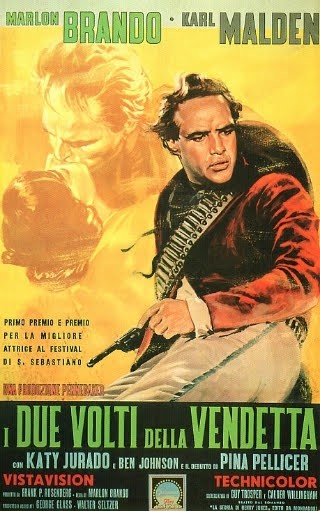
Some films can be extraordinarily difficult to write about; they may be overly complex or annoyingly abstract, their essence forever dancing tantalizingly beyond your grasp. Alternatively, there may be other factors involved, some quality which draws and fascinates you, making them easy to admire yet hard to truly love. That’s the position I find myself in when it comes to One-Eyed Jacks (1961), Brando’s one and only shot at directing. The visuals and theme appeal to me, and certain passages are beautifully realized. Still, when I look at it overall, I could never include it as one of my favorites.

The story (based on the novel The Authentic Death of Hendry Jones) is very loosely based on Billy the Kid. It concerns two men – Rio (Marlon Brando) and Dad Longworth (Karl Malden) – bank robbers plying their trade in Sonora in Mexico. Running from the army and carrying the proceeds of their latest hold-up, Longworth sets off to find fresh mounts for both of them. However, his inherent greed gets the better of him and he leaves Rio stranded. Leaping forward five years, we see the younger man breaking out of his Mexican prison. And he has but one thought in mind, revenge. His search eventually takes him across the border to Monterey, where Longworth has built a respectable new life for himself. The former outlaw has gained a wife and stepdaughter (Katy Jurado and Pina Pellicer respectively) and got himself elected sheriff. As the title suggests, both men only reveal a little of themselves to those around them. In Longworth’s case his law-breaking past is common knowledge, but his fear and sadism are carefully concealed beneath a veneer of bluff amiability. Rio too is adept at playing his cards close to his chest, and lulls his old partner into thinking that he bears no grudges. For all that, the animosity on side and distrust on the other cannot remain buried for long. The catalyst comes in the form of Longworth’s stepdaughter, and the passion she arouses in Rio. While his initial seduction of her seems primarily motivated by a desire to strike at Longworth’s cozy domestic set-up, it’s clear enough that his true feelings run deeper. Either way, it sets in motion a series of events that will inevitably lead to a violent and final confrontation between the two adversaries.

The film’s path to the cinema screen was a long and complicated one – Sam Peckinpah worked on the first draft of the script before being removed, and Stanley Kubrick was down to direct it until he too was replaced. So it fell to Brando, and his fingerprints are all over what we now have. Intensity is a word that’s frequently bandied around when this man’s name is spoken, and One-Eyed Jacks has some of that, a sort of relentless quality in its storytelling. But, and this is part of the issue I have with the film, there’s a labored feel about parts of it too. It’s said that Brando had accumulated over five hours of footage when he finished shooting, and the form we have today is still fairly lengthy. Charles Lang was the cinematographer and there’s no question of the beauty of some of the images – the Mexican and Californian locations look simply breathtaking at times. Still, Brando allows it to drift too much for my taste. The long period of recovery at the coast, after Longworth humiliates Rio and mutilates his gun hand, feels drawn out. Sure it allows time for the character of Rio to adjust to new circumstances and offers him the opportunity to reevaluate his plans, but it also slows the pace.

I’m going to be honest here and admit that, for one reason or another, Brando is an actor I’ve never warmed to. I guess a lot of it comes down to the fact that method acting often presents me with a problem. There is, by definition, something studied about it, a lack of spontaneity perhaps. All the preparation and internal reflection seems, to me at least, to steal a little of the honesty from a performance, especially where emotions are involved. There can be no question about Brando’s screen presence, and there are times when he is powerfully effective – he absolutely nails the simmering rage and indignation, and the scene on the veranda as he shares a tequila with Malden, and they smoothly tell each other lies, is played to perfection. Yet it’s the moments of truth which ring slightly hollow for me; Rio’s admission of deceit as he reclines on the beach with Louisa, and his later reaction to the news that he’s to become a father. These are key character moments, scenes where genuine, heartfelt honesty is required, and I’m not sure it’s achieved.

Malden, on the other hand, comes away better. This may be partly down to his role being more complex; he’s clearly a villain, and a deeply unpleasant one at that, but there are all kinds of undercurrents. Dad Longworth is a master of deception – a professional in the art in comparison to Rio’s half-hearted hoodwinking of gullible women – a pompous, jealous sadist masking his rotten core with a facade of bonhomie. And underpinning all that is his fear and cowardice. Malden conveys all of this quite effortlessly and by the end of the movie you feel that you know something of the real man. Of the supporting cast, three figures stand out – Katy Jurado, Slim Pickens (Peckinpah would use these two in one of the most heartrendingly beautiful scenes a decade later in the flawed yet magnificent Pat Garrett and Billy the Kid) and Ben Johnson. Jurado was blessed with a pair of the most soulful and expressive eyes you could hope to find, and she was able to evoke pride, dignity, pain and any emotion called for with consummate ease. He role as Malden’s wife afforded the opportunity to do just that and she seized it. Pickens always had that unpolished air about him that was ideal for down to earth types but could be equally effective, as is the case in this film, in portraying vaguely sinister yokels. And of course Johnson (like Pickens) was a natural cowboy who never gave a bad performance. Flitting in and out of the picture, all too briefly in most cases, are such notable character actors as Elisha Cook Jr, John Dierkes, Ray Teal and Timothy Carey.

One-Eyed Jacks has long been a staple of the cheap public domain DVD, and there have been some extremely ropey presentations over the years. I’m not sure if there’s been what you might call a definitive edition released yet but some are clearly superior to others. I have the Spanish DVD released a few years back by Sony/Impulso and it’s not bad in my opinion. The film is presented 1.85:1 anamorphic and looks pretty good. I’ve seen other widescreen editions (mostly derived from the old Laserdisc transfer, I think) where the colors were washed out and weak. My Spanish disc is acceptably sharp and the colors generally look richer. Released in the 60s but with more than a little 50s flavor about it, not least in the redemptive curve undertaken by Brando’s character, One-Eyed Jacks is something of an enigmatic movie. I’ve never been able to fully make my mind up about it, and that hasn’t changed. Love it, loathe it, or anything in between, western fans owe it to themselves to check it out and see if they can decide.


2014 in review

Thanks to all who visited and commented – let’s all hope for good things in 2015!

The WordPress.com stats helper monkeys prepared a 2014 annual report for this blog.

Here’s an excerpt:

The concert hall at the Sydney Opera House holds 2,700 people. This blog was viewed about 46,000 times in 2014. If it were a concert at Sydney Opera House, it would take about 17 sold-out performances for that many people to see it.

Click here to see the complete report.

Day of the Outlaw

I like westerns, I like movies which could be described as chamber pieces, and I like snowy backdrops. Day of the Outlaw (1959), directed by Andre de Toth, checks all these boxes. It’s one of those films genre fans will enthuse about yet remains criminally underrated by others. It’s also a film where there’s not a huge amount of action; there is, however, a kind of relentless tension and a whole lot going on just below the surface. In short, the film is a sleeper, a tight and atmospheric classic just waiting to be discovered.

I think one of the most enjoyable aspects of watching movies is to be found in the deceptively simple story, those tales which initially appear to be straightforward or predictable yet gradually develop into something much more complex and satisfying. Day of the Outlaw is a fine example of a work where layers of depth emerge bit by bit and draw you in before you’ve realized it. It opens in a wintry Wyoming town as two men, Blaise Starrett (Robert Ryan) and his foreman Dan (Nehemiah Persoff), ride in and bemoan the stringing of barbed wire and the consequent threat to the open range. Starrett’s blood is up and he vows a showdown with the homesteader responsible. The scene therefore is set for the kind of range war drama that’s been seen countless times. But this is a mere introduction, an opportunity to draw attention to the implacable and tough character of the lead. When it then becomes apparent that Starrett is in love with and covets the beautiful wife (Tine Louise) of his chief rival, the plot moves to another level. And still we’re only dancing around the periphery, for what really matters here is the journey – both literal and figurative – which Starrett (among others) will be forced to embark upon. In a deft piece of filmmaking sleight of hand the entire emphasis is moved away from that which the build-up has led us to expect. Just as we’re about to witness the duel between Starrett and his foe a bunch of newcomers arrive and take us off in a completely different direction. Jack Bruhn (Burl Ives) is a Quantrill-like figure, a soldier with a tarnished reputation now reduced to leading a band of amoral cutthroats. Bruhn and his men are loaded down with stolen gold, but he’s got a bullet lodged inside him and the army hot on his heels. The enforced stopover in the snowbound town represents a trial of sorts for the bewildered and helpless residents, but it also holds out a kind of hope for two lost souls – Starrett and Bruhn. Both men find themselves in opposition and through that also find a way to regain a little of the humanity that years of hard living have almost stripped away.

Redemption once again; Starrett and Bruhn have lost something along the way, their hearts have been hardened by the brutality of frontier life, and their salvation will be a by-product of their enmity. As far as I’m concerned, this is what drives the film along and gives it its power. I feel all the other plot devices are simply that, accoutrements put in place to facilitate the drama that forms the heart of the story. It’s the chance meeting of Bruhn and Starrett, at a key moment for both, which gives them pause and either forces or allows them (take your pick here) to alter the course of their respective destinies. The two characters wield a significant degree of influence over those around them and this is what first draws them into an uneasy mutual alliance. However, I believe that the real, if initially unacknowledged, motive comes from the fact that each recognizes something of himself in the other. The effect appears more profound in the case of Starrett, but it’s surely present in Bruhn too, and throws out a spiritual lifeline of sorts.

Day of the Outlaw is surely Andre de Toth’s best film, a well-paced exercise in mounting and sustained tension, aided by Philip Yordan’s adaptation of Lee E Wells’ novel. By having so much of the action confined to the saloon the sense of isolation, claustrophobia and suspense is multiplied. The impromptu dance, hastily organized to placate Bruhn’s increasingly restless men, perfectly conveys the threat and menace posed by the gang. Even when events later take us out into the wilderness of the snow-choked mountain pass that feeling of being locked into an inescapable situation is actually heightened rather than dissipated. A good deal of credit also has to go to cinematographer Russell Harlan here; his shooting of the frozen and forbidding landscape is chilling in every way. When you add in Alexander Courage’s spare, doom-laden score all the ingredients are in place for a memorable interlude in the icy wastes.

The cast is both deep and distinguished (Persoff, Elisha Cook Jr, Jack Lambert, Lance Fuller, Frank DeKova, Dabbs Greer, Alan Marshal et al) but Ryan and Ives easily dominate proceedings. Ives in particular holds the attention whenever he’s on screen, which is entirely fitting as he’s playing a man who’s holding a gang of dangerous roughnecks in check principally through sheer force of personality. The dance segment which I referred to above is a good illustration of this, the frayed dignity of the man shining through and setting him apart from a shabby command which is beneath him in every respect. Ives also gets right into the physical and psychological guts of his character, from the harrowing operation he endures without anesthetic to the slow dawning of his impending and inevitable demise. Overall, it’s a first-rate portrayal of a complex man, and one which is wholly believable. Just as the characters feed off one another, I think the same can be said the performances of the leads. Ryan was never a slouch as an actor anyway and his playing opposite Ives ensured he stayed on top of his game. He starts out as bitter, cold and unforgiving as the country around him, delivering a blistering and scathing verbal attack on his homesteader rival. He holds onto that steely determination throughout, but slowly lets the sharp edges soften a little as he becomes aware of the path he’s been taking and where it must surely lead.

Day of the Outlaw is fairly widely available on DVD now. I have the US release from MGM which presents the film quite nicely in its correct widescreen ratio. However, the film comes with absolutely no extra features, and I reckon it’s more than deserving of some. One of the reasons I started this blog was to have the chance to chat about the movies I love with those who share my passion. Over time though, I’ve also come to realize that I was partly motivated by a wish to see a bit more critical respect afforded to certain films and genres. The western in particular has tended to be passed over as nothing more than time-passing entertainment. Now there’s nothing wrong with entertainment for its own sake, a movie which doesn’t do so is failing straight out of the gate after all. Still, the underestimation of the western as an art form and as a vehicle for the intelligent examination of adult themes has persisted. A film like Day of the Outlaw highlights this critical neglect. I’d like to think that appreciation of the film has grown somewhat over time though, and I’d encourage anyone keen on polished and smart filmmaking to seek it out.

The Shooting & Ride in the Whirlwind

734_735_bd_box_348x490_original_zpscfd24e78

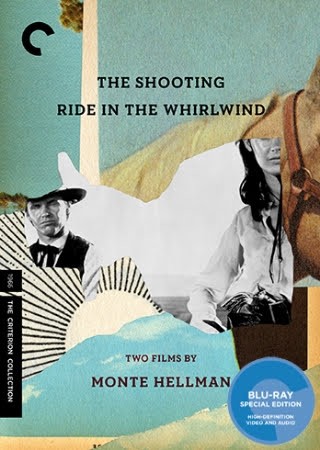
Films naturally reflect the times in which they are made, there’s no getting away from that. As an art form they of course focus on certain themes, frequently timeless ones at that, but there’s no divorcing the artistic ambition from the current circumstances. The western is particularly interesting in this respect as it uses a historical setting and period tropes to comment on a current situation. The Shooting and Ride in the Whirlwind, made back to back in 1966 by Monte Hellman, are a good illustration of this. Here are two films which could not have been made at another time; the mood and aesthetic are firmly rooted in the mid-60s, and in cinematic terms they look back to the classic era of the genre while also pressing forward and moving it in another direction. I see them as slotting in at the end of the genre’s transitional period, making them fascinating both historically and as an absorbing film experience in their own right.

The Shooting is as minimalist as they come with attention centered on just four people – Gashade (Warren Oates), Coley (Will Hutchins), Billy Spear (Jack Nicholson) and an unnamed woman (Millie Perkins). What’s more, precious little is revealed about the backgrounds of any of these characters; Gashade is referred to as having worked as a bounty hunter at one point, but that’s about it. Anyway, it matches perfectly the abrupt sparseness of the tale and the filmmaking style. As viewers we seem to arrive somewhere in the middle of the story, the events leading up to it being explained through a brisk flashback and the ongoing development of the narrative. In brief, the woman turns up and hires Gashade and Coley to lead her through the wilderness, without divulging exactly why she wants to travel or why she wants these men to accompany her. It gradually becomes clear that the events depicted in the flashback have a significant bearing on the woman’s motives, and then there’s the mysterious figure who follows all the way from a discreet distance. If anything, the lack of information and the way subtle hints are dropped as we go along cranks up the suspense. The film is virtually the antithesis of many current productions, where exposition seems to rule and everything has to be slavishly spelled out to audiences. By the time the startling conclusion rolls round almost as many questions have been raised as have been answered, yet the viewer is always treated as an intelligent adult capable of reading things in his or her own way.

Ride in the Whirlwind uses a more conventional narrative structure, and a slightly expanded cast, but it’s another pared down and deceptively simple piece of cinema. Once again no time is wasted in getting to the heart of the matter – a botched stagecoach robbery opens the movie in dramatic fashion and sets up the unfortunate circumstances into which three men will blindly stumble. Vern (Cameron Mitchell), Wes (Jack Nicholson) and Otis (Tom Filer) are cowhands heading back to Texas who unwittingly come upon the outlaw’s hideout. Sensing something amiss, they plan to ride on the following morning but everything goes awry when a trigger-happy posse shows up. As is the case in The Shooting, events overtake the men and force them into a situation where they have little control of their fate. In a sense this film offers a reversal of perspective; where The Shooting follows the action from the hunters’ point of view, Ride in the Whirlwind lets us see it all develop from the side of the hunted. There’s suspense too, but of a different kind – there’s no particular mystery to unravel and the motivation of all concerned is much more clear-cut and easily defined – as a tense struggle for survival ensues.

Aside from the common contributors – Hellman, Nicholson, Perkins and cinematographer Gregory Sandor in particular – both films are fatalistic, existentialist pursuit dramas. The characters are abruptly and without warning pitched into violent and desperate situations which they are powerless to avoid yet are also committed to seeing them through to the bitter end. There’s an authenticity there too in the spare, clipped dialogue. And then there are the Utah locations: barren, harsh and dusty, a remote and hostile environment where the human tragedies are played out and the land itself poses a physical challenge. So much of the imagery captured by Hellman and Sandor harks back to the classic westerns of the previous decade while the editing and oblique storytelling style is very much a product of the turbulent mid-60s, in fact it’s arguably ahead of its time. Anyone familiar with westerns will find countless nods to the films that went before and laid the groundwork – the dogged pursuit of the wrong men (The Ox-Bow Incident & The Bravados), the deliberate crippling of a gunfighter’s hand (The Man from Laramie, No Name on the Bullet, One-Eyed Jacks), the burning of the shack to flush out the occupants (Red Sundown), the sudden revelation of the hunter and his quarry’s identities (Winchester ’73) and so on. These are motifs that would crop up again in the future of course, attesting to the influential character of the films.

However, there are other factors which mark these productions out as being of their own era, and as forward-looking works too. For me anyway, a clear shift in tone has taken place. The late 40s and on into the 50s saw the world faced with its fair share of difficulty and uncertainty. Still, the aftermath of the Kennedy assassination and the massive social and cultural changes that were becoming apparent in the mid-1960s represented something totally different. Old certainties were being swept aside and consigned to a past that suddenly seemed very distant. Something new and, as is always the case when abrupt change occurs, vaguely unsettling was on its way; Hellman’s pair of westerns are a cinematic reflection of that sense of bewilderment and confusion.

And then there’s the matter of redemption, the mainstay of the genre throughout its golden years but something which would become increasingly rare with the passage of time. Gashade in The Shooting could be said to be on a redemptive quest, essentially chasing himself, or at least the darker side of himself, and perhaps achieving his goal in the end. I find it difficult to see how anyone else in that movie could be perceived in such terms though, and it just doesn’t apply at all in Ride in the Whirlwind. Therefore the altered emphasis in the western is more readily apparent in Hellman’s movies than was the case in other, earlier transitional works. The predominant feeling one comes away with, which is in marked contrast to what was to be found in the genre only a few years before, is ambiguity. While the true villains are easily identified, there’s a blurring or lack of definition when it comes to the heroes. Gashade’s inaction (albeit reluctant) effectively seals Coley’s fate and his subsequent assault on Spear could be seen as sentencing a man like that to certain death rather than genuinely sparing him. Similarly, when Vern and Wes break away from the homestead in Ride in the Whirlwind they cross a line ethically. The westerns that would follow, and not just the more nihilistic spaghetti variant, mostly saw the replacement of the hero with the anti-hero; a figure whom the audience could be asked to identify with but rarely admire, a figure whose moral plane was frequently only a degree or two above that of the villains.

Frankly, these films always looked a little rough any time I’d seen them in the past on any home video format. I’m delighted to say though that the new release by Criterion, available on both DVD and Blu-ray, sees them looking exceptionally fine. Both titles have undergone 4K restorations with the blessing of the director and the results are very pleasing. There’s plenty of detail in the image and the colors are rich and natural, really showing off the starkly beautiful Utah locations. As usual with Criterion releases there’s a wealth of solid extra features offered: the booklet has an essay by Michael Atkinson, and the disc has interviews with various members of the cast and crew. Kim Morgan provides a video essay on Warren Oates, and there’s a conversation between Will Hutchins and Jake Perlin. On top of all that, both movies have commentary tracks with Monte Hellman, Blake Lucas and Bill Krohn, which are relaxed, entertaining and informative. Overall, it’s an excellent package with the two films looking better than I’ve ever seen them.

These are two fine westerns, entertaining, thoughtful, and made by a man who understood the genre. Furthermore, they’re important movies in the evolution of the western, adding another link to the chain which runs from the silent era right up to the present day. I suppose Ride in the Whirlwind would be the more accessible of the two for viewers unfamiliar with Hellman’s work, but both really are essential viewing for anyone with a taste for intelligent and original filmmaking. I highly recommend them.


My thanks to the people at The Criterion Collection for making this review possible.

Underrated Thrillers

Earlier this year I contributed a list of underrated westerns to Brian’s site Rupert Pupkin Speaks. It was kind of fun thinking about and compiling those titles and I’m pleased to have had the opportunity to submit another selection. This time it’s underrated thrillers – I’ve written about all of them at one time or another on this blog, some of them a good few years ago now, but you’ll need to pop over to Brian’s place here to see which ones I settled on. Please have a look when you get the chance.

Another Anniversary

It’s exactly seven years ago today that I put up my first post on the now defunct FilmJournal site. Although my output at this place has slowed to something of a trickle of late, I didn’t want to let the occasion pass without a mention. I hope to get back to writing a bit more regularly as soon as possible, time permitting of course. Anyway, in the meantime, let me just say thank you to all the visitors and movie-lovers who have helped keep this site going – there’s been some vibrant and informative chat over the years, and that’s what really forms the heart of the place.

Shane

poster36_zps443243c4

There’s no living with a killing. There’s no going back from one. Right or wrong, it’s a brand… a brand sticks. There’s no going back…

It’s a little difficult to know what to say when it comes to a movie like Shane (1953); so much has been written about it over the years and its influence is wide-ranging. I think the western is a genre that lends itself particularly to studies of humanity, it’s less reliant on tricks and all the best examples have something of worth to say about how we treat and react to each other. Shane is a very human picture, a simple story with great depth and sensitivity. I guess it’s fair to categorize it as an archetypical 50s western. The theme of redemption runs right through it, forming its core; it celebrates community, family, love and, maybe most of all, the importance of and one’s need to feel a sense of belonging.

The plot is a fairly straightforward affair and I won’t spend a lot of time on it. The background lies in the dying days of the open range, a key stage in the transition of the frontier from a wild, lawless territory towards a more stable and civilized environment. Major social changes such as this inevitably involve a degree of pain for all involved. The ranchers who tamed the country bitterly resent what appears to be a curtailment of their hard won independence, while the homesteaders must weather both the elements and the hostility of the cattlemen. Into this atmosphere of intractable conflict rides a lone figure, Shane (Alan Ladd), who halts at one of the dirt farms. The owner is Joe Starrett (Van Heflin) who, along with his wife Marian (Jean Arthur) and young son Joey (Brandon De Wilde), is in the process of carving out a home and a future. Purely by chance, local rancher Rufus Ryker (Emile Meyer) isn’t far behind and this immediately raises Starrett’s suspicions. Still, he has no cause for concern on that score as Shane makes it plain he has no connection with Ryker and actually backs up Starrett. It so happens these two men have crossed paths at a fortuitous time for both: Starrett is short of help to work his property, but Shane’s need is arguably greater still. His manner and apparel mark him out as a gunfighter, one of those rootless drifters of frontier lore. Here’s a man who desperately desires to bury his past and perhaps dream of a future, but that requires he find a place where he’s wanted and where he feels he belongs. For Shane, the Starrett homestead is a kind of beacon, a chance to redeem himself and seek out some meaning or purpose in his life. Yet that redemption and purpose will have to be earned the hard way – battles must be fought, temptations overcome, and specters of the past slain and laid to rest once and for all.

£23

Shane is really all about relationships: between man and the land, the individual and society, the present and the past, and at the heart of it all is the Starrett family. This is one of the most wholesome and honest portrayals of family life I’ve seen and it’s not cutesy or fake. The Starretts represent trust, loyalty and devotion, in a credible way, in the face of hardship and adversity. As a viewer, it feels real and sincere, and it has to if that central dynamic which has the power to draw in a man like Shane is to be at all believable. What we have is one of those happy instances where the acting of Heflin, Arthur and de Wilde mesh perfectly with the writing of Jack Schaefer and the direction of George Stevens. All the interactions of the Starretts ring true, from the banal conversations about crockery round the table to the intense discussions on how best to confront the threat to their home. And hovering round the fringes is Shane, the man intimately acquainted with violence who has been beguiled by the allure of such simplicity.

Shane was a gift of a role for Alan Ladd, cementing his place in cinematic history. Ladd’s edgy discomfort was used to great effect in the films noir that first brought him to prominence, but the reluctant western hero was an even better fit. Ladd himself appears to have been a mass of contradictions and self-doubt, and that quality was ideal for his part here. Shane is an extremely self-aware character, aware of his skill with a gun and also fully cognizant of the deficiencies in his personal life. It’s a finely judged performance by Ladd, brimming with regret and yearning. The character of Shane is a man who knows he’s arrived at a crossroads; his past is never spoken of, only alluded to, and he realizes that an opportunity to make up for all his previous actions is within his grasp. He’s a natural outsider, detaching himself from the group given half a chance, yet always keen to be accepted into its ranks. His final decision to confront Ryker and save Starrett is simultaneously inspiring, fitting and heartbreaking. But it has to be – just like little Joey in that memorable finale, we want Shane to return and stay. Still we also understand that he must see things through if he’s to meet destiny head-on and achieve his redemption.

£24

George Stevens was one of those filmmakers who seems to have been deeply affected by his wartime experiences, his presence during the liberation of Dachau often being cited as a profound influence on his subsequent work. Be that as it may, his handling of violence in Shane is worth noting and I feel the quote I used at the top of this piece is of significance. I’ve discussed the depiction of violence in the classic era western on this site and elsewhere before, and Shane illustrates what I think is the dominant approach very well. The film isn’t a devil-may-care shoot-em-up, where killings are seen as little more than an entertaining afterthought. No, the shootings which take place have an impact on the viewer because the characters involved on the screen treat them seriously. Jack Palance may look, sound and act like the cold assassin with no hint of conscience, but the build up to and results of his actions are powerful. On the few occasions a gun is fired in the film the gravity of the consequences is never in question – the sound of the discharge alone is an assault on the senses. When Palance blasts Elisha Cook Jr into the muddy street there’s no flippancy, polish or Hollywood glamor on view – it’s brutal, ugly and shocking in its authenticity. And it doesn’t end there in the cold anonymity of the churned up earth, for the gut-wrenching business of bringing his body back to his loved ones for burial has to be seen to. Cynicism seems to be in fashion these days and I have no doubt there are those who may regard the shot of the dog mournfully pawing Cook’s coffin as it’s lowered into the earth as mawkish sentimentality. As far as I’m concerned though, it’s a supremely touching moment and perfectly encapsulates the grief of those gathered at the graveside. If the repercussions of a killing are hammered home, the effects of less serious violence aren’t swept aside either. The fist fight between Ladd and Ben Johnson is an example of this; there’s no music to be heard to distract us from the landing of blows, and the injuries are never disguised. In Shane, every act of aggression, whether major or minor, is shown to hurt someone.

I’ve deviated a little from my usual format in writing this piece. I could have gone into more detail regarding the plot and social/historical issues it raises, I could also have offered a deeper analysis of the contributions of the cast – Jean Arthur, Ben Johnson, Edgar Buchanan et al. I’m aware too that I’ve made no mention of Loyal Griggs’ superb photography of the Wyoming locations and the dim, smoky interiors, or of Victor Young’s careful scoring. None of that is a result of neglect or lack of appreciation on my part. No, I took a conscious decision to try to focus attention on a handful of those aspects, rather than attempt to draw in all of them, which I feel contribute to making Shane one of the enduring cinematic classics and a definitive 50s western. I hope I’ve managed to do so.


The Stranger’s View

Last weekend I went to the cinema to see a movie set in my homeland. I suppose it qualifies as a kind of period piece now, the action taking place over 40 years ago. ’71 is a thriller which unfolds amid the Troubles in Belfast in the titular year. Frankly, it impressed me a lot, and not only because it recreated the world in which I grew up, with its tight pacing and essentially simple storytelling. As I watched it, and then reflected on it afterwards, I was struck by how the film tapped into the mentality of the people, my people, and thus offered a very honest portrayal of the times and circumstances. The director of this movie is Yann Demange, a man of French birth. This had me thinking how some of my favorite films set in my country had been directed by those who were basically outsiders – Odd Man Out (Carol Reed) and The Gentle Gunman (Basil Dearden) – yet managed to get under the skin of the people on the screen and perhaps see us more clearly as we really are.

It occurred to me then that this isn’t some isolated phenomenon confined to films set in Ireland. Hollywood in its heyday was packed with émigré directors who shaped the popular culture of the era. Film noir is one of my own favorite styles and came to be a staple of American cinema in the golden age, yet the movement was largely dominated by those born far from its shores – Lang, Wilder, Siodmak (who grew up in Germany), Tourneur, Brahm, Ulmer and many others besides. Isn’t it a little odd that such men should wind up as the biggest movers and shakers in what was arguably a generic American film movement? The western, which is the genre closest to my heart, has fewer examples of course, but directors such as Lang, Tourneur, De Toth and Fregonese still made significant contributions to its development.

So, I guess that’s the question for the day: is it sometimes more beneficial for a filmmaker to come at their subject, or indeed genre, free of the inevitable baggage an insider brings along? Does distance in some way sharpen perspective and allow a clearer appreciation? I’m not sure  there’s a definitive answer but if anyone feels inclined to offer their thoughts, they are most welcome.