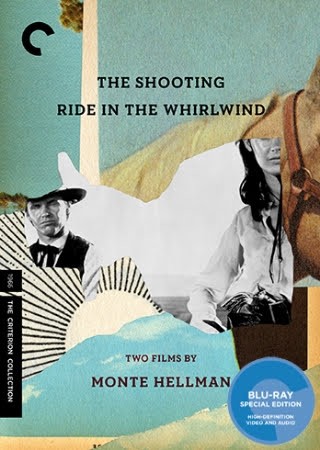
The Shooting & Ride in the Whirlwind

734_735_bd_box_348x490_original_zpscfd24e78

Films naturally reflect the times in which they are made, there’s no getting away from that. As an art form they of course focus on certain themes, frequently timeless ones at that, but there’s no divorcing the artistic ambition from the current circumstances. The western is particularly interesting in this respect as it uses a historical setting and period tropes to comment on a current situation. The Shooting and Ride in the Whirlwind, made back to back in 1966 by Monte Hellman, are a good illustration of this. Here are two films which could not have been made at another time; the mood and aesthetic are firmly rooted in the mid-60s, and in cinematic terms they look back to the classic era of the genre while also pressing forward and moving it in another direction. I see them as slotting in at the end of the genre’s transitional period, making them fascinating both historically and as an absorbing film experience in their own right.

The Shooting is as minimalist as they come with attention centered on just four people – Gashade (Warren Oates), Coley (Will Hutchins), Billy Spear (Jack Nicholson) and an unnamed woman (Millie Perkins). What’s more, precious little is revealed about the backgrounds of any of these characters; Gashade is referred to as having worked as a bounty hunter at one point, but that’s about it. Anyway, it matches perfectly the abrupt sparseness of the tale and the filmmaking style. As viewers we seem to arrive somewhere in the middle of the story, the events leading up to it being explained through a brisk flashback and the ongoing development of the narrative. In brief, the woman turns up and hires Gashade and Coley to lead her through the wilderness, without divulging exactly why she wants to travel or why she wants these men to accompany her. It gradually becomes clear that the events depicted in the flashback have a significant bearing on the woman’s motives, and then there’s the mysterious figure who follows all the way from a discreet distance. If anything, the lack of information and the way subtle hints are dropped as we go along cranks up the suspense. The film is virtually the antithesis of many current productions, where exposition seems to rule and everything has to be slavishly spelled out to audiences. By the time the startling conclusion rolls round almost as many questions have been raised as have been answered, yet the viewer is always treated as an intelligent adult capable of reading things in his or her own way.

Ride in the Whirlwind uses a more conventional narrative structure, and a slightly expanded cast, but it’s another pared down and deceptively simple piece of cinema. Once again no time is wasted in getting to the heart of the matter – a botched stagecoach robbery opens the movie in dramatic fashion and sets up the unfortunate circumstances into which three men will blindly stumble. Vern (Cameron Mitchell), Wes (Jack Nicholson) and Otis (Tom Filer) are cowhands heading back to Texas who unwittingly come upon the outlaw’s hideout. Sensing something amiss, they plan to ride on the following morning but everything goes awry when a trigger-happy posse shows up. As is the case in The Shooting, events overtake the men and force them into a situation where they have little control of their fate. In a sense this film offers a reversal of perspective; where The Shooting follows the action from the hunters’ point of view, Ride in the Whirlwind lets us see it all develop from the side of the hunted. There’s suspense too, but of a different kind – there’s no particular mystery to unravel and the motivation of all concerned is much more clear-cut and easily defined – as a tense struggle for survival ensues.

Aside from the common contributors – Hellman, Nicholson, Perkins and cinematographer Gregory Sandor in particular – both films are fatalistic, existentialist pursuit dramas. The characters are abruptly and without warning pitched into violent and desperate situations which they are powerless to avoid yet are also committed to seeing them through to the bitter end. There’s an authenticity there too in the spare, clipped dialogue. And then there are the Utah locations: barren, harsh and dusty, a remote and hostile environment where the human tragedies are played out and the land itself poses a physical challenge. So much of the imagery captured by Hellman and Sandor harks back to the classic westerns of the previous decade while the editing and oblique storytelling style is very much a product of the turbulent mid-60s, in fact it’s arguably ahead of its time. Anyone familiar with westerns will find countless nods to the films that went before and laid the groundwork – the dogged pursuit of the wrong men (The Ox-Bow Incident & The Bravados), the deliberate crippling of a gunfighter’s hand (The Man from Laramie, No Name on the Bullet, One-Eyed Jacks), the burning of the shack to flush out the occupants (Red Sundown), the sudden revelation of the hunter and his quarry’s identities (Winchester ’73) and so on. These are motifs that would crop up again in the future of course, attesting to the influential character of the films.

However, there are other factors which mark these productions out as being of their own era, and as forward-looking works too. For me anyway, a clear shift in tone has taken place. The late 40s and on into the 50s saw the world faced with its fair share of difficulty and uncertainty. Still, the aftermath of the Kennedy assassination and the massive social and cultural changes that were becoming apparent in the mid-1960s represented something totally different. Old certainties were being swept aside and consigned to a past that suddenly seemed very distant. Something new and, as is always the case when abrupt change occurs, vaguely unsettling was on its way; Hellman’s pair of westerns are a cinematic reflection of that sense of bewilderment and confusion.

And then there’s the matter of redemption, the mainstay of the genre throughout its golden years but something which would become increasingly rare with the passage of time. Gashade in The Shooting could be said to be on a redemptive quest, essentially chasing himself, or at least the darker side of himself, and perhaps achieving his goal in the end. I find it difficult to see how anyone else in that movie could be perceived in such terms though, and it just doesn’t apply at all in Ride in the Whirlwind. Therefore the altered emphasis in the western is more readily apparent in Hellman’s movies than was the case in other, earlier transitional works. The predominant feeling one comes away with, which is in marked contrast to what was to be found in the genre only a few years before, is ambiguity. While the true villains are easily identified, there’s a blurring or lack of definition when it comes to the heroes. Gashade’s inaction (albeit reluctant) effectively seals Coley’s fate and his subsequent assault on Spear could be seen as sentencing a man like that to certain death rather than genuinely sparing him. Similarly, when Vern and Wes break away from the homestead in Ride in the Whirlwind they cross a line ethically. The westerns that would follow, and not just the more nihilistic spaghetti variant, mostly saw the replacement of the hero with the anti-hero; a figure whom the audience could be asked to identify with but rarely admire, a figure whose moral plane was frequently only a degree or two above that of the villains.

Frankly, these films always looked a little rough any time I’d seen them in the past on any home video format. I’m delighted to say though that the new release by Criterion, available on both DVD and Blu-ray, sees them looking exceptionally fine. Both titles have undergone 4K restorations with the blessing of the director and the results are very pleasing. There’s plenty of detail in the image and the colors are rich and natural, really showing off the starkly beautiful Utah locations. As usual with Criterion releases there’s a wealth of solid extra features offered: the booklet has an essay by Michael Atkinson, and the disc has interviews with various members of the cast and crew. Kim Morgan provides a video essay on Warren Oates, and there’s a conversation between Will Hutchins and Jake Perlin. On top of all that, both movies have commentary tracks with Monte Hellman, Blake Lucas and Bill Krohn, which are relaxed, entertaining and informative. Overall, it’s an excellent package with the two films looking better than I’ve ever seen them.

These are two fine westerns, entertaining, thoughtful, and made by a man who understood the genre. Furthermore, they’re important movies in the evolution of the western, adding another link to the chain which runs from the silent era right up to the present day. I suppose Ride in the Whirlwind would be the more accessible of the two for viewers unfamiliar with Hellman’s work, but both really are essential viewing for anyone with a taste for intelligent and original filmmaking. I highly recommend them.


My thanks to the people at The Criterion Collection for making this review possible.

Underrated Thrillers

Earlier this year I contributed a list of underrated westerns to Brian’s site Rupert Pupkin Speaks. It was kind of fun thinking about and compiling those titles and I’m pleased to have had the opportunity to submit another selection. This time it’s underrated thrillers – I’ve written about all of them at one time or another on this blog, some of them a good few years ago now, but you’ll need to pop over to Brian’s place here to see which ones I settled on. Please have a look when you get the chance.

Another Anniversary

It’s exactly seven years ago today that I put up my first post on the now defunct FilmJournal site. Although my output at this place has slowed to something of a trickle of late, I didn’t want to let the occasion pass without a mention. I hope to get back to writing a bit more regularly as soon as possible, time permitting of course. Anyway, in the meantime, let me just say thank you to all the visitors and movie-lovers who have helped keep this site going – there’s been some vibrant and informative chat over the years, and that’s what really forms the heart of the place.

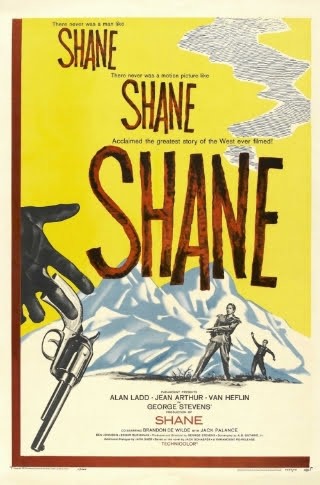
Shane

poster36_zps443243c4

There’s no living with a killing. There’s no going back from one. Right or wrong, it’s a brand… a brand sticks. There’s no going back…

It’s a little difficult to know what to say when it comes to a movie like Shane (1953); so much has been written about it over the years and its influence is wide-ranging. I think the western is a genre that lends itself particularly to studies of humanity, it’s less reliant on tricks and all the best examples have something of worth to say about how we treat and react to each other. Shane is a very human picture, a simple story with great depth and sensitivity. I guess it’s fair to categorize it as an archetypical 50s western. The theme of redemption runs right through it, forming its core; it celebrates community, family, love and, maybe most of all, the importance of and one’s need to feel a sense of belonging.

The plot is a fairly straightforward affair and I won’t spend a lot of time on it. The background lies in the dying days of the open range, a key stage in the transition of the frontier from a wild, lawless territory towards a more stable and civilized environment. Major social changes such as this inevitably involve a degree of pain for all involved. The ranchers who tamed the country bitterly resent what appears to be a curtailment of their hard won independence, while the homesteaders must weather both the elements and the hostility of the cattlemen. Into this atmosphere of intractable conflict rides a lone figure, Shane (Alan Ladd), who halts at one of the dirt farms. The owner is Joe Starrett (Van Heflin) who, along with his wife Marian (Jean Arthur) and young son Joey (Brandon De Wilde), is in the process of carving out a home and a future. Purely by chance, local rancher Rufus Ryker (Emile Meyer) isn’t far behind and this immediately raises Starrett’s suspicions. Still, he has no cause for concern on that score as Shane makes it plain he has no connection with Ryker and actually backs up Starrett. It so happens these two men have crossed paths at a fortuitous time for both: Starrett is short of help to work his property, but Shane’s need is arguably greater still. His manner and apparel mark him out as a gunfighter, one of those rootless drifters of frontier lore. Here’s a man who desperately desires to bury his past and perhaps dream of a future, but that requires he find a place where he’s wanted and where he feels he belongs. For Shane, the Starrett homestead is a kind of beacon, a chance to redeem himself and seek out some meaning or purpose in his life. Yet that redemption and purpose will have to be earned the hard way – battles must be fought, temptations overcome, and specters of the past slain and laid to rest once and for all.

£23

Shane is really all about relationships: between man and the land, the individual and society, the present and the past, and at the heart of it all is the Starrett family. This is one of the most wholesome and honest portrayals of family life I’ve seen and it’s not cutesy or fake. The Starretts represent trust, loyalty and devotion, in a credible way, in the face of hardship and adversity. As a viewer, it feels real and sincere, and it has to if that central dynamic which has the power to draw in a man like Shane is to be at all believable. What we have is one of those happy instances where the acting of Heflin, Arthur and de Wilde mesh perfectly with the writing of Jack Schaefer and the direction of George Stevens. All the interactions of the Starretts ring true, from the banal conversations about crockery round the table to the intense discussions on how best to confront the threat to their home. And hovering round the fringes is Shane, the man intimately acquainted with violence who has been beguiled by the allure of such simplicity.

Shane was a gift of a role for Alan Ladd, cementing his place in cinematic history. Ladd’s edgy discomfort was used to great effect in the films noir that first brought him to prominence, but the reluctant western hero was an even better fit. Ladd himself appears to have been a mass of contradictions and self-doubt, and that quality was ideal for his part here. Shane is an extremely self-aware character, aware of his skill with a gun and also fully cognizant of the deficiencies in his personal life. It’s a finely judged performance by Ladd, brimming with regret and yearning. The character of Shane is a man who knows he’s arrived at a crossroads; his past is never spoken of, only alluded to, and he realizes that an opportunity to make up for all his previous actions is within his grasp. He’s a natural outsider, detaching himself from the group given half a chance, yet always keen to be accepted into its ranks. His final decision to confront Ryker and save Starrett is simultaneously inspiring, fitting and heartbreaking. But it has to be – just like little Joey in that memorable finale, we want Shane to return and stay. Still we also understand that he must see things through if he’s to meet destiny head-on and achieve his redemption.

£24

George Stevens was one of those filmmakers who seems to have been deeply affected by his wartime experiences, his presence during the liberation of Dachau often being cited as a profound influence on his subsequent work. Be that as it may, his handling of violence in Shane is worth noting and I feel the quote I used at the top of this piece is of significance. I’ve discussed the depiction of violence in the classic era western on this site and elsewhere before, and Shane illustrates what I think is the dominant approach very well. The film isn’t a devil-may-care shoot-em-up, where killings are seen as little more than an entertaining afterthought. No, the shootings which take place have an impact on the viewer because the characters involved on the screen treat them seriously. Jack Palance may look, sound and act like the cold assassin with no hint of conscience, but the build up to and results of his actions are powerful. On the few occasions a gun is fired in the film the gravity of the consequences is never in question – the sound of the discharge alone is an assault on the senses. When Palance blasts Elisha Cook Jr into the muddy street there’s no flippancy, polish or Hollywood glamor on view – it’s brutal, ugly and shocking in its authenticity. And it doesn’t end there in the cold anonymity of the churned up earth, for the gut-wrenching business of bringing his body back to his loved ones for burial has to be seen to. Cynicism seems to be in fashion these days and I have no doubt there are those who may regard the shot of the dog mournfully pawing Cook’s coffin as it’s lowered into the earth as mawkish sentimentality. As far as I’m concerned though, it’s a supremely touching moment and perfectly encapsulates the grief of those gathered at the graveside. If the repercussions of a killing are hammered home, the effects of less serious violence aren’t swept aside either. The fist fight between Ladd and Ben Johnson is an example of this; there’s no music to be heard to distract us from the landing of blows, and the injuries are never disguised. In Shane, every act of aggression, whether major or minor, is shown to hurt someone.

I’ve deviated a little from my usual format in writing this piece. I could have gone into more detail regarding the plot and social/historical issues it raises, I could also have offered a deeper analysis of the contributions of the cast – Jean Arthur, Ben Johnson, Edgar Buchanan et al. I’m aware too that I’ve made no mention of Loyal Griggs’ superb photography of the Wyoming locations and the dim, smoky interiors, or of Victor Young’s careful scoring. None of that is a result of neglect or lack of appreciation on my part. No, I took a conscious decision to try to focus attention on a handful of those aspects, rather than attempt to draw in all of them, which I feel contribute to making Shane one of the enduring cinematic classics and a definitive 50s western. I hope I’ve managed to do so.


The Stranger’s View

Last weekend I went to the cinema to see a movie set in my homeland. I suppose it qualifies as a kind of period piece now, the action taking place over 40 years ago. ’71 is a thriller which unfolds amid the Troubles in Belfast in the titular year. Frankly, it impressed me a lot, and not only because it recreated the world in which I grew up, with its tight pacing and essentially simple storytelling. As I watched it, and then reflected on it afterwards, I was struck by how the film tapped into the mentality of the people, my people, and thus offered a very honest portrayal of the times and circumstances. The director of this movie is Yann Demange, a man of French birth. This had me thinking how some of my favorite films set in my country had been directed by those who were basically outsiders – Odd Man Out (Carol Reed) and The Gentle Gunman (Basil Dearden) – yet managed to get under the skin of the people on the screen and perhaps see us more clearly as we really are.

It occurred to me then that this isn’t some isolated phenomenon confined to films set in Ireland. Hollywood in its heyday was packed with émigré directors who shaped the popular culture of the era. Film noir is one of my own favorite styles and came to be a staple of American cinema in the golden age, yet the movement was largely dominated by those born far from its shores – Lang, Wilder, Siodmak (who grew up in Germany), Tourneur, Brahm, Ulmer and many others besides. Isn’t it a little odd that such men should wind up as the biggest movers and shakers in what was arguably a generic American film movement? The western, which is the genre closest to my heart, has fewer examples of course, but directors such as Lang, Tourneur, De Toth and Fregonese still made significant contributions to its development.

So, I guess that’s the question for the day: is it sometimes more beneficial for a filmmaker to come at their subject, or indeed genre, free of the inevitable baggage an insider brings along? Does distance in some way sharpen perspective and allow a clearer appreciation? I’m not sure  there’s a definitive answer but if anyone feels inclined to offer their thoughts, they are most welcome.

Northern Pursuit

poster23_zpsca6a4102

Well this is a first for me. The themed blogathon has grown in popularity and I’ve always wanted to contribute to one. The thing is I’ve never been one of those disciplined souls who’s felt able to commit himself to producing something appropriate on a given date. That said, when Kristina, the hostess of the always entertaining and informative Speakeasy, sounded me out and said she was running a blogathon in partnership with Ruth at Silver Screenings, well I thought I’d give it a go. The terms of reference are broad – Canada. I could pick anything I wanted so long as it pertained to Canada in some way. Well, I settled on Northern Pursuit (1943) as it stars one of my favorite actors, Errol Flynn, and was directed by the great Raoul Walsh. It’s a wartime propaganda piece, always interesting in themselves, and a good solid adventure/espionage yarn to boot.

A U-boat punches its way through the ice and deposits a party of German flyers on Canadian soil. The nature of their mission isn’t revealed – in fact, it doesn’t actually become apparent until quite late in the movie – and all we know is they are desperate to press on as quickly as possible into the inhospitable northern wilderness. Eventually the unforgiving conditions take their toll and an avalanche wipes out the whole party, save one man. Von Keller (Helmut Dantine) was the leader of the group and finds himself the sole survivor. He manfully struggles on through the wintry landscape until the elements overcome him. However, he’s a lucky man in many ways and is discovered just as he’s on the point of succumbing to exposure. Steve Wagner (Errol Flynn) and Jim Austin (John Ridgely) are a couple of Mounties out on patrol who happen to cut Von Keller’s trail just in time. The point where Von Keller is taken into custody is, for me anyway, the most intriguing part of the movie. Here we learn that Wagner is in fact of German descent and a sense of ambiguity is built up around the character and his motives. As viewers, we’re faced with a moral dilemma, one every bit as knotty as that apparently faced by the hero himself. Is it possible that the clean-cut and dashing Wagner could really be a Nazi sympathizer? The doubt lingers and is then fueled by the escape of Von Keller and a handful of his compatriots from an internment camp. Frankly, I feel it’s a little unfortunate that the allegiances of all the principals are revealed too early; while the remainder of the picture plays out as a reasonably tense and action-packed affair, the conventional nature of everyone’s behaviour is something of a disappointment after such a promising build up.

Despite the fact the film  was shot on Warner studio sets and on location in Idaho, it still acts as a showcase of sorts for the harshness and primal beauty of Canada’s far north. Cinematographer Sid Hickox captures some wonderful wintry images which are both forbidding and attractive. Walsh’s handling of the action scenes has all the assurance that typifies his work, and the quieter passages also bear his unmistakable stamp too. If you see enough of this director’s work, it soon becomes apparent how much he was interested in faces. There are close-ups throughout, quick cut reaction shots zeroing in on the actors which reveal more in an instant than reams of dull exposition could ever do. Now propaganda films can be a mixed bag, at their worst they can lay the jingoism on so thick it’s a bit of a chore to watch them. Northern Pursuit is one of the more interesting examples though. It gets its message across loud and clear yet there’s a thoughtfulness in the script which elevates it to an extent. For one thing, the grievances and dissatisfaction of the indigenous Indian population is touched upon, albeit in passing. The aspect that particularly drew my attention though was the treatment of Canadians of German extraction. A lesser film might well have opted for the simplistic approach and pandered to prejudice. To this film’s credit, the question of loyalty among the émigré community is dealt with in a balanced and enlightened way. The casting obviously plays a part, but the writers were also conscious of their responsibilities and saw to it that the complexities of such an issue were not neglected.

Flynn was still in his prime at this stage, although the trials and their aftermath would shepherd in his decline with remarkable swiftness. By his own admission, he was often simply walking through roles as his expenses mounted. His part in Northern Pursuit had some meat on its bones, although the potential isn’t fully developed. The first half of the movie holds out the prospect of a nuanced and subtly shaded characterization. That it’s not carried on into the latter stages isn’t Flynn’s fault though; the script moves in a much more traditional direction, and the result is a more one-dimensional (though still perfectly entertaining) portrayal. Helmut Dantine is strong in his role as the driven Von Keller, He also starts out better, coming across as grimly determined as opposed to the cold fanatic he reveals himself to be as the plot progresses. In a sense, the supporting players fare better over the 90 odd minutes. Julie Bishop, John Ridgely, Gene Lockhart and Tom Tully all turn in fine performances and see their roles evolve satisfactorily.

Warner Brothers released Northern Pursuit as part of an Errol Flynn adventure set some years ago, and the film looks pretty good on that DVD. It’s a nice clean transfer of a movie whose elements seem to have stayed in good shape – no distracting damage or major flaws. As far as I’m concerned anything with Flynn is highly watchable – the swashbuckler roles are certainly going to be ones he’s best remembered for, but I always enjoy seeing his other genre pictures. Northern Pursuit probably isn’t that well-known yet any collaboration between Flynn and Walsh is worth investing a little of one’s time in.

Submitted as part of the O Canada Blogathon.


Gunsmoke

At one time the Hollywood studios all seemed to have a particular style and feel associated with them. Even without seeing the credits you could usually tell which company had produced a movie just by its look. Mention Universal to most film fans and they will probably think automatically of the horror cycle running from the early 30s through to the mid-40s. Understandable as that is, it also means that the westerns the studio made in the 50s tend to be overlooked, although not by genre fans. The Universal western (or Universal-International to be more accurate) was for the most part a no-nonsense affair that moved at a fast lick and was visually attractive. Gunsmoke (1953) is a good example of the studio’s output – pacy, entertaining and lacking in pretension.

Reb Kittredge (Audie Murphy) has been making a living as a hired gunman, and the opening shots of the film see him and his friend Johnny Lake (Charles Drake) riding hard in an effort to outrun a posse of cavalrymen on their trail. The two men had been plying their trade in the Johnson County War but are now heading off in different directions – Johnny planning to sell his skills elsewhere, while Reb hopes to get  into the ranching business. He’s had an offer of employment from a man called Telford (Donald Randolph), and is setting off to find out what it entails when he’s bushwhacked – a lone sniper shoots his horse from under him using a buffalo gun. As is often the case in these movies, a man’s reputation has the nasty habit of preceding him and then dogging his steps thereafter. Reb has made his name dispensing lead and that’s really the only thing that interests people. It turns out Telford is a slick and ruthless business type who has been buying up all the land around, and now there’s only one man standing in his way. Dan Saxon (Paul Kelly) and his daughter Rita (Susan Cabot) are all that stand between Telford and total control. And this is where Reb comes in – Telford wants to hire him to ensure (by whatever means are necessary) Saxon doesn’t get his cattle to market before his mortgage comes due. So far this is all pretty standard fare, but the initial reluctance of Reb to take on the job and, more significantly, the fact he wins the ranch from Saxon on the turn of a card takes the story in a different direction. Reb has the ranch he always wanted but with Saxon now working for him, the daughter resenting him, Telford on his back, a deadline looming and a former friend gunning for him.

No 50s western would be truly complete if it failed to touch on the notion of redemption, at least in passing. I don’t for a moment believe Gunsmoke was ever striving for great depth yet it does touch on this classic theme. Murphy’s character is referred to as having gained notoriety for his actions in the Johnson County War – while it’s not made clear which side he hired out to the implication is surely that he earned his pay gunning for the big ranchers. By siding with Saxon, the small independent, and taking on the might of Telford and all his resources it could be read as an attempt to make up for his past deeds. Anyway, the pace is so brisk and the script so packed with incident that there’s not that much time to linger over such matters. The screenplay comes courtesy of D D Beauchamp and a novel by Norman A Fox, neither of whom were strangers to the western genre. The direction was handled by Nathan Juran, one of those studio professionals who rarely get a lot of credit for the quality of their work. Juran made a number of westerns with Murphy alongside other studio assignments. As time wore on he moved towards science fiction and fantasy pictures – 20 Million Miles to Earth, The 7th Voyage of Sinbad, Jack the Giant Killer, and so on – which paved the way for a television career notable for his contribution to various Irwin Allen shows. Juran may not have been an especially spectacular director but he was very solid and I’ve always found his work highly watchable.

Gunsmoke saw Audie Murphy settling more comfortably into his role as a movie star, and particularly as a western star. He would go on to better and more complex parts in the future of course but this film offered him an opportunity to play a guy with some interesting shadings to his character. He’s probably at his best in his exchanges with Charles Drake, who makes for a fine anti-heroic/villainous adversary. Susan Cabot is good too and shows plenty of grit throughout – her driving of a chuck wagon down a treacherous mountain incline is a memorable scene – proving herself capable of providing more than mere eye candy. Still, the acting honors have to go to the supporting cast, particularly Paul Kelly and Donald Randolph. Randolph is oily and effete yet menacing as a coiled serpent, the silky exterior masking a calculating and venomous nature. And Kelly is just about perfect as the rancher who will gamble on anything. His philosophical approach to life and all its tribulations adds a lot of charm to the movie.

Gunsmoke is out on DVD in Spain (it’s also available in Germany as part of a Murphy box set from Koch Media) via Llamentol. The image is pretty good, if perhaps a little soft, and doesn’t have any serious damage visible. Generally, the presentation improves as the feature progresses. I’ve seen the film on TV a number of times and the DVD is comparable to those broadcast versions as far as I can tell. Gunsmoke may not be the best western Audie Murphy made and it’s not the best Universal-International had to offer either. Having said that, I like it a lot – it’s brisk, colorful and entertaining from start to finish. There’s good professional work done by everyone – both in front of and behind the cameras – and the film stands as a fair representation of the style and ethos of a Universal-International western.

Andrew V McLaglen

It’s just come to my notice that veteran film and TV director Andrew V McLaglen has passed at the age of 94. The son of Oscar winner and John Ford favorite Victor McLaglen, his long career in showbusiness makes for impressive reading and some highly entertaining viewing. On TV he directed over a hundred episodes of Have Gun – Will Travel and wasn’t far off that total for Gunsmoke. On the big screen he helmed a number of late-era John Wayne movies and a trio of enjoyable adventures I remember seeing in the cinema back in the day – North Sea Hijack, The Sea Wolves and The Wild Geese.

Joe Dakota

£4

Last time I looked at a remake. The film in question today isn’t a direct remake, at least not a credited one, but instead it’s what we might term an alternative take on a similar theme. Anyone who has seen Bad Day at Black Rock will easily spot the parallels in Joe Dakota (1957), although this later production doesn’t attain the same level of driving intensity as Sturges’ film. I think it’s fair to say this movie doesn’t have the same ambition, not as far as social commentary is concerned anyway, but it’s still interesting enough and definitely a worthwhile 50s western.

Arborville is a tiny settlement, barely able to justify the label of a town. As an unnamed stranger (Jock Mahoney) rides out of the desert onto its solitary street there’s an almost unnatural calm. At first it seems as though Arborville has been abandoned, like a western version of the Marie Celeste on dry land. The mystery provides only a temporary puzzle though as a lone girl, Jody (Luana Patten), sulkily informs the stranger that the whole population is outside of town at work. The work turns out to be an oil drilling operation, and the locals aren’t exactly thrilled to see an outsider poking his nose in. The main spokesman, Cal (Charles McGraw), initially appears happy enough to allow the visitor to observe the drilling but grows suspicious when this unnamed man decides to explore further, particularly when he exhibits an interest in the old shack that stands next to the derrick. The tone of this opening section of the movie is a little uneven, mixing the suspenseful elements up with some broad knockabout comedy. However, as the story progresses the emphasis on the mystery consistently holds center stage. Everything revolves around the question of identity – the identity of the apparently affable stranger with questions to ask, and that of the old Indian, now disappeared, who once occupied the shack. So there are issues to be resolved in Arborville but no-one seems keen to offer any answers. Even the locals are reluctant to discuss the matter among themselves. What is clear is that the town is nursing a secret, and the stranger is determined to haul that hidden past, kicking and screaming if necessary, out into the open.

£5

Those familiar with Bad Day at Black Rock will know where the story is heading, and I’m not going to spoil things here for anyone who hasn’t seen either film. While the structure of both films is essentially the same the approach is a little different. Joe Dakota has the early lightness I already referred to and, even though the levels of suspense are ramped up as it goes along, the kind of searing examination of race relations that characterized John Sturges’ film is not present. Also, the insularity of the isolated frontier community isn’t probed in the same depth. Everything in Bad Day at Black Rock revolved around notions of hate, fear and neglect – Joe Dakota trades on fear too, but greed lies at the root of it all.

The script was by William Talman, best known as Hamilton Burger on the Perry Mason show, and Norman Jolley. This pair also worked together on another Jock Mahoney vehicle, I’ve Lived Before, which I’d like to see one day. The core story is a good one and works well in a western setting, relying on the isolation to act as both a cloak for the town’s guilty secret and a catalyst for the paranoia that accompanies it. The plot recounts a journey towards the truth and, like most 50s westerns, represents a simultaneous quest for redemption or absolution. By the close the collective guilt of all concerned is literally burnt away and cleansed as the mistakes of the past are consumed by flames.

Jock Mahoney was well cast in Joe Dakota, his laid back charm easily wins the viewer over to his side right from the beginning and there was an air of tough resolve about him too which makes him believable as the dogged seeker after the truth. He made a handful of films with director Richard Bartlett – of those, I’ve only seen the enjoyable Money, Women and Guns – who appears to have recognized his strengths and used them to good effect. Charles McGraw had the rough edges and raspy voice to play a variety of movie villains and he always a pleasure to watch. Joe Dakota was an opportunity for him to demonstrate his more devious side, as opposed to a physical threat, and he acts as a good foil for the athletic Mahoney. Barbara Lawrence and Luana Patten took on the two principal female roles, with the latter getting the juicier and more rewarding part. The supporting cast is pretty strong too, with Claude Akins and Lee Van Cleef indulging in some comic antics early on to soften the harder image we frequently associate with both men. It’s nice too to see the prolific Anthony Caruso – one of those faces you’ll immediately recognize – in a fairly prominent role.

£6

Joe Dakota was a Universal picture and can be tracked down on DVD easily enough. I have the Spanish release, which is fair but nothing special. A 1957 production would certainly have been shot widescreen but the DVD is clearly open matte – there’s lots of extraneous head room in the frame. Aside from that, the image is reasonable if a little soft. The Eastman color process could be problematic and was apt to fade over time but I can’t say it looks too bad in this case. The disc just offers the film and there are no extra features whatsoever. Generally, this is a good, solid western which presents a different riff on a similar scenario to Bad Day at Black Rock. It’s interesting to look at the contrasting approaches of these two films but I think it would be unfair to compare them directly. Joe Dakota stands up just fine on its own merits and is both entertaining and thoughtful.