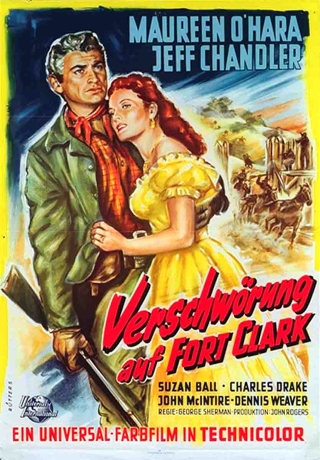
War Arrow

Something about the mid-range westerns that Universal-International was producing in the 1950s points to that hard to define quality which makes the genre so attractive. It’s partially down to the look, the color and locations, and partially the no nonsense style of storytelling. It’s not always easy to come up with a movie that offers entertainment while quietly making some point about a given issue. Universal-International movies often managed this, and the westerns directed by George Sherman during his time at the studio from the late 1940s on are a good example of this. In particular, his films that give some prominence to Indian or Native American affairs sidestep the ponderous or pretentious  pitfalls that have bedeviled many a well intentioned movie. War Arrow (1953) will not be found on any ‘best of’ lists and there’s no reason why it should; it breaks no new ground, nor does it do anything especially startling. However, the film is enjoyable, it uses its strong cast effectively, and Sherman’s characteristic sympathy for the Native American is subtly and seamlessly blended into the narrative.
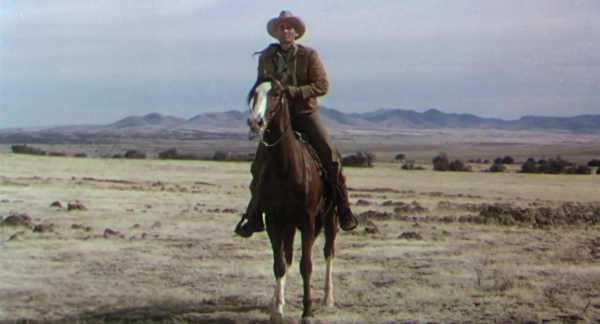
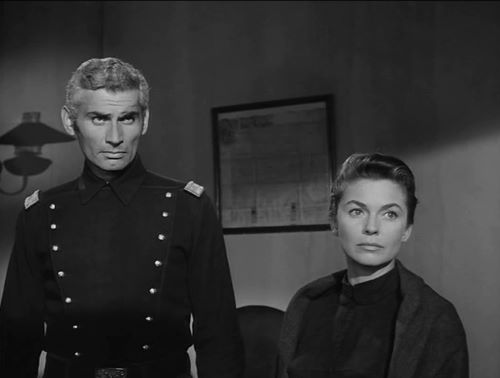
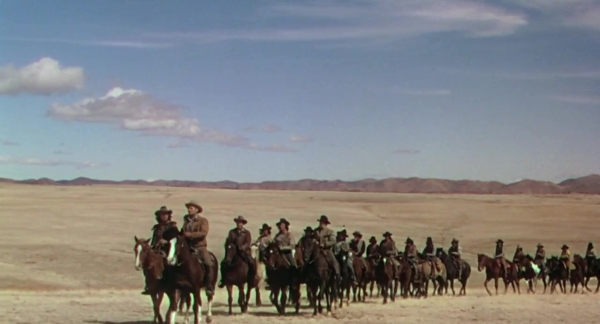
War Arrow is one of those westerns that takes its inspiration from some real historical event, in this instance the recruitment of Seminole tribesmen as cavalry scouts. I say inspiration here because it is a movie after all, not some attempt to represent real history. The film starts out with Major Brady (Jeff Chandler) and two sergeants (Noah Beery Jr and Charles Drake) on their way to Fort Clark, Texas. They have been sent to help in the struggle to contain the raiding parties of Kiowa that have been sweeping the state. They come across the grisly aftermath of one of those raids, with corpses and a burnt out wagon strewn like broken and discarded playthings on the scorched grass. Quite what three individuals are supposed to achieve where the full complement of a fort have failed is anybody’s guess. Their arrival is greeted with some suspicion by the local commander Colonel Meade (John McIntire), a feeling that will gradually be distilled into open hostility as he sees his approach sidelined and his authority not quite usurped but certainly undermined by Brady’s willingness to think outside the box. Meade is an adherent of the West Point manual, rigid in his views of both military tactics and the local tribes. Brady, on the other hand, is an opportunist at heart, a man who is prepared to take a more unorthodox path, and to improvise where necessary. His plan is to employ the kind of guerilla methods the Kiowa themselves have perfected, fighting fire with fire in a sense. And he’s keen to go a step further, to use the dispossessed and dislocated Seminoles as a sort of semi-official, roving commando. As the friction between the two schools of military thought grows in intensity there is another complication elbowing its way into Brady’s life.  The widow (Maureen O’Hara) of one one of the fort’s officers who is missing presumed dead has caught his eye. In itself, that ought not to represent a great problem were it not for the fact that she appears uneasy, and perhaps unconvinced, over the fate of her husband, while the frankly radical daughter (Suzan Ball) of the Seminole chief is also showing signs of interest.
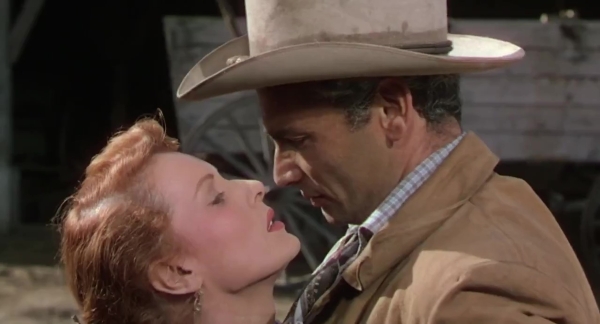
Sherman was a director who knew the genre and how to bring in a movie according to the studio’s requirements. Universal-International seemed to suit him and his time there saw him do some of his best work. I won’t claim that War Arrow represents him at his best, but it is an example of how he could produce a solid piece of entertainment from fairly ordinary material and get worthwhile work from his cast. His depiction of the Native Americans is as sympathetic as one would expect – granted the Kiowa do not come off well and act as bogeyman villains open to outside manipulation, but the Seminole fare much better. The script is by John Michael Hayes, someone who hadn’t much of a pedigree in westerns and who I tend to think of more in relation to his work for Hitchcock in the 50s, and it presents the Seminole in a strong light. They come across as indispensable to the success of the campaign planned out by Brady. They are seen as gutsy and committed, and a good deal more honorable than the frequently petty and hidebound Meade and his junior officers. Sherman gives plenty of time to this aspect, and shoots the battle scenes and skirmishes in a way that is both exciting and which highlights the contributions of the Seminole.
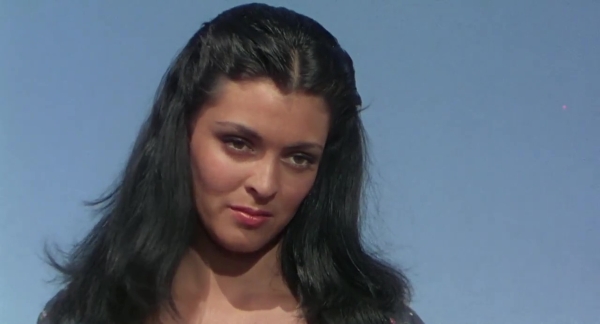
Jeff Chandler typically was good in military roles, either in westerns or contemporary war movies. Gravitas and authority came easily to him and these qualities could be tempered by thoughtfulness, inner conflict or iron determination as required. The part of Major Brady is a relatively straightforward one, an easy run out for him in essence and he carries it off with his usual smooth accomplishment. Maureen O’Hara made a number of films for George Sherman, including the director’s last Big Jake, with variable results. Personally, I think the actress did her best work in the genre for Ford, but this isn’t a bad effort and she is better in the latter stages where her character is given a little more depth. Suzan Ball was the other female star and she is marvelously forthright and assertive, although probably anachronistically so. It’s an attractively spirited performance and serves to emphasize the cruel tragedy of her short life – cancer would claim her just two years later at the age of 22. I think it’s fair to say that any movie benefits from the presence of John McInitre, a class act who could play it mean or sympathetic and who manages to inhabit the obduracy of his character here. Charles Drake and Noah Beery Jr add some lightness to proceedings, while Henry Brandon – still a few years away from his most memorable role as Scar in The Searchers – is the Seminole chief Maygro, with Dennis Weaver and Jay Silverheels filling the other native parts.
It always pleases me to sit down with a George Sherman film, especially one of his westerns. Even if War Arrow isn’t among his top titles, it still shows his professionalism and his sensibilities as a director are apparent, not least with regard to how he viewed Native Americans. The movie shouldn’t be that difficult to track down on DVD although the German Blu-ray, originally released by Koch Media, that I picked up years ago sadly seems to have drifted out of print.

I’m offering this as a contribution to the Legends of Western Cinema Week being hosted by Hamlette’s Soliloquy and others.

Iron Man

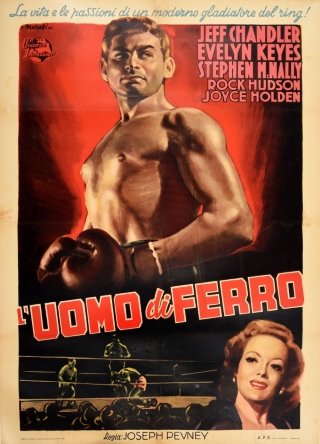
Everybody loves a winner, right? Well actually they don’t, there are those whose behavior draws crowds in the hope they are going to see them get a licking. It’s not just winning, rather it’s how a person wins and perhaps also why they win or even want to. Once upon a time, success in sports, and indeed life itself, was predicated not only on the results achieved or the prizes attained but also on the manner in which the game was played. Is boxing the ultimate sport? Perhaps it was at one point, or perhaps it only appeared to be so for a brief moment in time before sliding into a seemingly unrepentant morass of glitz and trash-talking. Still and all, there is at the heart of it all the seeds of nobility, and I think Iron Man (1951) attempts to tap into some of that. There is something about the image of two men pitting themselves against one another in a formalized setting, mathematically bounded spatially and in terms of timing, equipped with nothing but their guts, guile and sense of fair play. It appeals on an almost atavistic level, but that appeal is heavily dependent on both parties adhering to the rules, the rules of the game and by extension of humanity. It’s only when those rules are bent or warped either by the antagonists or those observing them that some of the purity is lost.

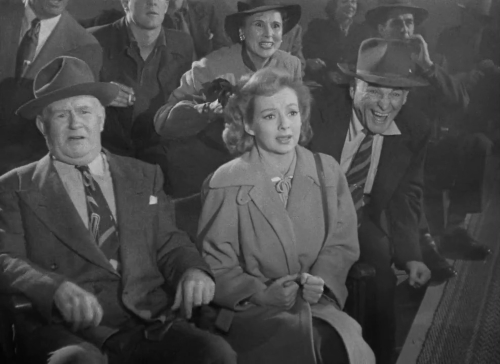
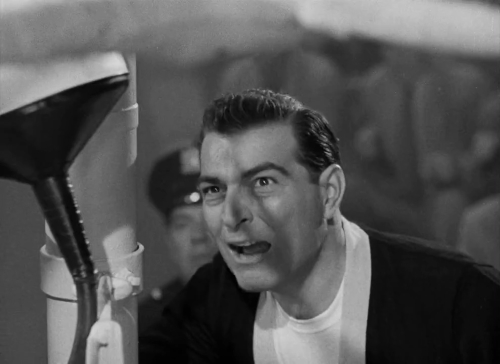
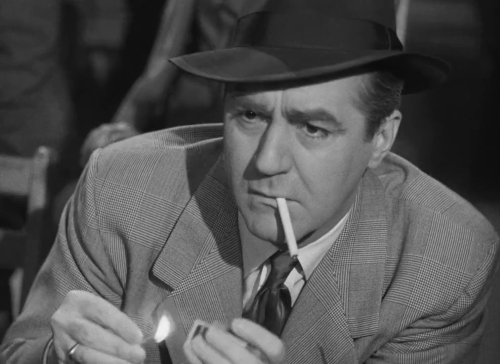
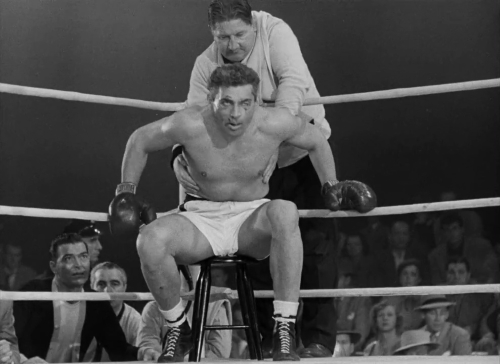
If the duel promises a contest of honor, the same quality cannot always be said to be evident among those watching it. One hears about the roar of the crowd, but what lies behind that?  Look at the eyes and listen, especially listen. All the passion that is embodied in the strained faces, the anxiety, the fear, the trepidation and for some the blood lust. And this is amplified in the sound, cheers and jeers, and if the latter dominates then what? This is the scene presented at the beginning of Iron Man – the announcer holding sway in the center of the ring, barking into the suspended microphone as the arc lights cast their harsh gaze, heralding the start of a world championship fight, calling out the names of the contenders. As the reigning champion steps up the voice of the thousands banked around the roped off area rises not in celebration but in reprobation. Coke Mason (Jeff Chandler) is the focus of this disapproval and he appears to drink it all in dispassionately, feeding off the negativity surrounding him. The view shifts to the spectators, one woman in particular. This is Rose (Evelyn Keyes), Mason’s estranged wife and she sits detached from the screams and boos, thinking back to how these circumstances came to be and of her own role in bringing them forth. We dissolve into a long flashback as Rose leads us back to the coal mines of Pennsylvania, to the man Coke Mason once was before he set out on the path that has led him to fortune and infamy. So we follow Mason as he embarks on the journey out of the grime and hazards of the mines, facing off against mindless prejudice from a belligerent co-worker, finding himself practically reborn after the trauma of a cave-in, on towards his early days as a rough and ready prize fighter egged on by Rose and his ambitious brother George (Stephen McNally). Right from the off Mason is a slugger without technique and, more crucially, without a true sense of why he is fighting. Maybe it would be more accurate to say, he does know why he’s fighting – for the money of course, but also as a reaction against his own deep personal insecurity – it’s just that he is incapable of controlling the fires in his soul. This is what drives him, the internal rages which once ignited are virtually unstoppable and threaten both his opponents and himself.

Iron Man boasts a George Zuckerman/Borden Chase screenplay from a novel by W R Burnett. Those are pretty impressive credentials right there and the movie moves smoothly through its hour and twenty minute run time to a conclusion that some might see as predictable but which  is deeply satisfying for its redemptive and restorative qualities. Director Joseph Pevney keeps it fluid and scenes are generally well paced. It’s the type of material that suited the talents of Pevney and the team around him and cinematographer Carl Guthrie creates some fine images, especially the early stuff below ground in the mine and then later in the fight sequences. Pevney and Guthrie shoot and cut expertly here, making use of starkly lit close-ups alternating with wider pans to draw the viewer into the fight and heighten the tension. The outcome might not be in serious doubt yet the stylish way it is presented is a pleasure to watch, and the emotional and thematic payoff is undoubtedly worth it.

Jeff Chandler handles the conflicted aspects of his character as well as one would expect. The reluctant fighter who is simultaneously motivated and frightened by what he carries around inside offers him plenty to play around with. He reportedly put in a fair bit of work on the practical physical aspects of the role and the fight scenes benefit from that. He never displays much grace in those moments, but that’s the part he’s portraying, a fundamentally awkward man who powers his way to dominance without bothering about the style. Rock Hudson is fine too, albeit in a lighter role as Chandler’s friend who moves from second in the corner to rival in the ring. Stephen McNally was never less than versatile and his flashy turn as the brother who rarely lets a scruple stand in the way of a fast buck is up to his typically high standard. His realization of the harm he has caused, alongside Evelyn Keyes’ similar conversion, is central to the resolution. Keyes cultivates her character nicely as the movie develops and her move from opportunism to remorse feels very natural. Jim Backus drifts in and out of proceedings as a reporter who ends up moonlighting as a promoter. It feels like an odd progression at first but it’s another key role and makes sense as the story unfolds.

Iron Man is another of those Universal-International titles which Kino have scrubbed up and marketed on Blu-ray in their impressive film noir line. The movie does undoubtedly highlight moral ambiguity and explores some dark places in the soul, and it’s a boxing film. Even so, I’m not sure I’d class it as film noir – others may see it differently and I can’t say labeling it or categorizing it in this way bothers me much one way or the other. It pleases me to see this film available in good shape and that’s really all that counts. In the final analysis, this is a good movie with the cast and crew all turning out very creditable work.

Female on the Beach

The Gothic mystery / romance characteristically placed wide-eyed young females from generally sheltered backgrounds in perilous situations. As often as not, they found themselves alone, or practically so, in some rambling old pile they had inherited and threatened by some as yet unknown figure. It’s a hoary old trope, but a it’s also proved to be an attractive one and pretty successful as a consequence. The classic variant still turns up of course and it has also been tweaked and updated to make the standard formula a better fit for changing circumstances and the demands or tastes of audiences. Female on the Beach (1955) is essentially a modernized take on the Gothic mystery. Sure the trappings have been altered and the setting has waves gently lapping on sultry shores rather than launching raging assaults on mean and jagged rocks, but the core elements remain in place – there’s a lone woman taking up residence in an expensive house, a romance with a shadowy and potentially dangerous man, an escalating series of threats and a correspondingly mounting sense of panic and anxiety. As is frequently the case with a lot of this type of material, some of it works very well while other parts suffer from exposure to the overheated atmosphere.

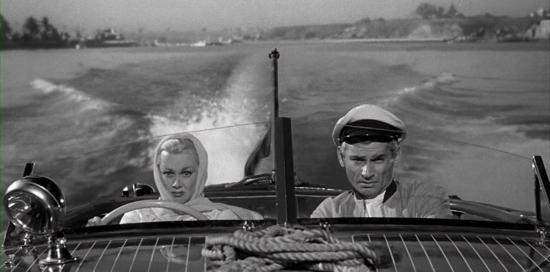
The first female seen on a beach in this movie is one who has just taken a swan dive off the veranda of her seafront home. She had been drinking, heavily, quarreling querulously with a lover and then in a fit of alcohol soaked remorse and self-pity rushed out onto the balcony to stumble and crash through the guard rail. The last we see is the final twitch of her hand, flicking farewell to the busted remains of a brandy balloon. The entire business had an air about it that was as much pathetic as it was tragic. One out, one in – the next arrival is the actual owner of the house. This is Lynn Markham (Joan Crawford), the widow of a big time gambler and a woman looking for nothing so much as solitude. What she ends up getting is the initially unwelcome attention of resident beach bum Drummond Hall (Jeff Chandler). He seems to be suspiciously familiar with the house, and there are little relics of his previous visits littering almost every corner of the place. None of this should be much of a surprise; Drummy (as everyone calls him) is an unapologetic gigolo, albeit something of a reluctant one. He was the man who exited the house pursued by the drunken entreaties of the last tenant just before she moved out permanently and suddenly. He appears to be set on continuing where he left off, business is business after all and a guy has to make a buck whatever way he knows best. Lynn Markham doesn’t intend to become the next mark to pick up Drummy’s checks though and tells him so in no uncertain terms. All of this recalls the tale of Zeus once realizing that the fox that can’t be caught and the hound that can’t lose its prey sets up a paradox of Olympian proportions. In short, something’s got to give. Well it does, love blossoms or lust triumphs – take your pick. And yet there’s a lingering doubt regarding the death of Lynn’s predecessor – accidents ,suicides and murders all produce the same result and it’s easy to mistake one for the other. With a persistent and dissatisfied police lieutenant lurking in the background, Lynn runs the gamut of passion, suspicion and outright fear as she falls for Drummy yet can’t shake the feeling that he may be looking to dispose of his catch as soon as he has secured all the wealth and benefits that come with it.

Director Joseph Pevney was on a solid and at times hugely impressive run of movies throughout the 1950s. There were some misfires and a few frankly humdrum efforts along the way, and some like Female on the Beach which look stylish despite an inherent modesty in terms of production, tease and flatter to deceive in scripting and development, and still manage to be entertaining despite some major flaws. The movie raises questions about the nature of love and betrayal, the importance of trust and the brittleness of human relationships. And the ending, the conclusions reached, is less than satisfactory. It ties everything up in a neat enough way but that doesn’t make it particularly convincing, nor I would argue does it offer a resolution with any promise. None of this is the fault of Pevney of course, the script being an adaptation by Robert Hill of his own play. Pevney, and cinematographer Charles Lang, create some attractive images despite or inspired by the natural staginess of the material. Somehow though, the melodrama and the thrills don’t blend as seamlessly as they might, curdling instead and leaving the finished product lumpy where it ought to have been smooth.

Jeff Chandler made a number of movies with Pevney and all that I’ve seen have been worthwhile on some level. Female on the Beach does have a certain superficiality to its sandblasted Gothic chic, but Chandler always brought an enticing mix of authority and vulnerability to his roles regardless. While dissatisfied self-awareness crossed with brooding calculation isn’t the easiest look to put across, he succeeds in doing so. Joan Crawford was nearing the end of her strong mid-career revival, the slightly trashy but very enjoyable Queen Bee and the very fine Autumn Leaves would soon be followed by a run of exploitative titles of gradually diminishing quality. Female on the Beach had her running on autopilot, suffering, emoting and tossing out some stinging barbs but never stretching herself. Jan Sterling was generally good value in any movie she appeared in and spars successfully with Crawford here. That said, the tone of her performance overall is ramped up a little too high, and again I feel the script is to blame for that. Cecil Kellaway and Natalie Schafer are wonderfully seedy as Chandler’s sponsors and handlers while Charles Drake is solidly unremarkable as the dogged detective – I think I prefer him in his more ambiguous roles.

Female on the Beach is easy to access for viewing, as are so many Universal-International movies these days. It was released on DVD in the US long ago in a box of vaguely noirish thrillers and then on Blu-ray by Kino. I have the UK DVD that Odeon put out some years ago and I think it’s a more than satisfactory presentation. To sum up, Pevney does his customarily slick job, Chandler and Crawford add some star power, but the script rarely rises above the mediocre.

This launches a short series of posts on the movies of Joseph Pevney that will be featured this summer.

Drango

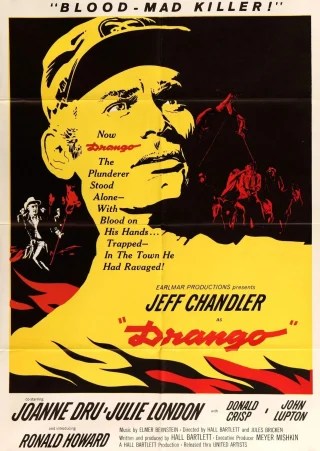
Drango (1957) is a somewhat obscure western that makes for interesting viewing. Taken as a document of the Reconstruction era in the wake of the Civil War, it doesn’t really succeed or at least it’s not especially convincing. On the other hand, it is very effective indeed as an examination of redemption, and in this case atonement. It’s far from the first time I’ve featured a movie driven by that theme as the classic western era is awash with examples. The fact that the film largely succeeds in spite of some of its weaknesses is due in no small part to the work of its star Jeff Chandler.

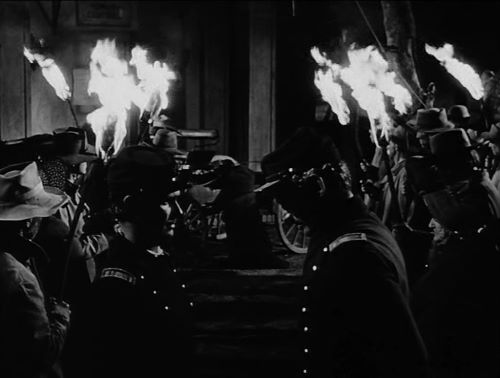
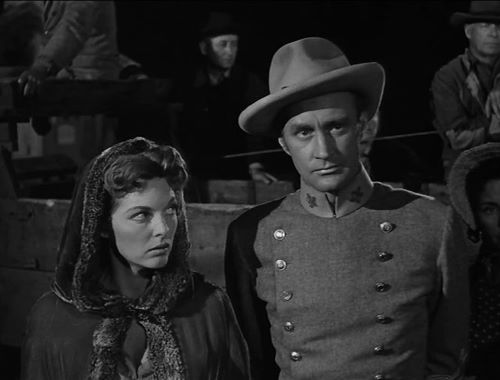
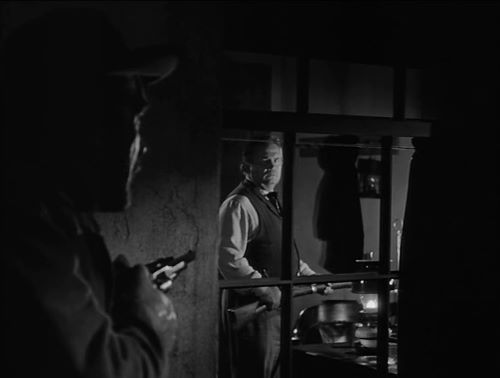
One can practically taste the hostility at the beginning of the film. The implacably  surly expressions of the inhabitants of the small town in Georgia which greet the new military governor give a strong indication of what lies ahead. It’s the post-Civil War period and the old wounds are still raw, old resentments still nurtured. The new governor is Major Drango (Jeff Chandler) and there is a brief, blink and you miss it reference to his past before more immediate concerns take over. Drango’s mission is to get things back to normal as soon as possible, which naturally involves seeing that law and order is restored. This kind of task requires considerable bridge building skills, something Drango sets about practicing as soon as possible. However, he is presented with an obstacle, a settler (Morris Ankrum) on an outlying farm turns up in his rooms hoping to persuade the Major to transport him to the nearest garrison for trial. This man was unsympathetic to the Confederacy and a raid on his property by returning veterans saw a man killed. Not unnaturally, he is dubious about receiving a fair trial in his home town. The rancor of his fellow citizens is tangible during his arraignment and his fears are to be proved correct when he’s subsequently abducted from the jail and lynched in the town square. It’s here that Drango’s guilt is first apparent, not least when faced with the scorn of the dead man’s daughter (Joanne Dru), and as the story progresses it becomes increasingly obvious that this is something he wears like a second skin. What is also clear is the fact that this guilt is rooted in something deeper, although exactly what is only revealed late in the day. In the meantime, he sets about winning hearts and minds, a goal made even more difficult by the subversive plotting of one of the town’s faded gentry (Ronald Howard), a man hell bent on fanning the flames of conflict once more.

Drango was made by Jeff Chandler’s production company Earlmar and he got hold of some fine talent to work on it. Elmer Bernstein wrote the score and those characteristic riffs and hooks he frequently employed can be heard throughout. The cinematography comes courtesy of James Wong Howe and his lighting of interiors and the nighttime scenes is as exemplary as one might expect. Hall Bartlett and Jules Bricken co-direct in a fairly matter-of-fact fashion but the pacing is good. Yet, as I mentioned at the top of this piece, there are weaknesses. If a film wants to be regarded as a serious consideration of the mood and effects of the Reconstruction era, then it’s not unreasonable to expect some reference to slavery. After all, this is set in a town in Georgia and a few of the characters live in the type of mansions to be found on plantations yet there is no mention whatsoever made of this. What’s more, the entire cast contains not one black face, which again strikes me as very odd indeed given the time and location depicted. The result is that there is a degree of artificiality to this image of a post-Civil War town and consequently the whole north-south friction aspect feels a bit fake. The film in essence starts to feel somewhat generic in its portrayal of post-conflict tensions. However, this is basically background material and what rescues the movie is the strong focus on atonement and redemption.

Jeff Chandler was an authoritative presence, a quality which grew as the years passed. He had what is commonly termed gravitas but that alone can make for dull viewing. Chandler’s great strength lay in his ability to convey a certain frailty behind the authority. He has a number of scenes where he gets to boss the situation, glaring down a horde of hungry and desperate townsmen as well as punching out a belligerent, bottle-wielding foe. He also makes a few speeches, which are heartfelt and impassioned but his best moments come in the smaller, quieter passages. The sensitivity of the man is clearly discernible when he has to extract a bullet from a patient who is still conscious, the concentration and reflected pain writ large on his features. Then there’s the potency of a simple and wordless scene where he leaves a few humble presents for a family of orphans on Christmas Day, and of course his carefully controlled outrage as he carries the remains of a youngster who has perished in a deliberate arson attack. All of this is buttressed by the corrosive guilt the man is carrying within – it’s only really when his true past is hauled out in the open that the reasoning which underpins his compassion makes sense.

Joanne Dru exudes stoicism as the woman who has lost her father, lost everything in life if truth be told. Her slow drift from bitterness to acceptance and finally love is achieved naturally and organically. Ronald Howard, in his first Hollywood film, provides an object lesson in pride and ruthlessness as the Canute-like figure who yearns for even more bloodshed. Julie London (Saddle the Wind, The Wonderful Country, Man of the West) was always an attractive addition to any cast and while her part here is less developed and less interesting than that of Joanne Dru, she brings an air of class to proceedings whenever she appears. There’s good support from Donald Crisp, Walter Sande, John Lupton, Milburn Stone and the curmudgeonly Chubby Johnson.

Drango is a hard-edged and at times quite dark redemptive western. Maybe it does not do or get everything right, but it’s a movie with its heart in the right place all the same. This is bolstered by a characteristically compassionate performance from Jeff Chandler, an actor who rarely if ever disappoints. As far as availability is concerned, there are DVDs from France and Italy, the latter looking crisp and clean though almost certainly presented open-matte. All told, this is a satisfying western that is well worth a look.

The Jayhawkers

Let’s start by looking at a list. Ride Lonesome, Rio Bravo, Last Train from Gun Hill, Day of the Outlaw, Face of a Fugitive, The Wonderful Country, The Hanging Tree, Warlock, No Name on the Bullet, These Thousand Hills. What do all these movies have in common? Well two things actually – they are all great westerns and they are all from 1959. The quality of those ten films is beyond doubt and while it’s arguably unfair and perhaps even pointless to make comparisons, it’s difficult not to do so when one realizes that The Jayhawkers also came out in 1959. Now it is not a bad film but it is a distinctly mediocre one, and that mediocrity is all the more apparent when one pauses and looks at that list above. Considering the heights the genre had scaled at that stage this feels like a minor effort indeed.

The Jayhawkers is set in Kansas in the period leading up to the Civil War. It concerns itself with machinations, manipulation and low-level empire building, these being the elements which frame in it in a wider context. On a more intimate level, and from my perspective a more engaging one, the film looks at issues of trust, betrayal and responsibility. Cam Bleeker (Fess Parker) has just broken out of jail, and is first seen wounded and exhausted, dragging his broken and bloody body back to the homestead he once shared with his wife. He has escaped because he’s heard his wife has died and, logically, wants to learn the truth. What he finds though is Jeanne Dubois (Nicole Maurey), a widowed Frenchwoman, and her two children living on what was his land. For a time, as he recovers from his wounds, it looks as though this is going to develop into a tale of a man reconnecting with the world and discovering something worthwhile via a surrogate family. That’s not to be, however, not for Bleeker and not for the audience either. In short, he is recaptured and offered a deal by the Governor to infiltrate the Jayhawkers, a gang of raiders led by one Luke Darcy (Jeff Chandler). What is the motivation? Well, it appears that Darcy was responsible for the debasement and death of Bleeker’s wife after his imprisonment, so we’re talking a classic revenge scenario. Yet it doesn’t quite develop in the way one might imagine; the revenge aspect is brushed aside in a perfunctory manner and the story evolves instead into an examination of the perils of rampant demagoguery as well as raising questions about the extent of personal loyalty.

With writing credits for director Melvin Frank as well as Frank Fenton, A I Bezzerides and Joseph Petracca, the political chicanery which underpins the story is frankly glossed over, the whole business of false flag tactics and the risks arising out of the cult of personality influence the development of the story but never overtake it. The focus throughout remains on the relationship which grows up between Bleeker and Darcy, and how that affects not only the fortunes of the two men but also those of Jeanne Dubois and her children. This is the area where I feel the movie falters, especially the writing of the character of Bleeker. Right from the beginning there is a feeling that he failed his wife, his imprisonment and consequent lack of support being a factor that led to her becoming involved with Darcy and all that followed on from that. Be that as it may, his determination then to make up for this would suggest a redemptive path, but it turns out to be one he treads for only a brief time. Instead, he finds himself first shamed by Darcy’s direct admission of his own culpability before being won over by the drive and ambition of his supposed enemy. Basically, the man set up as the hero at the center of the tale comes across as incredibly fickle and easily swayed. This is problematic enough, but what is worse is his inability to provide protection for those he professes to care about. He leaves Jeanne Dubois to fend for herself for much of the running time and, crucially, is absent when she is assaulted and abused by Darcy’s principal enforcer (Henry Silva). On top of that, he is indirectly responsible for serious injuries sustained by Jeanne’s little girl in the course of a botched raid.

If the writing of the character of Bleeker is less than satisfactory, the performance of Fess Parker is what I’d term adequate. He’s fairly one-note throughout, giving little sense of the conflict and complexity the role requires. What saves the picture is Jeff Chandler as the man who would be king of Kansas. It is a typically intense and authoritative piece of work from Chandler, blending messianic zeal, ruthlessness and flashes of down-to-earth humanity to create a far more interesting figure than the nominal hero. He is supposed to be a character one is never quite sure of and I think that aspect is communicated quite successfully. Nicole Maurey is fine too as the woman trying to build a new life and offer some kind of security to her children. In supporting roles, Henry Silva is as sly and menacing as one could hope for while Leo Gordon’s sidekick is jittery, anxious, and ultimately doomed.

Olive Films released The Jayhawkers on both Blu-ray and DVD some years ago and it looks pretty good for the most part although there are scratches and some print damage. It is an odd film though, the themes it contains are weighty yet the handling of them isn’t all that successful nor is it as assured as it ought to be, and I’m not altogether convinced Melvin Frank and Norman Panama were the right team to have behind a story like this. The entire movie creates an impression of wanting to be big and grand, partially fueled by a terrific Jerome Moross score that recalls his work on The Big Country, but it contrives to look and feel much more restricted. All told, it entertains and passes the time, benefiting from a strong and energetic turn from Jeff Chandler. Still, bearing in mind the other genre offerings produced that year it is somewhat disappointing.

Deported

Time for another guest post, once again courtesy of Gordon Gates. It’s a classic era film noir, so it slots right into his comfort zone. Seeing as it’s a Universal-International property, albeit yet another of the elusive ones, it probably belongs in the comfort zone of a few regular visitors here too.

There are many directors who are held in high esteem by fans of film noir, and of cinema in general. These include: Billy Wilder, Fritz Lang, Phil Karlson, John Huston, Jules Dassin, Jacques Tourneur, Anthony Mann and of course, Robert Siodmak. Siodmak hit the ground running in 1944 with a string of nine successful films noir starting with Phantom Lady. This was followed by Christmas Holiday, The Suspect, The Strange Affair of Uncle Harry, The Spiral Staircase, The Killers, The Dark Mirror, Cry of the City, Criss Cross and The File on Thelma Jordan. The 11th noir wasn’t so successful, this was 1950’s Deported, shot on location in Italy.

A ship docks in Naples and starts off-loading cargo and one man, Victor Mario Sparducci. Sparducci is played by Jeff Chandler, who is a mobster going by the name, Vic Smith. Chandler has just finished a 5 year prison bit for a $100,000 robbery. The cash was never recovered by the Police. Chandler, after he finished his term, was escorted to the docks and deported back to the old country. This is before he can grab the $100,000.

Chandler is barely off the docks in Naples when he runs into the pretty, Marina Berti. Berti invites Chandler to her rooms for a drink and a cuddle, which our man Jeff is all too happy to accept. This of course does not go as Chandler had expected. Waiting for him at Berti’s place is fellow mobster, Richard Rober. Rober has followed Chandler from the States. He is not amused that he never got his cut of the $100,000 holdup the two had arranged.

Some less than friendly words and fists are exchanged over the financial situation, with Rober being laid out. Chandler informs Rober that he intends to keep the whole take. “I did five years for that money, so as far as I’m concerned, it is mine.” Chandler then tells Rober to stay away, or he will kill him.

Chandler then heads for the small village his family had left when he was a child. He hides out with his uncle, Silvio Mincioti, while he plans a way to get his cash over to him from the States. Chandler soon hooks up with the village’s black market boss, Carlo Rizzo. He figures he will need Rizzo’s help once he comes up with a plan to retrieve his cash.

While all this is going on, Chandler finds time to romance local beauty, Marta Toren. Toren is a wealthy widow who spends her time doing charity work for the local poor. Toren soon falls for the rather rough around the edges Chandler.

This all happens in the first 20 minutes. The film then loses steam and becomes a travelogue for the next 30 plus minutes. This seemed to be a regular problem with American films being made overseas at the time. There really is no on screen sparks between Chandler and Toren. Their scenes together are more or less dead time. The film however, does catch fire again in the last 10 minutes.

Chandler has found the perfect way to get his cash from the States. He cables the person in the States holding his money, to buy 100 grand worth of food and medical supplies. These he has shipped to Italy to be given to the village. The trick here is that Chandler intends to hi-jack the items, then, sell them on the black market for 5 times the cost.

The viewer of course know there is going to be a falling out with Chandler and the black market types. There is also the added complication that Rober is back in play. The mandatory guns are produced and some well done violence ensues.

Also in the film is Claude Dauphin and if you look close and you will spot bit players Tito Vuolo and Vito Scotti.
The director of photography is Oscar winner, William H. Daniels. His noir work includes, Brute Force, Lured, The Naked City, Illegal Entry, Abandoned, Winchester ’73, Woman in Hiding and Forbidden. He also did the last reviewed film here by Colin, Foxfire.
The screenplay was by one time Oscar nominated Robert Buckner. Buckner also produced the film.
Considering all the talent involved is this film, it does not hit the mark. There are parts here that are quite well handled, but the quick start and the finish are not quite enough to save the film from at best, just being average. It suffers from a tad too much dead time. For a Siodmak film, I found it rather disappointing.
(INFO) All three of the leads died before their time with Toren going at 31, Rober at 42 and Chandler at 43.
The only means of viewing the movie at the moment appears to be online.
EDIT August 2021: Kino have announced a Blu-ray release for this movie in November 2021.
Gordon Gates

Foxfire

On the outside looking in doesn’t do anybody any good.

That one casual line in Foxfire (1955), spoken by one of the most hard done by and neglected characters in the movie as it happens, goes a long way towards catching the spirit and flavor of the entire picture. In a sense, all of the characters are outsiders in their individual worlds, some by chance and others by choice or design. This is a strong theme, one many of us will be able to identify with at some point in our lives and thus a solid bedrock on which to construct this story which I’d say is three parts melodrama and one part modern western. That part picks up on and weaves into the blend perhaps one of the more interesting, challenging and progressive thematic threads to be found in the fabric of the 1950s western, the clash of cultures which was inevitable in a new land and the dramatic tension growing out of that.

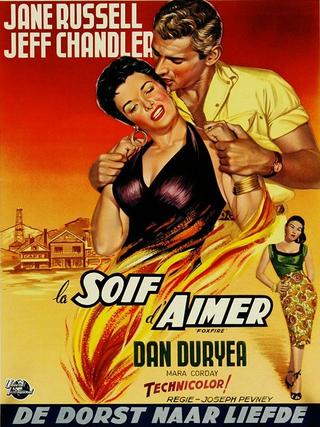
A desert highway, one of those arrow straight and seemingly endless thoroughfares that we viewers have traveled many times. Our companion on this occasion is a lone woman, Amanda Lawrence (Jane Russell), speeding along until she gets a flat tire. With no help available, she sets off on foot, burdened with what look like the assorted fripperies of a shopping expedition. There can’t be any doubt that this chic and carefully coiffed lady is very much an outsider in the primal landscape, a refugee from 5th Avenue cast adrift in the dust and heat of the southwest. Then out of that shimmering haze comes a jeep carrying two men – miner Jonathan Dartland (Jeff Chandler) and doctor Hugh Slater (Dan Duryea) – and we’re off. Amanda is clearly taken with Dartland and he’s at least interested in her.  What follows is a love story but it’s not a smooth one, and I think it’s questionable in the end what all of the protagonists are in love with. In fact, despite the relatively neat conclusion, those questions are only partly answered and I feel there’s a suggestion that they will rear their heads again.

As far as I can see, the characters are being pulled in different directions partly by their disparate backgrounds and partly by their status as outsiders. Beginning with Dartland, or Dart as everyone refers to him. We learn very early on that he is half Apache, with a mother who has returned to the reservation and wholly integrated herself back into tribal life after the death of her husband. He is forced to endure some bigoted and prejudiced attitudes – including one thoughtless gaffe on the part of Amanda before she learns about his heritage – but tends to brush them aside. He insists it means nothing to him but a couple of understated moments call this into question – the brief flash of hurt in his eyes when Amanda makes that crack about Indians, and then later the diffidence and self-consciousness he displays when entering the club for their first date, not to mention the haste with which he beats his retreat.

For all Dart’s claims of not being affected by his background, he’s very much aware that he is outside looking in. And he cannot fully break with his past; he avoids talking about his mother’s people, keeps his memories quite literally locked away and reacts with petulant sensitivity to their discovery. Nevertheless, the tone of his relationships, especially with Amanda is dictated by his upbringing, his instinctive prioritizing of self-reliance as well as his resorting to the physical as opposed to the emotional act of love when confronted with conflict. As I mentioned  above, I’m unsure whether he’s confident what he’s in love with – his wife or his ambition, and that siren song of kith and kin holds a powerful attraction.

What of Amanda? Is she any less an outsider? A socialite on vacation drawn to something attractive, and she does refer to Dart time and again as pretty in a neat subversion of traditional objectification. She labors hard to adapt to the harsh conditions of the mining town and also has to deal with the whispers of her own past tempting her to throw it all up in favor of the ease and plenty she was accustomed to. Again, does she really know what she wants – the rugged ideal of her imagination or the the reserved figure of reality?

You can always tell a script has depth when it adds meat to the bones of the supporting characters ; this one is from the pen of Ketti Frings, who had already written a few very good films noir as well as another Joseph Pevney / Jeff Chandler picture Because of You, and I’m keen to track that one down now. Dan Duryea’s boozy doctor could have been a mere caricature, a sidekick with a bottle who bumbles in the background. However, the character isn’t written with such broad strokes, there are layers present which are only gradually uncovered. He doesn’t truly belong either, another blow in from another world, a drunk as a result of personal trauma and casting around for a means to escape his circumstances. Duryea excelled at playing heels and it’s therefore not much of a surprise when his cunning and manipulative side rises to the surface. The one who arguably suffers this most, albeit with almost superhuman stoicism, is his nurse/lover played by Mara Corday. Like Dart, she is half Apache yet the barriers separating her from white society are even more entrenched. There’s something both outrageous and touching about her quiet patience and devotion to a man who habitually neglects her to the point of naked disrespect. Then there’s that wedding scene, where she is looking in in every sense, relegated to a place outside in the company of hookers and other undesirables. She is in a very real way a peripheral figure and is assigned only a limited amount of screen time, but her presence and its effect on the viewer is significant. Somehow, the casual acceptance (by herself as well as by the other characters, and perhaps even more so on her own part) of her regular social exclusion and the flippant exploitation of her affections do as much to highlight prejudice as some of the more direct and overt references involving  Dart.

I’ve watched and featured a number of Joseph Pevney movies this year and Foxfire is probably the most enjoyable one so far. I appreciated the understated way the drama unfolds and this is particularly true of the key scenes. The film has that appealing look that is so characteristic of Universal-International productions and William Daniels’ Technicolor cinematography honestly is quite breathtaking at times. The setting matters too, it feels entirely appropriate in this case that everything revolves around a mining settlement in the Arizona desert. The location offers a tangible link to the classic western and then there is that sense of the ephemeral, of a place hastily built amid a permanent wasteland – Chandler’s character dreams of making it a lasting settlement but there’s that nagging doubt again, as in his personal affairs, over how sure the foundations will be. Somehow the raw purity of the scorched backdrop offers a contrast to the transitory desires, ambitions, jealousies and angst of this group of people, none of whom appear to genuinely belong.

As for availability, there is a Blu-ray which has been released in the US and I understand it offers a fine presentation of the movie. Sadly, I’m Region B only when it comes to Blu-ray so I had to find other options. There has been a DVD release in Italy that is hard to fault as far as the picture quality is concerned. It might be standard definition but the 2.00:1 widescreen image is sharp as a pin, clean and colorful. Sure there are better melodramas to be found and the theme here may not have the kind of universal resonance that typically adds greatness. Nevertheless, this is a good movie, and it mostly worked for me, raising a number of issues I could relate to as well as providing an hour and a half of polished, solid entertainment. My recommendation is that anyone able to access this title should check it out.

The Plunderers

A new decade heralds change, or at least that would appear to be the received wisdom. It’s tempting to see it like Janus, as a point of transition gazing both ahead and back simultaneously. And no, this isn’t going to turn into some reflection on where we find ourselves today; it’s merely a coincidence that I happened to look at a movie which also appeared at the beginning of a new decade. The Plunderers (1960) came out just as the the western was about to enter a period of significant change. Could it be termed a transitional work? Well, for my money, it has much more in common with the works which preceded it, although perhaps there is a case to be made for it taking some tentative steps towards the post-classical era.

So, what’s it about? Conflict is naturally the key element of all drama and this movie presents it on a number of levels – interpersonal, intrapersonal and generational. On the surface, it’s a simple tale of four youthful drifters arriving in a tired and washed-up town, a place where all vigor has been abandoned and where the ageing population is unprepared for any challenge to the torpid complacency. These four are restless and dissatisfied, wearied from a cattle drive and emotionally raw at the realization that they just blew all their earnings in a week of indulgence in Dodge City. Right on the cusp of manhood, these youngsters need to reassert themselves, to make people sit up and take notice of their importance, but are singularly lacking in the maturity necessary to acquire that which they most desire, the respect of others. Thus, when an initial bit of minor roguery and mischief leads to the mildest of rebukes, their bravado is further stoked. It all leads up to threats, murder and, finally, a confrontation with a one-armed veteran, provoking a spiritual awakening of sorts.

There’s a lot going on here. We have the four interlopers trying to find their place in the world, but without the structure and guidance to point them in the right direction. This appears to be a throwback to the tales of rebellious youth that abounded in the previous decade, but the crucial difference here is that those earlier examples tended to push an essentially optimistic message whereas The Plunderers has an altogether sourer vision – the generational conflict depicted promises no positive outcome. Maybe this can be seen as a reflection of the stagnation that would begin to creep into the genre and give rise to a new and more nihilistic approach.  Or from a wider sociopolitical perspective it might be seen as holding up a mirror to the waning of the somewhat detached Eisenhower era which was about to give way to the more radical and energetic Kennedy years. Then again, I may well be trying to read too much into it all.

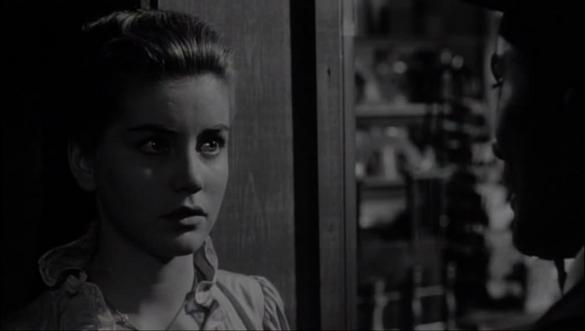
What is certain is that the movie charts the gradual reawakening of the conscience and sense of responsibility of its leading character. Jeff Chandler puts in a fine, understated performance as the  veteran who has been scarred both physically and psychologically by his wartime experiences. The fighting robbed him of the use of an arm and left him an emotional cripple as well. His withdrawal from his community is partnered by his distancing himself from his former lover (Marsha Hunt, happily still going strong at 102), and her needling of him for his lack of guts almost constitutes an assault on his masculinity. It feels as though his passivity and apparent impotence is being weaponized in both a literal as well as a figurative sense. What finally rouses him to action is the belief of the storekeeper’s young daughter (Dolores Hart). There is the suggestion that he has lost confidence in himself as a result of his injuries yet I think it’s clear enough that his fear is not based on an absence of self-belief as much as a reluctance to revert to the violence that he earned a fearsome reputation for indulging in during the war. While the classic 50s western built towards a spiritual rebirth, I think it’s telling that The Plunderers ends on a grimmer note with its emphasis on guilt and an inner monologue that’s actually a prayer for forgiveness.

Bit by bit, I’m getting round to featuring works by a variety of filmmakers who really ought to have been represented on this site earlier. Today it’s the turn of Joseph Pevney, an actor turned director who made a number of impressive genre movies throughout the 1950s before moving on to a long a successful career on television. The Plunderers was one of his last feature efforts and I think it’s a strong one. Almost the entire picture is shot within the confines of the town, keeping our attention focused and the dramatic tension ratcheted up. It’s very obviously a low budget affair, but Pevney’s interesting camera placements, along with the layered writing, help make a virtue of this. I feel it’s also refreshing to see the climactic duel making use of knives as opposed to the more traditional quickly-drawn pistols. All told, there is little on screen violence until quite late in the story – with  the exception of two tough and rather brutal beatings – and when it does take place it’s appropriately shocking in its abruptness and tragedy.

As far as options for anyone wishing to view this movie are concerned, there’s a manufactured on demand DVD available from the US via the Warner Archive and there had until recently been a release in Germany, but the latter seems to have gone out of print now. I’m an unashamed fan of low budget movies that punch well above their weight and I actively seek these out. Sometimes they work out fine and at other times they don’t; happily on this occasion, I felt The Plunderers was a success and I recommend checking it out. In fact, I enjoyed Pevney’s work so much here that I’m of a mind to feature a few more of his movies back to back. We’ll see…

Pillars of the Sky

Over the years there has been a good deal of ill-informed, and one might even say uninformed, material written and spoken about the classic western, and the depiction and treatment of the Native American Indian has arguably attracted the lion’s share of this negative commentary. That’s perhaps a slightly blunt way to open a post but it does rankle some to see unjustified assessments go unchallenged, not least because it contributes to critical neglect of the genre and a subsequent lack of appreciation and/or interest among potential viewers. Today, it feels as though we are increasingly living in a world of absolutes, one of stark blacks and whites where the very idea of nuance or shading is either dismissed outright or mercilessly lampooned. I suppose that one of the aspects that regularly draws me back to the classic 1950s version of the western is both the ease and the courage with which so many productions navigated moral, and historical complexities. Pillars of the Sky (1956) is an interesting entry in the decade’s Indian cycle,  one which adds religion and its influence on the conflict on the frontier into the blend.

It’s Oregon a few years after the end of the Civil War, and First Sergeant Emmett Bell (Jeff Chandler) is responsible for patrolling the reservation in tandem with his Nez Perce scouts. The general direction of the tale is a familiar one for anyone who has seen more than a few westerns from this era. Treaties will be compromised in the name of progress, trust betrayed in the name of expediency, and conflict stoked up off the back of misunderstandings. Still, before the storm comes the calm, represented by the peace efforts of missionary Dr Joseph Holden (Ward Bond). Holden is one of life’s true believers, a man who seeks to bring civilization and all the benefits he associates with his religion to the varied tribes sharing the reservation. Bell presents a more pragmatic face but one which is no less sincere or well-meaning for that. The arrival of the new commanding officer with with orders to supervise the construction and policing of a road through the territory spells trouble. For the army these are orders that have to be executed, for the Indian they are evidence of further hollow promises – whatever the perspective, the end result will be a fight nobody really wants yet one nobody really knows how to avoid either.

Adapted from a Will Henry story, Pillars of the Sky is a typically mature piece of work, eschewing any temptation to paint in broad brush strokes and present the viewer with a simplistic heroes and villains stand-off. As is the case in so many conflicts, there are no clearly delineated good or bad guys, just people manipulated by circumstances and personal loyalties into a situation that can all too easily slide out of control. What sets this production apart from other thoughtful appraisals of the frontier wars is the prominence afforded to the religious aspect. Now some may find this overdone, and I can imagine that accusations of excessive piety might be leveled. Personally, I’m not sure that it has to be approached in that way – the theme here relates to co-existence as far as I can see. Digging a little deeper, it deals with the idea of reaching an accommodation, and on a number of levels. There is of course the wider accommodation being sought between two competing civilizations and cultures, while a range of smaller and more personal examples are to be determined among the characters.

Let’s look at some of those characters then. Firstly, Jeff Chandler’s hard-bitten Sergeant Bell is man having to come to terms with a number of changes and challenges in his life. He has gone from being a Civil War officer to a peacetime non-commissioned man, leading to some amusing confusion for a young lieutenant who served under him in the past and still finds himself saying “Sir” to the man he’s now giving orders to. Bell’s struggle is dual one: he must reconcile his humanitarian instincts with the prickly toughness his years of hard experience have brought about while at the same time assessing his feelings towards a woman he loved and then apparently lost. That woman is Calla Gaxton (Dorothy Malone) and her own path is far from certain, having come west to make a final choice between her old flame Bell and her husband Captain Gaxton (Keith Andes). While this triangle is supposed to add another layer of drama to the story, it ends up as one of the weaknesses for me, with Malone underused and the competition between Chandler and Andes proving something of a damp squib alongside the genuine explosiveness of the main plot strand.

Ward Bond’s missionary offers  him a good role, allowing him to indulge in some larger than life bluster while displaying an equal measure of compassion. And there you have the conflict faced by his character – how best to apply his Christian principles to circumstances and an environment inherently hostile to such ideals. When it comes to portrayals of army brass, it’s common to see inflexible martinets blindly provoking violence yet Pillars of the Sky offers a welcome way around that tired cliché by having Willis Bouchey play an officer who is aware of his own fallibility. Lee Marvin adds another colorful supporting role to his CV as a characteristically hard drinking Irish sergeant. There’s a good deal of broad comedy in his part but plenty of pathos too in his later scenes in the aftermath of the big Indian attack. On the other side of the battle lines, Michael Ansara gives good value as the warrior Kamiakin who has firmly rejected the missionary teachings and contrasts nicely with Sydney Chaplin’s devout and devoted scout.

George Marshall might be best known for making the classic Destry Rides Again – mind you, I’d argue that his own remake of that film Destry in 1954 runs it very close. His long career covered most genres and he made a handful of other notable westerns in the 1950s in The Sheepman and The Guns of Fort Petticoat. I’d rate this among his better movies, for the rich and less common theme and the superb visuals too. CinemaScope westerns are attractive as a rule and the the shooting of the Oregon locations, with the help of cinematographer Harold Lipstein, is quite breathtaking at times, managing to recall Frederic Remington paintings in some shots.

Pillars of the Sky has been released on DVD in a variety of territories over the years and I suspect the same master will have been used for all of those. Universal International productions have a distinctive look and as viewers we’re fortunate to be able to enjoy so many of these via excellent prints and transfers. I have the German release of this movie from Koch and it looks very fine with a sharp, detailed and colorful image. In brief, this is a strong western, and another that has not received its full due, perhaps in part because of the reasons I alluded to in the introduction above. So, if anyone who is keen on westerns has yet to see this one, I recommend they look into it – it has action, drama, visual splendor and intelligence. Check it out.

The Tattered Dress

Ever wondered how films end up neglected? I was almost going to say “lost” but that’s an entirely different category; I mean movies which are viewable, accessible with a bit of effort, but neither commercially available nor presented in optimum condition. By the way, I’m not offering any answers here. I’m very bit as mystified as the next guy, and I’m really only indulging in a bit of idle musing after watching a less than perfect version of The Tattered Dress (1957). You could argue that the cast is largely peopled with actors who have drifted a little too far out of the public consciousness, although I’m not wholly convinced by that one myself. Regardless of that, the film was directed by Jack Arnold, a cult favorite if ever there was one, and yet this work remains (apparently) unrestored and stubbornly unreleased.

Cinema sometimes feels like the theater of the senses, or maybe a more sensual version of the theater. If we lose the immediacy of the live performance, we also gain something in extreme intimacy, and then in an instant we can also achieve the cool distance of an observer in a gallery. And all the while our senses are targeted and stimulated, particularly our vision and hearing. I’ve come to think that film sequences without dialogue – not silent film, just with the dialogue stripped out – come closest to pure cinema, storytelling predominantly through visuals, music and ambient sound. The Tattered Dress opens like this: with a torn frock, a breathtaking blond racing through a desert night in an open top convertible, a tense meeting with her husband, another ride and then a cool and clinical killing. And not a word spoken.

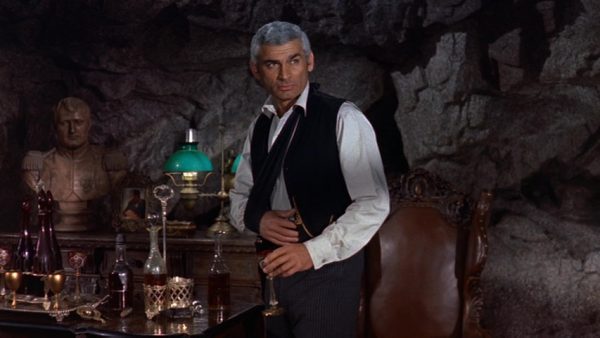
That’s the setup, a late night killing, a crime of passion by a shooter who needs a sharp lawyer to do the defending. That lawyer is James Blane (Jeff Chandler), famed for his ability to defend the indefensible and the bane of district attorneys everywhere. Blane is blunt, cocksure and beholden to one creed only, the need to win, to succeed and feed the legend of his own ego. His courtroom wizardry has seen him scale the peaks of his profession while he’s sacrificed his personal satisfaction to attain it. If his wife maintains an arm’s length relationship and his children are rarely seen, well so be it. He gets his clients off, and he gets this latest one an acquittal too, shredding the reputation of a small town sheriff on the way. However, this is only part of the story, and Blane’s moment of triumph is an imposter, disguising a comedown that will shake his faith in himself to the core. Yet perhaps he’ll learn something about himself in the process.

Jack Arnold is held in high esteem, and rightly so, for the Sci-Fi films he made in the 1950s. Those films, such as It Came from Outer Space and the excitingly cerebral The Incredible Shrinking Man, were landmarks not only for that genre but for genre filmmaking as a whole. Still, it would be a mistake, and a disservice to the man, if one were to classify him on those terms alone. Tucked in among his credits, one can find a brace of what I’m happy to assert are classy and superior examples of tight and economical western cinema – No Name on the Bullet and Red Sundown. Also, around the same time, Arnold was making (along with Jeff Chandler as it happens) Man in the Shadow where he took aim at small town corruption and racism. Here, under the guise of a slick legal thriller, he cast a sideways glance at the American Dream.

I’d like to think the desert setting, which Arnold seemed drawn to on a number of occasions, has some significance. Is it too much of a stretch to view that harsh and bleak backdrop as a kind of blank canvas upon which he felt greater freedom to explore his themes? Because he does dig under the surface of the glossy 50s American success story – the hotshot lawyer stirs urban/rural and western/eastern hostilities right from the beginning, and his idealized family unit (not to mention that of his smooth and wealthy clients) is shown to be anything but ideal. In short, there’s a nasty bit of corrosion creeping in beneath the chrome trim. The broken home and tarnished ideals of the man are the price he has paid in his ruthless pursuit of fame and fortune, elbowing such trifles as truth and justice aside in his dash for a questionable prize. So, at this point, let me make a proposal – that Arnold was every bit as concerned, all through his Sci-Fi, western and thriller work, with a critical examination of the flaws and  barely suppressed crises of the post-war American soul as the more critically acclaimed Douglas Sirk. While this is something I’ve pondered before, I’ll freely admit that this George Zuckerman scripted production hauled it all front and center for me – Zuckerman also wrote a number of screenplays for Sirk, including the perennially underrated The Tarnished Angels.

Now, a brief word on the performances. Jeff Chandler’s early death robbed the cinema of one of the most promising talents of the era. It has also led to an under-appreciation of his talents and abilities, but a look at any of his best roles quickly highlights his powerful screen presence. Plenty of actors, especially leading men in their prime,  are and were loath to accept what might be perceived as unsympathetic roles. Chandler, however, seemed comfortable enough taking on less than wholesome parts. The lawyer here is not a nice man, he’s a grasping and ruthless type who has lost his way, and yet Chandler embraces this negativity and offers a welcome three-dimensional portrait of ambition colliding with a hunger for personal fulfillment. Facing off against him is Jack Carson, the butt of plenty of jokes as a character player. His bulky joviality is nicely subverted here and his cool undermining of Chandler is very memorable. Jeanne Crain is the estranged wife, still in love with Chandler but proud enough to hold herself back until he rediscovers his humanity. And finally, there’s Gail Russell, that fragile beauty in the middle of a temporary comeback that was destined to be short-lived.

To finish this piece, which has ended up running slightly longer than my other recent postings, let me just reiterate that The Tattered Dress is a classy melodrama/thriller with a fine cast and on-form director. That it remains unreleased on any current home video format is something I struggle to understand. There are many films we can safely say are deserving of a high quality digital release – this is most assuredly one of them. I can only hope someone sets about rectifying this oversight soon.