Pillars of the Sky

Over the years there has been a good deal of ill-informed, and one might even say uninformed, material written and spoken about the classic western, and the depiction and treatment of the Native American Indian has arguably attracted the lion’s share of this negative commentary. That’s perhaps a slightly blunt way to open a post but it does rankle some to see unjustified assessments go unchallenged, not least because it contributes to critical neglect of the genre and a subsequent lack of appreciation and/or interest among potential viewers. Today, it feels as though we are increasingly living in a world of absolutes, one of stark blacks and whites where the very idea of nuance or shading is either dismissed outright or mercilessly lampooned. I suppose that one of the aspects that regularly draws me back to the classic 1950s version of the western is both the ease and the courage with which so many productions navigated moral, and historical complexities. Pillars of the Sky (1956) is an interesting entry in the decade’s Indian cycle,  one which adds religion and its influence on the conflict on the frontier into the blend.

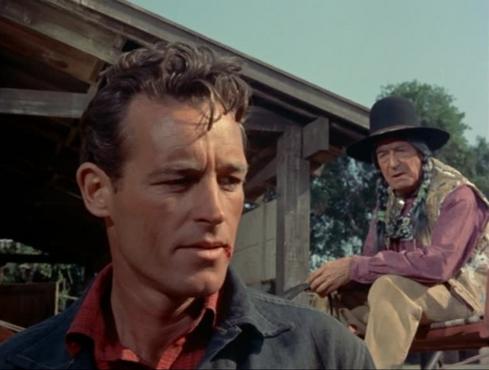
It’s Oregon a few years after the end of the Civil War, and First Sergeant Emmett Bell (Jeff Chandler) is responsible for patrolling the reservation in tandem with his Nez Perce scouts. The general direction of the tale is a familiar one for anyone who has seen more than a few westerns from this era. Treaties will be compromised in the name of progress, trust betrayed in the name of expediency, and conflict stoked up off the back of misunderstandings. Still, before the storm comes the calm, represented by the peace efforts of missionary Dr Joseph Holden (Ward Bond). Holden is one of life’s true believers, a man who seeks to bring civilization and all the benefits he associates with his religion to the varied tribes sharing the reservation. Bell presents a more pragmatic face but one which is no less sincere or well-meaning for that. The arrival of the new commanding officer with with orders to supervise the construction and policing of a road through the territory spells trouble. For the army these are orders that have to be executed, for the Indian they are evidence of further hollow promises – whatever the perspective, the end result will be a fight nobody really wants yet one nobody really knows how to avoid either.

Adapted from a Will Henry story, Pillars of the Sky is a typically mature piece of work, eschewing any temptation to paint in broad brush strokes and present the viewer with a simplistic heroes and villains stand-off. As is the case in so many conflicts, there are no clearly delineated good or bad guys, just people manipulated by circumstances and personal loyalties into a situation that can all too easily slide out of control. What sets this production apart from other thoughtful appraisals of the frontier wars is the prominence afforded to the religious aspect. Now some may find this overdone, and I can imagine that accusations of excessive piety might be leveled. Personally, I’m not sure that it has to be approached in that way – the theme here relates to co-existence as far as I can see. Digging a little deeper, it deals with the idea of reaching an accommodation, and on a number of levels. There is of course the wider accommodation being sought between two competing civilizations and cultures, while a range of smaller and more personal examples are to be determined among the characters.

Let’s look at some of those characters then. Firstly, Jeff Chandler’s hard-bitten Sergeant Bell is man having to come to terms with a number of changes and challenges in his life. He has gone from being a Civil War officer to a peacetime non-commissioned man, leading to some amusing confusion for a young lieutenant who served under him in the past and still finds himself saying “Sir” to the man he’s now giving orders to. Bell’s struggle is dual one: he must reconcile his humanitarian instincts with the prickly toughness his years of hard experience have brought about while at the same time assessing his feelings towards a woman he loved and then apparently lost. That woman is Calla Gaxton (Dorothy Malone) and her own path is far from certain, having come west to make a final choice between her old flame Bell and her husband Captain Gaxton (Keith Andes). While this triangle is supposed to add another layer of drama to the story, it ends up as one of the weaknesses for me, with Malone underused and the competition between Chandler and Andes proving something of a damp squib alongside the genuine explosiveness of the main plot strand.

Ward Bond’s missionary offers  him a good role, allowing him to indulge in some larger than life bluster while displaying an equal measure of compassion. And there you have the conflict faced by his character – how best to apply his Christian principles to circumstances and an environment inherently hostile to such ideals. When it comes to portrayals of army brass, it’s common to see inflexible martinets blindly provoking violence yet Pillars of the Sky offers a welcome way around that tired cliché by having Willis Bouchey play an officer who is aware of his own fallibility. Lee Marvin adds another colorful supporting role to his CV as a characteristically hard drinking Irish sergeant. There’s a good deal of broad comedy in his part but plenty of pathos too in his later scenes in the aftermath of the big Indian attack. On the other side of the battle lines, Michael Ansara gives good value as the warrior Kamiakin who has firmly rejected the missionary teachings and contrasts nicely with Sydney Chaplin’s devout and devoted scout.

George Marshall might be best known for making the classic Destry Rides Again – mind you, I’d argue that his own remake of that film Destry in 1954 runs it very close. His long career covered most genres and he made a handful of other notable westerns in the 1950s in The Sheepman and The Guns of Fort Petticoat. I’d rate this among his better movies, for the rich and less common theme and the superb visuals too. CinemaScope westerns are attractive as a rule and the the shooting of the Oregon locations, with the help of cinematographer Harold Lipstein, is quite breathtaking at times, managing to recall Frederic Remington paintings in some shots.

Pillars of the Sky has been released on DVD in a variety of territories over the years and I suspect the same master will have been used for all of those. Universal International productions have a distinctive look and as viewers we’re fortunate to be able to enjoy so many of these via excellent prints and transfers. I have the German release of this movie from Koch and it looks very fine with a sharp, detailed and colorful image. In brief, this is a strong western, and another that has not received its full due, perhaps in part because of the reasons I alluded to in the introduction above. So, if anyone who is keen on westerns has yet to see this one, I recommend they look into it – it has action, drama, visual splendor and intelligence. Check it out.

Spin a Dark Web

How essential is the femme fatale in film noir? Sure her presence is one of the characteristics you will hear mentioned time and again should  you ask people to check off a list of the necessary ingredients. But is this presence or absence actually integral, and does it define the style? I’m inclined to think no, I’ve seen plenty of undoubted films noir where this character didn’t appear and I don’t feel their dark credentials were diminished as a consequence. On the other hand, the question represents an itch I get the urge to scratch every so often, especially after watching a movie like Spin a Dark Web (1956), where there is an explicit femme fatale whose malign influence drives the plot.

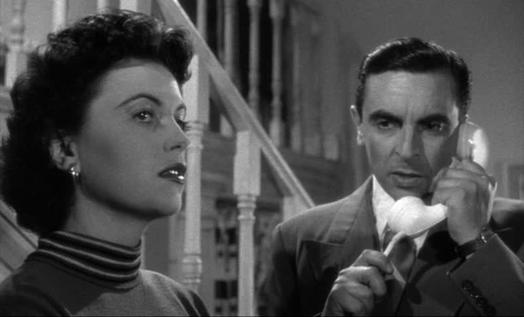
Whatever else one might say about film noir it certainly requires what might be termed the fall guy, someone who manages to get himself involved in a complex and perilous situation. Jim Bankley (Lee Patterson) fits that particular bill here, a Canadian living in post-war London, hanging around the fringes of the fight game and keen to pick up some easy money fast. He’s casually attached to a fight trainer’s daughter, Betty (Rona Anderson), but is restless and hungry for cash, restless enough to drop her if the rewards are appealing enough. Looking up an old friend leads to a encounter with gangster Rico Francesi (Martin Benson) and his predatory sister Bella (Faith Domergue). What follows won’t create too many surprises – Bankley is drawn by the glamor of the rackets and Bella is only to happy to lure him ever deeper into her web. As ever, while the profits of the racketeering and the attentions of the dangerously seductive Sicilian prove attractive, there will be a moment of truth, an occurrence which will bring home to our anti-hero the sourness at the back of it all. And that’s when the real danger kicks in…

I don’t suppose many people will be queuing up to sing the praises of director Vernon Sewell but the fact is I’ve become very fond of his work. He made a series of short and tightly paced movies throughout the late 1940s and the 1950s which are, based on the evidence of those I’ve seen so far, very entertaining and occasionally stylish too. Spin a Dark Web is, as I’ve acknowledged, a standard gangster yarn. Nevertheless, the extensive location shooting, much of which is done in a deliberately impersonal documentary style, adds a grittiness to the movie. Additionally, the planning and execution of the complicated racing sting that fleshes out the middle section of the film is well done and highly absorbing. Throw in a number of tough action set pieces and we’re looking at a solid little noir thriller.

Faith Domergue (Where Danger Lives) is the Hollywood star handed top billing in Spin a Dark Web, and the full-on femme fatale referred to at the top of this piece. She’s the kind of actress I can take or leave, largely dependent on the role she was asked to play. The role of Bella is one that works well in that it uses her cold passion to its best advantage. I think she possessed a detached chilliness and that’s ideal for the part of the self-absorbed and psychopathic woman. Those traits are ideal in the femme fatale, and it’s her conscience-free ruthlessness that makes this film succeed. So, can I answer the question I posed for myself? I’m going to hedge it by saying the femme fatale is essential here; without her deadly allure the fall guy or patsy is rendered meaningless and the film is stripped of much of its potency.

Balance is always important so a counterweight to the femme fatale in the shape of a Girl Friday figure is usually desirable, and it’s hard to think of the better choice for such a part in 1950s British cinema than Rona Anderson. She has the natural grace and charm to offset the driving aggression of Domergue, the selflessness to highlight the hollow appeal of the villainess. What would the British crime film be without Lee Patterson? I liked his work on The Flying Scot when I viewed it a few years ago and Spin a Dark Web again sees him turning in one of those typically dependable performances in a shady, semi-heroic part. I’m not sure I’ve seen much of Robert Arden beyond his central role in Orson Welles’ Mr Arkadin. He has the kind of hulking amiability about him that lends itself well to sidekick or best friend types, and just enough edginess to carry the notion of a man comfortable on the shadowy side of the street. Martin Benson is fine as the chief gangster, although he does stray close to caricature on a few occasions. Finally, there’s good support from familiar character actors Sam Kydd and Bernard Fox.

Spin a Dark Web has been released on DVD in the US by Sony as part of their MOD line. The disc only carries the movie and the trailer but it looks strong and is presented in an attractive 1.66:1 widescreen ratio. The film has also been put out in the just released Noir Archive Vol. 2 on Blu-ray, a set I may well pick up as it contains a number of other interesting sounding films I don’t already have. All in all, I found this an excellent British film noir, well acted and directed and coming in at a snappy hour and a quarter.

Three Steps to the Gallows

Last summer I spent a long time trawling through a range of British crime movies, and had a most enjoyable time in the process. I can’t promise to devote the same time this year but I do want to look at a few more examples of these B pictures. Additionally, it’s an opportunity to fit in some  cast and crew who have earned passing mentions on this site, and who I do want to draw a little attention to. So with that in mind, I’d like to begin with Three Steps to the Gallows (1953), a pacy and hugely entertaining film noir.

Alfred Hitchcock famously spoke of the “MacGuffin” as a plot device, namely something which is of inordinate and perhaps life-threatening importance to the protagonists of a drama, which motivates them and drives the narrative yet is of little real concern to the viewers. In Three Steps to the Gallows this applies to the diamonds, and I’d be amazed if anyone who watches this movie has the part played by these gemstones in mind by the time the film has come to a close. Nevertheless, diamonds, or should we say the smuggling of diamonds, is vital to the characters on screen. Gregor Stevens (Scott Brady) is an American seaman on shore leave in London, first seen happily disembarking from his ship and off to pay a visit to his brother who is resident in the capital. He’s checked out of his accommodation and a stop at the travel agency where he was employed as a courier reveals he has moved on from there, although a customer (Mary Castle) appears to recognize the name before seeing something that makes her reconsider. To cut to the chase, a few more inquiries lead Stevens to the shocking realization that his brother has not only been arrested for murder but has subsequently been tired, convicted and has a date with the hangman in three days time. And that’s where the diamonds come in; the condemned man seems to have been involved with a smuggling outfit and been framed for a killing as a result. Where does this leave the brother? Well, he has 72 hours to blunder and bludgeon his way around the criminal underworld in an attempt to clear his sibling’s name and, hopefully, nail the true culprits.

As was so often the case, Three Steps to the Gallows imported Hollywood talent to add some more box-office appeal. Both Scott Brady and Mary Castle were the transatlantic stars used, and they do add a touch of noir authenticity, in my opinion. Brady was a reasonably big name at the time, although he has probably been overshadowed somewhat by his more notorious older brother Lawrence Tierney since then. Brady had a few brushes with the law himself and had a tough demeanor too. It’s this aspect, the physicality of the man, that is highlighted most in the movie. His character crashes around London like an impatient and short-tempered bouncer, finding himself framed for a killing even as he tries to clear his brother and frequently resorting to his fists before his brain has had a chance to catch up. On paper, this possibly sounds off-putting but Brady manages to make this bruising lead sympathetic. Rita Hayworth lookalike Mary Castle, whose life took a series of noir turns itself, is fine as the girl who offers him his first opening and moves from potential femme fatale to Girl Friday. The supporting cast is typical of these B features and includes such welcome and well-known faces as Ballard Berkeley, Colin Tapley, Ronan O’Casey, John Blythe and Ferdy Mayne.

Three Steps to the Gallows was a Tempean Films production, meaning that it came from producers Monty Berman and Robert S Baker, the former also taking on the cinematography duties here. These two played a significant role in British film and television in the post-war years. Tempean Films was responsible for a number of spare and entertaining crime movies and the Baker-Berman partnership was then instrumental in bringing about many of the best ITC TV series, including The Saint with Roger Moore. The direction was handled by the ever reliable and generally stylish John Gilling, who started out as a prolific writer and director of B noir before moving on to bigger budgets, Hammer Films and television work. Here, Gilling moves everything along very snappily and the film perfectly captures the slightly seedy and decaying post-war milieu.

It’s easy to track down a copy of Three Steps to the Gallows, in the UK at least. The film has been released on DVD by Renown Films, that rich source of British B movies. The quality of the print is variable, looking crisp in some shots but dupey and with overdone contrast in others. There is also some print damage or dirt to be seen here and there, but the movie remains perfectly watchable at all times, and I doubt whether better versions are ever likely to surface. Anyone who enjoys British crime and noir movies of the era should find plenty to satisfy them in this one.

Indian Uprising

So many things seem to be connected.  And once you move into the field of the arts, and particularly cinema, this becomes all the more noticeable. Film fans tend to spend a fair amount of time griping about the latest remake and indeed the fact that more and more of that species seem to be appearing. I can appreciate that; there is that sense of laziness, of creative stagnation, and sometimes the trepidation that accompanies news that some personal favorite is about to be reimagined. Still, it’s not a new phenomenon and has been happening for about as long as people have been making movies. All of which brings me to Indian Uprising (1952), a modest yet engaging cavalry western, which is hardly the type you’d think anyone would have been clamoring to redo. Nevertheless, the writing team behind this picture are the same people whose names you will find attached to the very similar Apache Rifles, directed by William Witney more than a decade later.

The plot here is a familiar one for anyone who has seen more than a handful of westerns, but that’s not to be taken as a criticism since it’s the execution of  a story that matters more than how high or low it’s positioned on the originality scale. It’s Arizona in the 1880s and Geronimo (Miguel Inclan) is still free and more than a few steps ahead of General Crook’s cavalry. We see events from the perspective of Captain McCloud (George Montgomery), and the opening has his troops luring a band of Apache into an ambush which leads to the capture of Geronimo’s son. A valuable captive such as this offers an opportunity to draw the elusive war chief to the negotiating table, and McCloud is both humane and canny enough not to overplay his hand, ultimately setting the boy free to demonstrate good faith. What follows is a process that has often been observed. The Apache strike a deal and keep to it, but other interests are keen to make as much money as possible from the newly tamed territory. As expected, plans are set in motion to stir up latent racial antagonism, political pressure is applied, and the flames of a new conflict are kindled for the sake of a tidy profit.

The later Apache Rifles would focus on a different war chief, Victorio, and add a few other elements to the mix but the essence of that film and of Indian Uprising is the question of trust and good faith. These are eternal themes, ones that have resonance in all aspects of human interaction but are especially potent in movies looking at the Indian wars. The message conveyed here is a progressive one but it’s realistic enough not to allow its hopefulness blind us to the facts. The integrity and good intentions of the lead remain intact by the end but the ultimate shabbiness of the government line and its dissembling opportunism is confronted squarely and acknowledged, which is to the filmmakers’ credit. There are a mix of interiors and location work (including the often used Iverson Ranch and the instantly recognizable red earth of Arizona), with the latter showing director Ray Nazarro’s (Apache Territory) work off to best effect and also providing a dramatic backdrop for the major action set pieces.

If you take a look around any of the sites that devote time to classic westerns, it’s hard to avoid coming across some mention of George Montgomery. I’ve not featured him here before and the reason for that is down to the simple fact that I’ve not seen a lot of his films. This is somewhat remiss of me but I have taken steps to remedy that and have acquired a number of his movies – although in my defense, I will say that I’ve seen and enjoyed a number of episodes Cimarron City, his late-50s TV show. He’s a solid and personable lead, his part being a much more straightforward and less complicated one than the corresponding role Audie Murphy would take on in Apache Rifles, and an easy figure for audiences to identify with and root for.

The only woman in the picture is Audrey Long, and Indian Uprising would be her last movie before retiring and settling down to a long marriage to the creator of The Saint Leslie Charteris. She had a relatively brief career anyway although one which included a number of choice films; she played alongside John Wayne in Tall in the Saddle and also was cast in a couple of fine films noir Desperate and Born to Kill. A quick glance at her filmography drew my attention to another of her films I must look out for, Homicide for Three based on Patrick Quentin’s novel Puzzle for Puppets. This stood out for me because I’m a mystery fan and also due to the fact not many of Patrick Quentin’s Peter Duluth stories have been adapted for the screen, the Lex Barker and Lisa Gastoni vehicle Strange Awakening from Puzzle for Fiends being another example.

Thinking of cavalry movies nearly always brings John Ford to mind.  While Indian Uprising is certainly not in the same league as Ford’s work, there are a few common factors, quite aside from the general horse soldiers milieu. In the first place, Mexican actor Miguel Inclan appeared in The Fugitive and also, more notably, as Cochise in Fort Apache. One of Ford’s trademarks was his portrayal of the various army types and the domestic situation in the isolated outposts. The latter doesn’t get an awful lot of attention but, to me anyway, the stage Irish sergeants played by Joe Sawyer and John Call were not such distant relations of those of Victor McLaglen and Ward Bond.

Indian Uprising should be easy enough to locate. There’s a MOD DVD available in the US, a French DVD and the Spanish disc I picked up. I think it also turns up online in the usual places but I’m not positive on that. The image generally looks good with natural colors and minimal damage. While this is very much a second tier western it’s also an enjoyable one. These kinds of movies were the bread and butter affairs that kept the genre ticking over and are often better than some critics would have you believe. I liked the movie and I feel anyone who appreciates what such programmers have to offer will do so too.

The Outcasts of Poker Flat

If there’s one thing that turns my stomach, it’s respectability.

By the 1950s the western itself could be said to have attained something very close to respectability. Mind you, the relative dearth of awards bestowed on the genre, even in these peak golden years, possibly contradicts that. If respectability hadn’t entirely been conferred or, as the above quote from Miriam Hopkins’ character asserts, wasn’t even something worth angling for, it would be hard to deny the popularity the genre was experiencing. There are all sorts of theories propounded to account for that popularity, and I guess we’ve all become familiar with a fair few of them. In filmmaking terms, it’s the ultimate American genre, and for many that makes it part of the bedrock of cinema. I think the myth of the Old West as portrayed on screen is one of the strongest representations of the myth of America, and I’m referring to America here as an idea as much as a nation. One of the central tenets of that idea, to  my mind anyway, relates to rebirth, renewal and, that word which is hard to avoid under the circumstances, redemption. All the best examples of the western hinge on this, and The Outcasts of Poker Flat (1952) is no exception in that regard.

The story begins in the town of Poker Flat, in deep and forbidding darkness. The foul and muddy streets glisten in the night, and few people are to be seen, most are whooping it up in the saloons as they drink and gamble the evening away. Yet, there are a few figures abroad, detaching themselves from  the shadows momentarily to move from one brightly lit establishment to another, although a handful are heading in another direction. These are the men led by Ryker (Cameron Mitchell), and they are on their way to the assay office, planning to raid the safe within. That robbery, where Ryker cynically betrays and sacrifices his confederates, sees some new graves filled and a residue of bitterness left among the miners.

If justice can’t be fully meted out, then outraged morals can at least be assuaged, and so it is that certain undesirable elements are to be run out of town. The can in this case is to be carried by the gambler Oakhurst (Dale Robertson), the drunken Jake (Billy Lynn), ageing saloon girl the Duchess (Miriam Hopkins) and a young woman called Cal (Anne Baxter). The latter is the wife of Ryker, and is in possession  of the proceeds of the robbery, but this is not known to her ill-assorted traveling companions. However, this fact is to play a crucial role as the outcasts along with a young man and his pregnant fiancée are forced to lay up in an abandoned cabin to shelter from and wait out a blizzard.

Remakes are nothing new, it’s a practice stretching right back to the early days of moviemaking. The Outcasts of Poker Flat, freely adapted from Brett Harte’s story,  had already been filmed in 1919 by John Ford, and again in 1937. I’ve not seen either of the earlier versions so I can’t comment on how Joseph M Newman’s 1952 movie compares. It does develop the plot in a different way to Harte’s original text though, reducing the tragic elements and instead building up the positives. This is where I see the western movie, especially in the key post-war years and on into the 50s, bringing those redemptive concepts to full fruition, using contemporary sources and situations, retaining the core shape and then molding them all to slot into the mythic framework we now recognize. In The Outcasts of Poker Flat it’s those title characters who redeem themselves and are spiritually reborn via their confrontation not only with evil but also through society’s rejection of them and, as a consequence of this, their own revitalized self-reliance and self-confidence.

In visual terms, the progress of the characters along the road towards renewal is plain to see. The film starts out in deep and grimy darkness, rooted firmly in an uncommunicative, isolated and threatening environment. By the end though, light has come to dominate, a literal birth is soon to take place and the two leads opt not to return to Poker Flat but to take an alternative turn and strike off towards a new destination. Newman’s direction throughout has been very solid, emphasizing the narrowness and lack of space of the cabin, clearly drawing attention to the parallels in the characters’ lives. And then there’s the gradual widening  of perspective, leading up to the bright, airy and liberated feel of the final scene – a literal journey into the light, towards open horizons. While Newman’s direction is assured and controlled, the real star of the show is the wonderful and expertly lit cinematography of Joseph LaShelle.

The cast is small and ample time is available to allow most to make a mark. The principal female lead is Anne Baxter, a versatile actress who was in her prime at this stage and she offers good value as the conflicted wife who doesn’t quite know how best to extricate herself from the tangled mess her life has become.  Dale Robertson is generally a good western lead, a dependable presence who tends to anchor movies securely. That’s exactly what happens in The Outcasts of Poker Flat, where his unflappable stoicism keeps the tension manageable and the melodrama in check.

That tension comes from a combination of the elements, the isolation and then the return of Cameron Mitchell’s menacing villain. He does a neat line in shiftiness in this movie, coming across as genuinely mean and dangerous and with just enough insecurity to go along with it to add a layer of unpredictability. Billy Lynn is fine as the befuddled drunk and Barbara Bates (who had appeared with Baxter in All About Eve) is appealing and vulnerable but has little to do. On the other hand, Miriam Hopkins is on top form as the jaded and weary Duchess, a woman who knows her best years are behind her, and delivers some of the best lines with an acid relish.

For some reason The Outcasts of Poker Flat doesn’t seem to be widely available. I don’t think it’s out on disc in the US but there are European releases. There’s a French disc which I imagine will suffer from non-removable subtitles and there’s also an Italian DVD. I have a copy of the latter and I have to say the film looks terrific, it has been given a very clean and sharp transfer and the print used is clearly in great shape.

This piece represents the 200th western movie which I have written about on this site and I hope others will think it’s an appropriate choice. Sure I could have picked a big, better known title, but as I said some time ago when I marked the 100th western, it somehow seems more fitting to choose the kind of less celebrated movie I’ve spent a lot of time (although by no means exclusively) flagging up over the years.

Other Joseph M Newman westerns:

The Gunfight at Dodge City

Fort Massacre

A Thunder of Drums

The Turning Point

Organized crime, corruption and graft became increasingly common features of film noir as it moved into the 1950s. Those unattractive yet perennial problems seemed even less savory in a world just beginning to find its equilibrium again after the trauma and devastation of the war years. The desire to root out such rottenness, particularly after so many had sacrificed so much in pursuit of something finer, had the potential to provide powerful drama. Still, alongside this, it has to be acknowledged that there was a correspondingly strong chance of any movie going down this route declining into a dry, or even pompous, affair. The surest way to combat that unwelcome effect was to ramp up the human interest, to emphasize the personal angle while holding the preaching in check as far as possible. The Turning Point (1952) represents a broadly successful attempt to ensure this balance is achieved.

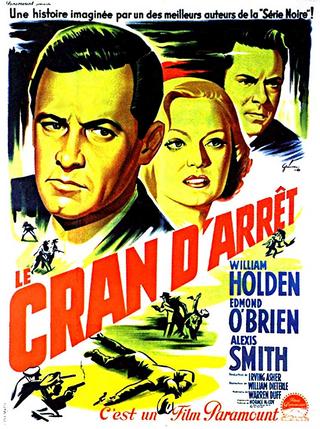
There is an especially nasty flavor to organized crime. It dresses itself up in a sneer, celebrates its own conceit and smirks at its own soullessness. It’s a crime without passion, an offense keen to court glamor yet one which leaves behind huge numbers of victims as it swaggers nonchalantly towards the next big score.  The Turning Point clearly acknowledges this as it follows prosecutor John Conroy (Edmond O’Brien) on his crusade against the mob in an unidentified Mid-West city (despite the fact the location work makes it abundantly clear the film was actually shot in Los Angeles). Superficially, there’s nothing new here and one might be forgiven for expecting another straightforward racket-busters yarn. However, there are elements introduced that muddy the ethical waters somewhat and thus raise the bar a few notches. To begin, there’s Jerry McKibbon (William Holden), the newspaperman whose friendship with Conroy will be tested both by his own inherent cynicism and his growing attraction to his friend’s girl (Alexis Smith). There’s the makings of an interesting moral dilemma shaping up there, but all this is somewhat overshadowed (although one could argue it’s also complemented) by the fact Conroy’s policeman father (Tom Tully) has secretly been in the pocket of the mob boss for some time.

As I alluded to above, films based around the mob and/or those tasked with taking them down can become wearisome in their predictability. There’s a tendency perhaps to focus on the  tough cool of the knowing gangster, the high-living wiseguy who’s got society’s number and plays it mercilessly. Either that or the audience is placed in the shoes of the straight arrow agents of the law, and all the grey sanctimony that inevitably follows in the wake of that approach. There’s something refreshing about the way The Turning Point enthusiastically embraces the flaws in human nature – the use of the source material by Horace McCoy (They Shoot Horses, Don’t They?) can’t have hurt.  Nor can the smooth and sensitive direction of William Dieterle, yet another of those who brought their European filmmaking sensibility with them and thus enriched Hollywood in the studio era.

Good casting goes a long way, in my opinion. Both Holden and O’Brien play to their strengths, the latter projecting businesslike  solidity, while the former exudes worldly (indeed world-weary) charm. Crucially, neither one overcooks it or allows it to slide towards parody. Alexis Smith was both capable and beautiful, working on a number of good movies over the years but maybe too many middling ones kept her star from rising as high as it could have. Tom Tully had the pivotal of the compromised cop, one that needed to  be written and performed well if the story was to retain its credibility. Happily, both the actor and the writers seem to have grasped this fact and the emotional core holds up as a result. Good villains are also essential in such tales, and small but memorable appearances from Ted de Corsia, Neville Brand and Carolyn Jones help things along. Ed Begley, a champion of bluster and indignation, does well as the crime boss; the scene where he calmly orders the firebombing of an entire building just to protect his interests is chilling in its calculation, and also heartbreaking in the dispassionately filmed aftermath.

A fair bit time has been taken up on this site bemoaning the lack of attention given to certain Universal-International tiles. The same can certainly be said of Paramount material – while a fair bit has leaked out over the years, plenty more remains either unavailable for viewing or  only exists in inferior form. This is true of The Turning Point, a film which was once announced for release on Blu-ray but then pulled as the elements were said to be sub-standard. At present, there are DVDs to be had from Spain and Italy but the transfers are pretty weak by all accounts, and I have a hunch they may not advance much, if anything, on what can be found quite easily online. A pity really, and it would be great if a more visually appealing version could be found and put on the market.

The Glass Web

There’s something interesting about looking at the shape of a filmmaker’s career, what they were doing at certain points, whether there were overlaps or complementary features to be discerned, or perhaps exploratory forays into entirely different areas. It’s educational too to note how the extraordinary can cozy up comfortably next to the ordinary. This is something that struck me while looking at some early work by Jack Arnold. In the same year he made the quite extraordinary It Came from Outer Space, he also directed the much more conventional noir/mystery The Glass Web (1953), although that’s not to say this latter title is without interest.

I tend to think of the desert when a Jack Arnold film comes to mind, and The Glass Web opens with a car coming to a stop in just that location. A couple get out and move into the foreground, the wife briefly bemoaning the isolation and discomfort before her husband does away with her and drops her body down an abandoned shaft. Stark and dramatic stuff, but as the camera pulls back it’s also apparent that it’s a studio set, a mock-up used in the shooting of an episode of a TV show. The actors dust themselves off and the all-important advertising message takes over. The actress who has just been swallowed up by the  desert sands is Paula Ranier (Kathleen Hughes), and in some ways this can be seen as a dry run for her  eventual fate. Without getting into too many details here, and the consequent risk of spoiling things for those unfamiliar with the film, we’re looking at a solid whodunit (although the actual “who” isn’t that difficult to work out) with a dark noir heart beating at the center. Everything hinges on a classic triangle involving Ranier, writer Don Newell (John Forsythe) and consultant Henry Hayes (Edward G Robinson), and it’s gradually revealed as a complex affair encompassing jealousy, betrayal, blackmail, guilt and humiliation.

As arguably befits a movie concerning itself with entertainment industry figures, the bulk of the action is shot on sets and in the studio, where the characters themselves spent most of their own lives. There are a handful of occasions where events do move outside on location, something I think Jack Arnold usually made good use of, but seeing as the whole story is an insular one centered on a fairly tight group of individuals the internalized feel works quite well. In terms of noir, the movie doesn’t break any new ground, focusing on those themes that had become staples of the form by then. I suppose the 3-D shooting was still innovative at the time but I’m not sure it would have brought a lot to proceedings here. Now I’ve only seen it flat but it doesn’t seem like one of those movies where the extra depth would have added much, and the fact there is a short sequence – as Forsythe roams the streets in a despairing mood at the thought of the hole he’s dug for himself – where a series of objects are essentially flung at the camera gives the impression the producer felt it necessary to artificially highlight this aspect.

On the other hand, the setting is of interest. The fact TV was very much in competition with, and indeed seen as a threat to, the movies at this stage is of note. Hollywood has always indulged in some inward-looking self-criticism and some of that approach is adopted. There is a particularly cynical view of the role of advertising in TV production – in fact it’s rather scornful, with characters commenting how the ads are the most important part of the finished show. Then again, there is also an implied acknowledgment of the power and immediacy of the new medium in the climactic scenes, the culprit carelessly making a confession on a deserted sound stage while the cameras surreptitiously roll and pick it all up. Just as TV  in reality could claim to show the viewers events as they happen, so we the audience (and the on screen cops too) get to view this drama unfold via a live feed.

I tend to think of John Forsythe mainly in terms of his television roles, where he was both a familiar face and voice for many years. Having said that, he made a number of memorable big screen appearances too, getting important roles in films by John Sturges and Alfred Hitchcock. His role in The Glass Web has enough complexity to make it satisfyingly unsympathetic and he plays well against the ever impressive Edward G Robinson. By all accounts, Robinson was a cultured man, an trait that often appears at odds with the kind of heavies he was often cast as in the early part of his career, and it’s enjoyable to see him as a character with a passion for art and the finer things.

Not for the first time, I  find myself writing about a Universal-International movie which remains commercially unavailable, and it pains me particularly to note yet another Jack Arnold title languishing in this fashion. The Glass Web pops up from time to time online, but it’s in the usual weak and compromised form. One can only hope that the movie, not to mention a number of others from the same studio, will eventually be afforded a release that allows more people to see it and form their own opinions about its merits.

Silver City

Watching movies again after a long gap can alternate between the rewarding and the disappointing. Any conclusions reached are, of course, entirely subjective as it’s we who represent the variable here, the ones who change, and not the movies themselves. And it’s a curious phenomenon, one whose mechanics I’ve never wholly understood beyond vague allusions to the mood one happens to be in on any given occasion. For what it’s worth, I find that my feelings towards most films don’t shift all that radically, and when I do perceive a change it’s a positive one as often as not. Still, when I recently had another look at Byron Haskin’s Silver City (1951) I experienced the opposite effect – a certain disappointment, as though the film I remembered were subtly different.

The show opens with a robbery and pitches us right into what promises to be a pacy adventure. The bright start and then the following sequence that establishes Larkin Moffatt (Edmond O’Brien) as a man fated to be dogged by a tarnished past has the potential to develop into something really meaty and satisfying. We follow Moffatt from one rejection to another as he trudges along the path of weary disillusionment trodden by legions of noir anti-heroes. This was the image I’d been carrying around in my mind – that of the pugnacious, tight-lipped guy slouching his way through a hard-boiled western in search of some form of personal redemption. But that’s only part of the story, and not necessarily a fair representation of it either. Moffatt is thrown a moral lifeline of sorts when Candace Surrency (Yvonne De Carlo) and her miner father Dutch (Edgar Buchanan) persuade him to take on the role of foreman when they’ve made a big silver strike. There’s trouble looming though in the shape of a grasping rival, Jarboe (Barry Fitzgerald), as well as the reappearance of  figures from Moffatt’s past who refuse to let him move on.

On paper, this all sounds quite good – and the fact it’s derived from a Luke Short story attests to its pedigree – but the fact is it plods along where it needs to zip, and the tone tends to vary in a way I didn’t find especially successful. Moffatt is for the most part portrayed as terse, tough and two-fisted but there are a few occasions where he’s involved in some knockabout antics which didn’t blend in naturally for me – there’s a manufactured saloon brawl that feels altogether too broad, in my opinion. Aside from that, I’m of the opinion that there’s almost too much going on in the script – jealousy, romantic subplots which crisscross feel somewhat repetitive, rivalries that spill over from relationships into business, and consequent grudges and bad feeling nursed by others. In short, there’s always something going on but the crowded nature of it all actually serves to slacken the pace rather than quicken it.

On the plus side, there is a fine cast here, led by the ever watchable O’Brien, bringing that natural noir sensibility he had to his role. Yvonne De Carlo always had that earthy allure and photographs wonderfully in Technicolor. I think she generally excelled in westerns and made quite a few, her blend of sexuality and toughness finding a natural home in the genre. Laura Elliott (AKA Kasey Rogers), who had a pivotal role in Strangers on a Train around this time, is fine too as De Carlo’s competition for O’Brien’s attentions. Moving on to the villainous roles, I ‘d argue there are too many of them for their own good. The great Barry Fitzgerald could never be less than enjoyable and he seemed to be having a high time with his malignant Irish pixie act. John Dierkes is good too as a murderous and vindictive drunkard but he’s underused, while neither Richard Arlen nor Michael Moore amount to a big enough threat to provide a solid core to the drama.

I think director Byron Haskin had a great visual sense and this film looks very attractive most of the time. Westerns tends to be at their best when the locations are used to good advantage and while this film has some good outdoor work, it has to be said that the director really made the most of the interiors, and there’s no doubt cameraman Ray Rennahan’s beautifully understated lighting played an important part in this too. Haskin made a trio of westerns around this time with Edmond O’Brien and I’m keen to see the most elusive of them, Warpath.  That title has only had a release in Spain as far as I can tell and I can’t find any reviews to throw light on its quality. Even so, I may well end up taking a chance on this myself in order to satisfy my curiosity.

Silver City has been out in the US on DVD and Blu-ray via Olive  for a few years now, and I think there are European versions on the market too. The movie looks reasonable, if not startling, and passes the time agreeably. However, I still feel there are the ingredients for something better in the mix, and I remain somewhat disappointed that my latest viewing had me noticing more of the flaws than the strengths. Anyway, that’s just my current take and, as ever, other opinions are available.

Invasion of the Body Snatchers

At first glance, everything looked the same. It wasn’t. Something evil had taken possession of the town.

There’s something powerfully compelling about stories of creeping paranoia, where reason is not merely sidelined but is trampled underfoot by the unthinkable. Those 1950s tales, born out of global fear and uncertainty, urging vigilance both towards the enemy within, and, especially in the case of Invasion of the Body Snatchers (1956), the enemy wearing one’s own face once felt like a curious relic of the recent past. Nowadays, with opportunists everywhere never passing up an opportunity to encourage suspicion and division, you’d be forgiven for thinking it way well represent a timeless observation on human frailty.

I find the 1950s an endlessly fascinating decade from a filmmaking point of view. There is an irrepressible post-war optimism on view, a sense of hope and positivity for the future; the big shiny automobiles, those spotless, picture postcard small towns, the neat homes resplendent with the latest technology, and most of all the outwardly content people all seem to reflect this satisfaction. Yet satisfaction can all too easily spill over into smugness and conceit, trapping the unwary and leading them into peril. Perhaps it’s our collective sense of doubt, something indelibly stamped on our consciousness by centuries of nasty surprises, that makes us wonder if there’s not danger lurking in the shadows cast by the glow of our apparent success. It’s this juxtaposition of ideas – the comfortable gloss sharing space with the uncertainty – that makes the best 50s movies such a draw for me.

Dr Miles Bennell (Kevin McCarthy) is one of those archetypal post-war figures, young, successful (albeit with a broken marriage behind him) and well-regarded in his community. And Santa Mira is one of those idealized communities I referred to above, comfortable and orderly and the last place one would think of as a threat. Nevertheless, that’s precisely what it represents, for the story rapidly makes it clear that the residents of this small settlement are behaving strangely. There are growing numbers of reports that members of their own families may be imposters, perfect physical and psychological replicas, yet lacking those tell-tale traces of humanity that only those most intimate with us would spot. Surely this is impossible though; it defies all rational explanation and even if it were true, how could one do anything about it before succumbing oneself, and who could be trusted in the interim? Here we have the dilemma faced by the increasingly isolated doctor.

That’s about as much detail as I plan to go into regarding the plot. Those who are already familiar with the film will know everything necessary anyway, and those who are not are entitled to go into it without having the developments spoiled for them by me. In any case, it’s the theme and the thinking behind the movie that interests me most here. The story comes from Jack Finney’s book (called simply The Body Snatchers) which originally appeared in serial form. There are of course some differences but the overall shape of the narrative is retained in Daniel Mainwaring’s screen adaptation. Even the frequently criticized prologue and  epilogue which frame the movie, and were apparently demanded by the studio to counter the perceived bleakness, are close in spirit if not actual detail to the original ending of the novel.

It’s what comes in between though that makes this one of the great Sci-Fi classics. I don’t think there’s much doubt that the film was conceived and executed as an entry into what we now think of as the Red Scare sub-genre, those films which tapped into Atomic Era anxieties and played (or maybe preyed) on fears of infiltration by those bent on damaging society. What lends  this story its power is its use of the notion that the “enemy” is indistinguishable, so much so in fact that even those nearest to us may not be all they appear. And then a further twist of the psychological knife is achieved by having us doubt even ourselves – should our guard drop for the briefest of instants, our souls may be stolen. It’s not a huge step then to regard the danger as something already a part of us, a sort of variation on the old original sin concept and the ultimate in horror, that the face of evil is not just familiar, but one’s own mirror image.

I guess Kevin McCarthy will be forever remembered for his role as the doctor whose calm confidence is not so much eroded over the course of a couple of days as brutally shattered by a series of relentless and terrifyingly swift developments. It’s a credit to McCarthy that the transition from cool professional to gibbering maniac is both seamless and entirely convincing. Dana Wynter gets a great part too as the returning romantic interest. There are nice supporting roles for King Donovan and the underused Carolyn Jones and Jean Willes. And it would be remiss of me not to mention a brief appearance by future director Sam Peckinpah.

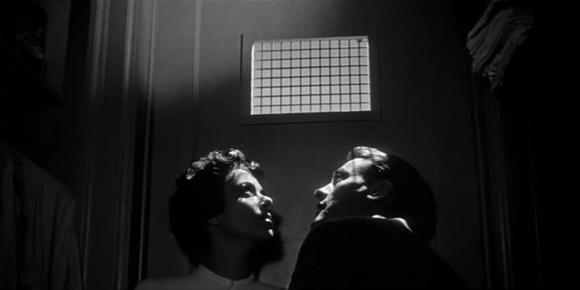
Mainwaring’s script, and Finney’s novel naturally, form the core of the movie, but the direction of Don Siegel and the cinematography of Ellsworth Fredericks are vital too. The latter bathes the movie in the kind of deep shadow which we normally associate with film noir and the effect (not to mention the parallel) is wholly appropriate given the subject matter. Siegel’s punchy, spare direction is a great asset, keeping the pace up and using a whole range of interesting angles and perspectives – squeezing the characters through tiny windows, moving them along cramped corridors, confining them in cupboards and even under boardwalks – to ratchet up the sense of claustrophobia, the limited room for maneuver and the ceaseless tension.

I see that Invasion of the Body Snatchers has recently had a deluxe Blu-ray release in the US, and it’s a film that’s certainly deserving of such treatment. I’ve not had an opportunity to sample that version but I do hope a European special edition turns up at some point in the future. In the meantime, I’d unreservedly recommend that anyone who hasn’t had a chance to see this movie should make an effort to do so as soon as possible. We’ve had some fine discussion here before on the difficulty in defining exactly what characterizes a great movie. I imagine it’s safe to say few will upbraid me if I assert that Invasion of the Body Snatchers is unquestionably one of the true greats.

The Violent Men

Quality is a hard thing to  define with any degree of precision. It’s something we all know when we see it but try putting it into words, creating a label for it which can be affixed to suitable candidates and you find yourself in trouble. If that’s a tough one, then differentiating or categorizing grades of quality is the kind of challenge one could base myths on. I, like probably most other people, will take some pride in my ability to recognize “a good movie”, even if that is merely my necessarily subjective view, and I might also try to impart to others exactly why I feel this is the case. But what separates a great movie from a simply good one? I genuinely don’t know, but again I can usually recognize it. All this abstraction leads me to The Violent Men (1955), a Rudolph Maté directed western with a superb cast and the kind of names on the other side of the camera which really ought to ensure its comfortable position among the acknowledged greats. Yet it doesn’t belong there, it’s not poor by any means but never rises above the level of quite good. And I can’t help but wonder why that’s so. Needless to say, any and all ideas on the subject are welcome and will be taken into consideration.

The framework within which the story plays out is a classic one for the genre, the range war. The motivation behind it all appears to be ambition and a twisted kind of love, twisted by a its traumatic birth in violent circumstances. I say appears here because it’s really greed, or perhaps covetousness might be more accurate, which propels everybody and everything towards another of those fiery yet cathartic conclusions. We follow it all from the perspective of John Parrish (Glenn Ford) a Civil War veteran who came west in the uncertain hope of recovering from his wounds. Well he did recover, and clearly made a success, albeit a slightly reluctant one, of his time as a small-scale rancher. However, in something of a subversion of the standard western trope the dearest wish of this young man is to go east. That’s what he claims anyway, or at least it’s what his betrothed, Caroline Vail (May Wynn), has encouraged him to believe. When we meet Parrish he’s poised to sell out and be on his way to a new life, but there are clearly nagging doubts stalking him. He’s ready to sign everything over to local big shot and bully Lew Wilkison (Edward G Robinson), a battle-scarred old tyrant who rules the range with an iron fist but who fails to see the treachery taking place under his own roof involving his restless wife Martha (Barbara Stanwyck) and his shiftless younger brother Cole (Brian Keith).

I spoke about the path that leads to a blazing climax earlier, but it’s a long and slow-burning fuse that leads us there. The first half of the movie builds everything up carefully and methodically, as Ford’s character gradually comes to terms with his own doubts, his sense of responsibility to a place and a people who arguably saved his life and offered him a new start. As he watches injustice pile on top of vindictiveness, till cold-blooded murder is done before his eyes, we see him wrestling with his own indecision. Ford was, in my opinion, a master at pushing against his own natural reticence, a characteristic which colored and strengthened his best performances. This quality gets a solid workout in The Violent Men, the pressure rising incrementally until a release must be  sought.

If drama needs conflict in order to have meaning, then that conflict should be founded on the existence of a strong villain to give it the necessary momentum. The Violent Men presents the nominal bad guy in the form of Edward G Robinson and he growls, blusters and threatens his way through the first half with aplomb. Still, I don’t think he can be classified the main villain; although there’s some effectively sullen slouching from Brian Keith, and even a bit of mean braggadocio from a young Richard Jaeckel, the honor surely belongs with Barbara Stanwyck. Mendacious and manipulative to the end, she pulls the strings and directs the mayhem, easily seeing off any competition from the other women in the cast – May Wynn, Diane Foster and Lita Milan. In support, Warner Anderson is enjoyable as Ford’s dependable foreman and there’s a typically unctuous turn from James Westerfield.

Rudolph Maté began as a cinematographer and carried his talents in that area into his subsequent work as a director, generally turning out visually attractive and striking movies. With a man like that directing and the actual photography duties shared between W Howard Greene and Burnett Guffey, it shouldn’t be any surprise that the film looks exceptionally fine, aided by shooting in the familiar Lone Pine locations. The story derives from a novel by Donald Hamilton, of the Matt Helm stories (much admired apparently by John Dickson Carr) and The Big Country. Personally, the only book by Hamilton I’ve read is Night Walker, which was reissued in paperback a few years ago, and I rather liked it so I’ve a mind to see if I can locate a copy of this. Anyway, plenty of talent on display here so far and that’s further enhanced by having the score penned by the great Max Steiner.

So, we wind up in a similar place to where we started, looking at a mightily impressive list of highly talented contributors in a well made western that flirts with themes that allude to classical tragedy. Make no mistake, this is a fine and entertaining piece of work yet it falls short of what I’d think of as greatness. Nevertheless, this isn’t a major criticism, more something that piques my curiosity. Just to round it all off, while The Violent Men has long been widely available on DVD, the image could use a bit of a brush up and there’s the potential for a very strong Blu-ray. As far as I’m aware, no-one has  released a Hi-Def version of the movie and I think this is a title deserving of that kind of treatment.