Ceiling Zero

poster7_zpsmiraqcml

If you spend any time watching, discussing, reading or writing about movies, then the auteur theory is one which will inevitably cross your mind. I was first exposed to this concept in my teenage years, and it’s a notion which I first embraced and then rejected. Over time I’ve shifted my position on the matter frequently, mainly due to my acceptance of the collaborative nature of the filmmaking process. I’ve now become more comfortable with the label, no longer seeing it as inherently pejorative towards the collective efforts of the other people involved. The fact is it’s hard to ignore the idea of the auteur when you look at the body of work of the most significant directors. Howard Hawks provides a good example of what I’m talking about; his films are remarkable for the frequency with which they return to a broadly comparable milieu, setting and theme. Ceiling Zero (1936) is the kind of film I think it would be impossible to view without thinking: yes, this is clearly a Hawks movie.

The title refers to the kind of weather conditions that were the bane of aviation pioneers, the sky right down on your nose and visibility all but non-existent, compelling them to rely on a combination of fickle instrumentation and gut instinct to see them through. The story takes place in a Newark airfield, and the focus is on a group of pilots and ground crew responsible for the mail run. Jake Lee (Pat O’Brien) is the superintendent, a former pilot himself who’s now the de facto boss, hiring, firing and calling the shots in the day-to-day running of the outfit. He’s a disciplined man, secure in his professionalism and apparently unsentimental. And yet that’s not entirely true, for there is a chink in his armor, a blind spot. Jake’s dedication to his job is superseded only by his loyalty to old buddies and former comrades in arms. It’s there to be seen in his easy friendship with veteran flyer Texas Clark (Stuart Erwin) and also his quiet concern for the welfare of an ex-pilot brain-damaged as the result of an accident and now reduced to the status of janitor/cleaner. However, it’s the arrival of another old pal, Dizzy Davis (James Cagney), which underlines this aspect of his character. Dizzy arrives at the airfield in spectacular fashion, indulging in plenty of fancy aerial acrobatics before touching down. It’s immediately obvious that Dizzy is a reckless individual, hard-living and wholly self-absorbed. His reputation as one of the flying greats precedes him, and he plays up to it shamelessly. What we’re watching here is, essentially, the final act in the life of a man who’s a victim of his own legend, coasting along on the reminiscences and indulgence of others. However, times change and a man can only subsist on his past glories for so long. With the job of the pilot moving relentlessly towards a more serious place, a guy like Dizzy is fast becoming a walking relic, a throwback to a devil-may-care era of swashbucklers. The crunch arrives when his selfishness and carousing brings tragedy to the tight-knit airfield, and puts both his character and his friendship with Jake under the microscope. But, as is the case with all the best movies, even those who have squandered the chances life offered before have the opportunity to achieve a salvation of sorts.

Frank Wead adapted Ceiling Zero for the screen from his own stage play and its theatrical roots are clear to see. The action is largely confined to one set, the airfield’s nerve center, where the human drama is played out. As such, it’s an ideal vehicle for Howard Hawks. His signature was always a focus on small groups, isolated in one way or another, and held together by their sense of professionalism. The characters here seem to exist within their own little world, a self-supporting community of like-minded individuals fiercely protective of each other and suspicious of the occasional incursions by those from the outside. A typical Hawks movie could be characterized as one where the characters’ interactions reign supreme, and the settings are merely cosmetic backdrops to facilitate the drama. Only Angels Have Wings (which bears some resemblance to this film) takes place in South America, Rio Bravo in the Old West, Hatari in Africa, The Thing from Another World at a polar research station. Yet in all those cases the location used is of much less importance than the dynamic between the people occupying them. And so it is with Ceiling Zero, where the whole thing revolves around the relationship between Dizzy and Jake.

James Cagney and Pat O’Brien became a recognizable and successful team during the 30’s and I’d rate Ceiling Zero right up there with Angels with Dirty Faces as one of their best collaborations. They both had that mercurial Irish quality that leads to some sparkling moments on the screen, their snappy waspishness colliding as the two stubborn personalities meet head on. Still, there’s the underlying affection and respect which gives it its heart – the sharp exchanges with the machine-gun delivery grab the attention yet it’s the quieter passages the two men share which reveal more. As Cagney’s bravado and vanity recede, and O’Brien’s simple humanity rises to the surface, a genuine friendship can be seen. And it’s there too in the reactions of both to the tragedies and losses they suffer – subtle, heartfelt and quite moving. While the film is really a showcase for Cagney and O’Brien – not that that’s any bad thing – there’s good support provided by Stuart Erwin, Isabel Jewell, June Travis and Barton MacLane among others.

As far as I know, Ceiling Zero has yet to make it to DVD in the US, but it has been released by Warner in France. The French disc offers a reasonable presentation of the film using a print which doesn’t display much in the way of damage but there is a softness to the image indicating a lack of restoration. French releases can have an annoying habit of forcing subtitles, although I’ve never found this to be the case with WB titles. It’s certainly not a problem with this movie – the option to watch with or without French subs is offered on the language selection menu. In my opinion, Ceiling Zero is typical Hawks, and anyone familiar with his work will need no further recommendation. Perhaps it’s not the easiest film to find but I reckon it’s well worth the effort.


Secret of the Incas

Certain movies just seem to stick in the mind for one reason or another, sometimes not the whole film but a scene or two or maybe even only part of a scene. That was the case with Secret of the Incas (1954), which I recall seeing on television as a kid. It was the climax, or parts of it anyway, that remained with me and I hoped for a long time to get the chance to catch it again. Over time I’d heard it said that the film had a big influence on the development of the Indiana Jones character, and it’s easy enough to see where that idea comes from, but that didn’t interest me so much – my early viewing had preceded Raiders of the Lost Ark by a few years. Returning to half-remembered movies can, of course, prove to be enormously disappointing – all the elements which appeared thrilling and memorable to a youngster can fall completely flat when viewed through adult eyes – but not always. I’ve been able to see Secret of the Incas a few times now and I think it still holds up as an entertaining adventure yarn.

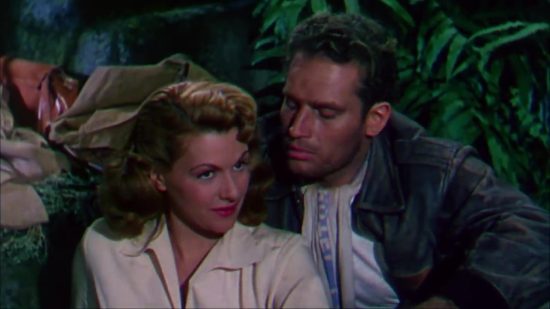
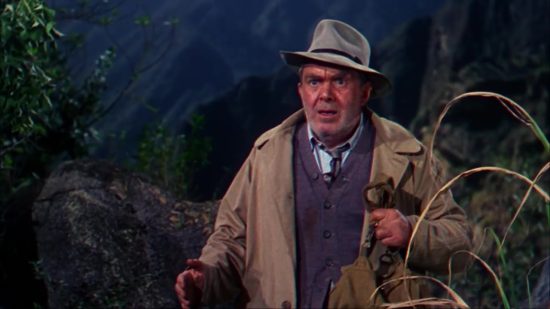
Harry Steele (Charlton Heston) is a classic pulp creation, scratching out a living in and around the Peruvian city of Cuzco. Trading on his looks and rugged demeanor, he latches onto newly arrived American tourists and offers his services as guide and, it’s strongly hinted, as a source of entertainment for the bored wives of the tired middle-aged businessmen who retain his services. Essentially, he’s a disreputable character, willing to do most anything to turn a buck and ever on the lookout for an opportunity to hit it big. In this case hitting it big would be the recovery of a fabled Inca artifact, a fabulous jewel-encrusted sunburst which has been lost for centuries and is of huge spiritual value to the indigenous people. While Steele runs his own schemes and scams he also makes use of, and is used in turn, by a fellow expatriate scoundrel, Ed Morgan (Thomas Mitchell). Both men long to get their hands on the Inca treasure, Steele actually having come into possession of a vital clue to its whereabouts, and the chance to do so presents itself in a somewhat roundabout fashion. The arrival in Cuzco of a Romanian defector, Elena Antonescu (Nicole Maurey), desperate to reach the US by any means looks at first to be an unwelcome distraction. However, the fact that the lady in question is being pursued by an official who just happens to have his own light airplane rouses Steele’s interest. He now has a way to get in and out of the lost city of Machu Picchu, where he believes the sunburst is hidden. Still, with Morgan on his trail, a team of archeologists excavating the site, and an ever-increasing stream of native pilgrims arriving daily, things may not be quite so simple.

Director Jerry Hopper had a pretty solid run of pictures in the early and mid-50s, he’d already worked with Heston on Pony Express and went on make the entertaining Smoke Signal with Dana Andrews afterwards. One of the most attractive aspects of the film is the beautiful location work in Peru, with Lionel Lindon’s camera lapping up the local color and spectacle. Hopper keeps things moving along nicely, blending footage of Peruvian customs to add a sheen of authenticity without allowing the narrative to flag. The script comes courtesy of Sydney Boehm and Ranald MacDougall, the former having written some fine films noir and there’s a brusque, hard-boiled quality to much of the dialogue that wouldn’t sound out of place in a crime film. Although this is a fairly unpretentious adventure, there’s also enough character development to ensure it doesn’t become overly formulaic. Steele grows and changes as events proceed and he undergoes the kind of redemptive arc I always appreciate seeing.

Charlton Heston almost inevitably ended up dominating any movie he appeared in, the sheer physical presence of the man demanding your attention. That trademark swagger is on display of course, but he has plenty of opportunities to show off his acting chops too. The early scenes highlight his complacent amorality, cuckolding clients to their faces and pocketing the money women give him with relish. If that were all it consisted of, it would be a one-dimensional performance though. What adds interest is the gradual awakening of some ethical sense, the realization that his current path will surely lead to his transformation into all he holds in contempt. Perhaps it’s the stinging rebuke of a woman or maybe the contact with those whose spirituality overrides base greed that pricks at his conscience; whatever the trigger actually is, the character of Steele comes to see himself as he really is, and what he may become.

Heston carries that off well, but the presence of Thomas Mitchell is vital in making it work. Mitchell always gave great value as far as I’m concerned, conveying a feeling of pathos better than any character actor I’ve seen. His playing of Ed Morgan is a spot on portrayal of a man gone to seed physically and emotionally. The stubbly face, the stained sweater, the fevered and darting eyes all point to decay and decline, and it’s all perfectly believable. Nicole Maurey is fine too as the political fugitive, a woman whose shady past is alluded to but never wholly explained. This leaves her with an air of mystery and we don’t really need to know what led her to flee to South America anyway. Less satisfactory is Robert Young’s staid archeologist – his performance isn’t a bad one yet the writing leaves his character’s storyline hanging and unresolved at the end. There are supporting roles for Peruvian singer Yma Sumac (her extraordinary and haunting vocal talents provide the basis for much of the soundtrack), Michael Pate, and a knowingly humorous Glenda Farrell.

Secret of the Incas appeared to be out of circulation for a long time but there are DVDs available in both Spain and Italy now. Olive Films had announced their intention to release the movie in the US at one point and then backed out of it citing the poor condition of the available elements. I have the Spanish DVD and it’s easy to see what probably discouraged the US company. The print has the kind of overall softness and instances of damage which mean it’s crying out for restoration. Having said that, the colors are quite strong and it’s by no means a struggle to watch. While I certainly found myself thinking about how much better the film could look I can’t honestly say the presentation reduced my enjoyment to any significant degree. If hunting for lost treasure, remote and exotic locations, and old-fashioned adventure are your thing, then Secret of the Incas should satisfy.

The Battle at Apache Pass

poster205_zpsnc0rmjnr

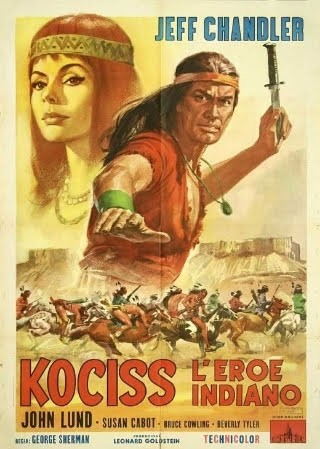
You might be forgiven for thinking the concept of the sequel or prequel was an invention of modern-day Hollywood, such is the frequency with which it is discussed and/or complained about on various internet fora. The fact is though such phenomena have been around a long time, the film industry never being one to pass up the opportunity to cash in on a winning formula. Delmer Daves had made one of the earliest and best of what has become known as the pro-Indian cycle of westerns in Broken Arrow and this was followed up a few years later by George Sherman’s The Battle at Apache Pass (1952), which saw Jeff Chandler reprise his role as the Apache leader Cochise. The film may not be quite the equal of its predecessor but with Sherman calling the shots it’s still a fairly strong entry, visually striking and featuring the kind of smooth economy characteristic of much of the director’s work.

With the Civil War raging to the east the army is stretched thin, so thin in fact that frontier outposts are being abandoned as the troops are transferred to the front line. The opening sees a fort in flames as its occupants move out and the hawkish Geronimo (Jay Silverheels) watches and ponders the implications. One man’s trouble is, as always, another’s opportunity and Geronimo see the chance to wrench back control of the territory formerly ceded to the might of the cavalry. The stumbling block to the belligerent warrior’s plans is the Chiricahua chief Cochise (Jeff Chandler), a man intent on finding some means of peaceful co-existence with the white interlopers. Cochise has reached a sort of informal understanding with the local army commander, Major Colton (John Lund). If Cochise is faced with internal challenges, then the same can be said of Colton. In fact, the soldier’s difficulties are greater as they come from  three directions – the scheming Indian agent Baylor (Bruce Cowling), the inexperienced and regulation-obsessed Lt Bascom (John Hudson), and a disreputable profiteer by the name of Mescal Jack (Jack Elam). Baylor is an ambitious man, one who is prepared to go to any lengths to achieve his aims, and has no hesitation in using the aggression of Geronimo along with the foolishness of Bascom and the greed of Mescal Jack to start a shooting war that will increase his personal power. The result of Baylor’s machinations is that Colton and Cochise are reluctantly forced into a confrontation neither man wants, and one which both of them knows can only end badly. The climax comes in the form of the titular battle, a spectacular affair which will see much blood spilled, and marks the beginning of the long and brutal Apache Wars, but also one which ends on a cautiously optimistic note.

The movie blends a number of historical events, principally what is known as the Bascom affair and the battle of the title.The former saw the attempted capture of Cochise using the ruse of a fake parley and led to a serious erosion of trust between the warring parties. The latter was one of those few occasions when the native Americans engaged the army in a face-to-face pitched battle, and suffered heavy casualties when the soldiers used artillery to blast them out of the rocks of Apache Pass. Sherman’s direction of the action scenes, particularly the climactic battle, is exemplary and shows evidence of  fairly large budget. However, the film is more than just a handful of set pieces strung together; Sherman knew how to tell human stories and the glue which holds it all together is the relationship between Colton and Cochise, and also the tenderness and love between the Apache chief and his wife Nona (Susan Cabot). This is what lends depth to the film, the bonds of love and loyalty, trust and honor, and it makes the climactic payoff all the more affecting. On a purely technical level, Sherman’s compositions are breathtaking at times, approaching Fordian proportions as he glories in the vastness and magnificence of the Utah locations, with ant-like human figures dwarfed by the ancient, primal landscape.

The Battle at Apache Pass was Jeff Chandler’s second go at portraying Cochise, and he would return to the role briefly at the beginning of Douglas Sirk’s Taza, Son of Cochise two years later. There have been comments in the past on this site relating to white actors portraying Native Americans, and I’d just like to take the opportunity to quickly address the matter here and forestall any (in my view) unnecessary complaints  – films such as the one in question in no way demonstrate any disrespect to the people on screen, and it actually goes to great lengths to make the point that the Apache were more wronged against. The casting decisions of over 60 years ago are what they are and shouldn’t be judged according to 21st Century standards – the fact remains that films such as this wouldn’t have been made at all if it weren’t for the casting of white actors in leading parts. For me, the crucial matter is how the parts were played rather than who played them. Jeff Chandler’s Cochise fully embodies the notions of dignity and honor; there’s no caricature on display, there’s merely a real human being concerned with the welfare of the people he leads and the woman he loves. The same could be said of Susan Cabot, who brings a real sense of grace and propriety to her part. John Lund doesn’t get mentioned often but he was a fine actor – I thought he was excellent opposite Barbara Stanwyck in No Man of Her Own – and has the right kind of weary decency as the army veteran. Richard Egan is another actor who really ought to have gone on to better things – his role as the sergeant here is very impressive and the interaction with, and deference towards, Susan Cabot’s Nona is a notable aspect of the movie. And let’s not forget Jack Elam, a familiar face in so many films. If ever a man was born to play slippery villains, then it was Elam and he certainly doesn’t disappoint here.

The Battle at Apache Pass is widely available in Europe, although I’m not sure if it’s been released in the US. I have the German DVD from Koch Media, and I’d imagine the other versions probably use the same master, which presents the film reasonably well. The colors are strong and true but there is a little softness from time to time and the presence of cue blips attest to the fact there hasn’t been any restoration undertaken. As is the case with most of George Sherman’s films, it’s both visually attractive and interesting in terms of theme. I liked it and recommend checking it out.


Dark Passage

Lie still. Hold your breath and cross your fingers.

I’m not a great believer in coincidences; sure they occur from time to time but too many of them all together tend to make me suspicious if anything. That’s in real life. In the movies the rules are a little different and I’m prepared to suspend my disbelief in circumstances that might normally give me pause. Film noir, especially its more paranoid and nightmarish examples, frequently thrives on the convenient coincidence. Dark Passage (1947) really piles the unlikely chance occurrences on top of each other to the point where the plot feels extraordinarily contrived and reality appears skewed. And yet it all ultimately works, because of the chemistry of the leads and also the sensitive and assured direction of Delmer Daves.

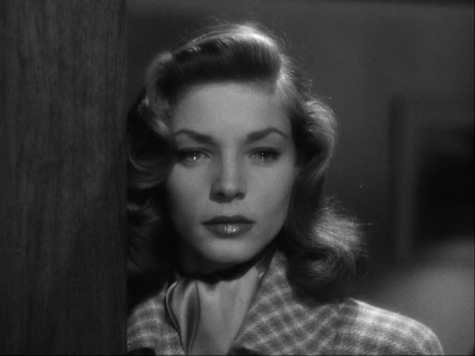
Amid the rising wail of sirens a truck speeds towards San Francisco, its load bouncing and rattling as it goes. Inside one of the barrels is a man, a man who’s just  broken out of San Quentin. This is Vincent Parry (Humphrey Bogart) and he’s been serving time for the killing of his wife. Parry insists he was framed and seems to have some vague notion of finding the real killer, but first he has to make it into the city. His first attempt, hitching a lift with a weaselly character (Clifton Young) in a roadster, is less than successful and could easily have led to his undoing. However, fate steps in and takes over at this point when a young woman, Irene Jansen (Lauren Bacall), happens along and smuggles the fugitive past the police roadblocks. And here we have the first of the long series of coincidences that dominate this story. Irene followed Vincent’s trial religiously, seeing parallels with the wrongful conviction of her late father, and even wrote letters to the press in his defense. It’s just by chance that she was passing that stretch of road on the very day Vincent decided to make his bid for freedom, but that’s only the start of it. Vincent seems to be stalked by alternating bouts of good and bad luck, almost everyone he encounters is acquainted with one another on various levels, and then there’s the lonely cabby (Tom D’Andrea) with a very useful contact. I won’t go into the various twists and turns the plot takes here – suffice to say Vincent acquires a new face, learns the truth and has at least the possibility of a new beginning dangled before him. Does he grasp that possibility? Well I suggest each viewer make up their own mind on that one – I feel the ending has the kind of ambiguous quality that allows you to interpret it as you wish.

Dark Passage was adapted from a David Goodis novel (I haven’t read it but I do have a copy sitting on my shelves) by director Delmer Daves and offers up an appetizing slice of noir, where an apparently hapless protagonist finds himself sliding ever deeper into circumstances over which he has little control. Daves indubitably did his best work in westerns but this film also provides plenty of scope for the optimism that runs as a common theme throughout his filmography. Film noir tends to focus on the sourer aspects of existence so it probably sounds a little odd to speak of such a positive characteristic in this context. However, it is there – not only in the solidly hopeful central relationship between Vincent and Irene, but also in the little vignettes that add a human face to the tale. Sam the cabby and his willingness to give a guy a break just because he reckons he has a good face, Irene’s would-be suitor who ought to be bitter but shows understanding instead, the hash slinger in the diner who regrets shooting off his big mouth, and the lonely strangers in the bus station all nudge the story forward in their small ways and afford glimpses of a world where decency hasn’t yet been fully eclipsed by greed and jealousy.

At the heart of it all are Bogart and Bacall, their real life love affair as apparent as ever in their comfort around each other. The fact that Bogart isn’t actually seen for the first half hour, the camera telling the story from a first person perspective up that point, doesn’t harm the inherent chemistry either as it’s all there in the voices and gestures that we do witness. With so many unlikely events coming at us hard and fast, it’s vital that there’s a solid center to hold it all together. The two leads ensure that everything remains grounded by their honest and affecting performances. And of course there’s the ending, an aspect I was unsure how to take for a long time. The noir purist may dismiss the coda as a mere sop to those longing for a traditional Hollywood ending, and it can be viewed in those terms. It could also be read as Vincent’s dream after the emotional phone call in the bus terminal. Personally, I’ve come to see it as a nice touch, open to whatever interpretation one cares to favor depending on mood, and entirely appropriate for a director like Daves.

Dark Passage has been available on DVD from Warner for ages now and the transfer still holds up pretty well. The image is quite crisp and shows off the interior and location photography of Sid Hickox just fine. One could criticize the fact that so many aspects of the plot are that bit too convenient, and the way Daves injects his optimism into the story may leave hardcore noir fans somewhat frustrated. Overall, I find it a very satisfying experience though – it offers plenty of thrills and suspense, and lets you walk away with a big smile on your face at the end.

The Gunfighter

How come I’ve got to run into a squirt like you nearly every place I go these days? What are you trying to do? Show off for your friends?

There can be absolutely no doubt that the 1950s represented the coming of age of the western, the genre’s full flowering as a mature and thought-provoking art form. Under the circumstances, it’s highly appropriate that the decade should open with a prime example of this growing assurance, a film which confidently presents a drama of great subtlety and humanity, and also happens to be one of the best pieces of work its director and star ever achieved. I’ve heard The Gunfighter (1950) described as a film which broke new ground and took the western in a whole different direction. I’m not sure I’d completely agree with such a sweeping comment as I feel there’s ample evidence of this move already being underway as the 40s drew to a close. I think it’s more accurate to say the film stands as a significant milestone in that process of development.

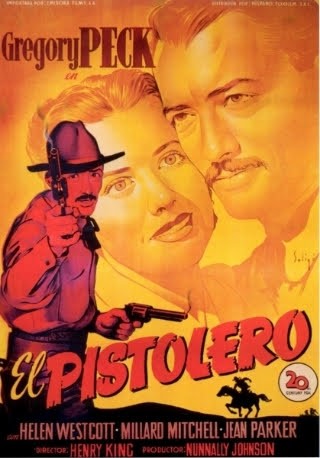
Jimmy Ringo (Gregory Peck) is a big man, one of those guys everyone knows by reputation alone. He’s made a name for himself as a gunman, a deadly killer whose fame or notoriety has become something of a curse. As the credits roll we see him riding hard across a bleak, twilight landscape. Is he running from his past or forging ahead towards a more hopeful future? I guess it’s really a bit of both; Ringo’s personal history and skills with a gun have left him open to challenges from every young tough with a hunger for the limelight. His first stop at a cheap-looking saloon sees yet another glory seeker (a very young Richard Jaeckel) goading him and throwing down the gauntlet. Despite his best efforts to avoid an unwanted fight, Ringo is left with no choice but to shoot the young hot head and make himself three more enemies in the shape of the victim’s brothers. And so he’s on the move again, away from his own legacy and also on towards what he hopes may be his salvation. Eight  years before he left behind a young bride (Helen Westcott) and an infant son, and his one dream now is to see them and maybe try to make a new beginning somewhere else. However, finding and contacting his wife won’t prove so easy as she has changed her name and determined to raise the boy without any knowledge of his infamous father. Ringo’s only ally, and he’s a reluctant one at that, is an old outlaw buddy turned marshal, Mark Strett (Millard Mitchell). Mark has given his word to safeguard the woman’s identity and will do no more than pass on Ringo’s message requesting a meeting. And so this tired gunman’s only choice is to wait it out in the saloon, besieged by rubbernecking locals and hero-worshiping kids, to see if there’s any possibility of a reunion and a fresh start. All the while the three revenge obsessed brothers draw nearer, and a young ne’er-do-well by the name of Hunt Bromley (Skip Homeier) itches to take his turn at throwing down on the great Jimmy Ringo.

What we have here is the classic western scenario of a man hemmed in by bad choices in his past, desperate to make some kind of amends and striving for salvation, redemption and renewal. One tends to think of the western frontier in terms of wide open spaces, of boundless possibilities and the promise of personal freedom. Ringo dreams of these of course, but his world has narrowed and closed in around him. The west of Jimmy Ringo has shrunk to the dimensions of a saloon bar in a nowhere town. His fame has imprisoned him and he’s living out a sentence written out and pronounced upon himself by his own actions. But that’s not to say Ringo is a villain in the classical sense; he’s as much a victim of poor judgment, and his obvious love for his estranged family and his desire to make a clean break with violence means he cuts more of a tragic figure. According to one of the extra features on the DVD, writer William Bowers (co-credited with Andre de Toth) got the idea for the story when he spent some time in the company of the legendary boxer Jack Dempsey. It seems that Dempsey was confronted by some blowhard eager to show off and prove his courage by challenging him to a fight. It’s that dark side of fame that’s explored here and the Old West setting, with its inherent focus on the myths of masculinity and machismo, is an ideal canvas for its presentation. The script necessarily confines the action to a handful of sets but director Henry King and cinematographer Arthur Miller never allow any sense of staginess to dominate. The restrictions on Ringo’s movement are essential to the telling of the tale, since his room for maneuver in life is limited it helps that the viewer shares that feeling of being unable to get out into the open. In the end our anti-hero does attain his goal, albeit in an oblique fashion, and the final image, by mirroring the opening, has that perfect symmetry that is always the mark of top class filmmaking.

Gregory Peck was a big box office draw at this point, a leading man with a strong female following and the role of Jimmy Ringo, or perhaps it’s more accurate to say the image, was to prove somewhat problematic. King wanted to nail the look of the period as well as he could and that meant making a few alterations to his star’s appearance. It’s been said that Darryl Zanuck laid the blame for the film’s lack of financial success squarely on Peck’s mustache, although it’s hard to know how seriously we’re supposed to take that. Nevertheless, Peck himself rated his performance highly and I guess it’s fair to say time has borne out his assessment. He brings a genuine feeling of the weariness of the burdens of his reputation to the role. The way his dusty and tired character carries himself as he enter the saloon for the first time hits just the right note, and his nervy twitchiness befits a guy who’s learned the hard way that he has to watch his back at all times. Peck was the same age as the character he was playing, although his look and demeanor suggest a man older than that. Apart from the conflict within Ringo which the script calls for, Peck also injects a touch of impish humor from time to time which rounds out the character and makes him seem more human – for example, the little interlude in the marshal’s office where he debates the merits of his being run out of town with the local ladies, all blissfully unaware of his true identity, and ends up conceding that hanging might indeed be a suitable punishment for him, is delightfully played.

Of the other cast members, Millard Mitchell really stands out. His portrayal of the reformed outlaw caught between his sense of duty to the community which has offered him a second chance and his loyalty to an old friend is spot on. As good as Peck is, it’s Mitchell who acts as the glue which binds everything together. Gruff, laconic and earnest, he displays a great sensitivity in his moments as the go-between passing Ringo’s message on to his wife, and his toughness is wheeled out too on the occasions when he has to confront the weaselly braggart Hunt Bromley. Skip Homeier always made a fine villain, and this early role is a memorable piece of work. He does a fine job of capturing the bravado, irreverence and resentment of youth, and I think it’s heavily implied in the final shot of the film (although other interpretations of that scene are possible) that Hunt Bromley is essentially a mirror image of a younger Jimmy Ringo. Karl Malden’s entrepreneurial barkeep is an entertaining turn too; obsequious in the face of opportunity and always calculating the profits to be gained, he comes to resemble a circus ringmaster wooing and shooing the onlookers keen for a peek at his prize exhibit. And of course there are the ladies. Helen Westcott as the conflicted wife is never less than affecting as she conducts an internal duel over her love for her husband and the need to protect her son, while Jean Parker is all guts and wistfulness as the widow of another gunman.

The Gunfighter was released on DVD by Fox some years ago as part of a box set of westerns in the US. There are also editions available in other regions but I think the US version is the best of the bunch in terms of picture quality – crisp, clean and sharp. Among the extra features on the disc are short pieces on the film itself, and its significance within the genre, and one on cinematographer Arthur Miller. While both are very welcome, I feel the movie actually deserves a more comprehensive analysis. The Gunfighter is one of the great westerns of the 50s, or any decade for that matter, and it’s always a pleasure to revisit it.

The Doolins of Oklahoma

Movies inspired by real life historical people and events can sometimes come in for a bit of stick. It’s common enough to read reviews and see complaints that things didn’t happen as portrayed on the screen. Personally, I have no objection to people pointing out the inaccuracies in such cases, indeed I’ve done so myself on occasion, but I never feel a movie should be judged or criticized too heavily on that score. Ultimately, history is fact and film is art; if the former is a priority, then I feel a well researched history book should be sought out. While I do think film can stimulate an interest in history, and encourage people to dig into the real facts, it fulfills an altogether different function. A movie needs to be evaluated on its own merits, as an artistic endeavor, and granted the license which comes with that. All this is by way of introducing The Doolins of Oklahoma (1949), which uses a set of authentic historical characters, and some events from their lives, to tell a classic western tale. Sure it departs from what is known to have happened but, for me anyway, this doesn’t detract from the quality of the film in the least.

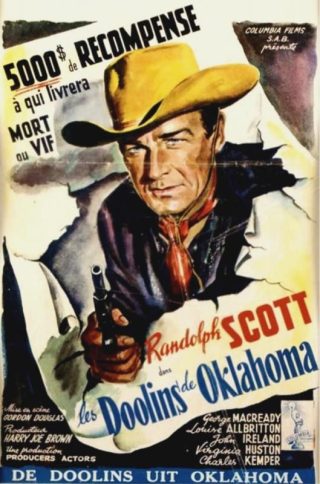
Our story concerns what was known as The Wild Bunch (no, nothing to do with the Peckinpah movie) who raided banks and trains mainly in Kansas and Oklahoma. It all starts with the botched bank robbery in Coffeyville that saw the Dalton gang wiped out, or almost. Bill Doolin (Randolph Scott) was a member of the gang whose horse came up lame, meaning he had to hang back. Having avoided the massacre of his fellow outlaws, Doolin nevertheless gets involved in a shooting that necessitates going on the run. Putting together his own crew, he proceeds to carry on where the ill-fated Daltons left off. However, as the prologue has already stated, this is the last decade of the 19th century and the frontier is closing fast, civilization and the law are spreading and men like Doolin are being squeezed out. Essentially, Doolin and his confederates are men living on borrowed time and they know it – most of the film involves pursuit, and relentless pursuit at that. The posse led by US Marshal Sam Hughes (George Macready) never lets up once they get a handle on Doolin. However, a western of this period has to be about more than mere hold-ups and shootouts, although there are plenty of those on view. Doolin is one of those classic gunmen yearning to leave his violent and lawless past behind him. For a brief period it even looks like he might have managed it too; an attempt to shake off the marshals leads him to a church in the middle of a service and that in turn introduces him to Elaine Burton (Virginia Huston), whom he weds. Doolin adopts a new identity and settles down, but it’s not to be. His old friends turn up and somewhat cruelly expose him to the in-laws, leaving him with little choice but to strap on his guns again and return to banditry. It’s that old familiar theme of the bad man trying to outrun his past and redeem himself. There are no happy Hollywood endings in this movie but, in a sense, he does achieve his goal. Perhaps it’s appropriate for an outlaw like Bill Doolin that he finally gains his desired redemption in an oblique, left-handed fashion.

Gordon Douglas is a director who I think it’s fair to say has a few fans among regular readers of this blog. I’m quite fond of his work myself and the more I see of it, the more I like it. As was usual with the studio professionals of the era, Douglas made movies in each of the major genres and did notable work in all of them. There’s a tendency to downgrade the efforts of many of these directors by dismissively labeling them journeymen. I find that as one looks deeper into the filmography of a man such as Douglas it becomes apparent how well crafted his films were. There are a number of highly accomplished pictures to be found, containing memorable scenes and moments of great sensitivity. The Doolins of Oklahoma features a number of what I’d term “instances of realization”, points at which the characters become aware of the full import of their actions. Lesser filmmakers can either downplay or over-egg such key moments, thus robbing them of their impact on the viewer. Two scenes spring to mind in this film, where Douglas hits just the right note and leaves us in no doubt regarding their significance: there’s the aftermath of the Coffeyville massacre where Doolin guns down the traitor who betrayed his friends and so seals his own fate in the eyes of the law, and later there’s his reluctant acceptance of the need to leave his new bride despite everything inside him wanting to do just the opposite. Those scenes are not overplayed in any way, nor are they brushed aside. The characters on the screen know how important they are, we know how important they are, and we know it because the director wanted it that way.

Aside from Douglas, there were other influential figures at work behind the camera. Yakima Canutt is noted for his stunt and second unit work on a range of pictures during the classic era – John Ford’s Stagecoach being one of the best known – and his hand is in evidence here. The action scenes have the kind of drive, authenticity and heart-stopping quality often associated with the man. In particular, the climactic stampede bears all the hallmarks of Canutt. And then there’s the cinematography of Charles Lawton, a man capable of capturing beautiful images in both black and white and color. The Doolins of Oklahoma makes excellent use of those Lone Pine locations which are a familiar sight to western fans, and the interior scenes are also expressively and atmospherically lit by this experienced and talented cameraman.

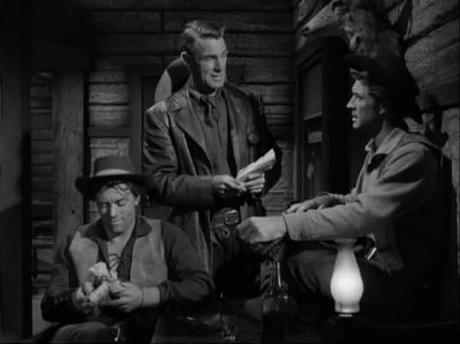
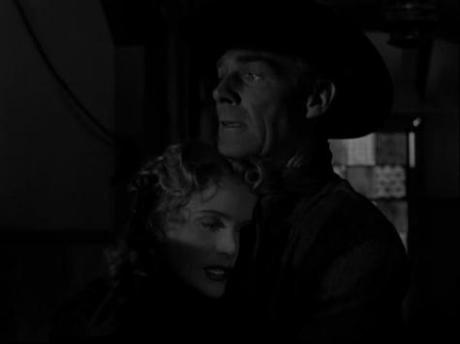
Randolph Scott’s decision to focus almost exclusively on westerns in the post-WWII years was not only a smart career move on his part, but also benefited the genre enormously. Most leading men of the time were capable of playing western characters, and indeed a significant number of them did so. Having said that, Scott was what I’d call the perfect fit for the genre – his slow Southern delivery and lean, leathery looks simply belonged in the west. More important than that though was the personality of the man, which shone through in all his roles, embodying three key ingredients: dignity, decency and resignation. These characteristics meant he was in a position to play the kind of complex figures who made the post-war western such an interesting and rewarding viewing experience. Scott’s heroes were nearly always three-dimensional because the man playing them invested them with that quality. And his anti-heroes, as is the case in The Doolins of Oklahoma, were all the more credible as a result of the subtle little quirks he brought to them. Two scenes in this movie stood out for me as marvelous examples of Scott at his best. The first occurs when Doolin returns to the home he once reluctantly abandoned, in the hopes of laying up there for a time. On arrival, he’s immediately struck by how well-kept the place is, and then the truth hits home – his wife had never left despite his absence. There’s something remarkably poignant about the way this flash of understanding affects him, and the way his innate integrity colors his reaction. The second comes right at the end, as Doolin and Elaine are reunited in the little church where they first met. This is a moment of destiny, a make-or-break point for the character. Scott’s playing is faultless; as he stands in the dark with the woman he loves in his arms, the regret and sadness wash over his features with the knowledge that there’s only one honorable course of action open to him.

Stoicism is a word often used in relation to Scott, and it could be applied here too. However, it’s the term I’d more readily employ to describe Virginia Huston’s portrayal of Doolin’s wife. Hers was a brief film career, but she was presented with a fine opportunity to shine in this movie. It’s a pivotal role in a sense, not flashy or showy, but one on which much of the script’s logic hangs. It called for a woman whose faith in and loyalty to her husband is sufficiently strong to force a character like Doolin to reassess himself. I think Huston nailed those aspects and thus rendered the relationship with Scott wholly believable. The supporting cast is particularly strong and features parts for George Macready, John Ireland, Jock Mahoney (who apparently also doubled for Scott in the fight scenes), Louise Allbritton, Noah Beery Jr, Frank Fenton and Charles Kemper among others.

The Doolins of Oklahoma was a film I’d never seen until it came out via a TCM/Sony collection of Randolph Scott westerns – a set which now looks like it may be out of print actually. The movie looks very well with no significant damage on show, and good contrast levels leave the black and white photography appearing nice and crisp. The extra features offered consist of a series of galleries highlighting the posters, lobby cards, still and publicity photographs. Anyone who is a fan of Randolph Scott, or just westerns in general, will surely take something positive away from this film. I was highly impressed both by Scott’s lead performance and by the smooth direction of Gordon Douglas. The film shows the progression taking place in the star’s work that would lead inevitably to those towering roles in the late 50s and the beginning of the 60s. It also provides evidence of the growing maturity of the genre itself on the eve of its golden decade. Recommended.

This piece is offered as part of the Randolph Scott Blogathon hosted by Toby of the ever entertaining and informative 50 Westerns from the 50s. I strongly urge all readers should head over there and check out the other contributions to this celebration of Scott’s work by following the link above. Alternatively, you can click on the badge below and that will lead you to the same destination.

Day of the Outlaw

I like westerns, I like movies which could be described as chamber pieces, and I like snowy backdrops. Day of the Outlaw (1959), directed by Andre de Toth, checks all these boxes. It’s one of those films genre fans will enthuse about yet remains criminally underrated by others. It’s also a film where there’s not a huge amount of action; there is, however, a kind of relentless tension and a whole lot going on just below the surface. In short, the film is a sleeper, a tight and atmospheric classic just waiting to be discovered.

I think one of the most enjoyable aspects of watching movies is to be found in the deceptively simple story, those tales which initially appear to be straightforward or predictable yet gradually develop into something much more complex and satisfying. Day of the Outlaw is a fine example of a work where layers of depth emerge bit by bit and draw you in before you’ve realized it. It opens in a wintry Wyoming town as two men, Blaise Starrett (Robert Ryan) and his foreman Dan (Nehemiah Persoff), ride in and bemoan the stringing of barbed wire and the consequent threat to the open range. Starrett’s blood is up and he vows a showdown with the homesteader responsible. The scene therefore is set for the kind of range war drama that’s been seen countless times. But this is a mere introduction, an opportunity to draw attention to the implacable and tough character of the lead. When it then becomes apparent that Starrett is in love with and covets the beautiful wife (Tine Louise) of his chief rival, the plot moves to another level. And still we’re only dancing around the periphery, for what really matters here is the journey – both literal and figurative – which Starrett (among others) will be forced to embark upon. In a deft piece of filmmaking sleight of hand the entire emphasis is moved away from that which the build-up has led us to expect. Just as we’re about to witness the duel between Starrett and his foe a bunch of newcomers arrive and take us off in a completely different direction. Jack Bruhn (Burl Ives) is a Quantrill-like figure, a soldier with a tarnished reputation now reduced to leading a band of amoral cutthroats. Bruhn and his men are loaded down with stolen gold, but he’s got a bullet lodged inside him and the army hot on his heels. The enforced stopover in the snowbound town represents a trial of sorts for the bewildered and helpless residents, but it also holds out a kind of hope for two lost souls – Starrett and Bruhn. Both men find themselves in opposition and through that also find a way to regain a little of the humanity that years of hard living have almost stripped away.

Redemption once again; Starrett and Bruhn have lost something along the way, their hearts have been hardened by the brutality of frontier life, and their salvation will be a by-product of their enmity. As far as I’m concerned, this is what drives the film along and gives it its power. I feel all the other plot devices are simply that, accoutrements put in place to facilitate the drama that forms the heart of the story. It’s the chance meeting of Bruhn and Starrett, at a key moment for both, which gives them pause and either forces or allows them (take your pick here) to alter the course of their respective destinies. The two characters wield a significant degree of influence over those around them and this is what first draws them into an uneasy mutual alliance. However, I believe that the real, if initially unacknowledged, motive comes from the fact that each recognizes something of himself in the other. The effect appears more profound in the case of Starrett, but it’s surely present in Bruhn too, and throws out a spiritual lifeline of sorts.

Day of the Outlaw is surely Andre de Toth’s best film, a well-paced exercise in mounting and sustained tension, aided by Philip Yordan’s adaptation of Lee E Wells’ novel. By having so much of the action confined to the saloon the sense of isolation, claustrophobia and suspense is multiplied. The impromptu dance, hastily organized to placate Bruhn’s increasingly restless men, perfectly conveys the threat and menace posed by the gang. Even when events later take us out into the wilderness of the snow-choked mountain pass that feeling of being locked into an inescapable situation is actually heightened rather than dissipated. A good deal of credit also has to go to cinematographer Russell Harlan here; his shooting of the frozen and forbidding landscape is chilling in every way. When you add in Alexander Courage’s spare, doom-laden score all the ingredients are in place for a memorable interlude in the icy wastes.

The cast is both deep and distinguished (Persoff, Elisha Cook Jr, Jack Lambert, Lance Fuller, Frank DeKova, Dabbs Greer, Alan Marshal et al) but Ryan and Ives easily dominate proceedings. Ives in particular holds the attention whenever he’s on screen, which is entirely fitting as he’s playing a man who’s holding a gang of dangerous roughnecks in check principally through sheer force of personality. The dance segment which I referred to above is a good illustration of this, the frayed dignity of the man shining through and setting him apart from a shabby command which is beneath him in every respect. Ives also gets right into the physical and psychological guts of his character, from the harrowing operation he endures without anesthetic to the slow dawning of his impending and inevitable demise. Overall, it’s a first-rate portrayal of a complex man, and one which is wholly believable. Just as the characters feed off one another, I think the same can be said the performances of the leads. Ryan was never a slouch as an actor anyway and his playing opposite Ives ensured he stayed on top of his game. He starts out as bitter, cold and unforgiving as the country around him, delivering a blistering and scathing verbal attack on his homesteader rival. He holds onto that steely determination throughout, but slowly lets the sharp edges soften a little as he becomes aware of the path he’s been taking and where it must surely lead.

Day of the Outlaw is fairly widely available on DVD now. I have the US release from MGM which presents the film quite nicely in its correct widescreen ratio. However, the film comes with absolutely no extra features, and I reckon it’s more than deserving of some. One of the reasons I started this blog was to have the chance to chat about the movies I love with those who share my passion. Over time though, I’ve also come to realize that I was partly motivated by a wish to see a bit more critical respect afforded to certain films and genres. The western in particular has tended to be passed over as nothing more than time-passing entertainment. Now there’s nothing wrong with entertainment for its own sake, a movie which doesn’t do so is failing straight out of the gate after all. Still, the underestimation of the western as an art form and as a vehicle for the intelligent examination of adult themes has persisted. A film like Day of the Outlaw highlights this critical neglect. I’d like to think that appreciation of the film has grown somewhat over time though, and I’d encourage anyone keen on polished and smart filmmaking to seek it out.

The Shooting & Ride in the Whirlwind

734_735_bd_box_348x490_original_zpscfd24e78

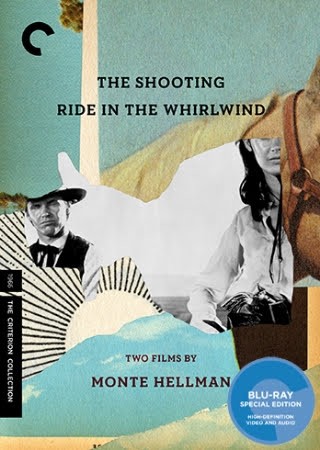
Films naturally reflect the times in which they are made, there’s no getting away from that. As an art form they of course focus on certain themes, frequently timeless ones at that, but there’s no divorcing the artistic ambition from the current circumstances. The western is particularly interesting in this respect as it uses a historical setting and period tropes to comment on a current situation. The Shooting and Ride in the Whirlwind, made back to back in 1966 by Monte Hellman, are a good illustration of this. Here are two films which could not have been made at another time; the mood and aesthetic are firmly rooted in the mid-60s, and in cinematic terms they look back to the classic era of the genre while also pressing forward and moving it in another direction. I see them as slotting in at the end of the genre’s transitional period, making them fascinating both historically and as an absorbing film experience in their own right.

The Shooting is as minimalist as they come with attention centered on just four people – Gashade (Warren Oates), Coley (Will Hutchins), Billy Spear (Jack Nicholson) and an unnamed woman (Millie Perkins). What’s more, precious little is revealed about the backgrounds of any of these characters; Gashade is referred to as having worked as a bounty hunter at one point, but that’s about it. Anyway, it matches perfectly the abrupt sparseness of the tale and the filmmaking style. As viewers we seem to arrive somewhere in the middle of the story, the events leading up to it being explained through a brisk flashback and the ongoing development of the narrative. In brief, the woman turns up and hires Gashade and Coley to lead her through the wilderness, without divulging exactly why she wants to travel or why she wants these men to accompany her. It gradually becomes clear that the events depicted in the flashback have a significant bearing on the woman’s motives, and then there’s the mysterious figure who follows all the way from a discreet distance. If anything, the lack of information and the way subtle hints are dropped as we go along cranks up the suspense. The film is virtually the antithesis of many current productions, where exposition seems to rule and everything has to be slavishly spelled out to audiences. By the time the startling conclusion rolls round almost as many questions have been raised as have been answered, yet the viewer is always treated as an intelligent adult capable of reading things in his or her own way.

Ride in the Whirlwind uses a more conventional narrative structure, and a slightly expanded cast, but it’s another pared down and deceptively simple piece of cinema. Once again no time is wasted in getting to the heart of the matter – a botched stagecoach robbery opens the movie in dramatic fashion and sets up the unfortunate circumstances into which three men will blindly stumble. Vern (Cameron Mitchell), Wes (Jack Nicholson) and Otis (Tom Filer) are cowhands heading back to Texas who unwittingly come upon the outlaw’s hideout. Sensing something amiss, they plan to ride on the following morning but everything goes awry when a trigger-happy posse shows up. As is the case in The Shooting, events overtake the men and force them into a situation where they have little control of their fate. In a sense this film offers a reversal of perspective; where The Shooting follows the action from the hunters’ point of view, Ride in the Whirlwind lets us see it all develop from the side of the hunted. There’s suspense too, but of a different kind – there’s no particular mystery to unravel and the motivation of all concerned is much more clear-cut and easily defined – as a tense struggle for survival ensues.

Aside from the common contributors – Hellman, Nicholson, Perkins and cinematographer Gregory Sandor in particular – both films are fatalistic, existentialist pursuit dramas. The characters are abruptly and without warning pitched into violent and desperate situations which they are powerless to avoid yet are also committed to seeing them through to the bitter end. There’s an authenticity there too in the spare, clipped dialogue. And then there are the Utah locations: barren, harsh and dusty, a remote and hostile environment where the human tragedies are played out and the land itself poses a physical challenge. So much of the imagery captured by Hellman and Sandor harks back to the classic westerns of the previous decade while the editing and oblique storytelling style is very much a product of the turbulent mid-60s, in fact it’s arguably ahead of its time. Anyone familiar with westerns will find countless nods to the films that went before and laid the groundwork – the dogged pursuit of the wrong men (The Ox-Bow Incident & The Bravados), the deliberate crippling of a gunfighter’s hand (The Man from Laramie, No Name on the Bullet, One-Eyed Jacks), the burning of the shack to flush out the occupants (Red Sundown), the sudden revelation of the hunter and his quarry’s identities (Winchester ’73) and so on. These are motifs that would crop up again in the future of course, attesting to the influential character of the films.

However, there are other factors which mark these productions out as being of their own era, and as forward-looking works too. For me anyway, a clear shift in tone has taken place. The late 40s and on into the 50s saw the world faced with its fair share of difficulty and uncertainty. Still, the aftermath of the Kennedy assassination and the massive social and cultural changes that were becoming apparent in the mid-1960s represented something totally different. Old certainties were being swept aside and consigned to a past that suddenly seemed very distant. Something new and, as is always the case when abrupt change occurs, vaguely unsettling was on its way; Hellman’s pair of westerns are a cinematic reflection of that sense of bewilderment and confusion.

And then there’s the matter of redemption, the mainstay of the genre throughout its golden years but something which would become increasingly rare with the passage of time. Gashade in The Shooting could be said to be on a redemptive quest, essentially chasing himself, or at least the darker side of himself, and perhaps achieving his goal in the end. I find it difficult to see how anyone else in that movie could be perceived in such terms though, and it just doesn’t apply at all in Ride in the Whirlwind. Therefore the altered emphasis in the western is more readily apparent in Hellman’s movies than was the case in other, earlier transitional works. The predominant feeling one comes away with, which is in marked contrast to what was to be found in the genre only a few years before, is ambiguity. While the true villains are easily identified, there’s a blurring or lack of definition when it comes to the heroes. Gashade’s inaction (albeit reluctant) effectively seals Coley’s fate and his subsequent assault on Spear could be seen as sentencing a man like that to certain death rather than genuinely sparing him. Similarly, when Vern and Wes break away from the homestead in Ride in the Whirlwind they cross a line ethically. The westerns that would follow, and not just the more nihilistic spaghetti variant, mostly saw the replacement of the hero with the anti-hero; a figure whom the audience could be asked to identify with but rarely admire, a figure whose moral plane was frequently only a degree or two above that of the villains.

Frankly, these films always looked a little rough any time I’d seen them in the past on any home video format. I’m delighted to say though that the new release by Criterion, available on both DVD and Blu-ray, sees them looking exceptionally fine. Both titles have undergone 4K restorations with the blessing of the director and the results are very pleasing. There’s plenty of detail in the image and the colors are rich and natural, really showing off the starkly beautiful Utah locations. As usual with Criterion releases there’s a wealth of solid extra features offered: the booklet has an essay by Michael Atkinson, and the disc has interviews with various members of the cast and crew. Kim Morgan provides a video essay on Warren Oates, and there’s a conversation between Will Hutchins and Jake Perlin. On top of all that, both movies have commentary tracks with Monte Hellman, Blake Lucas and Bill Krohn, which are relaxed, entertaining and informative. Overall, it’s an excellent package with the two films looking better than I’ve ever seen them.

These are two fine westerns, entertaining, thoughtful, and made by a man who understood the genre. Furthermore, they’re important movies in the evolution of the western, adding another link to the chain which runs from the silent era right up to the present day. I suppose Ride in the Whirlwind would be the more accessible of the two for viewers unfamiliar with Hellman’s work, but both really are essential viewing for anyone with a taste for intelligent and original filmmaking. I highly recommend them.


My thanks to the people at The Criterion Collection for making this review possible.

Northern Pursuit

poster23_zpsca6a4102

Well this is a first for me. The themed blogathon has grown in popularity and I’ve always wanted to contribute to one. The thing is I’ve never been one of those disciplined souls who’s felt able to commit himself to producing something appropriate on a given date. That said, when Kristina, the hostess of the always entertaining and informative Speakeasy, sounded me out and said she was running a blogathon in partnership with Ruth at Silver Screenings, well I thought I’d give it a go. The terms of reference are broad – Canada. I could pick anything I wanted so long as it pertained to Canada in some way. Well, I settled on Northern Pursuit (1943) as it stars one of my favorite actors, Errol Flynn, and was directed by the great Raoul Walsh. It’s a wartime propaganda piece, always interesting in themselves, and a good solid adventure/espionage yarn to boot.

A U-boat punches its way through the ice and deposits a party of German flyers on Canadian soil. The nature of their mission isn’t revealed – in fact, it doesn’t actually become apparent until quite late in the movie – and all we know is they are desperate to press on as quickly as possible into the inhospitable northern wilderness. Eventually the unforgiving conditions take their toll and an avalanche wipes out the whole party, save one man. Von Keller (Helmut Dantine) was the leader of the group and finds himself the sole survivor. He manfully struggles on through the wintry landscape until the elements overcome him. However, he’s a lucky man in many ways and is discovered just as he’s on the point of succumbing to exposure. Steve Wagner (Errol Flynn) and Jim Austin (John Ridgely) are a couple of Mounties out on patrol who happen to cut Von Keller’s trail just in time. The point where Von Keller is taken into custody is, for me anyway, the most intriguing part of the movie. Here we learn that Wagner is in fact of German descent and a sense of ambiguity is built up around the character and his motives. As viewers, we’re faced with a moral dilemma, one every bit as knotty as that apparently faced by the hero himself. Is it possible that the clean-cut and dashing Wagner could really be a Nazi sympathizer? The doubt lingers and is then fueled by the escape of Von Keller and a handful of his compatriots from an internment camp. Frankly, I feel it’s a little unfortunate that the allegiances of all the principals are revealed too early; while the remainder of the picture plays out as a reasonably tense and action-packed affair, the conventional nature of everyone’s behaviour is something of a disappointment after such a promising build up.

Despite the fact the film  was shot on Warner studio sets and on location in Idaho, it still acts as a showcase of sorts for the harshness and primal beauty of Canada’s far north. Cinematographer Sid Hickox captures some wonderful wintry images which are both forbidding and attractive. Walsh’s handling of the action scenes has all the assurance that typifies his work, and the quieter passages also bear his unmistakable stamp too. If you see enough of this director’s work, it soon becomes apparent how much he was interested in faces. There are close-ups throughout, quick cut reaction shots zeroing in on the actors which reveal more in an instant than reams of dull exposition could ever do. Now propaganda films can be a mixed bag, at their worst they can lay the jingoism on so thick it’s a bit of a chore to watch them. Northern Pursuit is one of the more interesting examples though. It gets its message across loud and clear yet there’s a thoughtfulness in the script which elevates it to an extent. For one thing, the grievances and dissatisfaction of the indigenous Indian population is touched upon, albeit in passing. The aspect that particularly drew my attention though was the treatment of Canadians of German extraction. A lesser film might well have opted for the simplistic approach and pandered to prejudice. To this film’s credit, the question of loyalty among the émigré community is dealt with in a balanced and enlightened way. The casting obviously plays a part, but the writers were also conscious of their responsibilities and saw to it that the complexities of such an issue were not neglected.

Flynn was still in his prime at this stage, although the trials and their aftermath would shepherd in his decline with remarkable swiftness. By his own admission, he was often simply walking through roles as his expenses mounted. His part in Northern Pursuit had some meat on its bones, although the potential isn’t fully developed. The first half of the movie holds out the prospect of a nuanced and subtly shaded characterization. That it’s not carried on into the latter stages isn’t Flynn’s fault though; the script moves in a much more traditional direction, and the result is a more one-dimensional (though still perfectly entertaining) portrayal. Helmut Dantine is strong in his role as the driven Von Keller, He also starts out better, coming across as grimly determined as opposed to the cold fanatic he reveals himself to be as the plot progresses. In a sense, the supporting players fare better over the 90 odd minutes. Julie Bishop, John Ridgely, Gene Lockhart and Tom Tully all turn in fine performances and see their roles evolve satisfactorily.

Warner Brothers released Northern Pursuit as part of an Errol Flynn adventure set some years ago, and the film looks pretty good on that DVD. It’s a nice clean transfer of a movie whose elements seem to have stayed in good shape – no distracting damage or major flaws. As far as I’m concerned anything with Flynn is highly watchable – the swashbuckler roles are certainly going to be ones he’s best remembered for, but I always enjoy seeing his other genre pictures. Northern Pursuit probably isn’t that well-known yet any collaboration between Flynn and Walsh is worth investing a little of one’s time in.

Submitted as part of the O Canada Blogathon.


Gunsmoke

At one time the Hollywood studios all seemed to have a particular style and feel associated with them. Even without seeing the credits you could usually tell which company had produced a movie just by its look. Mention Universal to most film fans and they will probably think automatically of the horror cycle running from the early 30s through to the mid-40s. Understandable as that is, it also means that the westerns the studio made in the 50s tend to be overlooked, although not by genre fans. The Universal western (or Universal-International to be more accurate) was for the most part a no-nonsense affair that moved at a fast lick and was visually attractive. Gunsmoke (1953) is a good example of the studio’s output – pacy, entertaining and lacking in pretension.

Reb Kittredge (Audie Murphy) has been making a living as a hired gunman, and the opening shots of the film see him and his friend Johnny Lake (Charles Drake) riding hard in an effort to outrun a posse of cavalrymen on their trail. The two men had been plying their trade in the Johnson County War but are now heading off in different directions – Johnny planning to sell his skills elsewhere, while Reb hopes to get  into the ranching business. He’s had an offer of employment from a man called Telford (Donald Randolph), and is setting off to find out what it entails when he’s bushwhacked – a lone sniper shoots his horse from under him using a buffalo gun. As is often the case in these movies, a man’s reputation has the nasty habit of preceding him and then dogging his steps thereafter. Reb has made his name dispensing lead and that’s really the only thing that interests people. It turns out Telford is a slick and ruthless business type who has been buying up all the land around, and now there’s only one man standing in his way. Dan Saxon (Paul Kelly) and his daughter Rita (Susan Cabot) are all that stand between Telford and total control. And this is where Reb comes in – Telford wants to hire him to ensure (by whatever means are necessary) Saxon doesn’t get his cattle to market before his mortgage comes due. So far this is all pretty standard fare, but the initial reluctance of Reb to take on the job and, more significantly, the fact he wins the ranch from Saxon on the turn of a card takes the story in a different direction. Reb has the ranch he always wanted but with Saxon now working for him, the daughter resenting him, Telford on his back, a deadline looming and a former friend gunning for him.

No 50s western would be truly complete if it failed to touch on the notion of redemption, at least in passing. I don’t for a moment believe Gunsmoke was ever striving for great depth yet it does touch on this classic theme. Murphy’s character is referred to as having gained notoriety for his actions in the Johnson County War – while it’s not made clear which side he hired out to the implication is surely that he earned his pay gunning for the big ranchers. By siding with Saxon, the small independent, and taking on the might of Telford and all his resources it could be read as an attempt to make up for his past deeds. Anyway, the pace is so brisk and the script so packed with incident that there’s not that much time to linger over such matters. The screenplay comes courtesy of D D Beauchamp and a novel by Norman A Fox, neither of whom were strangers to the western genre. The direction was handled by Nathan Juran, one of those studio professionals who rarely get a lot of credit for the quality of their work. Juran made a number of westerns with Murphy alongside other studio assignments. As time wore on he moved towards science fiction and fantasy pictures – 20 Million Miles to Earth, The 7th Voyage of Sinbad, Jack the Giant Killer, and so on – which paved the way for a television career notable for his contribution to various Irwin Allen shows. Juran may not have been an especially spectacular director but he was very solid and I’ve always found his work highly watchable.

Gunsmoke saw Audie Murphy settling more comfortably into his role as a movie star, and particularly as a western star. He would go on to better and more complex parts in the future of course but this film offered him an opportunity to play a guy with some interesting shadings to his character. He’s probably at his best in his exchanges with Charles Drake, who makes for a fine anti-heroic/villainous adversary. Susan Cabot is good too and shows plenty of grit throughout – her driving of a chuck wagon down a treacherous mountain incline is a memorable scene – proving herself capable of providing more than mere eye candy. Still, the acting honors have to go to the supporting cast, particularly Paul Kelly and Donald Randolph. Randolph is oily and effete yet menacing as a coiled serpent, the silky exterior masking a calculating and venomous nature. And Kelly is just about perfect as the rancher who will gamble on anything. His philosophical approach to life and all its tribulations adds a lot of charm to the movie.

Gunsmoke is out on DVD in Spain (it’s also available in Germany as part of a Murphy box set from Koch Media) via Llamentol. The image is pretty good, if perhaps a little soft, and doesn’t have any serious damage visible. Generally, the presentation improves as the feature progresses. I’ve seen the film on TV a number of times and the DVD is comparable to those broadcast versions as far as I can tell. Gunsmoke may not be the best western Audie Murphy made and it’s not the best Universal-International had to offer either. Having said that, I like it a lot – it’s brisk, colorful and entertaining from start to finish. There’s good professional work done by everyone – both in front of and behind the cameras – and the film stands as a fair representation of the style and ethos of a Universal-International western.