Ten of the Best – Women of the West

Over a decade ago (it really doesn’t seem that long… ) I posted a list of western actors. I followed that up with a post on western directors, film noir directors, and film noir stars. The latter included a mix of male and female stars and it has long been my intention to put up a list that would balance that first entry by turning the spotlight on the women who made significant contributions to the western. I’m not sure why I’ve left it so long, I guess other things just kept getting in the way and it got shunted off for another day. There are those who would say the western is an inherently masculine genre, but I don’t feel that’s a fair or just assessment. The western was and remains one of the greatest of all cinema genres precisely because it was so malleable, was so dependent on absorbing myriad influences, and drew highly creditable work from such a wide range of personnel. So, let’s cut to the chase and have a look at ten actresses who added immeasurably to my my enjoyment of my favorite genre.

Felicia Farr
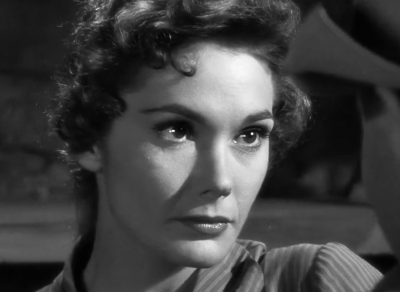
I can’t imagine opening this list with anyone else. Felicia Farr’s part in 3:10 to Yuma is comparatively small yet it’s a pivotal one. Those short scenes she shares with Glenn Ford’s outlaw are memorable and powerfully touching, adding another layer of yearning and regret to an already poignant movie. Director Delmer Daves also used Farr in two other fine westerns, The Last Wagon and Jubal, while George Sherman cast her to good effect in Hell Bent for Leather and Reprisal.

Virginia Mayo
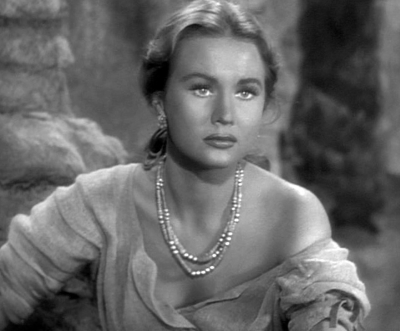
Making her western debut in Colorado Territory, Raoul Walsh’s remake of his own High Sierra, Mayo impressed herself on the genre right away. I won’t go into spoilers here for those who haven’t seen it but the climax of that film is as tragic as it is poetic, and Mayo’s actions give it its power. Walsh would cast her again in the underrated Along the Great Divide while she had other good parts in The Proud Ones, Great Day in the Morning and  Fort Dobbs to name just a few.

Dorothy Malone
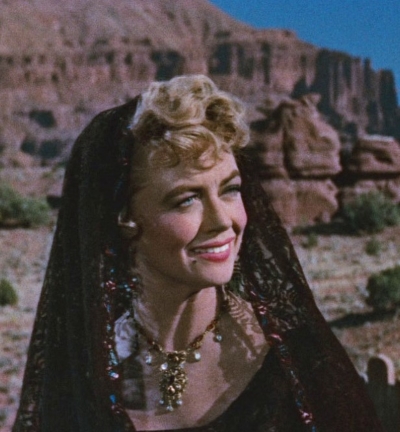
While Virginia Mayo was the passionate, beating heart of Colorado Territory, her rival for the affections of Joel McCrea’s doomed outlaw was a coquettish and calculating Dorothy Malone. She would take on some terrific roles throughout the 50s, including some very respectable films noir as well as a couple of plum parts for Douglas Sirk – the superlative The Tarnished Angels and an Oscar winning performance in Written on the Wind – and of course plenty of westerns. Among the highlights are At Gunpoint (why has this movie never had a decent release anywhere?), Pillars of the Sky, Quantez, The Last Sunset and Warlock.

Barbara Stanwyck

One of cinema’s great actresses, Stanwyck made  couple of westerns in the 1930s and 1940s (Annie Oakley, Union Pacific and California) but it was in the 50s that she made her mark on the genre, and fell in love with it in the process. Starting off with the emotionally charged and wondrously melodramatic The Furies for Anthony Mann, she would regularly return to the west. Some of those films were only partially successful, but a movie like The Violent Men has much to recommend it and Samuel Fuller’s Forty Guns is an enduring classic in my opinion.

Vera Miles

Anyone who worked with John Ford, and was cast in major roles in his films has to be worthy of consideration here. Vera Miles had started out in the genre with a part in The Charge at Feather River and in Jacques Tourneur’s Wichita. These are fine movies by any standard yet a top role in The Searchers, which is arguably the best western of all time, and one of the best films of any kind, lifted her into a different league. The fact Ford cast her again in The Man Who Shot Liberty Valance, one of the key films marking the close of the classic western era cements her place for me.

Maureen O’Hara

The Ford connection is strong with the next entry on the list, even if their western collaboration was limited. The fiery Irish redhead had already made Comanche Territory when Ford used her opposite John Wayne in Rio Grande, unfairly regarded by some as the least of the director’s Cavalry Trilogy. She would work memorably with Ford and Wayne again in other genres and went on to make good westerns such as War Arrow (George Sherman) and The Deadly Companions (Sam Peckinpah’s debut feature).

Claire Trevor

Sticking with Ford (and indeed Wayne) for the present, we now come to Claire Trevor. It’s hardly too much to say that Stagecoach was instrumental in boosting the status of the western, lifting it firmly and decisively into the A class where it would continue to hold a dominant position for the next quarter of a century. Trevor’s turn as Dallas, the “fallen woman” driven out of polite society only to find love, respect and a future with Wayne’s Ringo Kid, is a superb piece of work. Perhaps her subsequent westerns didn’t offer the same scope for her abilities – Texas, Dark Command (Raoul Walsh), The Desperadoes, The Stranger Wore a Gun – but she was a regular visitor to the cinematic west, and that ride on the Lordsburg stage counts for a lot.

Katy Jurado

The Mexican actress with maybe the most soulful pair of eyes in the business. The wistful look she bestows on Gary Cooper as he stands alone in an empty street in High Noon is as good a way to announce one’s arrival in the genre as I can think of. She brought her unique quality to such movies as Broken Lance, Man from Del Rio and The Badlanders throughout the 1950s. Her appearances in westerns tailed off after that, One-Eyed Jacks with Brando in the next decade and then a small but hugely affecting part in Sam Peckinpah’s Pat Garrett and Billy the Kid.

Julie Adams

Anyone familiar with my writing over the years will be aware of how much I enjoy the output of Universal-International, and the westerns that studio produced are among my favorites. Sometimes it feels as though it’s impossible to watch a U-I western and not see her. Budd Boetticher frequently used her in his movies for the studio – Wings of the Hawk, Horizons West, The Man from the Alamo – and she had good roles for Anthony Mann in Bend of the River and Raoul Walsh in The Lawless Breed and then later on in Joseph M Newman’s The Gunfight at Dodge City.

Debra Paget

Starting out with some small roles in notable films noir (House of Strangers, Cry of the City), Paget struck western gold in the influential Broken Arrow for Delmer Daves. In a sense, one could say she became typecast in westerns, finding herself playing yet again a Native American in White Feather (scripted by Daves) and the powerful and visceral The Last Hunt for Richard Brooks. Typecast or not, she brought a great deal of dignity to those parts and the western genre would be poorer without her performances.

So there it is, my list of ten actresses who have enriched the western over the years. I had to indulge in a bit of ruthless trimming to keep it down to ten, but that’s to be expected and I also anticipate that my picks aren’t going to satisfy everyone. Well, that’s the nature of lists and half the fun is hearing others point out who they would have included instead. Feel free to disagree in the comments section below.

The Velvet Touch


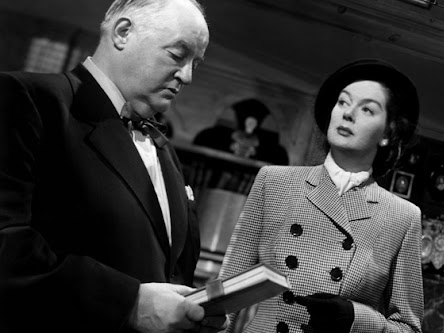
Guilt, fear and suspicion – these are all key characteristics of film noir. Marry those elements to the duplicity inherent in the world of the theater, where the necessity to don and discard the masks of performance, and the result should be a richly cultured blend of deceit. These circumstances provide a wonderful source of drama and melodrama, one tapped regularly by filmmakers. Sometimes the world of moviemaking itself becomes the main focus, while on other occasions it is the older and grander backdrop of the traditional theater. The latter forms the setting of The Velvet Touch (1948), where ambition, desire and tangled relationships on and off the stage see barbed witticisms replaced by a blunt instrument, resulting in tragedy.

In a sense, the whole movie could be summed up as a shift from comedy to tragedy. The leading lady of the story, and the leading lady of the Broadway production which has just reached the end of its run, is Valerie Stanton (Rosalind Russell). She has earned success and renown as a star in light comedic roles yet that pebble in the shoe of human nature that picks at many a person, and most especially the protagonists of film noir, is present. Yes, dissatisfaction is whispering insistently in Valerie Stanton’s ear, urging her to spread those artistic wings and set off and explore new areas. That alongside a new romantic relationship with an architect Michael Morrell (Leo Genn) is pushing her ever closer to a break with the past. And the break is a clean one when it does come, just as clean and sharp as the blow she strikes her producer and former lover Gordon Dunning (Leon Ames). This is essentially where the viewer comes in, literally in through the window of Dunning’s office, gliding in from the neon lit New York sky to witness the end of a highly strung and threat filled argument, the end of one man’s life and the beginning of a fresh ordeal for others. Shortly afterwards the movie dissolves into a lengthy flashback as Valerie reflects on the circumstances which led, step by relentless step towards this moment of violence. What follows is an investigation into the death conducted by the shrewd and reassuringly portly Captain Danbury (Sydney Greenstreet), an investigation that sees suspicion fall on the devoted but spurned Marion Webster (Claire Trevor). With dread and self-interest setting the pace and driving events into still darker corners of morality, the climactic denouement hints at life imitating art and those lines separating the the performer and the performance becoming blurred once more.

Those blurred lines  recall A Double Life to an extent, but even so I don’t think the similarities run too deep. Sure there’s the theatrical setting and the star, although only towards the very end of the story here, seeing aspects of her personal life and circumstances mirrored in the role she has taken on, Ibsen’s Hedda Gabler in this case. While The Velvet Touch is a good picture, attractively shot by Joseph Walker from a Leo Rosten (Sleep, My Love) script, it doesn’t have the same depth. That Rosten screenplay has some wonderful dialogue, as sharp and incisive as a scalpel and devilishly funny too; the exchange between Genn and Russell when they first meet at a party and he feigns ignorance of her celebrity is a delight. Some of that may be down to director Jack Gage too. He started out in the business as a dialogue director on  René Clair’s ever charming I Married a Witch as well as Double Indemnity for Billy Wilder. He then fulfilled the same role on  several pretty good melodramas, with Barbara Stanwyck (My Reputation), Bette Davis (A Stolen Life), and Rosalind Russell in Eugene O’Neill’s Mourning Becomes Electra before landing his one and only credit as a feature film director.

I will have to admit  that I’ve never been a great fan of Rosalind Russell. That said, I do admire her work and in particular I admire what I think of as her courage in embracing certain roles – for example, Joshua Logan’s Picnic sees her throw herself into her character in an extraordinarily challenging way. The part of Valerie Stanton is not an especially attractive one. Admittedly, she is wronged in some respects but her egoism and fealty to her own ambitions, whatever the cost to the innocents around her, is desperately unpleasant. It requires guts and great self-confidence from a performer to undertake such roles, and it is to Russell’s credit that she didn’t shy away from the more unsavory aspects. Claire Trevor rarely disappoints and turned in another excellent piece of work in the same year that she would win the Best Supporting Actress Oscar for her humiliated moll in John Huston’s Key Largo. She got across the bitterness and hurt of the perennially wronged woman perfectly, bringing a considerable amount of dignity to it all.

I often wish Sydney Greenstreet had made more movies. That imposing physical presence in tandem with his rich and unmistakable voice could be employed with equal success to comedic, dramatic and outright villainous roles. I have seen almost all of the films he appeared in and it is safe to say he enriched every one of those. His entrance in The Velvet Touch is terrific. Moving onto the stage to interview the assembled cast, he at first projects an air of vague menace as he casts a fishy eye over the nervous group in front of him. His gaze shifts then to the pitifully small chair at his disposal as he lowers his bulk with trepidation onto it, and breaks into an avuncular chuckle in full recognition of the absurdity of it all. It is a beautifully played aside, milking the tension expertly before leavening it with some much needed humor. Of the others, Leo Genn is debonair and smooth, Leon Ames is brimming with malice and energy and primed for a deserved fall, Dan Tobin radiates a knowing whimsy as a conceited critic, and Frank McHugh gets another chance to practice his patented puppy dog enthusiasm.

The Velvet Touch has been released on DVD in the UK by Odeon and in the US by Warner Brothers so it should be easy enough to track down. It’s a solid noir melodrama set amid that theatrical milieu that this viewer never tires of and has a handful of strong performances to recommend it. I recommend it.

Two Weeks in Another Town

poster202_zpseeehnr2s

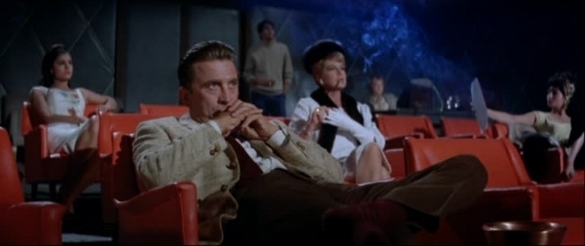
Introspection can be both self-indulgent and revealing, turning the gaze inward in search of some truth that seems elusive in the outside world can bring rewards, perhaps most notably for those whose business it is to present a facade for public consumption. It shouldn’t be all that surprising then that Hollywood, where dreams and illusion are daily spun from the dancing lights of the projector, periodically turns the cameras around to focus on itself. There’s something almost perverse about the industry’s need to pick away at its own glamorous veneer, as though it were prodding us in the ribs and daring us to confront the artifice at its heart. Two Weeks in Another Town (1962) was Vincente Minnelli’s second bite at the hand which fed him, following the previous decade’s The Bad and the Beautiful.

Jack Andrus (Kirk Douglas) is a movie star, one of that glittering breed idolized and worshiped by so many. Although it’s perhaps more accurate to say the Jack Andrus we see at the beginning was a movie star, a subdued figure strolling ineffectually round the grounds of the psychiatric clinic where he’s staying. The scar on his face, a memento of the events that led him to his current abode, has healed. However, it’s as nothing compared to the raw wounds he still carries around inside. His doctor says he feels Andrus is fit to leave, not necessarily cured but able to leave all the same. And there’s a hint of hope for the future too, a cable from his old director asking him to fly out to Rome for a small part in his latest production. But we’re talking about the movies here, where nothing and nobody can be taken at face value, and the truth is that Andrus is essentially washed up. The director, Maurice Kruger (Edward G Robinson), doesn’t really have any intention of using him on screen. Basically, it’s a ploy, partly as a kind of sop for Kruger’s guilt over his involvement in Andrus’ breakdown. If our star has hit bottom, then the once great director is headed in the same direction, although his decline is slightly more graceful and a little less dramatic. The picture represents something of a last bid for glory for Kruger, and it’s in danger of being derailed by the ruthlessness of his hard-headed Cinecittà producer. Standing between him and the prospect of failure and humiliation is Andrus, the man he first built up and then destroyed. So what does he do? He tosses this one-time star a few crumbs from his table, hoping that the hunger of a starving man will prove his salvation. To Andrus, the vital but seemingly demeaning task of supervising the post-production dubbing is like a slap in the face initially. Still, the lure of the movie business, and maybe more importantly, the chance to prove himself capable of doing anything of worth again is strong. And then there’s the figure of Carlotta (Cyd Charisse), the woman he tried to love and lost his mind over. She flits in and out of proceedings, simultaneously taunting Andrus with reminders of what he’s lost and holding out the promise of new adventures ahead. What it all boils down to is a two-week sojourn in a town where he may either drown in the heady atmosphere or, if he can see through the showbiz smokescreen, have the chance to regain the mastery of his soul once again.

£6

While I still think Two Weeks in Another Town is a very good film, it could potentially have been a great one. Charles Schnee wrote the script from a novel by Irwin Shaw, and the score was provided by the great David Raksin. With Milton Krasner shooting Minnelli’s beautiful nighttime setups just about all the ingredients were in place for a stone cold classic. But then, and ironically mirrored by the plot itself, came the interference from the studio. In his autobiography (The Ragman’s Son, Pan Books 1989,  pp 342-344), Douglas claims the movie was recut and edited when Joseph Vogel became the new head of MGM, stripping out some of the racier and more dramatically satisfying elements. I think that much can be seen in the somewhat sketchy development of a few of the characters. What we’re left with is the core of the story, of a man desperately seeking personal and spiritual redemption and the peace that comes with it. In addition, there’s the unmistakable stamp of Minnelli, the careful framing of whose shots create the kind of tableaux that approach visual poetry on occasion. It would be remiss of me not to mention his masterful use of color – the whole film is drenched in the deep, saturated hues which often characterize his work. Perhaps he falls short of achieving the dramatic and visual intensity of his sublime Some Came Running, but there are moments when he gets within striking distance at least.

Kirk Douglas was making his third appearance in a Minnelli production and he’s well cast in a role that calls for the type of mood swings which range from ebullience through manic intensity by way of brooding melancholy.  While the focal point of the story is on Andrus’ journey of self rediscovery, and the necessary laying to rest of old phantoms along the way, there’s room too for some interesting observations and musings on the nature of the actor, that wearer of masks. A wistful, early morning conversation with a besotted Daliah Lavi sees Douglas reflecting on the contradictory nature of the actor, the retreat from reality and submergence of the self in the character of others which actually runs counter to the overwhelming desire to better understand one’s own sense of being. Ultimately, it’s the reconciliation of these seemingly incompatible urges which lies at the heart of his character’s motivation.

£7

Robinson’s aging director is also notable, both in itself and as a commentary on the corrosiveness of the movie-making business. The essential insecurity of the man is demonstrated though the need to reaffirm himself through his notorious affairs with leading ladies  – which has had such an adverse effect on his relationship with his wife, an exceptionally acidic Claire Trevor – and also his desperation to prove once again his worth as an artist. It’s his fear of losing control, both personally and creatively, which drives him and finally twists his soul towards bitterness and distrust. The person who links (and divides) Douglas and Robinson is Carlotta as played by Cyd Charisse. Apparently a good deal of her part ended up on the cutting room floor, which is a shame as she is very good based on what we do see of her. Whether it was intentional or not from the outset, she comes across as a blend of the enigmatic and the alluring, leaving a trail of emotional devastation in her wake while attempting to seduce her former lover back onto the same self-destructive path. The contrast comes in the form of Daliah Lavi’s Roman ingenue (demurely clad in simple and pure white throughout as opposed to the arch and lurid costumes of Charisse) whose understated charm and innocence helps restore Andrus’ perspective. I was less impressed by George Hamilton’s troubled young star, never feeling all that convinced by the struggle he’s supposed to be waging against his personal demons. In support, there are small parts (virtual cameos in truth) for George Macready and James Gregory.

Two Weeks in Another Town is available on DVD as part of the Warner Archive in the US and there’s also an Italian release available. I have that Italian disc and it presents the film in the correct anamorphic scope ratio. The transfer is good, clean one with no notable instances of damage. Colors are generally well reproduced, something very important in a film such as this, and the image is pleasing overall. The disc offers the original English soundtrack and an Italian dub, and there are no subtitle options of any kind. As for extras, there’s the theatrical trailer and some galleries. Frankly, I like this movie, but films about films always interest me anyway, and I feel it’s a great pity that parts of it were excised at the behest of the studio boss at the time. Nevertheless, the movie that we have available to view, in spite of its imperfections, is never less than fascinating for the peek behind the facade of filmmaking it affords us and also the central story of a man battling to come to terms with himself and the choices he’s made in life. I recommend it.

Kirk Douglas reaches the grand age of 99 today and I thought I’d take the opportunity to post this piece on that occasion to draw attention not only to this great actor’s birthday but also to just one of the countless strong performances he’s delivered over a long career.

Man Without a Star

poster298

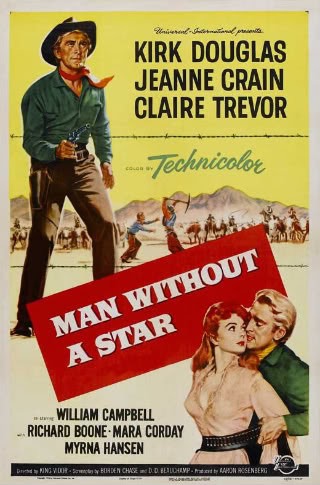
When you think of films about the passing of the old west and the shrinking of the frontier it’s examples from the late 1960s and 1970s that tend to spring to mind. As the western entered its own autumnal phase, the movies, perhaps quite naturally, turned their focus onto the gradual decline of the period they depicted. However, the sense of a way of life passing wasn’t confined to films of this time alone. Man Without a Star (1955) was made during the genre’s heyday, yet it tells the tale of a man driven ever further by the inexorable closing of the open range to seek out a place that offered the kind of freedom he once took for granted. This is a fascinating and emotive theme, and it runs throughout the film, but it’s diluted somewhat by a script that has the hero behaving in a way that, while entirely appropriate within the framework of the classic western, sees him contradicting his own personal philosophy.

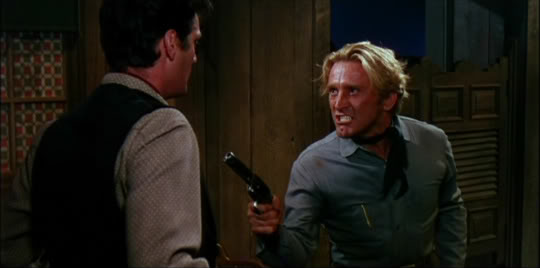
Dempsey Rae (Kirk Douglas) is a drifter, as the title suggests, a man who’s lost or perhaps never had a point of reference to guide him through life. His wanderings have taken him ever further from his roots in search of an elusive idyll. He waxes lyrical about the open range that used to allow men to go wherever their fancy took them, and thinks he may have stumbled upon his goal when he finds himself hired on as a hand on an expanding ranch. But that’s not to be; the barbed wire that signals the end of the vast expanses of untamed country are never far behind. No sooner has Rae settled into this comfortable position than the neighbouring ranchers start to string wire and close off the land to protect their grazing from the encroachment of his employer. That employer is Reed Bowman (Jeanne Crain), a hard headed woman from the east who intends to make her fortune no matter what obstacles are thrown in her path. After some initial hostility, she sees Rae as the man on whom she can depend on both a professional and personal level. And so Rae becomes Reed’s top hand, her lover, and her enforcer. That ought to be more than enough to occupy any man, but Rae has also taken on a kind of paternal role for a young man, Jeff Jimson (William Campbell), who has drifted north with him. It’s the arrival, with more cattle to swell Reed’s already substantial herd, of an old acquaintance of Rae’s that tips the balance though. Steve Miles (Richard Boone) is a mean and dangerous figure who’s prepared to take the ruthless steps that Rae baulked at, and will force his rival onto the sidelines. Miles’ actions force Rae’s hand and he has no option but to reconsider his previous prejudices. This, naturally, is par for the course in a western but it does have the effect of making Rae’s character less focused – he smoothly crosses the line to defend those whose methods he once railed against. Here we see a man who has suffered personal loss, whose body is crossed by the scars left behind by the hated wire, yet one who is prepared to forget all that and side with his former enemies as a result of his dislike of Miles and his methods. It builds Rae up into a hero of course, but it also cops out to a degree. I can’t help feeling that the story might have panned out into something more interesting and subversive had the character of Rae been allowed to stick to his guns and go down fighting rather than yield to the advance of progress.

£30

I haven’t seen a huge number of King Vidor’s films, especially not his early output. However, of those I have seen (six or seven pictures I guess), I must admit they all look great. Man Without a Star is no exception in that regard, there’s a richness to the images on show that’s extremely attractive. Clearly, having a top class cameraman like Russell Metty on hand didn’t hurt, and the result is some very well staged sequences. The climactic stampede, leading to the fight between Douglas and Boone, is a good example of this. Kirk Douglas’ performance in the movie is what I’d term a patchy one and not really up there with the best he was capable of. At times, he produces the kind of intensity that marked his more memorable roles, while at other moments he resorts to something akin to a parody of himself. In the same way that his character arc, which I mentioned before, doesn’t entirely satisfy, the jump from brooding, hair trigger moodiness to comedic mugging fails to flow naturally. In fact, the comic interludes are perhaps the least successful aspects of the film. At one appalling point, William Campbell strolls into the saloon done up in the kind of outfit that might have given Bob Hope pause for reflection in The Paleface, leading to some merciless ribbing from Douglas. The thing is though that it doesn’t actually work as it just feels forced and it jars. Scenes such as this don’t blend in with the rest of the movie and seem like they’ve been ported over from an entirely different production. What does succeed is the needling relationship between Douglas and Richard Boone, whose work generated some discussion on this site a few weeks back. Personally, I found myself yearning for more screen time for Boone and considerably less for Mr Campbell. Another positive aspect is the role played by Jeanne Crain. The traditional western template equates the feminine with domesticity, pacifism and a civilising influence. Man Without a Star, on the other hand, sees this truism overturned. Ms Crain exudes a sassy antagonism, sat on her buckboard, skirts hitched high and hat at a provocatively rakish angle. It is she, rather than the meek, male neighbouring ranchers, who takes on the role of aggressor and advocate of the open range that characterised the real wildness of the old west.

As far as I’m aware, Man Without a Star is currently available on DVD from three sources, and all of them bear some imperfections. There’s a French release that presents the movie, I believe, in a 4:3 aspect ratio and forces subtitles on the English track. There are also versions out in Germany and Australia, both of which have the movie in the correct 2:1 ratio. I’ve only seen some screencaps of the German disc but it appears that the colours have been drained and the overall result is a drab and flat looking image. I have the Australian DVD, which offers far richer colours yet looks like it may be interlaced. Despite that, the R4 version is a generally pleasing effort and I can’t say I was aware of any print damage or other distractions. The disc is completely barebones – no extras, no subtitles, not even a menu that I can locate. All in all, Man Without a Star is an imperfect film; it looks good and explores some interesting themes, but there’s an uneven quality to both the writing and lead performance that weaken it slightly. Even so, it’s an above average production that deserves to be seen by anyone with an interest in westerns of the period.


Key Largo

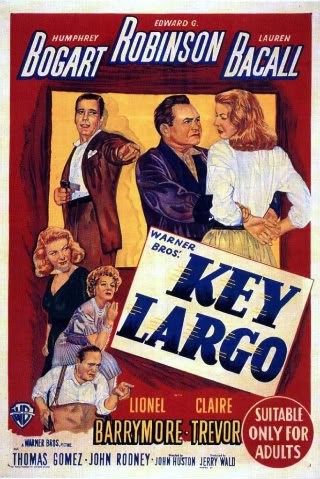
It’s hard to watch a film like Key Largo (1948) without being reminded of endings; it represented the final screen collaboration of Humphrey Bogart with both Lauren Bacall and Edward G Robinson, and it was one of the last movies he would make for Warner Brothers. Not only that, but it was also one of the last hurrahs for the old style gangster picture – but more about that later. It’s also a production that can be viewed from a number of angles: as a character driven drama, a gangster/noir mash-up, a commentary on the situation facing returning veterans, or as an allegory on fascism. Now this kind of multi-faceted approach can either lead to an unfocused piece or add to the rewatch value. I think the latter wins out here.

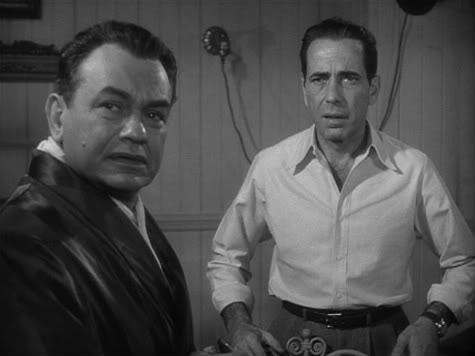
If the title and written prologue weren’t enough then the opening helicopter shot establishes the fact that the action takes place along the Florida Keys. As the camera zooms in on a bus making its way along the linking causeway we get our first glimpse of Frank McCloud (Bogart), a WWII veteran paying a visit to the relatives of a fallen comrade. McCloud’s destination is a hotel that, owing to the fact it’s the off-season, is virtually closed down. There is, however, one group of guests in residence when he gets there. None of these people seem especially friendly or anxious to welcome another visitor, and one of thier number, a Mr Brown, is conspicuous by remaining closed in his room. By and by, it emerges that McCloud’s companions are actually criminals, although that fact was unknown to the hotel owner, Temple (Lionel Barrymore), and his daughter-in-law Nora (Bacall). If McCloud had any suspicions, they are confirmed by the appearance of Mr Brown. Mr Brown isn’t his real name of course – he is one Johnny Rocco (Robinson), a one-time mob kingpin bent on rebuilding his criminal empire. At this point the already oppressive atmosphere grows heavier, both figuratively and literally, as an approaching hurricane threatens to tear up everything in its path. In the midst of all this, a duel develops between Rocco and McCloud – one that will finally be resolved on a motor launch bound for Cuba.

Key Largo was made at what was arguably the height of John Huston’s career, and its success is due to a combination of top class scripting (with Richard Brooks), photography, and acting. Bogart and Robinson occupy centre stage and their war of wills is what drives the whole thing forward. Eddie G’s Rocco is a devious and bullish creation, yearning for past glories that he must surely know in his heart are unattainable. Rocco and his cohorts are seen cowering before nature’s primal force and attempting to brass it out with a show of transparent bravado, pronouncing with unconvincing confidence that prohibition must surely come back and how things will be different this time. But these men are aware that they’re living out of time and it’s interesting to note that Al Capone, on whom Rocco was clearly based, was dead a year at that point. Bogart’s weary vet is one of his more complex characters, and could be compared to his Rick from Casablanca. Both men are initially reluctant to get involved or “stick their neck out” but do so eventually for the right reasons. The difference, however, is that Rick’s passivity was motivated by considerations of profitability whereas McCloud’s was the result of a deep disillusionment. That should have struck a chord with contemporary audiences: a whole generation of young men had marched off and risked their lives (and seen others lose theirs) in order to rid the world of oppression and fascism, only to return home and be confronted by a domestic version.

There are two key scenes that help define McCloud’s character. The first is a wonderfully photographed series of close-ups that show Rocco whispering suggestively into Nora’s ear (not a word is heard, but the inference is clear enough) before she spits contemptuously into his outraged face. With an unspoken dignity, McCloud moves across and quietly puts an arm around her shoulder before gently leading her away. I remember hearing Richard Brooks refer to this scene in a documentary as a moment of simple decency that everyone would like to emulate, and that’s hard to argue with. A similar situation takes place when Rocco humiliates his woman (Claire Trevor) by forcing her to sing unaccompanied as the price for the drink she craves. When he then goes back on his word, McCloud again does the right thing by pouring a whisky for the devastated woman despite the danger to himself. This is not a man who avoids confrontation due to cowardice or fear of personal injury but one who has grown apathetic and merely needs a prod to show his true colours. The aforementioned Claire Trevor deservedly won an Oscar for her role as the faded, alcoholic singer whose pride and self respect have been pushed into the background. That scene where she degrades herself in front of strangers through desperation is toe-curlingly effective and probably clinched the award for her. Lauren Bacall, in the only other significant female role, is much more subdued and is called on to do little more than gaze soulfully at Bogart. Of the four films Bogart and Bacall made together, this one is markedly different. The two Howard Hawks pictures had that director’s breezy playfulness about them, while Dark Passage was almost a study in bizarre coincidence. Key Largo has a grim, downbeat tone throughout that may surprise, or even disappoint, those hoping for a rerun of the couple’s previous work together.

Key Largo has been out on DVD for a long time now but the transfer still holds up well enough. I have the Warner UK version and the image is hard to fault, being pretty crisp all the way. I thought the dialogue levels were a little low but that’s probably just a feature of the film as there are a number of hushed conversations, and anyway Max Steiner’s atmospheric scoring doesn’t suffer. Extras are almost non-existent and are limited to the film’s trailer. The movie itself is a good example of how well Bogart and Huston worked together (it may come up wanting for those seeking out another Bogart/Bacall pairing though) and is the kind of picture that rewards multiple viewings. It gets the thumbs up from me.

Dark Command

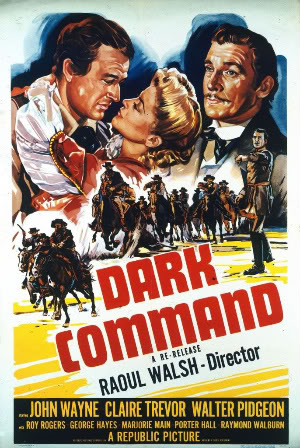
William Clarke Quantrill was one of those controversial figures who gained fame or noteriety, depending on where one’s sympathies lay, as a result of his activities during the Civil War. The nature of those activities has ensured that his character and associates have continued to appear on screen on a fairly regular basis, right up to Ang Lee’s much maligned Ride with the Devil. Raoul Walsh’s Dark Command (1940) takes Quantrill, changes his name to Cantrell, and adds a written caveat at the beginning to explain that certain liberties have been taken with the truth. As such it’s not a biopic of the man in the traditional sense; it merely uses the character and a few events from his life to tell a standard western story. Taken on this level it works very well, but then I don’t think I’ve ever seen a film by Walsh that didn’t work on some level.

Dark Command opens in Lawrence, Kansas on the eve of the Civil War, with Bob Seton (John Wayne) arriving in town in the company of perennial sidekick ‘Gabby’ Hayes. Seton is an uncomplicated Texan who’s in the process of working his way across the country. In making the acquaintance of banker’s daughter Mary McCloud (Claire Trevor), he also meets local schoolteacher Cantrell (Walter Pidgeon). Both men clearly have romantic designs on Miss McCloud, and their rivalry later extends to the political arena when they run for the newly instituted position of town marshal. It is Seton’s victory in this election that proves the catalyst for Cantrell’s abandonment of civic duty in favour of a much more lucrative career as a guerilla raider. Actually this brings about a change in the two lead characters; Seton becoming tougher and more assured once the weight of responsibility falls on his shoulders, and Cantrell revealing his venal nature in his quest to attain “greatness”. This personal animosity is played out while, all around, the town divides itself along pro-Union and pro-Confederacy lines. The wider national conflict is referred to only through dialogue and one of those, now cliched, burning map shots.

As I said before the film isn’t a straight biopic and never claims to be giving all the historical facts. Having said that Quantrill did work as a teacher in Lawrence in the years preceding the Civil War, although I’m not aware of his running for marshal or other elected office. It has been said of Raoul Walsh that his idea of humour was burning down a whorehouse; in Dark Command he goes one step further by burning down a whole town, although not for comedic value. The sacking of Lawrence by Quantrill is a known historical event and the film duly acknowledges this. However, this set piece, which forms the climax of the story, doesn’t dwell on the gory excesses of Quantrill’s men. Instead it uses it as a means of neatly wrapping up the personal battle between Seton and Cantrell. One could pick out all kinds inaccuracies relating to timelines, weaponry, the ultimate fate of Quantrill and so on, but I’ve never felt that this serves much of a purpose. Movies are a means of telling stories, and if this requires the makers to play a little fast and loose with the facts, well, so be it.

John Wayne made Dark Command one year after Stagecoach, the film which offered him a way out of the cycle of B westerns he’d been doing since the failure of Walsh’s The Big Trail. It’s a little ironic that the man who first introduced Wayne to the cinema-going public should again feature at the rebirth of his career. The Duke is still not the finished product here, although he’s not far away; audiences wouldn’t really see his fully formed western character until Tall in the Saddle, a few years later. There’s a bit too much mugging in the first half of the picture, although the easy, confident Wayne we’re all familiar with starts to emerge as the story moves along. Walter Pidgoen was an actor I’ve never really warmed to, but he was capable of turning in good performances as men carrying around a lot of internal baggage – How Green Was My Valley would be a good example of this. His Cantrell is never all that convincing as an out-and-out villain but maybe that’s just the way the part was written. Where he’s at his best are those private moments when he gives vent to all the pent up frustration that comes from thwarted ambition. Claire Trevor, who received top billing here, was a fine actress and does well as the conflicted woman at the centre of events. In Stagecoach she showed good chemistry with Wayne and that spark continues to be evident in this film. Romantic interludes were never Wayne’s strong suit but the tough Miss Trevor manages to draw out her co-star quite successfully.

I’ve already alluded to the fact that Raoul Walsh’s sense of humour tended towards the broad, and that’s certainly the case in the scenes with ‘Gabby’ Hayes. In much the same way as with Walsh’s contemporary and fellow Irish-American John Ford, audiences either get this kind of humour or they don’t. Superficially, one could see similarities in the styles of these two directors, but Ford remains the better known filmmaker. That’s not to say that Walsh should be regarded as a lesser figure, mind; he was every inch the professional and turned out some of the finest films of classic era Hollywood. It should also be mentioned that Dark Command contains some top class second unit work from the great Yakima Canutt. There’s a spectacular wagon jump from atop a cliff, and another outing for his patented under-a-moving-wagon escape ala Indiana Jones. Today’s climate of clumsy editing and overused CGI makes this viewer yearn for the era when there was genuine creativity and artistry in the second unit.

The movie is available on DVD in both R1 and R2. I have the old R1 from Artisan and the picture quality is quite good. Like all those Republic pictures released by Artisan there hasn’t been any restoration done, so there are instances of speckling and the odd cigarette burn. However, the print remains in pretty good shape and is always watchable. The R2 comes from Universal UK, and while I don’t have it to compare I would be wary of its quality considering its source. Dark Command is a fine western with an epic feel that comes partly from the bigger budget that Republic granted it. I’d recommend it to the general western fan and anyone with an interest in the Civil War era, or the development of the Duke’s career.