Ten of the Best – Women of the West

Over a decade ago (it really doesn’t seem that long… ) I posted a list of western actors. I followed that up with a post on western directors, film noir directors, and film noir stars. The latter included a mix of male and female stars and it has long been my intention to put up a list that would balance that first entry by turning the spotlight on the women who made significant contributions to the western. I’m not sure why I’ve left it so long, I guess other things just kept getting in the way and it got shunted off for another day. There are those who would say the western is an inherently masculine genre, but I don’t feel that’s a fair or just assessment. The western was and remains one of the greatest of all cinema genres precisely because it was so malleable, was so dependent on absorbing myriad influences, and drew highly creditable work from such a wide range of personnel. So, let’s cut to the chase and have a look at ten actresses who added immeasurably to my my enjoyment of my favorite genre.

Felicia Farr
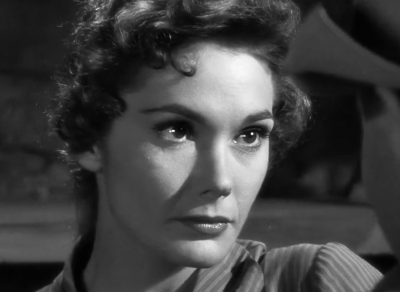
I can’t imagine opening this list with anyone else. Felicia Farr’s part in 3:10 to Yuma is comparatively small yet it’s a pivotal one. Those short scenes she shares with Glenn Ford’s outlaw are memorable and powerfully touching, adding another layer of yearning and regret to an already poignant movie. Director Delmer Daves also used Farr in two other fine westerns, The Last Wagon and Jubal, while George Sherman cast her to good effect in Hell Bent for Leather and Reprisal.

Virginia Mayo
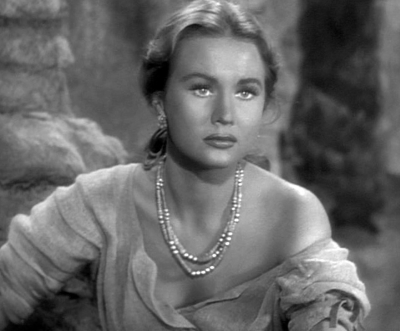
Making her western debut in Colorado Territory, Raoul Walsh’s remake of his own High Sierra, Mayo impressed herself on the genre right away. I won’t go into spoilers here for those who haven’t seen it but the climax of that film is as tragic as it is poetic, and Mayo’s actions give it its power. Walsh would cast her again in the underrated Along the Great Divide while she had other good parts in The Proud Ones, Great Day in the Morning and  Fort Dobbs to name just a few.

Dorothy Malone
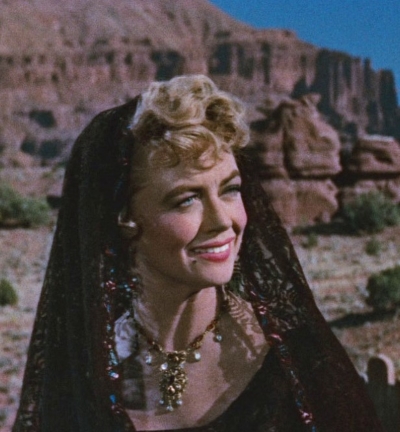
While Virginia Mayo was the passionate, beating heart of Colorado Territory, her rival for the affections of Joel McCrea’s doomed outlaw was a coquettish and calculating Dorothy Malone. She would take on some terrific roles throughout the 50s, including some very respectable films noir as well as a couple of plum parts for Douglas Sirk – the superlative The Tarnished Angels and an Oscar winning performance in Written on the Wind – and of course plenty of westerns. Among the highlights are At Gunpoint (why has this movie never had a decent release anywhere?), Pillars of the Sky, Quantez, The Last Sunset and Warlock.

Barbara Stanwyck

One of cinema’s great actresses, Stanwyck made  couple of westerns in the 1930s and 1940s (Annie Oakley, Union Pacific and California) but it was in the 50s that she made her mark on the genre, and fell in love with it in the process. Starting off with the emotionally charged and wondrously melodramatic The Furies for Anthony Mann, she would regularly return to the west. Some of those films were only partially successful, but a movie like The Violent Men has much to recommend it and Samuel Fuller’s Forty Guns is an enduring classic in my opinion.

Vera Miles

Anyone who worked with John Ford, and was cast in major roles in his films has to be worthy of consideration here. Vera Miles had started out in the genre with a part in The Charge at Feather River and in Jacques Tourneur’s Wichita. These are fine movies by any standard yet a top role in The Searchers, which is arguably the best western of all time, and one of the best films of any kind, lifted her into a different league. The fact Ford cast her again in The Man Who Shot Liberty Valance, one of the key films marking the close of the classic western era cements her place for me.

Maureen O’Hara

The Ford connection is strong with the next entry on the list, even if their western collaboration was limited. The fiery Irish redhead had already made Comanche Territory when Ford used her opposite John Wayne in Rio Grande, unfairly regarded by some as the least of the director’s Cavalry Trilogy. She would work memorably with Ford and Wayne again in other genres and went on to make good westerns such as War Arrow (George Sherman) and The Deadly Companions (Sam Peckinpah’s debut feature).

Claire Trevor

Sticking with Ford (and indeed Wayne) for the present, we now come to Claire Trevor. It’s hardly too much to say that Stagecoach was instrumental in boosting the status of the western, lifting it firmly and decisively into the A class where it would continue to hold a dominant position for the next quarter of a century. Trevor’s turn as Dallas, the “fallen woman” driven out of polite society only to find love, respect and a future with Wayne’s Ringo Kid, is a superb piece of work. Perhaps her subsequent westerns didn’t offer the same scope for her abilities – Texas, Dark Command (Raoul Walsh), The Desperadoes, The Stranger Wore a Gun – but she was a regular visitor to the cinematic west, and that ride on the Lordsburg stage counts for a lot.

Katy Jurado

The Mexican actress with maybe the most soulful pair of eyes in the business. The wistful look she bestows on Gary Cooper as he stands alone in an empty street in High Noon is as good a way to announce one’s arrival in the genre as I can think of. She brought her unique quality to such movies as Broken Lance, Man from Del Rio and The Badlanders throughout the 1950s. Her appearances in westerns tailed off after that, One-Eyed Jacks with Brando in the next decade and then a small but hugely affecting part in Sam Peckinpah’s Pat Garrett and Billy the Kid.

Julie Adams

Anyone familiar with my writing over the years will be aware of how much I enjoy the output of Universal-International, and the westerns that studio produced are among my favorites. Sometimes it feels as though it’s impossible to watch a U-I western and not see her. Budd Boetticher frequently used her in his movies for the studio – Wings of the Hawk, Horizons West, The Man from the Alamo – and she had good roles for Anthony Mann in Bend of the River and Raoul Walsh in The Lawless Breed and then later on in Joseph M Newman’s The Gunfight at Dodge City.

Debra Paget

Starting out with some small roles in notable films noir (House of Strangers, Cry of the City), Paget struck western gold in the influential Broken Arrow for Delmer Daves. In a sense, one could say she became typecast in westerns, finding herself playing yet again a Native American in White Feather (scripted by Daves) and the powerful and visceral The Last Hunt for Richard Brooks. Typecast or not, she brought a great deal of dignity to those parts and the western genre would be poorer without her performances.

So there it is, my list of ten actresses who have enriched the western over the years. I had to indulge in a bit of ruthless trimming to keep it down to ten, but that’s to be expected and I also anticipate that my picks aren’t going to satisfy everyone. Well, that’s the nature of lists and half the fun is hearing others point out who they would have included instead. Feel free to disagree in the comments section below.
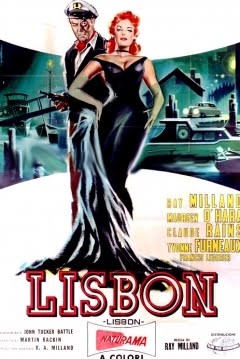
Lisbon

poster201_zpswll8j0rz

There were lots of changes taking place in filmmaking in the mid-50s. Actors were trying heir hand at directing and/or producing, location shooting was growing ever more popular and Europe, with the tax breaks offered, drew many, and then there were all the widescreen processes coming to the fore as the studios struggled to compete with the challenge posed by television. Lisbon (1956) is one movie which offers an illustration of all these factors at work. It’s a handsome-looking Cold War thriller made by Republic Pictures in the period when the studio was sliding into terminal decline and only a few years away from ending feature production altogether.

It’s early morning in a luxurious villa on the outskirts of Lisbon, and Aristides Mavros (Claude Rains) has just been awakened by his manservant. While sitting on the side of his bed, shaking the sleep out of his head, his attention is drawn by the gentle chirping of songbirds on the windowsill. Smiling indulgently, he sprinkles some seed for the birds to feed on and withdraws to the side. As the tiny creatures gather for the unexpected treat, Mavros brings a tennis racquet crashing down on them before offering the mangled bodies to his cat for breakfast. The wrong-footing of the audience, by turning a potentially sweet pastoral scene into something more macabre, is attempted a few more times throughout the movie, but never quite as successfully or shockingly. It is thus established that Mavros is a villain, although viewers will have to make up their own minds by the end if his brand of ruthlessness is any worse than that of other characters. The central plot is relatively straightforward as Cold War films go: Sylvia Merrill (Maureen O’Hara) is a rich American, whose elderly husband has been abducted and is being held somewhere behind the Iron Curtain. Mrs Merrill wants her husband back and is prepared to pay Mavros a substantial sum of money to arrange it all. For his part, Mavros engages the services of the one man in Lisbon with a boat fast enough to guarantee pick-up and delivery of the frail tycoon. Robert Evans (Ray Milland) is a smuggler using a converted torpedo boat to run whatever is profitable into Lisbon beneath the suspicious but powerless eyes of the Portuguese authorities. Evans’ usual cargo is the likes of perfume and tobacco, but he’s not above widening his interests to encompass people, as long as the price is right. As the complex business of negotiating and arranging the handover gets underway, trust and betrayal, those perennial bedfellows, come into the equation. Is Evans the kind of man to be relied on with so much money floating around? If Mavros is a crook, is he at least a dependable one? And what are Mrs Merrill’s real motives?

Lisbon was Ray Milland’s second feature as a director, following on from his impressive debut in A Man Alone, and it’s a reasonable effort, although it lacks the tightness of the earlier movie. Of Milland’s five feature films, I’ve now seen three (Hostile Witness is unwatched on my shelf and The Safecracker has eluded me so far) and I feel he was pretty good behind the camera. However, in my opinion, there’s a bit too much stodge in the middle here as the nature of the various relationships is explored and defined. While all this is necessary for the plot to make sense, the execution lacks a bit of snap but is just about rescued from descending into tedium by the very attractive location photography. As widescreen filmmaking became the norm, various studios were developing their own versions of the process. Republic Pictures came up with what they called Naturama, an anamorphic scope form, although the screencaps here show that the copy of the film I watched, sadly, didn’t provide the chance to see the full effect.

In all five of his directorial features, Milland also took top billing, a smart move for an actor nearing the end of his time as a leading man. His advancing years actually work out well enough here as he’s playing a slightly shopworn and tarnished hero. Overall, I wouldn’t call it a demanding role; there’s a smidgen of ambiguity, by dint of his character’s profession, but it’s standard action/romantic stuff for the most part. Claude Rains has the choice role – although my feeling is that even if it weren’t so written, he would still have managed to make himself the most interesting figure on view – and dominates every scene he’s in from first to last. Ever suave and urbane, Rains was also capable of adding a calculating, reptilian quality when the occasion demanded. His Mavros is a terrific piece of perverse sophistication, utterly unscrupulous and delighted by his own sadism; there’s a lovely moment when he orders the burning of two of his “secretary’s” favorite dresses because she had committed an indiscretion, and then changes his mind and makes it just one on learning that she also kicked the pompous manservant. I was less satisfied by Maureen O’Hara – not because of her acting, but due to the script having her character complete the kind of volte-face that seems far too abrupt to be credible. There’s a nice turn though from Yvonne Furneaux (The Mummy, Repulsion) as Mavros’ companion, who finds herself falling for Milland. In support we get Edward Chapman, Francis Lederer, Jay Novello and Percy Marmont.

Lisbon isn’t the most widely available title – I have this Spanish DVD, and I don’t think it’s been released anywhere else to date. However, as I mentioned above, the aspect ratio is compromised – the titles play in proper scope but switch to 16:9 as soon as the actual feature kicks in. The lack of headroom suggests cropping mainly at the sides of the image, although there may well be some zooming taking place too. I once caught a TV broadcast of the film, similarly cropped to fit a 16:9 screen, so I think it’s reasonable to suppose the DVD is derived from a master prepared for television. Under the circumstances, I can’t honestly recommend this as a purchase. The film is a reasonably entertaining thriller with a good opening and finish, but the mid-section is a bit slack. Despite some weaknesses, the location work and Claude Rains add lots of value – it’s just a shame a better version isn’t available.


The Fallen Sparrow

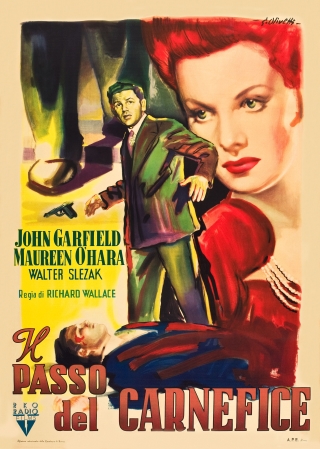
Wartime propaganda movies can be a bit of a mixed bag when viewed with modern eyes, the passage time allowing them to be considered more objectively as pieces of cinema. Some fare very poorly, with weak, stereotypical characterization tending to be the principal fault. On the other hand, there are others which hold up better, which use a little more subtlety and whose stories are more engrossing. The Fallen Sparrow (1943) is one of the stronger efforts, thanks largely to its star and cinematographer. However, it’s not a movie without its faults, most of which stem from an inability to fit comfortably into any one category: it’s a spy thriller with an antifascist message, a film noir in visual terms, and a psychological melodrama. I think it’s the propaganda aspect that lets it down the most though, not because it’s especially dated but more because the motivation of the villains is hard to swallow.

John McKittrick (John Garfield) is a war veteran, not of WWII but the Spanish Civil War. A policeman’s son, he fought on the Loyalist side, was captured and held prisoner long after the conflict had ended. We first see him on a train bound for his native New York. There’s a nervy urgency about the man, and a glimpse at a scrap of newspaper tells us that he’s heading home as a result of an apparently accidental death. A boyhood friend took a dive from a high-rise apartment, and it’s soon made clear that McKittrick is unsatisfied with the official version of events.So far the plot has all the hallmarks of a standard mystery thriller, but it’s McKittrick’s back story that gives it an added twist. During his incarceration in Spain McKittrick was a victim of prolonged sessions of torture, and he only escaped due to the intervention of his recently deceased friend. The effect of this is twofold – McKittrick suspects that the death was no accident and was actually linked to events in Spain; additionally, those years in the dungeons suffering at the hands of faceless tormentors have left him in a psychologically fragile state. With the police keen to give him the brush off, McKittrick sets about looking into the circumstances of the death himself. This leads him into the slightly surreal world of the refugee community – where exiled aristocrats keep company with night club musicians and the granddaughter of a prince (Maureen O’Hara) sells hats to society matrons for a living. Within this odd milieu lurks the threat of a fascist cell and its preoccupation with the recovery of one of the more unusual spoils of war. Teetering on the brink of sanity, McKittrick weaves his way through this group of blue bloods, spies and assorted lackeys in an effort to get to the bottom of the mystery and exorcise his personal demons.

Richard Wallace isn’t a director i can say I’m all that familiar with. He’s probably best know for taking charge of Sinbad, the Sailor with Douglas Fairbanks Jr, but he also made a moderately good noir, Framed, with Glenn Ford. Both Framed and The Fallen Sparrow show that Wallace had some talent for the dark cinema, and this movie in particular features a few very nice touches. I guess the fact that Nicholas Musuraca, who photographed some of the most visually interesting film noirs, was behind the camera helped a lot, and the pair conjure up a handful of scenes whose atmosphere wouldn’t look out of place in a horror movie. There are plenty of impenetrable shadows that whisper menace, and architectural features like pillars and balustrades are used to pin the hapless and haunted McKittrick in place. The overall effect is to heighten the sense that the hero of the movie is still trapped by the ghosts and monsters of his past, and he frequently seems to be as much the prey of the dark forces crowding around him as the hunter he’s trying to be.

The film very much belongs to John Garfield, although there’s good support from Maureen O’Hara and Walter Slezak. I think Garfield is one of the most tragic figures of Hollywood’s Golden Age – a man of immense talent and raw power doomed by poor health and the political climate of the times. He always came across to me as the tough guy with the soft center, possessed of a streetwise cockiness and vulnerability that, while an elusive quality, was a key ingredient of the finest noir protagonists. His career lasted only thirteen years and by 1952 he was dead, aged just 39. He suffered from a heart condition and it’s highly likely that his hounding by HUAC during the McCarthyite Red Scare of the late 40s and 50s was a contributory factor in his early demise. However, in the short time he graced the screen with his presence, Garfield made some terrific and memorable movies, especially noir pictures. Body and Soul, Force of Evil and The Breaking Point are all genuine classics as far as I’m concerned, and even his lesser works like The Fallen Sparrow show how good he could be. I think the most interesting thing about this movie isn’t really the plot, instead it’s Garfield’s portrayal of a severely damaged individual, a psychologically shattered man clinging to the remnants of his sanity. His terror, as the nights draw in and the shadows lengthen, is palpable. The viewer really gets to share in his dread, boxed up in his apartment and sweating despite the snow falling outside, as the dragging footsteps of the limping man of his nightmare past echo in his mind. Walter Slezak brought a creeping menace to many roles, not least Hitchcock’s Lifeboat, and his turn as a crippled intellectual fascinated by man’s cruelty to man is well realized. The early scene where he softly lectures a drawing-room of stuffy society types on the delicacies of the torturer’s art, as Garfield stands awkward and withdrawn before him, is a chilling moment. Maureen O’Hara is only one of three women linked to the mystery – the others being Patricia Morison and Martha O’Driscoll – but she gets the meatier and more significant role. She’s not an actress that you would automatically associate with film noir but does fine as a possibly duplicitous woman with divided loyalties.

The Fallen Sparrow was an RKO production and is now widely available in DVD in Spain, Italy, France and the US (via the Warner Archive). I have the UK edition of the film released by Odeon and it’s a reasonable transfer. The image is fairly sharp and has good contrast levels to show off Musuraca’s photography. However, it has to be said the print is quite dirty, with plenty of speckles and instances of minor damage. The disc is completely free of extras, just the option to play the movie or select a scene. The movie is adapted from a book by Dorothy B Hughes and while it’s not up to the standards of the best versions of her stories – In a Lonely Place and Ride the Pink Horse – I reckon it’s still a movie that most fans of film noir would want to see. I feel that aspects of the plot, derived from the overdone combination of propaganda, espionage and melodrama, do hurt it. Having said that, Garfield’s intense performance and Musuraca’s beautiful, atmospheric photography raise the quality quite a few notches. All in all, it’s an enjoyable if not wholly successful film.