The Barefoot Contessa

“I suppose that when you spend most of your life in one profession you develop what could be called an occupational point of view.”

Write what you know. Isn’t that the classic line of advice offered to all budding scribes? When Humphrey Bogart’s character speaks those words above as the camera pans on the opening scene of The Barefoot Contessa (1954) there is at the very least a flavor of that sentiment on display.  And if Hollywood knows anything, it surely knows about the path to fame and about each and every pothole mining the route that leads there. Self-awareness, so long as it’s kept on a short enough rein to prevent its spinning off into self-indulgence, can be healthy; it grants perspective and that along with what I can only term soul are the essential ingredients of creativity. So “Hollywood on Hollywood” has been a productive sub-genre over the years, permitting the movies and their makers to take a look at themselves and inviting the viewer to peel back a corner of the mask for a glimpse of what lies behind. Such films generally fall into two categories, ranging from the celebratory to the acerbic. The Barefoot Contessa lands somewhere in the middle, perhaps because it is itself a story pitched halfway between Hollywood exposé and a meditation on fate.

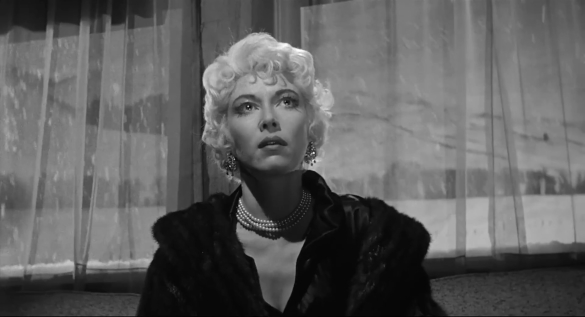
That air of fatalism pervades the movie, right from the rainswept introduction in an Italian cemetery, where a pensive Harry Dawes (Humphrey Bogart) casts his mind back over the few short years when he came to know the titular character. He stands a little apart, slightly detached from the other assorted mourners, although all of them are separated from each other in pairs and little clusters. This detachment is somehow appropriate, as fitting in its own way as the low key setting of this last farewell. These people have gathered to pay their respects to Maria Vargas (Ava Gardner), a one-time flamenco dancer from the back streets of Madrid who would later find fame on the screen as Maria D’Amato, before ending her life as the Contessa Torlato-Favrini. It’s appropriate because although the movie traces the brief rise and fall of Maria Vargas everything that is shown is filtered through the perceptions of others, those who tell her story to the viewer. Harry Dawes does the lion’s share of the telling, he was the one who was credited as having “discovered” her or mentored her in any case. As we segue into a flashback to the club in Madrid where Maria dances by night, the tone is set with great deftness. Her dancing is never observed, only the reactions of the audience provides a sense of her. While the camera roves around the assorted patrons, it becomes clear the woman who holds them all rapt is offering a reflection of what they all feel – the responses vary from frank admiration to surreptitious desire, as love, passion, frustration and shame flash across the screen and the faces of the assembled watchers in waves. And then it’s over, the dance is done and the star vanishes back to her own privacy as the beaded curtain swings back into position.
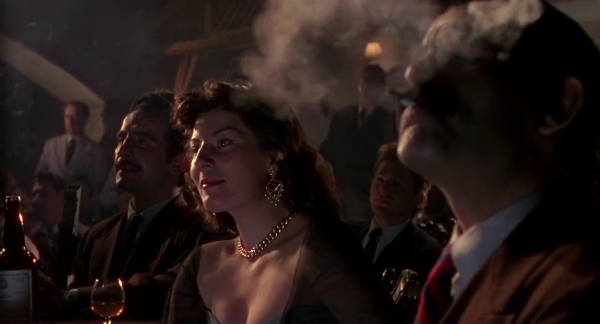
In what might be taken as a subtle dig at Hollywood forever playing catch-up with regard to popular trends, no sooner has the main attraction vacated the stage than the people from the movies arrive. The aforementioned Harry Dawes is tagging along with Kirk Edwards (Warren Stevens) a buttoned up producer reminiscent of Howard Hughes, Oscar Muldoon (Edmond O’Brien) whose glittering eyes and glistening face speak of perspiration and PR, and a burnished blonde courtesan by the name of Myrna (Mari Aldon). Kirk Edwards is a mean vulgarian, a shell of a man high on his own sanctimony and motivated only by the manipulative power of the dollar. He has flown his entourage all the way to Spain to see Maria Vargas dance and maybe offer her a contract. And now he has arrived too late, but such a man cannot countenance this kind of ill-fortune. He orders, savoring the humiliation the whole process entails, first Oscar and then Harry to fetch the aloof dancer to his table. While Oscar sweats and schmoozes Maria out of agreeing to a screen test, Harry is left with literally no option but to track down and persuade her to change her mind. Where Oscar’s sweat failed, Harry’s sincerity triumphs and Maria is on her way to stardom.

Exit Harry, temporarily. And enter Oscar, the vacuous nature of the publicity man firmly to the fore as he takes up the narration, charting the course of a life and spirit he freely admits he could never quite fathom. Of course Oscar doesn’t do depth, he does his master’s bidding. Partially due to the liberating effect of being around a woman who has no time for the fakery and front that stardom seems to demand, he sees his world view shifting ever so slightly. His remit is to guide us through the downfall of Kirk Edwards and Maria’s move on to the next phase of her life as the principal exhibit of Alberto Bravano (Marius Goring), a Latin playboy with no discernible character. This is a shorter interlude, a stepping stone on the way to Maria’s ultimate destination. Soon, the tale is taken up by Vincenzo Torlato-Favrini (Rossano Brazzi), the tortured aristocrat who is tragically incapable of real love, able only to venerate and deify. It is he who commissions the marble statue of Maria that will ultimately mark her final resting place, a cold approximation of beauty that is as cold and blank as his own helpless passivity.

Ava Gardner’s Maria Vargas drifts through the movie, and I use that term quite deliberately. As I said, at the beginning, the story is deeply fatalistic. Both by her words and her actions the lead character is presented as a woman unable to, or perhaps unwilling to, completely break from the past and take command of her destiny. The whole barefoot business ties into this, an explicit acknowledgment that the past is an integral part of oneself, functioning either as a brake on ambitions and aspirations or as a means of grounding one in reality. I don’t say this is a philosophy I particularly sympathize with, but it is there, it defines the whole mood of the piece and is well realized. Ava Gardner’s performance here is key to that realization and is almost a subversion of her typical screen persona. Earthy is the word that  frequently springs to mind when I think of her rather than ethereal yet it is the latter quality which she conveys throughout much of the film. Sure she has her moments of fire, but she never allows her natural vigor to overshadow that acceptance of a life directed by the golden threads of the Moirai.

The Barefoot Contessa is not a film that works for everybody, maybe due to that air of languor that grows out of its core fatalism. Then again it might be the wordiness of the script that bothers some, but I’d argue that anyone knowingly approaching a Joseph L Mankiewicz film and finding that aspect an issue ought to know better in the first place. Personally, I’m inclined to think that the third act, that beautifully shot and achingly poignant Italian interlude is most problematic. It is not a question of where the film is going or even where it ends up that hurts it, rather it is the playing of Rossano Brazzi that I think takes the edge off it all. Although I’ll concede he gets the futile desperation of his character across, I don’t think Brazzi was ever the most magnetic presence at the best of times and that becomes an issue here. It is undoubtedly a tricky part to carry off, but I just do not see him as the object of Gardner’s grand passion, the man who has that something which she never found elsewhere. Without that, one of the main props of the story is seriously weakened.

Bogart’s name was top of the bill and his bookending of the narrative is nicely judged. His later films weren’t always all they could have been, even if his own work was as strong as ever for the most part. His peak years were often characterized by that tough insolence that has spawned so many imitators, but he had more to him than that when he wanted or was allowed to show it. The Barefoot Contessa lets him reveal a warmer side than usual. Even if it’s tempered by the weariness and regret that came easily to him, there is an empathy on display which is very attractive. In support Edmond O’Brien sweet talked his way to an Oscar playing Oscar; there’s a degree of showiness as there nearly always is with award winning turns and he makes what is on paper a pretty miserable character more appealing than he probably ought to be, still it’s an engaging and memorable bit of work. Warren Stevens achieves an almost reptilian stillness as the soulless tycoon and it’s fun seeing him face off against a very theatrical Marius Goring in their big confrontation scene. Valentina Cortese, Elizabeth Sellars and Mari Aldon all have their moments even though their parts are relatively minor.
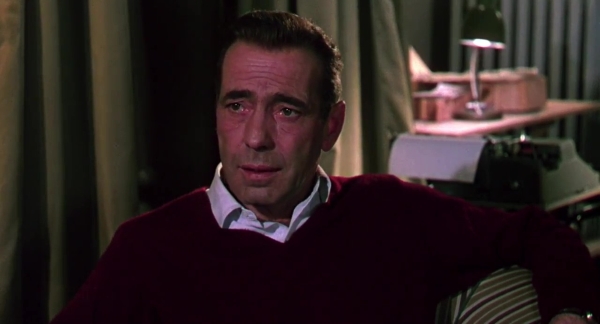
The Barefoot Contessa got a Blu-ray release in the US from the now defunct Twilight Time and then later in the UK via Eureka. I have that UK BD which now appears to have gone out of print and it’s a fine looking transfer of the movie that makes the most of Jack Cardiff’s beautiful cinematography. I don’t always mention scores or soundtracks, which I know is remiss of me, and so I want also to take the opportunity to draw attention to Mario Nascimbene’s evocative work on the movie. I wouldn’t want to claim The Barefoot Contessa is a flawless work as I am aware that it has its weaknesses and doesn’t appeal to all. However, it is and has long been a favorite of mine, ever since I stumbled on an early evening TV broadcast nearly forty years ago.

Well, that about wraps it up for 2023. I’d like to say thank you to everybody who came along for the ride over the last twelve months. Here’s to 2024 and here’s hoping it brings peace and happiness to us all. Happy New Year!

Storm Fear

Confinement breeds volatility. And confinement, be it physical, emotional, spiritual or social, is a key element in film noir. As space is limited, so is the room for maneuver and so are the options available to the protagonists. This is provides a situation ripe with dramatic potential – take a small group of characters menaced by an external threat and simultaneously squeezed by internal pressures and sit back to watch what happens. This is the essence of Storm Fear (1955), and it’s a formula which has been employed on and off by filmmakers in productions as diverse as Day of the Outlaw, The Small Voice and Key Largo.

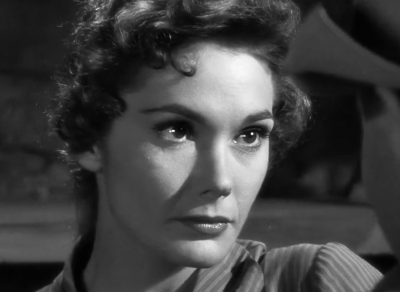
Storm Fear has its characters in uncomfortable places all the way through, right from the beginning when young David Blake (David Stollery) and Hank (Dennis Weaver), the hired help, come in from the snow, into the remote mountain cabin. David’s mother Elizabeth (Jean Wallace) is guarded and somehow restrained while her husband Fred (Dan Duryea) is even more detached. The mood and atmosphere of the cabin and its occupants is wrong, discontent and dissatisfaction pervade like some insidious form of emotional dry rot. Fred is a man bowed and broken by personal and professional failure, a shuffling, shambling figure forever burrowing deeper into the oversized scarf he twists and kneads, his comfort blanket in a world from which he has retreated. Elizabeth is a martyr to duty and disenchantment, going through the motions in a barren and loveless marriage. Suddenly, this chill facade is shattered by the arrival of Fred’s brother Charlie (Cornel Wilde). Charlie is a hood, a no-good type with a long history of crime following him around, and on this occasion he’s also got two accomplices in tow (Lee Grant & Steven Hill). He is on the run after a bank raid has netted him a sack full of money, a bullet in the leg and a looming murder rap. All of that ought to amount to a fair amount of pressure within and without yet there is the added complication of the tangled relationship which links Charlie, Fred and Elizabeth.

Cornel Wilde made his debut as a feature director with Storm Fear. He was also the producer and had Horton Foote adapt the novel of the same name by Clinton Seeley for the screen. In fact, Wilde assembled some impressive talent behind the cameras, with Elmer Bernstein providing the score and Joseph LaShelle taking care of the cinematography. As a result, this movie has a polished and highly professional look. Wilde paces everything well, drawing ample tension from the lengthy scenes within the cabin as the characters fume and feud. The climactic scenes out on the mountain, as the cold and weariness takes their toll, open things up somewhat, but that’s only in a superficial sense. The stark landscape and harsh conditions impose their own restrictions and in classic noir fashion the poor choices these people have been making throughout their lives narrow all their avenues of escape. It’s not so much a matter of being unable to stop what’s coming as being unable to outrun what went before.

Wilde’s acting is solid, he adds a slight stammer to his character’s delivery to indicate his core insecurity. It’s an affectation of sorts but it fits the character and he never makes it feel forced. Jean Wallace, who was married to Wilde, is especially strong in a difficult and multifaceted role. She is called upon to range from guilt and remorse to resilience and resolve. It amounts to a tricky balancing act on her part and she carries it off successfully all told. I guess most viewers will be accustomed to seeing Dan Duryea take on showy parts. As such, his portrayal of Fred Blake could be regarded as something of a departure. It’s a comparatively quiet role, contemplative and reproachful to the point of being ineffectual, with a hint of puritanism lurking below the surface. I’m not sure it works though. Lee Grant, making a rare screen appearance in the middle of those lost years when she was victimized by the blacklist, is almost unrecognizable as the bleached moll with a considerable thirst. I’ve seen largely positive reactions to Steven Hill’s turn as Wilde’s psychotic sidekick, but I can’t say I appreciated his work here. Hill was an alumnus of the Actors Studio and that is very apparent here. I’ve never been a fan of method acting although I’ll concede some such as Montgomery Clift made it work for them. Hill, a little like Rod Steiger at his most excessive, never leaves the viewer in any doubt that he is giving a Performance, and not for one moment did I feel he was anything other than an actor playing a part.

Kino released Storm Fear in the US years ago and it’s a handsome looking production. LaShelle’s crisp cinematography comes across well and the pacy, self-contained story never outstays its welcome. It’s a late-era film noir that harks back to the previous decade’s focus on personal rather than wider societal conflicts. While I have some reservations about a few of the performances, there are a lot of good things going on and the movie is certainly worth a look.

Ten of the Best – Women of the West

Over a decade ago (it really doesn’t seem that long… ) I posted a list of western actors. I followed that up with a post on western directors, film noir directors, and film noir stars. The latter included a mix of male and female stars and it has long been my intention to put up a list that would balance that first entry by turning the spotlight on the women who made significant contributions to the western. I’m not sure why I’ve left it so long, I guess other things just kept getting in the way and it got shunted off for another day. There are those who would say the western is an inherently masculine genre, but I don’t feel that’s a fair or just assessment. The western was and remains one of the greatest of all cinema genres precisely because it was so malleable, was so dependent on absorbing myriad influences, and drew highly creditable work from such a wide range of personnel. So, let’s cut to the chase and have a look at ten actresses who added immeasurably to my my enjoyment of my favorite genre.

Felicia Farr

I can’t imagine opening this list with anyone else. Felicia Farr’s part in 3:10 to Yuma is comparatively small yet it’s a pivotal one. Those short scenes she shares with Glenn Ford’s outlaw are memorable and powerfully touching, adding another layer of yearning and regret to an already poignant movie. Director Delmer Daves also used Farr in two other fine westerns, The Last Wagon and Jubal, while George Sherman cast her to good effect in Hell Bent for Leather and Reprisal.

Virginia Mayo

Making her western debut in Colorado Territory, Raoul Walsh’s remake of his own High Sierra, Mayo impressed herself on the genre right away. I won’t go into spoilers here for those who haven’t seen it but the climax of that film is as tragic as it is poetic, and Mayo’s actions give it its power. Walsh would cast her again in the underrated Along the Great Divide while she had other good parts in The Proud Ones, Great Day in the Morning and  Fort Dobbs to name just a few.

Dorothy Malone

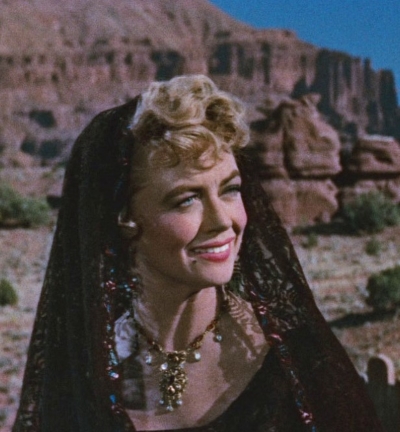
While Virginia Mayo was the passionate, beating heart of Colorado Territory, her rival for the affections of Joel McCrea’s doomed outlaw was a coquettish and calculating Dorothy Malone. She would take on some terrific roles throughout the 50s, including some very respectable films noir as well as a couple of plum parts for Douglas Sirk – the superlative The Tarnished Angels and an Oscar winning performance in Written on the Wind – and of course plenty of westerns. Among the highlights are At Gunpoint (why has this movie never had a decent release anywhere?), Pillars of the Sky, Quantez, The Last Sunset and Warlock.

Barbara Stanwyck

One of cinema’s great actresses, Stanwyck made  couple of westerns in the 1930s and 1940s (Annie Oakley, Union Pacific and California) but it was in the 50s that she made her mark on the genre, and fell in love with it in the process. Starting off with the emotionally charged and wondrously melodramatic The Furies for Anthony Mann, she would regularly return to the west. Some of those films were only partially successful, but a movie like The Violent Men has much to recommend it and Samuel Fuller’s Forty Guns is an enduring classic in my opinion.

Vera Miles

Anyone who worked with John Ford, and was cast in major roles in his films has to be worthy of consideration here. Vera Miles had started out in the genre with a part in The Charge at Feather River and in Jacques Tourneur’s Wichita. These are fine movies by any standard yet a top role in The Searchers, which is arguably the best western of all time, and one of the best films of any kind, lifted her into a different league. The fact Ford cast her again in The Man Who Shot Liberty Valance, one of the key films marking the close of the classic western era cements her place for me.

Maureen O’Hara

The Ford connection is strong with the next entry on the list, even if their western collaboration was limited. The fiery Irish redhead had already made Comanche Territory when Ford used her opposite John Wayne in Rio Grande, unfairly regarded by some as the least of the director’s Cavalry Trilogy. She would work memorably with Ford and Wayne again in other genres and went on to make good westerns such as War Arrow (George Sherman) and The Deadly Companions (Sam Peckinpah’s debut feature).

Claire Trevor

Sticking with Ford (and indeed Wayne) for the present, we now come to Claire Trevor. It’s hardly too much to say that Stagecoach was instrumental in boosting the status of the western, lifting it firmly and decisively into the A class where it would continue to hold a dominant position for the next quarter of a century. Trevor’s turn as Dallas, the “fallen woman” driven out of polite society only to find love, respect and a future with Wayne’s Ringo Kid, is a superb piece of work. Perhaps her subsequent westerns didn’t offer the same scope for her abilities – Texas, Dark Command (Raoul Walsh), The Desperadoes, The Stranger Wore a Gun – but she was a regular visitor to the cinematic west, and that ride on the Lordsburg stage counts for a lot.

Katy Jurado

The Mexican actress with maybe the most soulful pair of eyes in the business. The wistful look she bestows on Gary Cooper as he stands alone in an empty street in High Noon is as good a way to announce one’s arrival in the genre as I can think of. She brought her unique quality to such movies as Broken Lance, Man from Del Rio and The Badlanders throughout the 1950s. Her appearances in westerns tailed off after that, One-Eyed Jacks with Brando in the next decade and then a small but hugely affecting part in Sam Peckinpah’s Pat Garrett and Billy the Kid.

Julie Adams

Anyone familiar with my writing over the years will be aware of how much I enjoy the output of Universal-International, and the westerns that studio produced are among my favorites. Sometimes it feels as though it’s impossible to watch a U-I western and not see her. Budd Boetticher frequently used her in his movies for the studio – Wings of the Hawk, Horizons West, The Man from the Alamo – and she had good roles for Anthony Mann in Bend of the River and Raoul Walsh in The Lawless Breed and then later on in Joseph M Newman’s The Gunfight at Dodge City.

Debra Paget

Starting out with some small roles in notable films noir (House of Strangers, Cry of the City), Paget struck western gold in the influential Broken Arrow for Delmer Daves. In a sense, one could say she became typecast in westerns, finding herself playing yet again a Native American in White Feather (scripted by Daves) and the powerful and visceral The Last Hunt for Richard Brooks. Typecast or not, she brought a great deal of dignity to those parts and the western genre would be poorer without her performances.

So there it is, my list of ten actresses who have enriched the western over the years. I had to indulge in a bit of ruthless trimming to keep it down to ten, but that’s to be expected and I also anticipate that my picks aren’t going to satisfy everyone. Well, that’s the nature of lists and half the fun is hearing others point out who they would have included instead. Feel free to disagree in the comments section below.