Trooper Hook

He fights his way, I fight mine. We’re just a couple of dogs haggling over the same bone. Only it happens to be his bone.

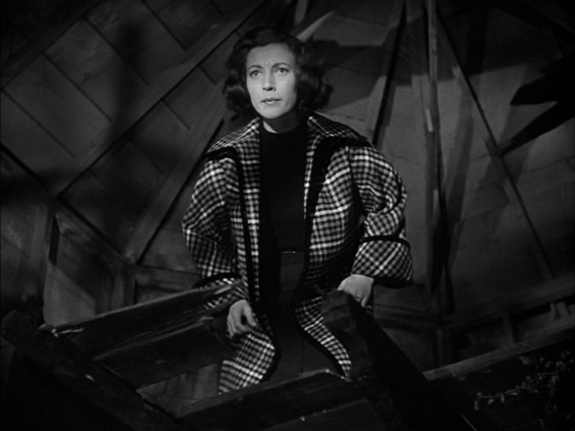
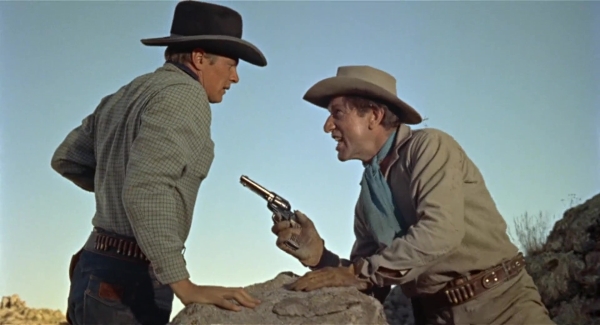
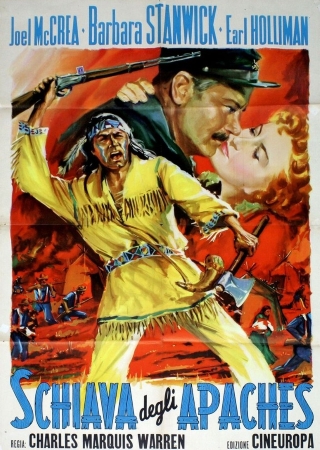
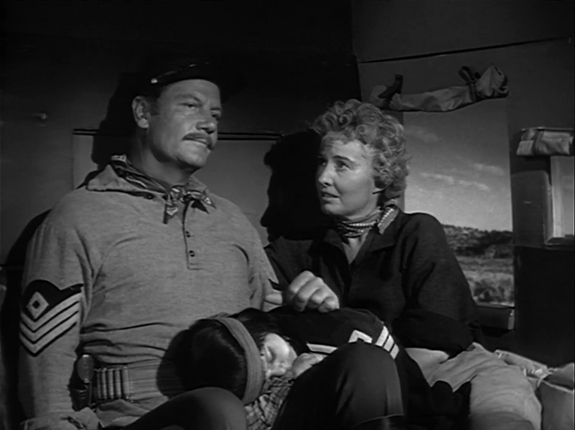
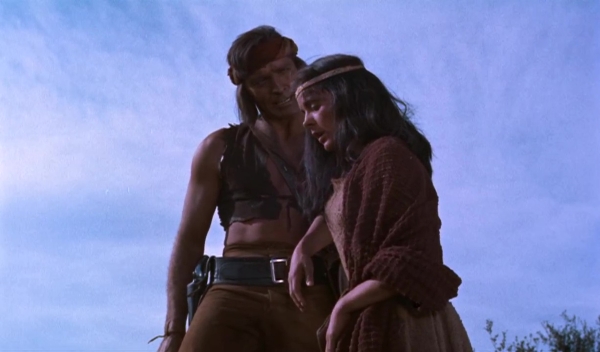
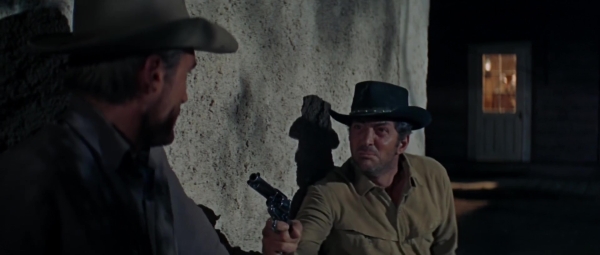
Whenever anyone tries to tell you that the westerns of the classic era were simplistic, one-sided shoot-em-ups that glossed over the complexities of the era they depict you could do worse than point to a line such as that highlighted above. The truth is of course that there are numerous examples of westerns in the classic era, especially in the genre’s golden years of the 1950s, which took a grown-up approach to the various injustices suffered, to the prejudices and fears of all involved, and thus embraced the consequent nuances of a fascinating period of time. Trooper Hook (1957) is a movie whose limited budget places no constraints on the intelligence of its script, or on the sincerity of its central performances. And it also exposes the redundancy of boilerplate dismissals of the genre’s depth by those who allow self-righteousness and a judgmental turn of mind to blind them.

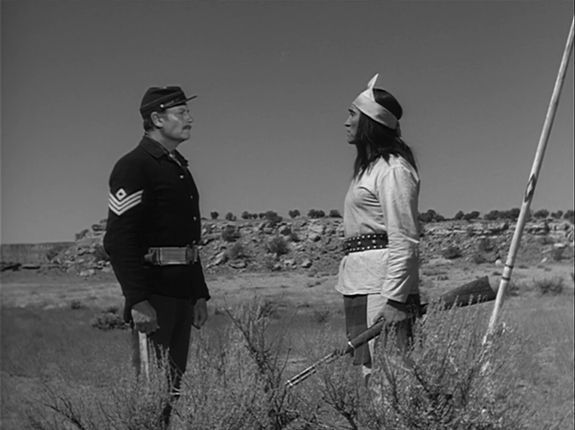
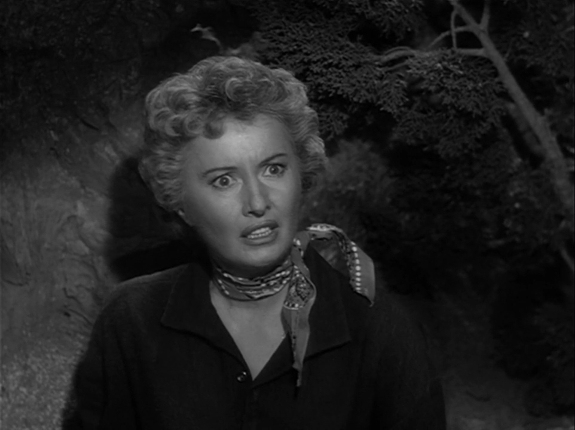
Executions and reprisals, a harsh and uncompromising way to begin any story, but one which sets the tone for what will follow. That is not to say Trooper Hook is a movie of gratuitous or even excessive violence, rather it is a picture which frankly examines an enmity which is implacable and deep seated. The executions are of the straggling survivors of the first wave of an army assault on an Apache settlement. The battered and beaten soldiers are backed up on a bluff above the village as the Apache leader Nanchez (Rodolfo Acosta) calmly has them shot down one by one. Almost immediately, the next wave of cavalry troops descend on the Apache, round them and their families up and burn their settlement to the ground. Among the prisoners awaiting transportation to the fort, and ultimately the reservation, is a white woman and her young son. This is revealed to be Cora Sutliff (Barbara Stanwyck), the only survivor of a raid who was subsequently taken prisoner and whose child is the son of Nanchez. Unsurprisingly, after years of captivity and rough treatment, she is largely unresponsive. Of course any long term hostage or captive is going to struggle to integrate themselves back into the society from which they were snatched. However, Cora’s future is even more in doubt since the world she knows is one riven by hatred. She endured and to some extent overcame the hostility of the Apache women but now is confronted by the equally ugly contempt and rejection of her own people. And then there is the boy, Cora is strongly protective of him, his father will not rest till he gets him back, and the whites largely want nothing to do with him. All but one man that is. Sergeant Hook (Joel McCrea), is a veteran campaigner, one who has known loss, hardship and desperation himself, and thus is a man loath to sit in judgment of others. His task is to escort Cora and the boy back to the husband she hasn’t seen for many years, and to head off any threats that arise, whatever direction they may come from.

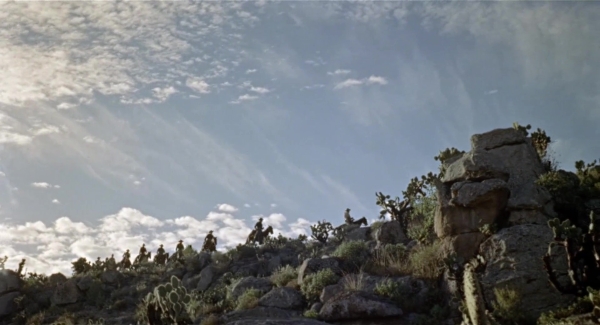
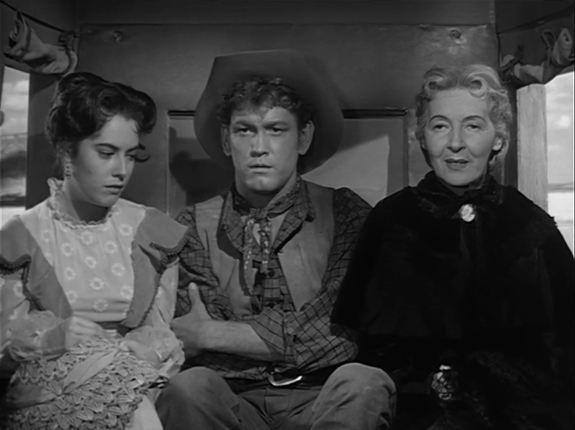
Charles Marquis Warren was what I’d call an occasional director, devoting more time to writing and producing and doing so with great success, particularly on television with both Gunsmoke and Rawhide. His direction of Trooper Hook is fine as far as I can see, drawing a sense of intimacy from the interior scenes, especially those taking place in the stagecoach, and touching on that frequent western image of apparently tiny and insignificant human dramas playing out against the backdrop of a massive, primal landscape. Cinematographer Ellsworth Fredricks captures that expansiveness in the scenes shot on location in Utah, with his camera high among the craggy peaks alongside grimly impassive Apache warriors coolly observing the dash of the stagecoach far below on the dusty, arid floor of the canyon. Visuals aside, the strength of the movie lies in its theme of acceptance amid seemingly wall to wall  hatred, as well as or maybe allied to the maturity of outlook that forms its core. It was adapted from a story by Jack Schaefer (Shane, The Silver Whip, Tribute to a Bad Man, Monte Walsh) so it’s pedigree is strong – this is taken from one of his short stories I haven’t read, but I intend to set that omission on my part right.

Much of the maturity underpinning the movie comes not only from the writing but also the casting. The two leads were over 50 years old at the time – Stanwyck was 50 and McCrea 52 – and both of them, in the last of a half dozen movies they made together, bring a lived-in credibility to their roles. Stanwyck achieves an extraordinary stillness in her early scenes, a watchful withdrawal that feels appropriate for a woman who at that point had to all intents and purposes been assimilated into the Apache tribe. Such is the layering of the role though, and therefore the performance, that her detachment is also right for someone who is just beginning to realize that hers is not to be a sweet homecoming, that her very survival will be taken as an affront by many. The way she tries to talk herself into believing the husband she has not seen for an age will accept not only her but her son too is a masterclass in pathetic self-delusion, and the despairing gaze she casts in McCrea’s direction as she babbles out this fantasy is telling. McCrea’s ageing soldier is decent, dignified and authoritative, all the qualities that make the western hero such an admirable figure; I think I’d actually go further and say he comes close here to epitomizing the traits and values that made the post-war US so admirable. The strength of Hook derives from his honesty, his warmth and his defense of the weak, his refusal to buy into cheap bigotry or cruelty. If only there were more of his type around in the world today.

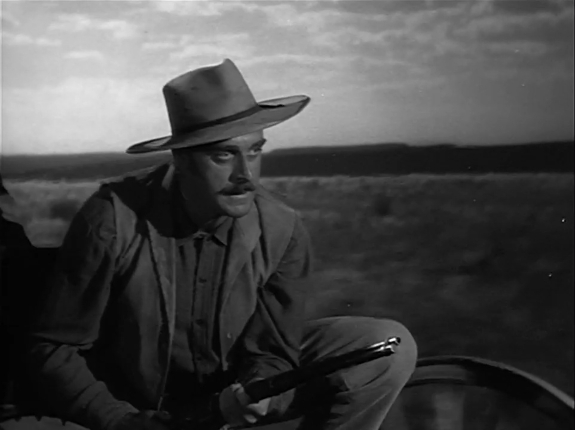
The film is imbued with this generosity of spirit, it’s reflected all through the cast. Earl Holliman’s itinerant cowboy, forever short of cash yet long on good nature, is another openhearted individual, prepared to take huge risks to ensure the safety of those who did him a good turn. It’s there too in the quiet courage of the passengers, particularly Susan Kohner, just off making The Last Wagon for Delmer Daves and only a year or two away from her Oscar nominated turn in Sirk’s Imitation of Life. Royal Dano is barely recognizable as the grizzled stagecoach driver but he too carries a strong sense of honor beneath that gruff exterior. By way of contrast, the ever reliable Edward Andrews essays the type of oily venality he brought to many a part. And John Dehner deserves credit for his portrayal of a man who cannot find it within himself to rise above his prejudices. That’s a tricky role, one that could easily slide into villainous caricature yet such is Dehner’s professionalism that he instead paints a picture that earns pity and scorn from the viewer in equal measure.

The only issues I have with the film are the somewhat redundant use of Tex Ritter’s song to punctuate the action onscreen, as well as the editing of the version I viewed. There is a choppiness to that editing, with scenes ending so abruptly that they are highly suggestive of a cut down print. I know there are some who don’t rate Trooper Hook so highly, but I’m an unashamed fan of the movie. There is so much of what I love about the classic western encapsulated here – the ability to tell a story that is rich and deep, that has meaning and soul, within a relatively simple framework. But more than anything there is that straightforward belief in the ultimate triumph of all that’s fine in the human heart, that steadfast faith in our capacity for being better despite the malice that may  threaten us at times.

I Walk Alone

You know, Noll, I think you’re afraid now. And I’m not. Frankie with his bootleg liquor, me with those checks I forged, you with this set-up here. Everyone trying to get something for nothing. Frankie paid, I paid. It’s your turn now…

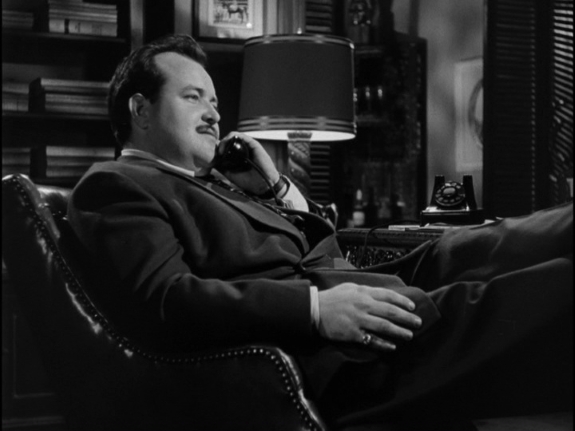
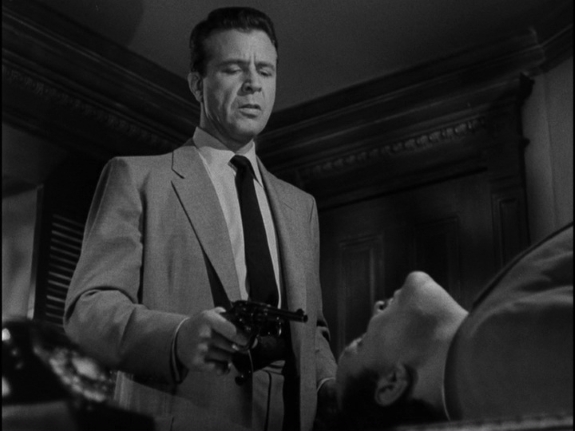
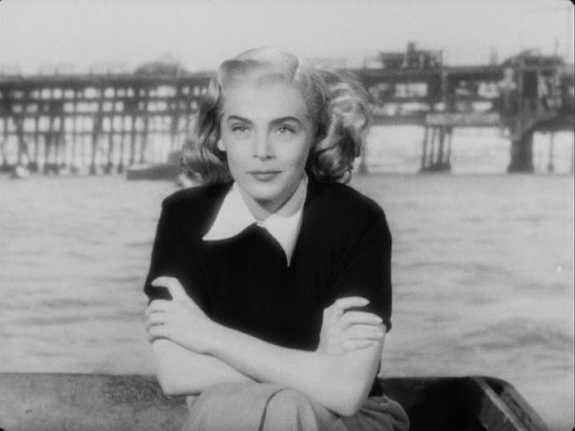
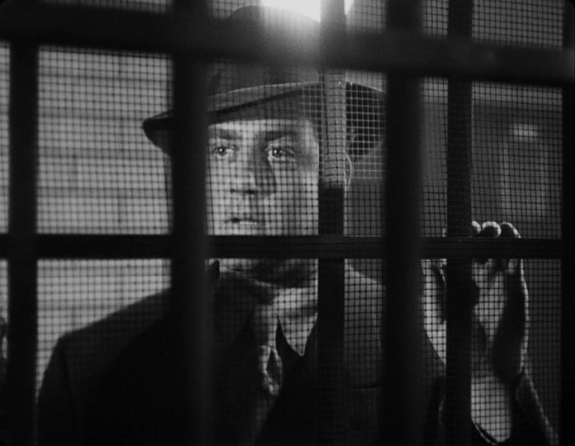
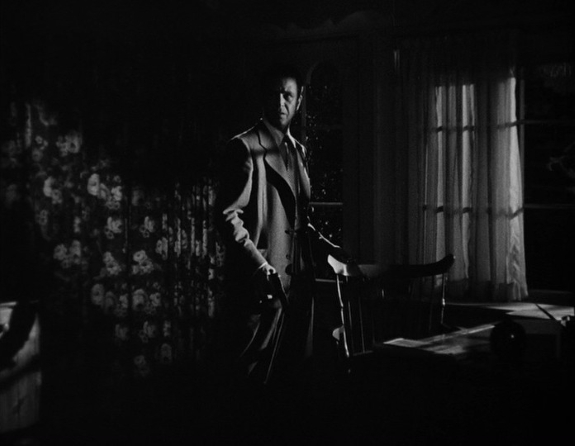
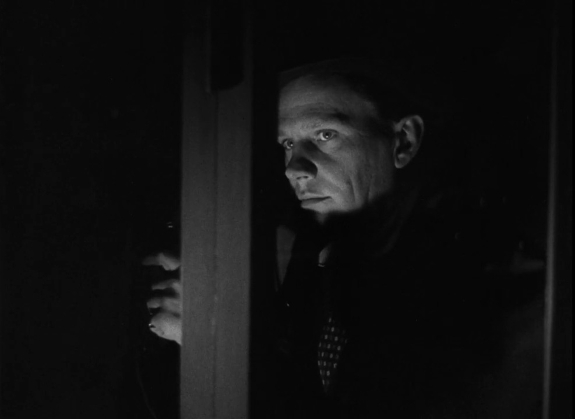
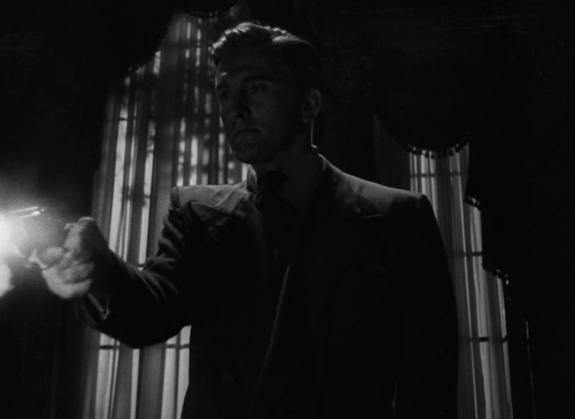
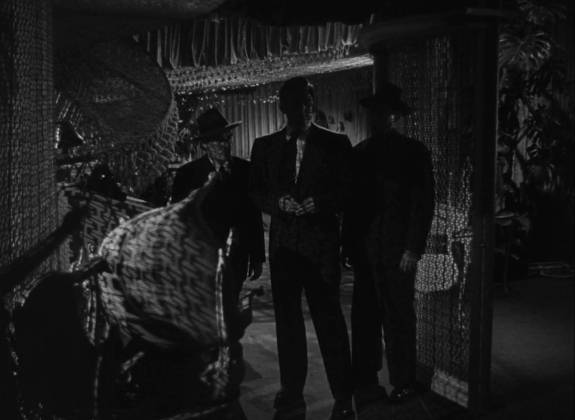
Checks and balances, adding a bit here, taking away a bit there. The books and the by-laws, a new post-war landscape where the sheen of legality is little more than a patina, a glossy veneer to add on top of the old rackets to create the illusion of respectability. I Walk Alone (1947) trades heavily on that highly polished hypocrisy, presenting a world of glamorous nightclubs where sharp suits and elegantly gowned ladies in superficially smooth surroundings seem to have taken the place of the rough and tumble hoods of Prohibition. Still, the high class tailoring and drapery only offer a limited disguise for the muscle, corruption and decadence. The world depicted here, at least that which is seen through the eyes of the protagonist, is one which has been flipped on its head, where none of the old certainties hold any longer and hoods hide and mask their actions with a web of financial chicanery. Plus ça change…

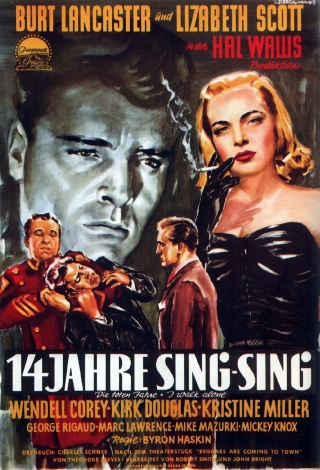
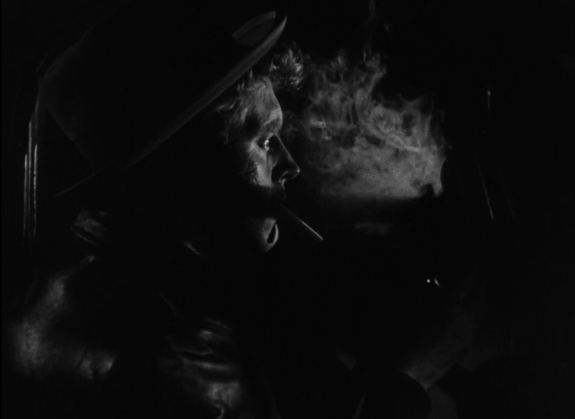
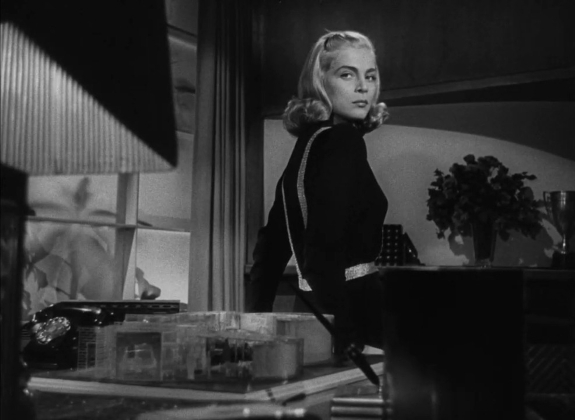
Frankie Madison (Burt Lancaster) is just out of prison and he’s sore. He has served 14 years and now he’s looking to collect on what he feels is his due. To that end he heads to the glitzy Regency, an upmarket nightclub run by his old partner in crime Noll Turner (Kirk Douglas). The fact is Frankie and Noll made a deal just before the former was picked up and sent up the river to split their profits straight down the middle. However, in all those years the only thing Frankie ever received from his old partner was a carton of cigarettes every month, not even one visit. He figures he’s owed, and there’s a little voice just starting to murmur insistently that maybe Noll plans to gyp him out of the rich pickings that have since come his way. Why? Well for one thing there’s the nervy attitude of his friend Dave (Wendell Corey), a man who has been becoming gradually more neurotic over the years and who visibly pales whenever any mention of the unfortunate fates of those who had crossed up old acquaintances crops up. Then there is Noll himself, genial and velvety in his solicitude yet watchful and calculating at the same time. When he arranges for his torch singer mistress Kay Lawrence (Lizabeth Scott) to charm Frankie and coax information from him over a carefully staged intimate dinner all the pillars of a setup have been put in place. Slowly the full extent of Noll’s self-serving duplicity dawns on Frankie, and he’s soon to discover that the, arguably more honest, strong-arm tactics he would once have relied on to get results are now hopelessly inadequate when faced with an updated criminality, one that subverts the law to serve his purposes.

I Walk Alone offers a classic noir framework: a man who has been away for an extended period of time returning to a world that is recognizable on the surface but which has in fact been radically altered at the core. If one is to see mature film noir as an artistic reflection of the post-war perceptions of the returning veterans, then this is something of a textbook example. It’s hardly a stretch to see parallels between Frankie Madison’s sense of being frozen out and the struggles of a whole generation to rediscover its place and role in a society that must now have felt odd and alien. There are two scenes which takes place in Noll’s office underlining the societal shifts that have taken place and the frustration of trying to deal with this.

First up, there is Frankie’s confrontation with Noll when he learns how he’s been stiffed and is getting the brush off. He resorts to his old two-fisted approach, laying one on his former buddy and storming out fired up with indignation and plans for retribution. Then later, having cobbled together a ragtag bunch of would-be enforcers courtesy of another old confederate (the instantly recognizable pockmarked Marc Lawrence), he sets about muscling what he’s owed out of Noll. However, this is the point where he comes face to face with what can only be viewed as a corporate minefield, an impenetrably complex series of cutouts that serve only to emphasize the absolute inefficacy of Frankie’s brute force methods in this brave new world. To witness his enraged impotence is akin to watching a bull elephant in its death throes, and the humiliation is compounded and completed when Mike Mazurki’s hulking doorman hauls him out to the back alley to hand him the beating of a lifetime.

Nevertheless, this acts as a catalyst, striking the scales from the eyes of Dave and Kay and helping to galvanize Frankie into taking genuinely effective action. As such, the movie tosses a lifeline of sorts to those ruing the passing of a more straightforward age. There is the hope held out that the conmen and the chiselers would get their comeuppance, that some sort of justice would prevail, which may be considered as diluting the noir sensibility. Maybe, or maybe the late 1940s didn’t fully encapsulate, or not as fully as we’re led to believe at any rate, the kind of existential despair that is frequently cited as the basis of noir. Perhaps the world today where gaslighting fraudsters and incompetents sit unchallenged at the top of the heap is the real noir era. Perhaps.

I Walk Alone was the first collaboration between Burt Lancaster and Kirk Douglas, and the fact they played so well off each other makes it easy to see why they appeared together with such regularity over the following four decades. Lancaster’s star rose faster and he was receiving top billing at this stage whereas Douglas was still working his way up, albeit strongly, in supporting roles. Lancaster uses his physical presence very effectively, and there is that vulnerability too beneath it all that was brought out very successfully in these early Hal Wallis productions. Douglas is less imposing in physical terms but he has that menacing air, principally via his voice and those sharp eyes. Lizabeth Scott is fair but that’s about it, her smoky-voiced allure is always welcome though and she was made for slinking around nightclubs singing throaty odes to ill-starred romances. Wendell Corey did a nice line in whey-faced fear, that and indignation were his strengths and he gets to exercise both as the guilt-ridden bookkeeper.

After a few early efforts as director Byron Haskin spent two decades as a cinematographer and effects man. I Walk Alone signaled his return to directing and from that point on, barring a few blips, he embarked on a remarkably solid run right up until Robinson Crusoe on Mars in 1964.  It is a very entertaining movie, well cast and beautifully shot by Leo Tover. It both links to and contrasts with the old 30s gangster movies and the film noir mood and aesthetic of the time. Until Kino brought the movie out some years ago it was one of those titles that appeared to be destined to remain mostly talked about or featured in books on noir rather than actually seen. Happily, that is no longer so and I recommend giving it a look.

The Fallen Idol

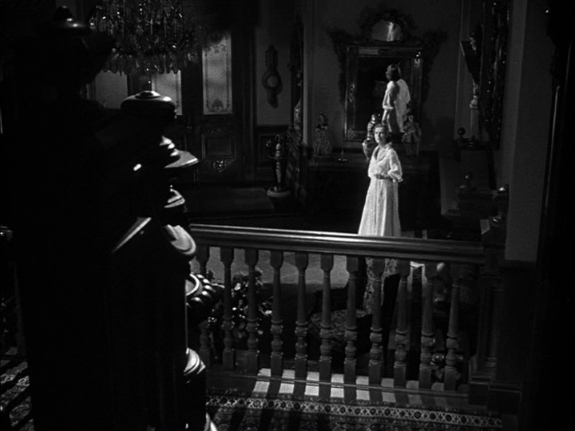
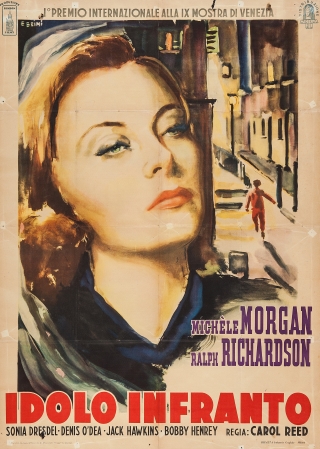
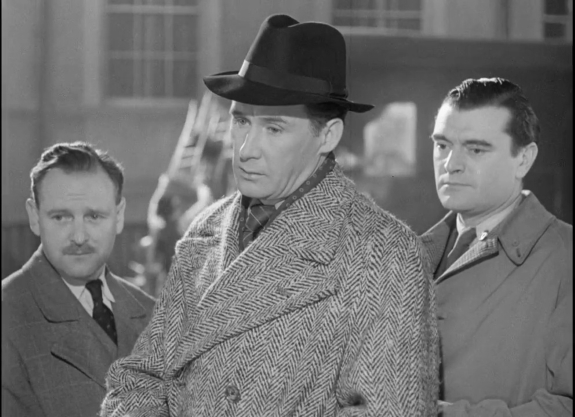
Is it possible to encapsulate the cinema of a nation in just a word or a phrase? I guess received wisdom, or maybe some sense of deference to the depth and breadth of most cultures, would nudge many people towards a negative answer. Still and all, I think that sometimes the essence of a nation’s approach to filmmaking (and the artistic temperament that lies back of that) can be neatly summarized thus. While this idea has occurred to me before, it was while I was revisiting Carol Reed’s The Fallen Idol (1948) the other day that I found myself mulling it over again. The movie itself is one of the director’s finest, a study in suspense and longing, a powerful melodrama observed primarily through the eyes of a fanciful child and shaded accordingly. And so it was that as I watched the drama play out the word “quiet” floated insistently into my thoughts. Somehow that quietness, or restraint if one prefers, that pervades the film felt like it was actually a byword for the best offerings of British cinema.

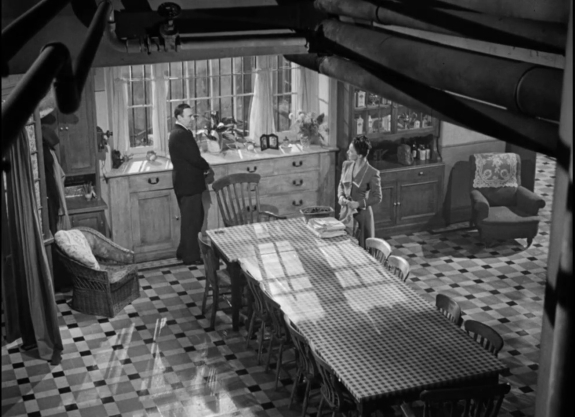
Belgravia, a location that exudes solidity, tradition and indeed diplomacy. Those imposing structures with their sense of permanency and the home to many an embassy have something of that quiet dignity I referred to about them. There’s an orderliness to it all, and what better way to put a human face on that concept than to represent it in the shape of a very proper English butler. Such a figure is familiar to almost everyone via literature, film and television if not in the flesh. He exists as a link of sorts, offering a vague connection between the present and some distant semi-feudal past, between high born aristocrats and the ordinary citizen. He is, in short, soft-spoken, impassive, dignified and authoritative, a paragon of decorum. Or is he? Is it right or reasonable to label any man a paragon of anything other than the mass of foibles and feelings that make up his inner self? Baines (Ralph Richardson) is the butler in the household of the ambassador of some unnamed nation. He is efficient and intelligent, diligent and charming. And his private life is a tangled mess of bitterness, betrayal and seemingly impossible passion. His marriage is a barren and loveless wasteland, a stale and frequently argumentative co-existence with a wife (Sonia Dresdel) who has grown suspicious and discontented. On the surface, his relief from this emotional desert comes via the whimsical and easy-going rapport he has developed with Philippe (Bobby Henrey), the lonely and over-imaginative son of the ambassador.

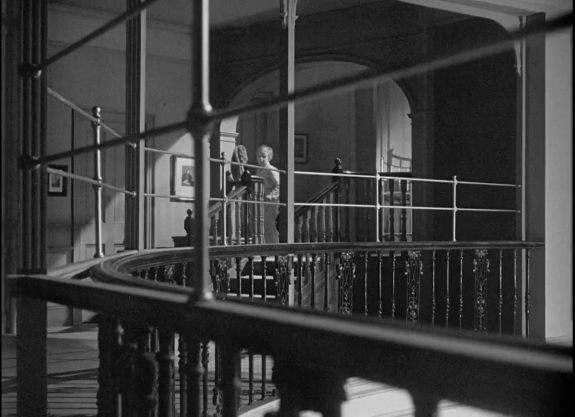
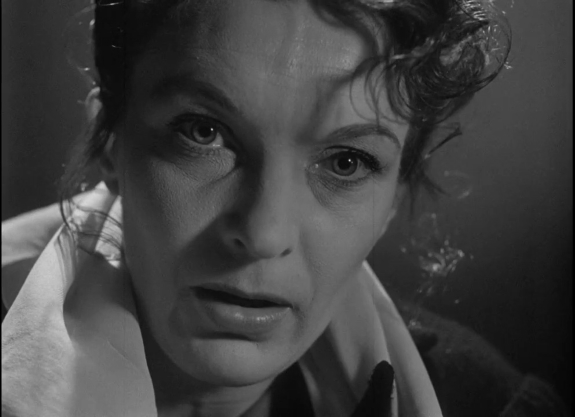
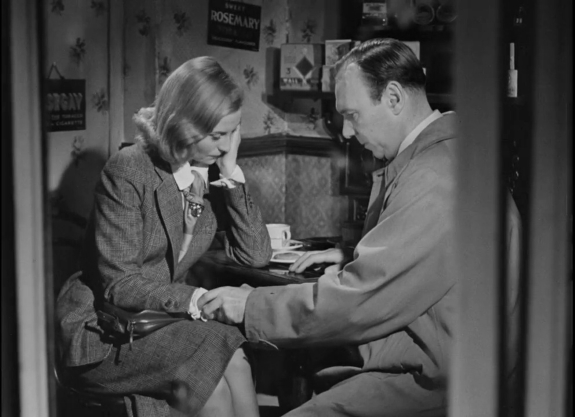
Nevertheless, as is so often the case in life, the image presented to the world at large tells only half of the tale. The Baines who ensures the smooth and comfortable running of his employer’s home, the spinner of yarns for the eager ears of a credulous and adoring Philippe has another outlet for the emptiness he experiences. He is quietly and discreetly engaged in an affair with Julie (Michele Morgan), a typist at the embassy. This fact is revealed by accident when Philippe innocently follows his hero one day and chances upon the lovers meeting quietly in the mundane setting of a nearby tea shop. Such is the simplicity and ingenuousness of childhood that the nature of the relationship is lost on the youngster and he happily and unquestioningly accepts that Julie is Baines’ niece. Still, the complications of the adult world must inevitably intrude as suspicion and desperation lead to confrontation. In that adult universe, jealousy and longing make for an explosive combination as the truth is inexorably brought to light. The audience see the argument between Baines and his wife all the way through and know how it resolves, but the boy (reflecting the half-understood perceptions of the very young) witnesses only part of it, fascinated and frightened by the heightened emotions laid bare before him. As he scrambles up and down the fire escape, peering in dread through the windows while the argument rages within, he misses out on the crucial moment and sees only the lethal consequences. Carol Reed’s direction is superb not only during these set piece scenes, but all the way through. The subsequent investigation, the possibilities that gradually emerge, the doubts and fears of all concerned are conveyed with marvelous subtlety. The master stroke of course is the way the entire thing is viewed and presented through the prism of a child’s faltering awareness and mounting despair.

Aside from that marital spat that leads to tragedy, the quietness of it all dominates. While I feel this is a quality that pervades British cinema of the era, it is clearly a deliberate stylistic choice on the part of the filmmakers here. Many key exchanges are only half heard, uttered softly and intimately, with the kind of discretion that is the specialty of lovers or close confidantes, or indeed professionals who live by a code of caution. The conversations are frequently sotto voce, heard in snatches and presented with the contrived nonchalance adults sometimes adopt to shield the very young from the harsh complexities of life. This air of calculated concealment sets the mood for the picture precisely because it is a story seen from the standpoint of a small boy. It’s evident in the interactions of the trio of policemen, not least Denis O’Dea’s gently probing inspector, though ably supported by a watchful Jack Hawkins and a humorous turn from Bernard Lee as the interpreter whose talents appear questionable.

Ralph Richardson delivers a performance that is that is wholly authentic, displaying an outward bounce and buoyancy to charm and beguile a wide-eyed Philippe – so memorably portrayed by Bobby Henrey. Richardson sails rather close to eccentricity in these moments but he does so in such an attractive fashion that it doesn’t especially matter. He layers the character beautifully too and that sad little scene played out in the tea shop is heartbreakingly poignant in its restraint, and arguably because of it. It’s not just some stiff upper lip pose either but rather it’s a barely suppressed emotional crisis held in check largely due to the presence of the young boy who couldn’t possibly comprehend or grasp the powerful passions ebbing and flowing across the table before him were they to be let loose. Michele Morgan does fine things with her eyes and voice to supplement all this but it’s Richardson who owns the scene, who wrings truth out of the simplicity and ordinariness of the setting; that turning away when Julie exits, the fiddling with the newspaper, the shuffling round the shop his eyes downcast as he struggles to master the despair that threatens to overwhelm him is suffused with gut-wrenching pathos. But so very quietly.

The Fallen Idol was the first of three adaptations of works by Graham Greene that Carol Reed brought to the screen. The Third Man is undoubtedly the most highly regarded of those, but The Fallen Idol is every bit as good in its own way. Actually, when one pauses to remember that those two movies preceded by Odd Man Out were all made one after another between 1947 and 1949, it really does serve to highlight Reed’s greatness as a filmmaker. I don’t believe there’s any doubt that this is a movie everybody should make the time to see.

Apache

Which words get tossed around most often when the western is discussed? I guess I talk a lot about redemption, it’s the cornerstone of the genre for me. Others, depending on the direction from which they are approaching it, may look at the way it portrays expansionism, or how it charts and critiques civilization. Some like to focus on the elegiac aspects, and some go in for revisionism. But does anyone ever mention a sense of urgency? Maybe we should though. A lot of classic era westerns have a paciness to them, both for budgetary and for storytelling reasons. Yet when one stops to think not only of the relatively short window in time occupied by the historical concept of the Old West but also the equally brief flowering of the classic movie version, it somehow feels appropriate to regard urgency as at least one of the characteristics worth considering. Apache (1954) is what I would call an urgent movie. It is a motion picture in a very literal sense, the protagonist moves almost continually and it offers little respite for the viewer either as events unfold on screen. The theme too is one of an era drawing to a rapid close, of time threatening to overtake people and the consequent need to keep pace with it all.

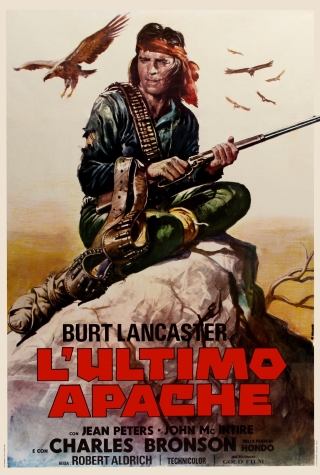
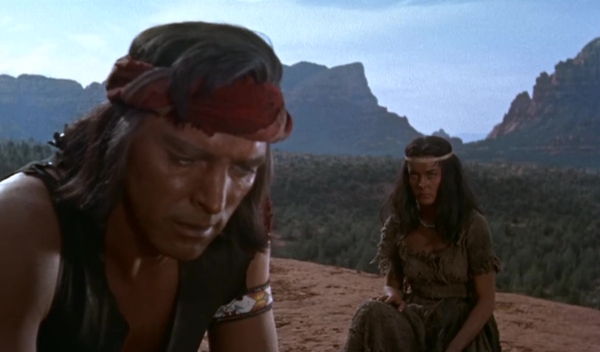
It opens with the surrender of Geronimo, the end of the Apache Wars and to all intents and purposes the closing of native resistance in general. One man at least is not keen on this capitulation and the first view of Massai (Burt Lancaster) has him riding in aggressively in a last ditch attempt to disrupt the event. It’s as good an introduction of the character as one could wish for, highlighting his belligerence, defiance and energy. Nevertheless, despite his bullish bravado, he’s not to succeed. Instead he is manacled with the other former fighters and placed on board a train headed for Florida. Even as the locomotive makes it’s way across the country, Massai’s restlessness and rebelliousness remains undimmed. Taking advantage of a temporary halt in Missouri, and the hubris of embittered Indian agent Weddle (John Dehner), he escapes. This leads to a brief yet fascinating interlude where Massai spends some time wandering around town, bemused and ultimately threatened by a way of life that couldn’t be more alien to him. That sense of urgency, that driving need to return to his roots while he still can, kicks in again and his overland odyssey is broken only by an encounter with a Cherokee in Oklahoma who has resigned himself to the reality of the newly civilized world. It leads to a wonderfully droll moment where Massai asks incredulously how it is that he has a wife but has to fetch and carry the water himself. The old Cherokee looks at him ruefully and admits with a sigh that some of the ways of the white man are indeed hard. The lessons Massai has learned along the way have given him hope though, hope that he may find the means to continue to exist as a free Apache, albeit less warlike and in the company of his love Nalinle (Jean Peters). This is not to be, however, and the drunken duplicity of Nalinle’s father as well as the distrust of the army and scouts see him back in chains. All the while, the movement never ceases, the cross-country trek, the recapture and later escape, and then the long run to the wilderness of desert and mountain, the settling of old scores and the desperate effort to reclaim some shreds of the past before the relentless advance of civilization rends them forever.

Apache fits neatly into that group of westerns taking a more sympathetic view of the native American  that had begun to appear in the early years of the decade. This pro-Indian cycle set in motion and characterized by the likes of Anthony Mann’s Devil’s Doorway and Delmer Daves’ Broken Arrow played a significant role in the evolution and maturation of the western which was taking place at this time. No doubt there are those who will protest the casting of Lancaster and Peters, as well as Charles Bronson, Paul Guilfoyle, Morris Ankrum and others, as Native Americans but it’s no more than a reflection of the casting practices, and indeed the choices available, at that time. Anyway, my own take on any spats over inauthentic casting is that surely acting is the adopting of roles and the presentation of characters and their traits. I see it as striving for some thematic and dramatic truth, and reality be damned. Was the theater of the ancients any less valid or lacking in artistic integrity as a result of the wearing of masks?

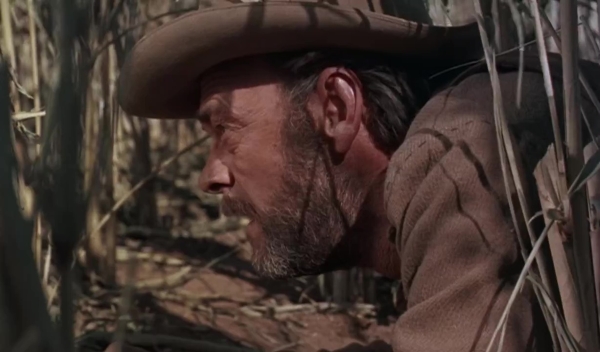
By maintaining the focus on Massai, and by extension the Indians who had not yet been fully integrated into an ever encroaching civilization, director Robert Aldrich and writer James R Webb also keep the focus on the overriding sense of urgency, of time running out. Massai admits to his woman at one point that he is aware of the fact he has perhaps only a few years at best ahead of him, that civilization and his consequent demise will catch up with him some day. And this is where the real urgency resides, the need he soon feels to lay some kind of lasting foundation, to provide some sense of continuity. In narrative terms, this is clearly indicated by the planting of seeds in the earth to grow corn, the idea introduced by the old Cherokee, tested unsuccessfully at first by Massai himself, and then encouraged and brought to full fruition by Nalinle. This notion of growth, of building a future out of nature itself is further highlighted by Nalinle’s pregnancy and the direction in which that development pushes the story. The “some day” Massai foresees arrives at the end. The climactic scene with John McIntire’s Al Sieber crawling through the undergrowth of the cornfield as he stalks the wounded warrior provides a visual metaphor for the creeping advance of civilization, threatening not only Massai’s last Apache, but the future he has tried to cultivate too. Still, the ending is one that is suffused with both hope and a hint of reconciliation.

Aldrich himself claimed not to have wanted to finish the movie in this way, preferring the more negative ending that was laid out in the novel Bronco Apache by Paul Wellman that formed the basis for the script. Some may see that as further evidence of the commonly held belief that Aldrich was first and foremost a cynic, but I’m not so sure. Perhaps that bleakness that could shine through some of his films on occasion was more prominent, rawer in some way, in his early efforts. Even if that is the case, I remain unconvinced that this should be seen as his defining characteristic. There are plenty of examples sprinkled through his work of him displaying if not a completely positive outlook then at least one which sees the better side of humanity in the ascendancy. I’m thinking here of Autumn Leaves, Hush… Hush, Sweet Charlotte, The Flight of the Phoenix and The Last Sunset, the latter being a movie I’m happy to admit I have come to reassess after being encouraged to give it another go. I recall a commenter on this site once referring to a certain writer as being in “the truth business”, even if I don’t now remember who was being so lauded. Anyway, that’s all by the by. The point is that the phrase stuck with me as it seems that it’s surely the goal of every artist to mine the truth. As such, it feels misguided to regard Aldrich merely as a cynic, as some critics would support, rather than a genuinely rounded artist in the sense that he too was a seeker after truth.

So, without deliberately spoiling matters for anyone yet to view it, I like the way the movie ends. It feels appropriate in that it validates the points made, the struggles endured and the promises alluded to throughout its running time. All that urgency that preceded it, the crowded, pressing framing frequently employed to create the sensation of a cramped and restricted set of circumstances eases. The simple yet instantly recognizable sound of a future long awaited calls a halt to what threatened to be impending tragedy and the “some day” that had loomed large is banished, to be replaced by the chance of a better day. In short, it’s a fine way to bring the story to a close.


The Sons of Katie Elder

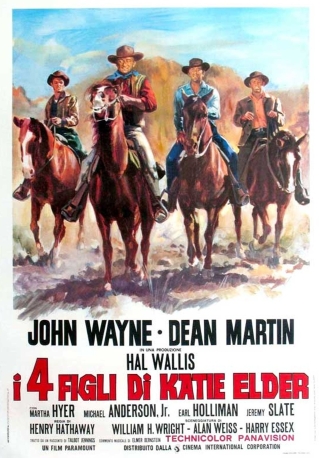
I think it’s fair to say that the going always appears to be trickier once one hits the downside of a slope. There’s that ever present temptation to succumb to the lure of relaxation, to freewheel, to sit back and let the momentum carry one wherever it fancies. If we are to see the western as having scaled the heights of its artistic potential by the end of the 1950s, and on into the beginning of the next decade to be fair, then the following years must represent the other side of that hill. By the mid-60s the treacherous nature of that downhill path was becoming apparent, the more so since it proved to be a pretty steep descent for the most part. As the decade wore on there were increasing numbers of westerns that do not quite work, or which flat out fail in some cases. It can be a dispiriting experience trawling through some of these when one bears in mind what had come before. Still, one of the strengths of this genre is its overall resilience, its ability to offer up something worthwhile just when it seems that hope has passed. The Sons of Katie Elder (1965) is not what I would personally term a great western, but it is a very good and entertaining one.

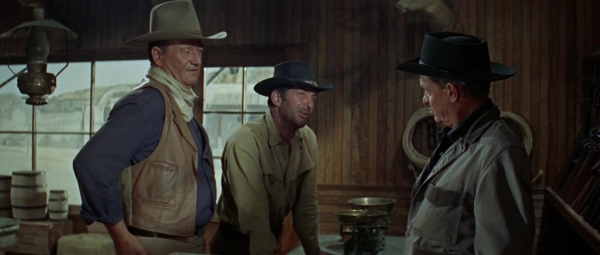
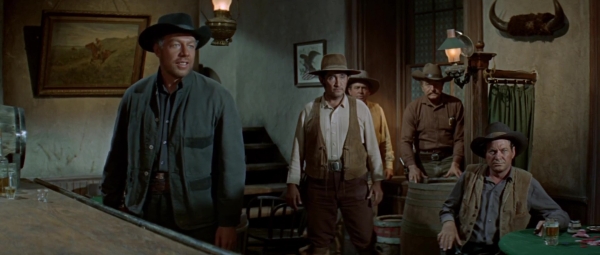
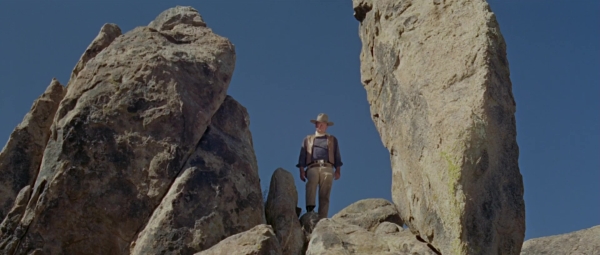
The plot of The Sons of Katie Elder follows a well trodden path. A newcomer buys influence and expands his power, elbowing aside any local objections or stamping hard on them should the need arise. In the case of the eponymous Mrs Elder and her offspring, the latter action appears to have been applied. We never get to see Katie Elder, she has already passed away before the movie begins and the opening scene has three of her sons, Tom, Matt and Bud (Dean Martin, Earl Holliman, and Michael Anderson Jr respectively) waiting by the train halt for the senior member of the clan to arrive prior to attending the funeral. The oldest brother John Elder (John Wayne) is a gunfighter of renown or ignominy, depending on one’s perspective. Well he doesn’t show up so the service takes place without him, or so it seems. The fact is he has slipped back home unobtrusively and we can observe him watching proceedings from afar, high among the rocks overlooking the cemetery, aloof and vaguely forbidding in his isolation. As the story progresses, it becomes evident that the Elder family has been cheated, the father was almost certainly murdered and his wife then forced to leave the home where she raised her four boys before they went on their separate ways. Now they are back though and experiencing a combination of guilt for their neglect of a woman who everybody held in the highest regard as well as an incipient sense of indignation over being gypped. And that’s how it plays out – the process of arriving at some kind of accommodation with feelings of self-reproach develops side by side with a deepening conflict with Morgan Hastings (James Gregory), the man now occupying the land that was once theirs.

The notion of past events coloring or shading the present frequently results in good drama, and the shadow of Katie Elder looms large in the lives of her sons. Where each of them is seen to be flawed or negligent or profligate, their mother is spoken of with warmth and respect by all those who had known her. This conceit is a neat way to allow the characters to address their own deficiencies within a narrative framework which encompasses justice and redemption. Having Katie exist only as a memory offers the opportunity to build something of a myth around her, as of an ideal to be lived up to. By rendering her in those terms her spirit starts to feel emblematic of the mythical west, almost as though woman and land have fused. It’s an aspect that is further highlighted when Martha Hyer speaks of her to the four sons as all of them stand around the old lady’s beloved rocking chair.

Texas is a woman, she used to say, a big, wild, beautiful woman. You raise a kid to where he’s got some size, and there’s Texas whispering in his ear and smiling, saying, “Come and have some fun.” “It’s hard enough to raise children,” she’d say. “But when you’ve got to fight Texas, a mother hasn’t a chance.”

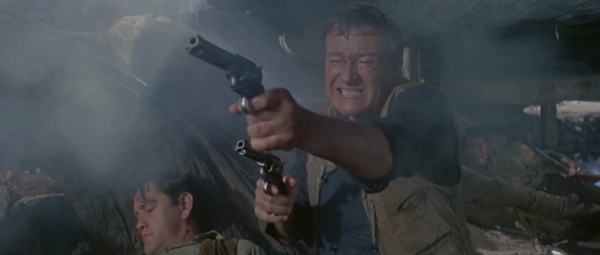
The Sons of Katie Elder was John Wayne’s first film after undergoing major surgery for lung cancer. He’d had a lung and a couple of ribs removed only a few months before but looked and acted remarkably robust under the circumstances. It’s an ebullient performance, big and commanding with the balance between humor and seriousness deftly maintained. Henry Hathaway framed and shot him in such a way as to emphasize the iconic, monumental stature he was growing into by this time. Some of the action scenes are very stylized, but superbly put together at the same time – the big gun battle at the river crossing, and that memorable moment when he belts George Kennedy’s sniggering bully full in the face with an axe handle.

Dean Martin made his western debut alongside Wayne in Rio Bravo, giving a fine performance first time out and growing ever more comfortable in the genre in subsequent outings. Maybe he became too comfortable at times later on, cruising along on charm and a wink at the camera. His role as Tom Elder allows him to indulge the laid-back persona at times – a nicely played comedic interlude in a saloon involving a glass eye,  as well as some other horseplay involving his siblings – but not to the extent is diminishes the more dramatic moments. Earl Holliman is quite subdued, much more composed than some of the less secure characters he was often cast as. The youngest brother was Michael Anderson Jr and he was enjoying a wonderful run in westerns that year; aside from The Sons of Katie Elder, he had roles The Glory Guys and Major Dundee. One notable feature of this movie was the absence of any other women bar Martha Hyer, who serves as a kind of conscience for the the Elders, recalling the strong character of the late Katie and reminding the sons of their duty to her memory. It’s worth pointing out too that the movie represented a rehabilitation for Dennis Hopper. He had apparently enraged Henry Hathaway during the making of From Hell to Texas and found himself essentially frozen out in Hollywood till Wayne got him the part in this film. Of course he would go on to work with Hathaway, and an Oscar winning Wayne, once more a few years later on True Grit.

The Sons of Katie Elder is what I’d call a satisfying western, something that was not the case with a number of genre efforts as the decade wore on. Hathaway’s films were always very smoothly put together and this one is no exception. Basically, he keeps everything balanced; the classic western themes are there, the cast features a lot of very familiar faces who are used sparingly and not in the tired “by the numbers” fashion of, say, an A C Lyles picture, Lucien Ballard has it looking extremely attractive and Elmer Bernstein’s score is one of his better ones. All in all, this is a very watchable and enjoyable film.

The Trap

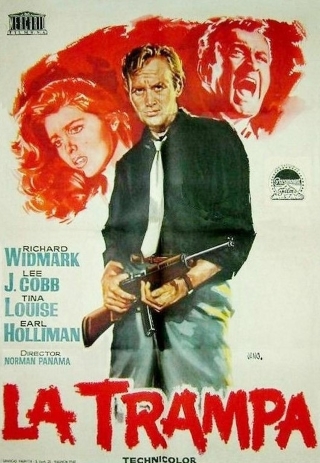
Corrosive family rifts, coercion and pursuit. These are attractive ingredients for a crime melodrama, hooking and holding the viewer rapt if blended skillfully. The Trap (1959) manages to pull this off for the most part. Perhaps there is a little too much back story to reveal, which is supposed to lend more heft to the central conflict, but that’s not really a deal-breaker. On the whole, the movie succeeds as a taut and lean crime story from  producer Melvin Frank and director Norman Panama, people one wouldn’t normally associate with this particular genre. That said, in the same year they turned out two enjoyable and accomplished movies outside of their perceived comfort zone in this title and The Jayhawkers.

Heat, dust and Joshua trees; one could almost be forgiven for thinking we have strayed unsuspectingly onto the set of a Jack Arnold movie. Well, the surroundings may create that impression at first, but those cars eating up the dust on the parched desert highway are in no danger of running into extraterrestrial interlopers. The threat here stems from an altogether more grounded source – mobsters.

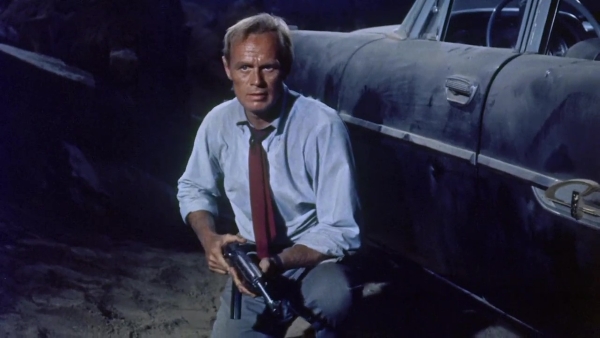
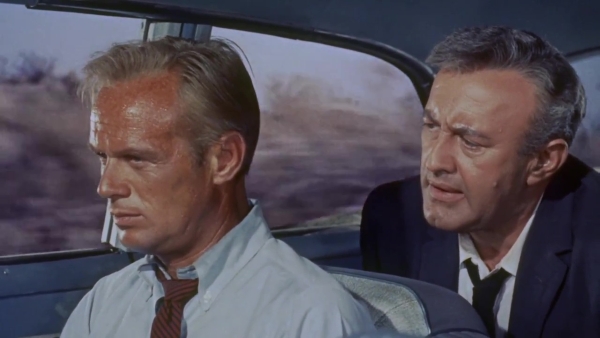
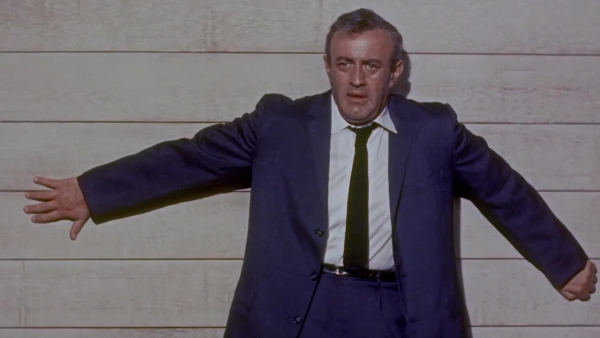
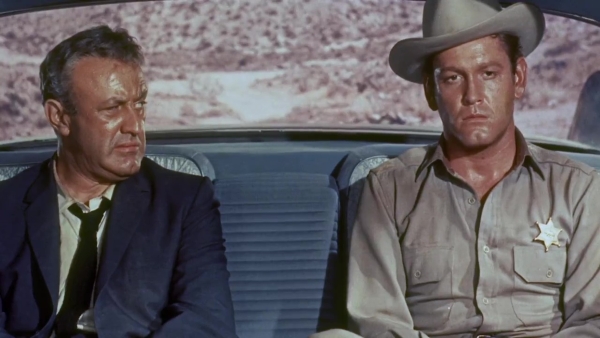
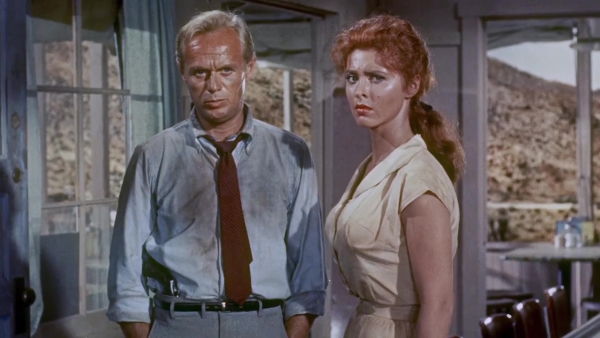
Ralph Anderson (Richard Widmark) is being driven back to the town of Tula, one of those unremarkable settlements clinging to the edge of the desert and no more than a speck on the map. If mobsters can be regarded as the enemy within as far as society is concerned, then Anderson is headed back to the town of his youth where he is seen as something of an enemy within his own family. His father (Carl Benton Reid), the local sheriff, has virtually disowned him, or so it seems, after a drunken escapade led to his being sent to reform school. His younger brother Tippy (Earl Holliman) is hitting the bottle hard himself, morose in his job as deputy and just barely hanging onto the frayed ends of a loveless marriage to Ralph’s old flame Linda (Tina Louise). So why does an apparently successful lawyer like Ralph Anderson come back to such an unwelcoming situation. The fact is he has no real choice, the mob are squeezing him to ensure he uses what influence he might still have over his family to ensure the local airfield is kept open and unguarded long enough to allow fleeing capo Victor Massonetti (Lee J Cobb) to get out of the country. If all goes well, it should be a simple affair. If all goes well. However, things are rarely simple when greed and jealousy get stirred up on an already baking hot afternoon.

Crime movies are a little like distance runners, they thrive on leanness and a well judged sense of pace. The Trap checks those boxes for the most part – the pacing remains pretty constant and is in keeping with the sense of urgency felt by the main players. There is leanness there too in the 80 minute run time and the comparatively small cast, especially once the action moves out of Tula and into the sandy desolation all around. Much of the action is confined to tense episodes of distrust and doubt in sweatbox cars, punctuated by interludes in the open where the tension remains. The idea of a desert as a claustrophobic environment is an interesting one. Sure it represents a heat trap, the stage where the actors tread being replaced by a griddle for them to hop around in perpetual danger and discomfort. However, it’s the anonymity of it, the threats concealed in the dips and hollows of its vastness, that has the greatest effect. The sight of the hero and his companions huddled behind rocks and bullet riddled bulk of their car as the light fades and the faceless, unseen enemy holds them pinned down feels marvelously restrictive.

These are the strengths of the movie, and in fairness they dominate. The earlier build-up in town has its purpose, it sets up the conflict between the brothers and the true reasons for that are gradually revealed. However, the action needed to move out, the story needed to strip away the extraneous details that could easily have bogged it down. It’s at its best out in the wilderness with the focus firmly fixed on just Widmark, Holliman, Cobb and Louise. It offered Widmark a comfortable run out, not stretching him greatly but presenting the chance to use his well developed screen persona effectively. Earl Holliman, who just recently passed away, is also on fairly familiar ground as a weak willed character who is aware of his failings but struggles to accept them. Cobb is Cobb, brash and loud, goading and sowing discord wherever he sees an opportunity to profit from it. Tina Louise was in the middle of a superb run of movies at this point with prominent roles that year in two very good westerns, the underrated The Hangman and De Toth’s superlative Day of the Outlaw. She does fine here as the woman who is living with regret and is far from happy to be the cause of added friction between the two brothers. Lorne Greene may be absent from the screen for much of the time but he adds menace early on as the perspiring heavy responsible for fixing up Cobb’s escape.
I like The Trap quite a lot, especially once the action moves out of town and the cast and story itself are pared down to the essentials. This isn’t a western yet it retains some of the flavor of that genre, both as a result of its desert backdrop and also the pitting of what ultimately amounts to a man alone against a more powerful and lawless adversary. And of course there is the redemptive thread that runs through it. It’s well worth checking out for fans of Widmark, or any of the principals for that matter.

The Tarnished Angels

Where possible, I like opening a post with a quote that either sums up the sentiments of a movie or at least captures something of its mood. There was a comment by Douglas Sirk on his own work that I felt would be apposite here yet, for the life of me, I can’t locate it just now. As such, I’ll have to settle for the gist of it: it ran along the lines that he liked to make movies about characters who were forever in pursuit not of some dream of the future but instead of their own past selves, straining to reconnect with or recapture something of their youth, something precious lost in the midst of the messy business of living. That notion is steeped in the kind of melancholic reverie that is very appealing. It encapsulates enough unattainability to lend an air of tragedy to any drama and at the same time there is too the promise that maybe some flavor of a spirit since departed can be held onto, some faltering beacon to serve as an anchor. The Tarnished Angels (1957) has a lot of that spirit coursing through it, describing a cyclical, circular path of beginnings and endings, and still offering a shot at renewal and rediscovery as it draws to a close.

The entire concept of the barnstorming pilots traversing the country every season and spending much of their time racing around the massive pylons that mark the course of their near suicidal races is in itself circular. Round and round they all go, chasing the prize money and the fleeting adulation of a crowd of vicarious thrill seekers who will forget the broken daredevils before the ambulance or hearse hauls away whatever remains of them when the shrieks and cheers have faded away. Yes, round they go with all the futility of dogs chasing their own tails, tarnished by their own cut price way of life and with no realistic chance of ever touching the person they once were. Yet, no matter what might pick away at one in the darker moments of life, human nature is sustained not by defeatism but by hope – it is one of the key or defining elements of the human condition after all. So it is with Roger Shumann (Robert Stack), his wife LaVerne (Dorothy Malone), son Jack (Chris Olsen) and their mechanic Jiggs (Jack Carson). These four live a nomadic, gypsy existence, knowing no home beyond their own dreams. Roger Shumann is a figure carved from classical tragedy, a hero in the eyes of others who is terrified by his own limitations. He is one of those post-war lost souls, a man cast adrift in a world that celebrated the feats of courage he once displayed and now bewildered by the artificiality of trying to recreate that daring. And there’s guilt too, that illogical but unshakeable questioning of many who lived through conflict of why one has survived while others paid the ultimate price. It’s a blind too for his own insecurities as he substitutes recklessness in the air for paucity of courage in his personal life. Of course, the route Shumann takes towards redemption in this respect forms one of the major pillars of the story – the brooding intensity of the man is well realized by Stack as he shies away from true affection and then plumbs the absolute depths of moral dissoluteness. His request that LaVerne should quite literally prostitute herself to secure the use of a plane is a shocking moment, the decay of a soul laid bare. From this nadir though he rises again, finally, to first acknowledge his love and then take to the skies to make a last attempt at touching what he once was, and earning for himself something of value through an act of unplanned heroism.

The setting fits in with the cyclical theme too, taking place over the course of Mardi Gras in New Orleans, that carnival celebration that peaks and fades every year and marks the end of indulgence and the last chance to feast and cut loose before the penance and deprivation of Lent begins. It signals the end of Roger Schumann’s time; he has been afforded a taste of his days as a better man and it also represents the opportunity for his wife and child to start afresh. Dorothy Malone did the best work of her career for Sirk – she had won an Oscar for Written on the Wind and The Tarnished Angels was a chance to work again with the same core team of Sirk,  producer Albert Zugsmith, writer George Zuckerman, Stack and Rock Hudson. Her performance here is every bit as good and perhaps better than that award winning role, LaVerne Shumann being a marvelously true creation and wholly credible in her disappointment and disillusionment yet never lacking that spiritual vitality that sustains life. Sirk’s camera lingers with care and tenderness on her features time and again, as she reads My Antonia, sips her drink, smokes her cigarette, or just surrenders to lonely wordless reflection.
She is at her best in her interaction with Hudson’s alcoholic Burke Devlin, the journalist who ended up a hack reporter but who sees the Shumanns as his way back into the world. He starts out with his mind set on exploiting a bit of cheap sensationalism before coming to the realization that the story he thought he was covering is only a cloak for a more timeless tale, something that is worth telling in its own right and which may represent his salvation too. Hudson gets to deliver a superb monologue right at the climax, one that is in turns heavy with reprobation and hope. However, some of the finest moments are those quiet ones in his run down apartment with Malone where all the bumps and hollows of life are navigated in the half light.

Tragedy pays a visit to all those characters, but it doesn’t loiter around them. It wipes the slate in a sense before passing on and leaving the door at least ajar for something more positive to slip in. Jack Carson’s Jiggs is maybe the exception, his destination left undefined at the end. Carson was a great character actor, bulkily comedic in many a picture though generally with a strong sense of pathos about him. Jiggs is a loyal figure, but there is a strong suggestion that the loyalty is largely as a result of his unfulfilled love for LaVerne. He has a couple of standout moments in the movie; his appalled outrage at Shumann’s insensitivity first when he displays jaw-dropping cheapness in drawing spots on a pair of sugar cubes to simulate dice and then proceeds to use them to shoot for the responsibility for bringing up Laverne’s child, and then his reaction to Roger’s shameless exploitation of his wife. Finally, there is that moment at the end of Roger’s wake when everyone drifts away and the lights are slowly doused, when he stands alone in the shadows abandoned and bereft. The other supporting roles are filled with accomplishment, but less shading overall by Robert Middleton and the perpetually sneering Robert J Wilke. A quick word too for Chris Olsen. The child actor only had a brief screen career but a glance at some of his credits – The Tall T, The Man Who Knew Too Much, Bigger Than Life – reveals a lineup to be proud of.

I think The Tarnished Angels is Douglas Sirk’s best film, though I suppose some others might opt for one of his other melodramas. William Faulkner certainly seems to have considered the movie the best adaptation of his writing, something I wouldn’t want to argue with. I’ve seen the film many times over the years and it affects me strongly on each viewing, generally revealing some new insight or idea as all the great pictures do. Sit back and watch it if you haven’t done so, or just watch it again if you have.


She Played With Fire

I sometimes think I spend far too much time on associations, images that recall other images, movies that bring to mind other movies, or names that automatically start me thinking of other people. Such is the case with Frank Launder and Sidney Gilliat, mention of whose names inevitably sparks thoughts of Alfred Hitchcock as a result of their having produced the script for The Lady Vanishes. That association feels a little stronger when viewing She Played With Fire (1957), which is also sometimes referred to as Fortune is a Woman, as it derives from a story by Winston Graham and he of course wrote the novel which  formed the basis of Hitchcock’s last great film Marnie. This all sounds as though the movie has a wonderful pedigree, which I suppose it has even if the attractively packaged end product isn’t quite as satisfying as one might hope.

Some premises hook viewers early or even immediately in exceptional cases. Personally, I struggle to work up a huge amount of enthusiasm over plot devices like insurance fraud, a swindle can clearly make for an engaging and involving storyline but it’s usually when a human face is seen to suffer. That said, a good movie ought to be able to rise above the potentially mundane aspects of its plotting – it’s a visual medium after all and a touch of style in that area can gloss over a lot. She Played With Fire does display a degree of visual panache and the opening blend of dreams and reality by way of art sets everything up nicely. In brief, Oliver Branwell (Jack Hawkins) is an insurance man, one of those post-war types who has spent a good deal of his time overseas and always comes across as a bit of a square peg in the round hole he’s chosen to lodge himself in. An investigation into a fire and the resultant damage to some pictures at a stately pile in the country brings Branwell abruptly and unexpectedly face to face with his own past. The claimant is Tracey Moreton (Dennis Price), a vaguely decadent asthmatic, but the surprise from Branwell’s perspective is Moreton’s wife Sarah (Arlene Dahl). She is the woman he once romanced and then lost in the Far East and the embers of that fling have evidently not quite cooled. Everything remains very proper though despite the ever present temptation. In time however, the pair are drawn closer together, and then the possibility of a clever bit of fraud comes accidentally to the attention of Branwell. Without going into too many details, he is soon questioning the good faith of Sarah and then finds himself plunged into a truly messy affair as a nighttime investigation of the Moreton mansion coincides with a massively destructive conflagration and the discovery of the owner’s corpse just before everything goes up in flames. This all leads to some foolhardy deceit, a whirlwind romance, blackmail and the uncomfortable possibility that a supposedly dead man might actually be still alive.

I have seen this movie labeled a film noir and while I can see how some of Gerald Gibbs’ striking high contrast cinematography, as well as the convoluted deceptions and tangled interpersonal relationships, are suggestive of this, I wouldn’t describe it as such myself. I can’t say I object to anyone categorizing the movie as noir but I tend to regard it as a classic mystery with a smattering of noir tropes. Does it succeed on those terms? To a point it does yet there’s an unevenness to it as a whole that weakens it. The tension arising out of the blackmail strand is dropped or allowed to slacken too early and this robs it of suspense and urgency. A bigger issue though is the fact the whole fraud and murder mystery which ought to underpin the film is frankly nowhere near as compelling as it needs to be.

What does keep it all afloat is a combination of Gibbs’ lighting and some evocative composition and framing from director Gilliat. In short, this is a movie that looks good all the way through. The acting helps matters along too, especially from the ever reliable Hawkins. He could generally be depended on to produce a pained stoicism, earnest and honest but leavened with something of a twinkle in the eye that prevented everything from sliding into dourness. Arlene Dahl was highly decorative and has a hint of duplicity about her, enough to generate some suspicion though perhaps not enough to sustain it all the way through to the end. Dennis Price was born to play wastrels and does so effortlessly here, it’s just a pity he’s not given more screen time. Bernard Miles is a touch theatrical as the seedily adenoidal would-be extortionist, but it’s a memorable turn for all that. Greta Gynt seemed to be enjoying herself immensely as an incorrigible good time girl, a lovely piece of light comedic acting, while Christopher Lee pops up in a blink and you’ll miss him cameo as one of her unfortunate conquests. It was also a nice touch to cast father and son Malcolm and Geoffrey Keen as two generations of the insurance firm Hawkins is working for.

She Played With Fire was a Columbia film which was released first on DVD in the US by Sony as part of their MOD line and then later it was licensed out to Kit Parker Films and appeared on Blu-ray in one of the company’s multi-title film noir collections. I’ve often wondered why the film never made it to Blu-ray in the UK, especially when Indicator were releasing a lot of Sony/Columbia product not to mention the fact they like to highlight British cinema titles where possible. Perhaps the slightly odd fact the movie has the kind of plot that is simultaneously too convoluted and too slight discouraged them? Still, the deep cast of familiar British character actors and the inevitable if incidental links to Hitchcock would seem to invite the kind of analysis to be found among the supplementary features of many Indicator discs. All told, an enjoyable albeit imperfect movie.

To Have and Have Not

“Was you ever bit by a dead bee?”

It’s tempting to use the more familiar, suggestive lines about matches, whistling and so on as an opener to the Howard Hawks adaptation of To Have and Have Not (1944). However, that business with the bee, uttered several times by Walter Brennan’s craftily befuddled rummy and later parroted by a smokily seductive Lauren Bacall feels like a better way in. Howard Hawks favored movies about tight knit groups, like-minded types who were bound together by a commitment to do whatever has to be done as well as holding some shared notion of personal honor. They should be people who live by their own code, and who recognize almost instinctively those who belong in their club. Well any such club ought to have a code word or phrase, one known to or capable of being interpreted correctly by their comrades. And so it is with Brennan’s bee shtick – the select band of “right guys” is neatly delineated as those who see the question for what it really represents and who in turn just know how to respond. There’s a lot of Hawks in that line and what it signals. As such, it seems apt to use it to lead into a movie which has more of Hawks in it than Hemingway.

Is it noir? Is it a romantic thriller? Is it a slice of polished wartime propaganda? I guess To Have and Have Not is a little of all of these, but not only is it recognizably a Howard Hawks film, it’s also the movie that introduced Bogart to Bacall and the movie watching public to a cinematic partnership that transcended the silver screen. All of this would make it an important piece of work even if the film itself had been less than satisfactory. Fortunately though, that’s not the case as the whole concoction succeeds in checking every box. From the moment Franz Waxman’s instantly memorable score, dripping intrigue and danger, segues into the caption that informs us we’re about to descend on a delightfully ersatz  Warner Brothers approximation of wartime Martinique we are hooked as fast as one of the marlins Harry Morgan’s clients pay big bucks to pursue. Morgan (Humphrey Bogart) is skipper of a charter fishing boat and our first glimpse of the man kind of sums up the classic Bogart persona – insolent, sardonic and independent, openly contemptuous of the pettiness of officialdom yet careful not to push what luck he has left too far.

Hemingway’s novel was a dark tale of a down on his luck man running anyone and anything that looked like turning a buck out of Cuba in the pre-war years. The story is that Hawks once told Hemingway that he reckoned he could make a successful movie out of the author’s worst book and he settled on To Have and Have Not to prove his point. Now I don’t know whether or not this was in fact Hemingway’s worst book – I tend to think nothing he wrote could be termed as objectively bad – but I can say it’s the one I enjoyed less than any of the others. It’s a short book, but the tone is largely grim and dour and I’ve not felt the urge to revisit it since I last read it perhaps a quarter of a century ago. Hawks’ movie, with a script that was worked on first by Jules Furthman and then later by William Faulkner, uses the novel as a jumping off point at best, where Morgan gets gypped out of a fee by a slippery client and a stray bullet fired by a Vichy gunman. It leaves him out of pocket and, having just made the acquaintance of fellow drifter Marie Browning (Lauren Bacall), of a mind to stick one in the eye of the Vichy collaborators.

From this point on there’s not much of Hemingway in it but lots of Hawks, and of course the electric central pairing. It develops into a romantic adventure with a hint of Casablanca about it all – a totemic yet rather bland freedom fighter complete with attractive wife trying to stay a step ahead of the fascists, Axis villains, and a reluctant and essentially isolationist hero who comes to realize that this is an unsustainable position. Aside from an interlude on Morgan’s boat involving a near fatal encounter with a gunboat on a foggy night, most of the action takes place in the hotel, shifting from bedrooms to bar to cellar, all punctuated by a succession of provocative quips, as well as the shared ritual of lighting cigarettes and intermittently moody visuals, while Hoagy Carmichael tinkles away at How Little We Know in the background. There is that deeply satisfying feeling of convergence about it, watching an essentially ill-assorted group draw closer together and gel when faced with a common enemy. This was always attractive to witness, but nowadays it’s difficult not to feel even more wistful about a time when it was widely believed that the only decent thing to do was to oppose rather than lionize authoritarian bullies.

Bacall was, by her own admission, awed by the whole business and apparently hit on the “chin down, eyes up” pose she makes such effective use of as a means of holding those jitters in check. If so, it was a remarkably successful piece of improvisation and goes a long way to kindling those sparks struck whenever she shares the screen with Bogart. Her introductory scene, smouldering in the doorway, is as good as any actress ever got and I think it’s fair to say it followed her around for the rest of her life. Bogart was right at the top of his game at this point and probably at the height of his fame too. He displays such ease and composure in the front of the camera in this movie, every gesture timed to perfection, every beat of his dialogue struck  – tough, lonesome and noble in spite of himself, this as much and maybe even more than Rick Blaine is his signature role.

The A pictures of the classic era all benefited enormously from the hugely experienced crews that worked behind the cameras. It’s one thing to have someone like Hawks in the director’s chair, but having people like Furthman and Faulkner working on the script, Franz Waxman providing the score, and safe hands such as Sidney Hickox looking after the cinematography provide a solid base. And then there were the character players, moving from picture to picture, largely unsung but helping to hold it all together. Walter Brennan was one of the greats, a three time Oscar winner, and his twitchy rummy, veering from wide-eyed wonder to something approaching a sly worldliness makes for a terrific foil to Bogart’s slouching hero. Marcel Dalio as the hotelier with underground connections feels like a first cousin of the harried croupier he played in Casablanca. Another alumnus from that movie, Dan Seymour, plays the secret police boss Renard as though Sydney Greenstreet had swallowed Conrad Veidt, sinister, bulky and malignant. The frequently loud and boorish Sheldon Leonard is more subdued as Seymour’s lieutenant, tossing in the odd line but mostly alternating between glowers and leers in the background. Hoagy Carmichael is a memorable presence too, the wonderfully named Cricket forever chewing soulfully on a toothpick and dispensing tunes and philosophical advice as the mood strikes him.

As this will be my last entry for 2024, I wanted to finish the year with a look at a movie that never gets old for me. Surely there are few better ways to spend one’s time than hanging round a waterfront bar in Martinique learning how to whistle. So thanks for stopping in over the last twelve months and here’s hoping everyone has a good 2025.

Other posts I have written on the Bogart & Bacall movies can be found here:
The Big Sleep
Dark Passage
Key Largo

How the West Might Have Been Won

While my previous post arguably brought up the matter of the parameters one applies to the notion of the western, it was a few comments leading on from that which added some impetus and got me thinking a bit more. I guess I have my own idiosyncratic criteria which I wouldn’t expect to satisfy everyone. So be it, but that wasn’t the direction I now found my thoughts running in anyway. What I ended up contemplating was the course that the western as a genre charted after it had peaked in the late 1950s and on into the early 1960s. Reaching a peak means that some form of change is inevitable, but the path the genre adopted led to a sustained decline. That path essentially operated on two levels: one the one hand, there was that slightly desperate and ultimately unsatisfying effort to ape the nihilism at the heart of the spaghetti western, while on the other hand, there grew up a fruitless attempt to cling to the tropes of the classic form, one rendered stale by the crucial absence of thematic richness. Somehow these twin approaches converged at the artistic quagmire that came to be referred to as the revisionist western, where the myth was not merely deconstructed but practically obliterated. Yet what if an entirely different approach had been pursued instead, one which filmmakers had flirted with and dabbled in but failed to fully embrace?

I’m speaking here of what is sometimes called the modern or contemporary western, and I’m also well aware that there will be those who struggle to accept that such movies are “real” westerns at all. While I can’t say I share such reservations, I do understand them. Fairly recently, I happened to revisit a couple of movies that fall into this category, The Lusty Men (1952) and Hud (1963), with a view to maybe writing them up separately. Nevertheless, it now seems apposite to fold them into this piece on what I’ve been toying with for a while now, namely that the western might have been better served  in the long run had filmmakers made a clean break and gone a different way. I guess it’s always easy to spot missteps when one has the benefit of hindsight to frame it all, but looking back at so many less than satisfactory westerns that were made from the mid-1960s on does create the impression of people trying to recapture lightning in a bottle. Instead of reaching for the unattainable, I can’t help but wonder if the people making westerns wouldn’t have been better off acknowledging that the way to secure the future of a genre so strongly rooted in the past was to allow it to naturally evolve into a recognizably modern form which still retained something of the spirit that made it great in the first place.

In The Lusty Men Nicholas Ray stirs together the doomed romanticism of Jeff McCloud (Robert Mitchum), a dwindling band of itinerant rodeo performers and one of his characteristically uneasy relationships. From the moment a limping and broken McCloud gazes with the kind of melancholic longing only Mitchum could impart so effortlessly at his childhood home, it’s clear he is meant to represent some bridge between a lost idyll and a world where skills once carefully acquired to tame the land itself are now of use primarily for display and entertainment. Wes Merritt (Arthur Kennedy), his protege, sees this the other way round – that the shows and spectacle may be a way to reconnect with the land. The whole movie traces McCloud’s slow reconciliation with the man he has now become, of the fact the world no longer holds a place for him. It also charts Merritt’s concurrent but bumpy journey back to his origins, aided by the tough earthiness of his wife (Susan Hayward) and by McCloud’s sacrifice. The world of Ray’s The Lusty Men is very much a contemporary one, and never tries to suggest otherwise, but by the time those still standing take stock of the lessons learnt and head back to the land which spawned them they are strengthened by their experience. The viewer too is fortified by the time spent tagging along on their journey, and that’s in no small part down to the way the essence of the classic western is transferred to the mid 20th century setting.

Martin Ritt’s Hud, adapted from a Larry McMurtry novel, came along a decade later and is a darker affair all told. It’s a film about change and passing, about a fractured family dealing with the notion of passing, of guilt and blame and principle. Paul Newman’s titular character is the new face of the west, amoral and self-absorbed, straining against ties to the past as represented by his father (Melvyn Douglas) and casually dismissive of a future hinted at by his nephew Lonnie (Brandon deWilde). Buoyed by two superb Oscar winning performances from Patricia Neal and Douglas, the former touching on a marvelous sense of resignation and regret, while the latter simply exudes pain and dignity, it scratches away at the mythology of the west. The culling of the herd is sobering in its matter of fact coldness, and Douglas’ subsequent putting down of his prized Longhorns, the last of the breed, is deeply symbolic and even more traumatic on a personal level – the hurt of the man is palpable. There is a bleakness to all this, yet the ending also looks to the resilience of the genre. If Hud’s shutting out of the modern world is indicative of a dead-end insularity, then Lonnie’s rejection of his uncle’s negativity and his striking out alone in the world looks toward a different horizon, an approach the genre itself is built upon.

While what I’m going to call ‘regular’ westerns made from the middle of the 1960s onward are very much a mixed bag for me – with far too many misses weighing down the hits – I don’t think I’ve seen a ‘modern’ western that actually disappointed me. The form continues to be made, and quite successfully too if TV shows such as Yellowstone are any kind of guide, but it still feels as though it is only visited from time to time. Admittedly, I’m doing no more than musing and hypothesizing here, spitballing something I’ve not yet reached a conclusion on myself. Increasingly though, I think Hollywood may have missed a trick by not abandoning the traditional western at some point in the late 60s, or at least by the 1970s, and turned the genre away from the static form it devolved into. Had this happened, had it become a contemporary rather than a historical form, perhaps we would be talking about the western in entirely different terms today, as a still thriving genre.