Foxfire

On the outside looking in doesn’t do anybody any good.

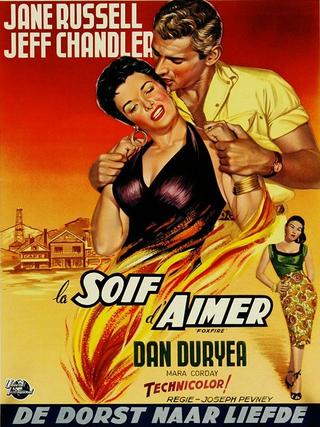
That one casual line in Foxfire (1955), spoken by one of the most hard done by and neglected characters in the movie as it happens, goes a long way towards catching the spirit and flavor of the entire picture. In a sense, all of the characters are outsiders in their individual worlds, some by chance and others by choice or design. This is a strong theme, one many of us will be able to identify with at some point in our lives and thus a solid bedrock on which to construct this story which I’d say is three parts melodrama and one part modern western. That part picks up on and weaves into the blend perhaps one of the more interesting, challenging and progressive thematic threads to be found in the fabric of the 1950s western, the clash of cultures which was inevitable in a new land and the dramatic tension growing out of that.

A desert highway, one of those arrow straight and seemingly endless thoroughfares that we viewers have traveled many times. Our companion on this occasion is a lone woman, Amanda Lawrence (Jane Russell), speeding along until she gets a flat tire. With no help available, she sets off on foot, burdened with what look like the assorted fripperies of a shopping expedition. There can’t be any doubt that this chic and carefully coiffed lady is very much an outsider in the primal landscape, a refugee from 5th Avenue cast adrift in the dust and heat of the southwest. Then out of that shimmering haze comes a jeep carrying two men – miner Jonathan Dartland (Jeff Chandler) and doctor Hugh Slater (Dan Duryea) – and we’re off. Amanda is clearly taken with Dartland and he’s at least interested in her.  What follows is a love story but it’s not a smooth one, and I think it’s questionable in the end what all of the protagonists are in love with. In fact, despite the relatively neat conclusion, those questions are only partly answered and I feel there’s a suggestion that they will rear their heads again.

As far as I can see, the characters are being pulled in different directions partly by their disparate backgrounds and partly by their status as outsiders. Beginning with Dartland, or Dart as everyone refers to him. We learn very early on that he is half Apache, with a mother who has returned to the reservation and wholly integrated herself back into tribal life after the death of her husband. He is forced to endure some bigoted and prejudiced attitudes – including one thoughtless gaffe on the part of Amanda before she learns about his heritage – but tends to brush them aside. He insists it means nothing to him but a couple of understated moments call this into question – the brief flash of hurt in his eyes when Amanda makes that crack about Indians, and then later the diffidence and self-consciousness he displays when entering the club for their first date, not to mention the haste with which he beats his retreat.

For all Dart’s claims of not being affected by his background, he’s very much aware that he is outside looking in. And he cannot fully break with his past; he avoids talking about his mother’s people, keeps his memories quite literally locked away and reacts with petulant sensitivity to their discovery. Nevertheless, the tone of his relationships, especially with Amanda is dictated by his upbringing, his instinctive prioritizing of self-reliance as well as his resorting to the physical as opposed to the emotional act of love when confronted with conflict. As I mentioned  above, I’m unsure whether he’s confident what he’s in love with – his wife or his ambition, and that siren song of kith and kin holds a powerful attraction.

What of Amanda? Is she any less an outsider? A socialite on vacation drawn to something attractive, and she does refer to Dart time and again as pretty in a neat subversion of traditional objectification. She labors hard to adapt to the harsh conditions of the mining town and also has to deal with the whispers of her own past tempting her to throw it all up in favor of the ease and plenty she was accustomed to. Again, does she really know what she wants – the rugged ideal of her imagination or the the reserved figure of reality?

You can always tell a script has depth when it adds meat to the bones of the supporting characters ; this one is from the pen of Ketti Frings, who had already written a few very good films noir as well as another Joseph Pevney / Jeff Chandler picture Because of You, and I’m keen to track that one down now. Dan Duryea’s boozy doctor could have been a mere caricature, a sidekick with a bottle who bumbles in the background. However, the character isn’t written with such broad strokes, there are layers present which are only gradually uncovered. He doesn’t truly belong either, another blow in from another world, a drunk as a result of personal trauma and casting around for a means to escape his circumstances. Duryea excelled at playing heels and it’s therefore not much of a surprise when his cunning and manipulative side rises to the surface. The one who arguably suffers this most, albeit with almost superhuman stoicism, is his nurse/lover played by Mara Corday. Like Dart, she is half Apache yet the barriers separating her from white society are even more entrenched. There’s something both outrageous and touching about her quiet patience and devotion to a man who habitually neglects her to the point of naked disrespect. Then there’s that wedding scene, where she is looking in in every sense, relegated to a place outside in the company of hookers and other undesirables. She is in a very real way a peripheral figure and is assigned only a limited amount of screen time, but her presence and its effect on the viewer is significant. Somehow, the casual acceptance (by herself as well as by the other characters, and perhaps even more so on her own part) of her regular social exclusion and the flippant exploitation of her affections do as much to highlight prejudice as some of the more direct and overt references involving  Dart.

I’ve watched and featured a number of Joseph Pevney movies this year and Foxfire is probably the most enjoyable one so far. I appreciated the understated way the drama unfolds and this is particularly true of the key scenes. The film has that appealing look that is so characteristic of Universal-International productions and William Daniels’ Technicolor cinematography honestly is quite breathtaking at times. The setting matters too, it feels entirely appropriate in this case that everything revolves around a mining settlement in the Arizona desert. The location offers a tangible link to the classic western and then there is that sense of the ephemeral, of a place hastily built amid a permanent wasteland – Chandler’s character dreams of making it a lasting settlement but there’s that nagging doubt again, as in his personal affairs, over how sure the foundations will be. Somehow the raw purity of the scorched backdrop offers a contrast to the transitory desires, ambitions, jealousies and angst of this group of people, none of whom appear to genuinely belong.

As for availability, there is a Blu-ray which has been released in the US and I understand it offers a fine presentation of the movie. Sadly, I’m Region B only when it comes to Blu-ray so I had to find other options. There has been a DVD release in Italy that is hard to fault as far as the picture quality is concerned. It might be standard definition but the 2.00:1 widescreen image is sharp as a pin, clean and colorful. Sure there are better melodramas to be found and the theme here may not have the kind of universal resonance that typically adds greatness. Nevertheless, this is a good movie, and it mostly worked for me, raising a number of issues I could relate to as well as providing an hour and a half of polished, solid entertainment. My recommendation is that anyone able to access this title should check it out.

Rogue Cop

Patterns, connections, trends and interdependence. These are things which draw my attention in general, and in cinema in particular. I’d like to think that visitors to this site have noticed this from time to time, and I’d be even more pleased if I’d managed to pique the interest of some by following up on certain threads that suggest themselves to me. Redemption is the one theme that I guess stands out from the crowd of other ideas, and it’s certainly the driving force behind Rogue Cop (1954), which I want to focus on today. I’d also like to touch on what I feel is a defining feature running thorough 1950s cinema as a whole and maybe then cast an eye over the shape and texture of noir at that time. So yes, it ought to be clear enough that I’m setting myself  a nice uncomplicated and unambitious task with this one…

Rogue Cop opens in an understated and matter-of-fact manner, with the credits running over a series of background images of cops going about their daily business in the city, making and taking calls, driving squad cars and all seguing into a nighttime scene where the sirens scream and the neon flickers. Throughout this it remains everyday, mundane and routine, even as a showgirl drifts out of the theater where she’s been working and makes her way to a penny arcade. Even there the drug deal she’s intent on completing is nothing out of the ordinary, nor indeed is the casual filleting of her pusher by a competitor. So there you have it, life and death played out as just another unremarkable event in an overlit and gaudy locale – the whole process as cheap and throwaway as the scene of the crime itself.

Yet, in plot terms, this is more than just another statistic to write up in the records. Chance, that old staple of any self-respecting film noir, steps in and sees to it that the killer who is coolly departing should bump into a young patrolman. This man on the beat is Eddie Kelvaney (Steve Forrest) and while he doesn’t make a pinch he does get a good enough look at the knife man to be able to make an identification. Had he not been there at that moment, or had another less ethical man been pounding that particular pavement, the tale would have meandered off in a different direction.  But he was there and the fates would also have it that his older brother Chris (Robert Taylor) is a detective with a lot of shady contacts, with the healthy bank balance and unhealthy reputation that brings. Pressure will be brought to bear on Chris to ensure Eddie toes the line and forgets who he saw and where he saw him. Were it only about Chris himself, this would not be a problem; however, Eddie is an idealist and a man who holds firm to the principles of decency his late father lived by, and which his brother professes to regard with contempt. What follows is that age old contest, the battle for the soul of a man with temptation taking place in an urban wasteland with winking lights as opposed to the deserts of antiquity.

Rogue Cop was adapted from a novel by William P McGivern, the man who provided the source material for Fritz Lang’s punishing examination of corruption and abusive relationships The Big Heat. Similar to Lang’s movie the noir quotient of this production stems as much, and probably more, from the theme as it does from the visuals. While John Seitz shoots the whole thing beautifully and earned himself an Oscar nomination for cinematography, it’s not got that painted shadows look that the term film noir so often conjures up. It’s got a brighter appearance in general and director Roy Rowland aims for the kind of pared down and uncluttered visual simplicity that Lang had been working on.

Is it possible then that the look here was a reflection of the thematic shift taking place within film noir itself? Noir in the 1940s felt as though it concerned itself primarily with disenchantment and compromised morality on a personal, and thus more intimate, level. Moving into the next decade saw a cleaner and simpler aesthetic gain prominence, which might suggest that thematically it was drifting towards a more sharply defined ethical conundrum. The focus was increasingly on decay in institutional terms, and the ethical deficiencies in broader society. A good deal of the action is situated in flash night clubs and swish apartments, well-lit and with the type of surface gloss that is deceptive – a store-bought glamor that seeks to blind us to the real cheapness, the shabby abuse and exploitation lurking behind it all.

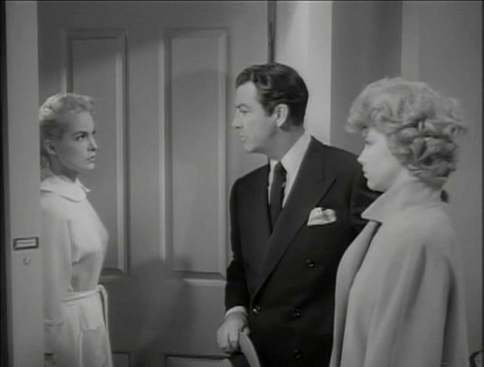
There are those who will tell you a film noir has to have a femme fatale. Personally, I feel she is a common or typical feature but not an essential one, although I do think a strong and pivotal female role in general is vital. Rogue Cop offers two such parts – Janet Leigh’s jaded entertainer desperate to escape the sins of the past and, giving a terrific performance, Anne Francis’ boozy moll who suffers grievously for a moment’s tactlessness. These two are key to the development of the plot and in determining the path Taylor’s dirty cop will follow.

Taylor is, right from the beginning, a man trying to save himself, a man hungry for redemption, even if he doesn’t realize it till later. The fact remains though that the itch is there, the mask of cynicism barely disguising the intensity of his concern over his brother’s welfare. He’s only a short step away from acknowledging his desire to find a way out – and that tipping point is achieved first by the fate of his brother, later intensified by the treatment of Francis, and finally confirmed by the constancy of Leigh. It’s this spiritual quest that lends weight to the whole movie and lifts it above a mere run-of-the-mill critique of corruption. All of which had me wondering why exactly this theme of redemption is to be seen all through 1950s cinema. I’ve often written about it here in relation to the western, where it found perhaps its truest expression, but it transcended genre and is almost ubiquitous. Was it a reaction, albeit a delayed one,  to the war years? And did it climax at or around the end of the decade? My feeling is that it had – with the closing of the classic noir cycle and the gradual winding down of the golden age of westerns. Still, this is just a feeling on my part and others may be able to offer a more definitive answer.

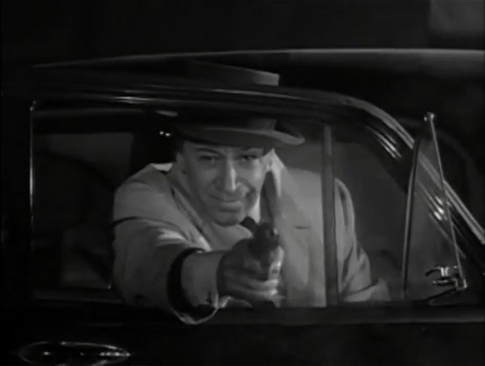
Of course Rogue Cop, being released in 1954, wasn’t coming at the end of any cycle. In fact, it signaled a return for at least one person to bigger pictures than had been the case for a while. That person was George Raft, one of the early stars of the gangster movie whose star slowly faded through the 1940s. I’ve heard it said – although I’d be happy to be corrected on this if anybody knows different – that Raft at the height of his fame was very choosy about his roles and became very cautious about the image he was projecting on screen. Essentially, he was said to be turning down anything that involved a persona which was less than squeaky clean, something which always struck me as a singularly petty and counterproductive approach. As the chief villain here, Raft is very good indeed, full of malice and vindictiveness. Watching him get this across so successfully had me thinking about the secret of getting under the skin of a villain, of making or becoming a bad man on screen. That demands both self-confidence and humility, it requires that an actor be big enough in his soul to be comfortable playing someone genuinely small and mean of spirit. In short, it needs courage.

Unfortunately, Rogue Cop remains on the missing list as far as official releases on disc are concerned. It is easy enough to watch online in passable condition but it deserves to be available commercially. Whatever is holding that up, it’s not the quality of the movie itself. This is a superb 50s film noir with first rate performances all round from an excellent cast, and a solid script which offers plenty of food for thought while simultaneously raising a number of interesting questions.

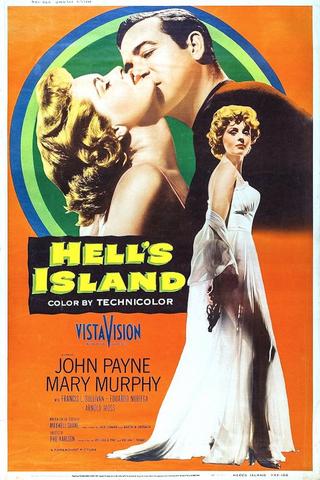
Hell’s Island

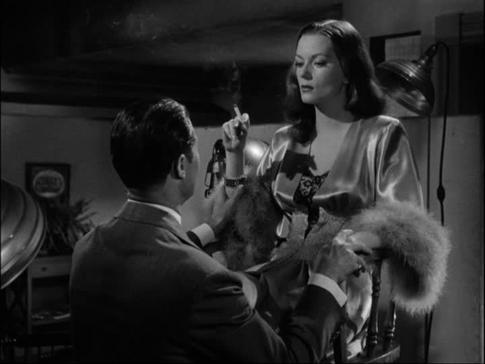
Yes, I know – there are those who will argue, quite vociferously too, that there’s no such beast as a color noir. I’ve heard these arguments before, seen them made with passion and insight. However, while I fully respect the view I cannot buy into it. OK, ultimately, none of this matters a jot but it’s the kind of stuff we film fans do like to chew the fat over. Anyway, I’m of the opinion that Hell’s Island (1955) ought to be categorized as film noir as it has enough of the core ingredients to qualify.

Somewhat unusually, the opening credits play over what turns out to be the climax of the movie. From there we move to a hospital, where the protagonist has been undergoing surgery for a bullet wound. Still lying on the table as the doctor patches him up, Mike Cormack (John Payne) recounts his tale to the local policeman. Now I might as well make it clear that some may find the whole affair more than a little contrived. There’s no denying this, and I think that you have to embrace this aspect if you plan on enjoying the ride. So, here we are in the operating theater, with the hero chain-smoking (with the doctor’s consent) and narrating the peculiar set of circumstances that brought him to that point in just over a week. He’d been working as a kind of bouncer in a Las Vegas casino when he’s handed a proposition – for $5000 he’s to travel to a Caribbean island and inquire into the whereabouts of a valuable ruby that the owner wants back. Why him? That’s simple: the wife of the last man in possession of the gem is an old flame of Cormack’s and he’s therefore seen as having a ready-made foothold. To me, this and what follows is all characteristic of pulp noir – the impossibly convoluted tangle of relationships overshadowing everything before we even start, a clipped and world-weary voiceover from the lead, a location where the opportunities for corruption seem ideal, a femme fatale (Mary Murphy) who looks and acts like she’s been hoodwinking suckers all her life and, of course, a tough guy lead everyone appears intent on crossing up.

This was the third feature director Karlson and star Payne made together (following on from 99 River Street and Kansas City Confidential) and it has to be said it’s the least of the three. That doesn’t mean it’s a bad movie; if anything, acknowledging that this is a lesser affair is a testament to the high quality of the previous two collaborations. It’s enjoyable and pacy, with moments of toughness to hold the attention. Furthermore, it’s photographed by Lionel Lindon so there’s a polished and stylish look to it all. Yet, as I mentioned above, it’s also unashamedly pulpy, and there’s never any serious attempt to sell the story as anything else. We get the shady, overweight underworld type in a motorized wheelchair (Francis L Sullivan), the femme fatale’s  effete associate (Arnold Moss) , and then there’s the protagonist who’s pursuing the novel career path of lawyer-drunk-bouncer-patsy. When I say that all of these are blended together in a budget-conscious, set bound (mind you, it is an attractive set) Pine-Thomas production, then it ought to give a sense of the kind of movie we have. Basically, it’s a caper with some hard edges, as well as being a good-looking showcase for its stars.

By this stage, John Payne had settled comfortably into these types of roles. He was capable of slugging it out convincingly with the best of them, and was credible whether on the receiving end of a casually brutal beating or booting a musclebound henchman into a pool full of hungry alligators. The scenes where he and Mary Murphy are trading kisses and threats are nicely done, but they too have that artificial, semi-cartoonish quality as though ripped from the cover of a 50s paperback; the whole thing winks at you in a stylish, sexy way but in your heart you know it’s superficial. A lot of the sexiness stems from Mary Murphy, giving an arch performance that’s fun to watch but you never really get the impression that she was stretching herself. And the thing is she was a good actress – having made a strong impression in The Wild One, she enjoyed a fair run in the 1950s. Around the time of this movie she was in two, in my opinion anyway, superior productions, Ray Milland’s fine western A Man Alone and Wyler’s The Desperate Hours alongside Bogart and March. The following year she would go on to play opposite Richard Basehart in Joseph Losey’s underrated and neglected The Intimate Stranger/Finger of Guilt – you can find reviews of that one by Sergio here and by Vienna here.  Moving further down the cast list, a slippery Arnold Moss is good value as expected. Frankly, I like a good heavyweight villain and so I feel it’s a pity Francis L Sullivan (in what I think may have been his last role role before his untimely death) doesn’t get more screen time.

Hell’s Island is one of those films that remains stubbornly difficult to acquire in decent quality. I picked up a German DVD (I believe there are also Spanish and Italian variants on the market but I have no idea how they fare in comparison) which is just barely OK. The movie is offered in a choice of presentations – a 4:3 one that seems to be a letterboxed non-anamorphic image, and a 16:9 one that I guess is blown up from the other?  Basically, it’s watchable but the image is muddy and colors are muted and dull. What’s needed is a full restoration – whether or not that’s likely is anybody’s guess. All in all, Hell’s Island is what I think of as enjoyable pulp noir – there’s as much, or more, caricature as characterization, and you’re never quite convinced that these people exist. Yet the direction and the actors keep you watching and at no time does it commit the cardinal sin of being dull or uninteresting. So, while it might not be essential you should still have a good time with it.

Incidentally, this happens to be the 500th post on this blog. Bearing in mind how long this place has been open for business, some might consider that slacking. Nevertheless, it is a milestone of sorts and worth mentioning in passing if nothing else. So my sincere thanks to all of you who have contributed so much to the shared experience over the years – I couldn’t do it without you. Stay safe and well everybody!

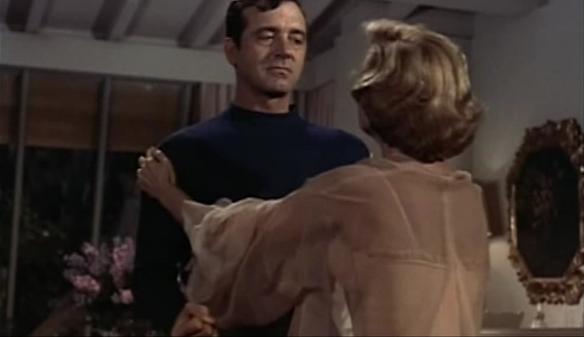
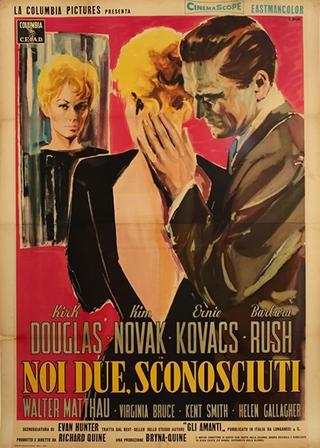
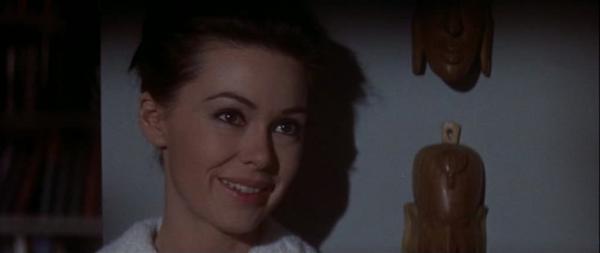
Strangers When We Meet

This is a story about building a house. Is that too glib? Perhaps it sounds like it is, but it’s not meant to be. Would it be better if I said it’s about lack of fulfillment? Well, that’s true too; it’s a movie about both, and at  heart it’s a movie about people in love. All of these elements converge in Strangers When We Meet (1960), separate and unconnected when they initially come together, just as the title itself suggests, fuse and then diverge again at the close. Still, that climactic separation is not quite as clean or as complete as one might expect – after all, nobody and nothing can remain unchanged and unaffected by their experiences.

The post-war suburban idyll, that’s the image we’re first presented with. A peaceful and prosperous looking street gradually filling up with chattering parents and children bustling along to the bus stop. They gossip and exchange small talk, bid a temporary farewell to the kids and then start to drift apart again, off to resume their day as the strangers they had been a few minutes before. But not all of them; architect Larry Coe (Kirk Douglas) lets his gaze linger a touch longer on the demure yet voluptuous Maggie Gault (Kim Novak), and she discreetly returns that slow-eyed appraisal. So there we have it, those tiny hairline cracks in the veneer of prim middle-class respectability are suddenly exposed to the glare of the early morning sun. I don’t suppose it’s necessary to go into huge detail regarding the plot here. Suffice to say that Larry and Maggie are both less than satisfied in their lives; she is married to a stiff and undemonstrative man while he feels suffocated by the twin pressure of unrealized professional potential and a wife (Barbara Rush) he blames for stifling his creativity. Therefore, we have two people struggling with what they think are unfulfilled lives, ripe for romance and risk. The trigger for it all, what tips the balance, is the aforementioned house. Larry has been given a commission by a bestselling novelist (Ernie Kovacs)  to construct his dream home – something he seizes onto hopefully, as a drowning man will snatch at anything buoyant. It’s this that actually brings Maggie and Larry together, the building of the house proceeds alongside the blossoming of their illicit relationship, with its completion resulting in… Well, watch it yourself and see.

Director Richard Quine had been making a succession of mostly light comedies throughout the 1950s, with a couple of films noir such Pushover and Drive a Crooked Road thrown into the mix. Bearing that in mind, a melodrama in the mold of Douglas Sirk would appear to be an odd project for him to take on. For all that, it works very well indeed, with Quine tackling the serious themes with skill, tact and sensitivity. He never allows it all to become too broad, overheated or overwrought. And visually, he paints  from an exciting and evocative palette as he and cinematographer Charles Lang Jr light, frame and color the movie beautifully – from the marvelously tinted and shadowed first “date” for the clandestine lovers to the warm autumnal mellowness of the final scene, and through it all Ms Novak’s costumes progress from brazen scarlet to virginal white later in the movie, indicating a journey back to spiritual purity. All in all, an excellent handling of cinema’s own special syntax.

So to the writing, the solid core of any piece of filmmaking and frequently the area where the most significant strengths or weaknesses lie. In this case it comes from the pen of Blackboard Jungle writer Evan Hunter ( a man I’m more familiar with for his 87th Precinct books under his other pseudonym of Ed McBain) and adapted from his own novel. As I said in the introduction, it’s a movie about building a house and as such needs a firm foundation to anchor it. Indeed the characters themselves comment on a few occasions about the precarious placement of the house, half joking that it may all come crashing down. And here the architect is seen to be really constructing his building for the woman he loves; she appears to have inspired it and even if he’s not fully aware of this himself, I think it ought to be clear enough to the viewer. The tragedy here is that he’s building this for someone else to occupy, which leads back to the accompanying theme of lack  of fulfillment – the entire premise of his love can never truly be fulfilled.

Still, it’s not quite as bleak as all that. I can only offer my own interpretation but I think  that, ultimately, Hunter wants to put across the idea that the act of loving, both the physical and the emotional, are as close to personal fulfillment as anyone can hope to arrive at. That it may not always be a success or be directed towards the right person is perhaps irrelevant. Some will be lucky, they will connect with that ideal or perfect match, but for others the knowledge that they were able to touch on a form of perfection in an imperfect situation may actually be enough, or at least be enough not to negate that love which was but briefly shared.

The last time I wrote about a movie starring Kirk Douglas was on the occasion of his 103rd birthday. Since then he has sadly left us but in doing so he also left behind a wonderful legacy of performances to be enjoyed. He was of course a front line star, a man who seemed as big as the movies themselves yet versatile enough to be wholly believable in whatever role he took on. As an increasingly embittered middle-class man drifting into dissatisfied middle age, he’s never less than credible.

There’s a nice degree of subtlety involved in Douglas’ differing interactions with both Barbara Rush and Kim Novak, as wife and mistress respectively. Both actresses bring a lot to the movie too, Novak has the bigger role with more screen time and she uses that enigmatic quality to good effect – incidentally, this was the third of four films she made for Quine – and the hesitancy and uncertainty she tapped into so well in Hitchcock’s Vertigo is in evidence again. Rush has to wait till the third act to get her big moments and handles them just fine, notably the creepy confrontation with Walter Matthau’s two-faced neighbor. Matthau himself is delightfully sleazy and oily in his role, taunting Douglas during the pivotal barbecue scene before later making his move on Rush in the literally tempestuous climax. A word also for Ernie Kovacs, someone else who was used on a number of occasions by Quine. There are only hints at his quirky comedic side as he gives us an interesting take on the self-doubting writer, a successful man who is every bit as much in search of fulfillment, primarily the artistic kind in his case, as any of the other characters. The fact is that pretty much everyone in the movie is living their own variation on the American Dream; the problem is it’s giving most of them sleepless nights.

I’m not sure if Strangers When We Meet has been released on Blu-ray – someone will no doubt set me straight on that – but it is freely available in multiple locations on DVD. I’ve had the Italian release for some time but only recently got around to it, and I’m very pleased that I did. The movie has, to my eyes anyway, been presented very well and the marvelous Scope  image is highly immersive. The fact is of course that the story itself draws you in with its touching and deeply affecting portrayal of lost people searching desperately for meaning, fulfillment and genuine love.  It really is a rich, layered and intelligent piece of filmmaking, a joy to watch and one I’ll most certainly be revisiting.

The Sign of the Ram

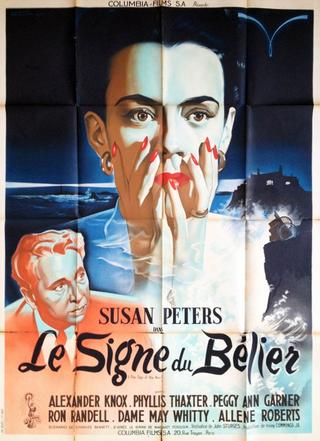
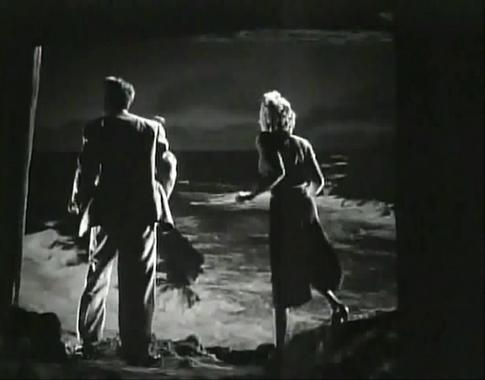
As I was watching The Sign of the Ram (1948) I found myself idly wondering  – and I seem to have a great deal of time for idleness these days – about a number of things, perhaps the least significant of which was a growing curiosity about how many noir melodramas involved grand old houses perched precariously atop dramatic cliffs with boiling seas below. Sitting and admiring the atmospheric matte paintings in the background, I had a hunch there must be lots, but I think now that’s probably an exaggeration on my part. Whatever the number might actually be, it won’t alter the fact that this is a fine setting for a movie, the drama and violence of nature vying for attention with the emotional tempests raging within the quasi-Gothic old pile that houses a host of troubled souls.

Nothing is quite as it seems. Sherida Binyon (Phyllis Thaxter) arrives to take up her new position as secretary to poet Leah St Aubyn (Susan Peters), who is confined to a wheelchair. Her husband Mallory (Alexander Knox) is devoted to her and it’s quickly apparent that everyone in the house, all the children of Mallory’s first marriage, shares these sentiments. On the surface, it looks as though the sweetness and stoic rejection of self-pity on Leah’s part are the inspiration for this. Yet that’s not the case at all; Leah’s disability is the result of her rescuing the younger St Aubyn members during a storm off the coast, a heroically altruistic act which saw her cast upon the rocks and her body broken. Bit by bit, it becomes increasingly apparent that there’s an implicit, unspoken sense of guilt at the back of it all, a tacit acceptance that the lives snatched back from the grasp of the sea represent a debt that is hard to repay. In a savage twist on that old belief that saving a life leaves a person responsible for that life in the future, it is gradually revealed that Leah has manipulated her family’s gratitude into a corrosive form of guilt. And all the while the ocean booms against the Cornish rocks, biding its time till the payment it’s due can be collected.

Personally speaking, John Sturges isn’t the first name I’d think of were I asked to name a potential director of a film noir with a strong flavoring of Gothic melodrama. Of course Sturges, like all contract directors in the studio era, worked across a range of genres and was no stranger to film noir – Mystery Street, Jeopardy & The People Against O’Hara comprising a few. Nevertheless, I tend to think of westerns, and as to a lesser extent, war movies when he’s spoken of. He had a terrific eye for composition and the way the framing of a shot could be used to the greatest advantage. This would become ever more apparent in the future when he embraced and fully exploited the potential of the wide screen, and he knew how to place his actors on location too. The Sign of the Ram is set bound though and shot in Academy ratio so it could be said that it wasn’t playing to his strengths. While that may be true to some extent, he does take full advantage of what opportunities are afforded and, aided immensely by the masterly cinematography of Burnett Guffey, shoots from below an above to alter the mood and adds frames within frames to narrow the focus and fasten the viewers’ attention.

Looked at from the perspective of 2020, The Sign of the Ram doesn’t feature a cast full of the kind of names that are going to be immediately recognizable. Despite that relative unfamiliarity, it would be fair to say the film boasts an interesting lineup. The leading lady and prime mover of the whole piece is Susan Peters, and hers is a fascinating and tragic tale. With her star on the rise and only a year or so into her marriage to actor and future director Richard Quine, she was the victim of a hunting accident when a discarded gun discharged and the resultant wound left her paralyzed from the waist down. She was just 23 years old then and she would pass away at the age of 31. This film was to be her comeback and she is fine in her role, carefully hiding her true feelings from those around and only offering hints to her dissatisfaction in her private moments and through her constant chain-smoking. All told, it’s an excellent study of the consequences of manipulation driven by fear.

Alexander Knox is likely to be the best known face on the screen, his long and varied career highlighting his versatility – something I noted before when looking at his excellent work in an unfamiliar western setting in Man in the Saddle – and he gets across the decency of his character in a most believable fashion here. Phyllis Thaxter looks set to enjoy a more dynamic role as the new secretary, a point of view figure for the audience to identify with, but she seems to gradually drift towards the sidelines as the story unfolds. Peggy Ann Garner gets the showier part as the younger daughter in the family while Allene Roberts and Ross Ford are both perfectly acceptable as her siblings. Diana Douglas (the wife of Kirk Douglas at the time) comes more into the spotlight in the latter stages and there’s solid support from Dame May Whitty and Ron Randell.

The Sign of the Ram is a Columbia picture and, as far as I’m aware, has not enjoyed a release on disc anywhere. However, it can be tracked down for online viewing. I guess the lack of big name stars in the cast may have led to this movie being neglected. In addition, I sometimes think that Sturges work overall has not been had the critical attention much of it deserves. Perhaps his move into big budget, popular movies through the 1960s and then the variable quality of his later work is the reason. Whatever the reason, he’s highly rated on this site and I feel this film from early in his career is at least worth a look.

Undercover Girl

A slight departure today, but one which I’m sure most who read and follow here will appreciate. In short, I’m honored to be able to host a guest post from Gordon Gates, a man who has contributed to many a discussion here over the years and who brings along a wealth of knowledge on genre pictures and television shows. He very kindly offered to do a guest write-up, and also floated the possibility of others in the future. I’m delighted to be able to offer Gord this space to highlight a movie of his choice, and I’ve no doubt other readers here will share those sentiments.
I would like to thank Colin for the chance to do a guest review. I am by no means an expert on film but I know what I like. Film Noir, westerns, war films, Sci-Fi and early television are at the top of the list for me. Up first, I’m going to dive into film noir. Undercover Girl  (1950) is a Universal-International B film that stars Scott Brady, Alexis Smith, Royal Dano, Gerald Mohr, Gladys George, Angela Clarke and Richard Egan. This was the second feature helmed by actor turned director, Joseph Pevney. The story was supplied by Harry Essex whose work includes, Desperate, The Killer That Stalked New York, The Fat Man, Bodyguard, I, The Jury and Kansas City Confidential.

This one starts out in Los Angeles where a Police informant is badly wounded in a vicious knife attack. Before he bites it, the informant tells his Police Detective contact, Scott Brady, there is a large shipment of drugs coming to town. The shipment is arriving from New York. He also manages to whisper there is a crooked New York cop involved.As this is going on in LA, back on the east coast, Police Detective Regis Toomey, the crooked cop, has had a change of heart. Toomey has a meeting with mobster, Gerald Mohr about the 10 large he took to look the other way. He tosses the cash back at Mohr and tells him he is taking him in. This does not go well for Toomey. A henchman of Mohr puts the kibosh on Toomey..

Now we meet Alexis Smith, Smith is a trainee with the NYPD following in her father’s footsteps. She takes Toomey’s murder hard and redoubles her efforts to make the force.

LA cop Brady is soon in New York to see if he can uncover anything about the drug shipment. Smith does not believe Brady that her father might have been a bent copper. She offers to help out Brady. Brady takes her up on the offer. He will send her in as an undercover type back in LA.

It is back to LA to fill in Smith on her new identity etc. They hook Smith up with an old time gangster’s moll, Gladys George. George is pumped by Smith for every bit of info she can get. This will help establish Smith’s criminal “bona fides” for her new identity. She is to play a buyer for a drug ring in Chicago.

Several weeks of studying are needed before Smith can be inserted into the local criminal crowd. Smith is put up in a downtown rooming house next door to Angela Clarke. Clarke is the former dolly of low level underworld type, Royal Dano. Clarke is a drunk always looking for a bottle. A few words in her ear from Smith, and a promise of some cash, soon does the trick.  Clarke agrees to put Smith in touch with Dano.
Dano shows up at Clarke’s apartment in a less than happy state. He is not amused that Clarke has set up the meeting with an out of town type. Clarke gets slapped around, then, shoved out the 3rd floor window. Dano beats the feet out the door and right into Miss Smith. She points to a back way out of the building.

Smith fills in Brady on the night’s events. Brady thinks the case is now far too dangerous to continue, but Smith still wants revenge for her father’s murder. She tracks down Dano and convinces him to introduce her to someone higher up the drug food chain. A promise of 1000 bucks quickly has Dano on side.

Miss Smith is soon shown into the office of a doctor. The man, Edom Ryan, has a sideline selling heroin. Ryan actually works for the same mobster, Mohr, who killed Toomey in New York. Keeping an eye on Doc Ryan is, “mad as a hatter” gunsel, Harry Landers. Also on Mohr’s payroll is Lynn Ainley.

Before Ryan agrees to any transaction, he needs to check out Smith’s identification etc. Smith knows all the proper answers to the right questions, and is bumped up the line. She meets the boss, Mohr. A deal is quickly arranged for a substantial amount of product for an equally substantial pile of cash.

Now of course the flies start to roost in the ointment. Miss Smith runs into her former beau from New York, Richard Egan. He blows her cover in front of Dano. Dano, an enterprising bottom feeder if ever there was one, decides to blackmail Policewoman Smith. Five large or he turns her over to Mohr. He gives a time and place to Smith for the exchange.

This lays out all the ground work for the film. Needless to say several double crosses, some flying fists, a barrage of bullets and a stack of bodies are needed to bring the tale to a proper end.

This is another of those Universal-International films that is rather difficult to lay one’s hands on. But it is well worth the time if it can be found.

Scott Brady was the younger brother of noir favorite Lawrence Tierney. Look close early and you can spot the third Tierney brother, Edward, in a small unbilled bit.

The cast is all quite good here, with the always entertaining Royal Dano in particular shining as the low-life grifter. This was director Pevney’s second foray into noir territory after the equally entertaining, Shakedown. He hits the mark all the way through. Pevney directed in several genres during the 1950′ s before making the move to television. Two of more well know TV episodes were from Star Trek. These were, Amok Time and The Trouble With Tribbles. Pevney’s film work includes: Desert Legion, Iron Man, Back to God’s Country, Yankee Pasha, Away All Boats and The Plunderers.

As for myself, I’m from Western Canada. Right now I’m based in Calgary Alberta though I have lived in British Columbia and the Yukon. Quite a few films have been make around here as we are only 60 miles from the Rocky Mountains. Eastwood’s Unforgiven, Costner’s Open Range are just a couple of the westerns made here.

Gordon Gates

Tiger by the Tail

The last time I posted here I spoke about voiceover narration in movies and expressed some doubts about its efficacy. Now that was largely prompted by my experiencing what I felt was a fairly redundant example of the technique. That said, the fact is that this narrative device does serve a purpose and, as others have pointed out, is frequently an attractive feature in various films noir. Generally, I’d go along with that – although it has to be said that a recent viewing of Richard Fleischer’s Trapped had me drumming my fingers at what seemed like an interminable lecture at the beginning. And this, in my own meandering way, brings me to Tiger by the Tail (1955), a British film noir which I reckon uses its narration in the most effective way, that is as a means of conveying the thoughts, fears and regrets of the lead.

The opening is suitably evocative – nighttime, a sparse urban setting and a lone figure stumbling along a pavement before collapsing. As a patrol car pulls up and a policeman goes to attend to the fallen man the credits roll. Thereafter the story unfolds in flashback, with intermittent narration provided by the protagonist. He is John Desmond (Larry Parks), an American journalist somewhat reluctantly handed the assignment of taking over the London office of his organization. He’d been expecting the Paris job and the last minute decision to switch him to Britain hasn’t done much for his mood. The combination of post-war austerity and the less than enchanting weather is picking at him and a decision to go out for a drink alone proves to  be a fateful one. This is what brings him into contact with Anna Ray (Lisa Daniely), and he embarks on a relationship that will see him embroiled in a killing and left to the mercy of a group of ruthless counterfeiters. His only way out is to try to unravel the meaning of a cipher in a notebook, and thus hopefully bring down the gangsters. As is often the case in the world of film noir, Desmond has first to be led up the garden path by a femme fatale in the shape of Ms Ray before being bailed out by a loyal Girl Friday figure – in this case Jane Claymore (Constance Smith), the secretary who proves herself considerably more resourceful than her ill-fated boss.

As films noir go, the plot here is pretty standard fare. There’s a protagonist who’s not exactly a chump but nor is he any brighter than he needs to be. The villains are twisty and mean, and the women, both good and bad, are arguably sharper than anyone. The script adapts a John Mair novel and comes via Willis Goldbeck. Generally a writer and occasional director (I keep meaning to do something catching up with Ten Tall Men, the Foreign Legion picture he made with Burt Lancaster), Goldbeck penned a number of Dr Kildare programmers as well as a couple of Stuart Palmer adaptations , not to mention the deeply unpleasant Freaks for Tod Browning. Tiger by the Tail is a smoothly written piece, albeit a seemingly unusual one for a man close to the end of his career and due to go out on a relative high with a brace of John Ford movies – Sergeant Rutledge and The Man Who Shot Liberty Valance.

The movie looks attractive throughout and is set up nicely by that generic but stylish and effective opening. The cinematography is by Eric Cross (who also shot the visually interesting The Dark Man) and the always reliable John Gilling occupies the director’s chair. Gilling had an eye for a good-looking setup and even if he was as abrasive as his reputation suggests he did, as a rule, manage to get solid or better performances from the actors he worked with. He remains something of an underrated filmmaker although, interestingly, the upcoming Hammer box set from Indicator/Powerhouse is as near a John Gilling collection as we’re  likely to see.

And so to the actors. Neither Larry Parks nor Constance Smith will be household names these days, and indeed I’d be amazed if anyone aside from the most dedicated film buffs are at all familiar with them. Nevertheless, back when Tiger by the Tail went into production both would have enjoyed a considerably higher profile. For different reasons these two people dropped virtually out of sight after having tasted success. One would have though a Best Actor nomination in a big budget movie would ensure a more lasting fame, but such was the power of the blacklist that someone like Parks could see his career grind to a halt almost immediately. I’ll have to confess that I’ve not seen much of his work and can only recall The Swordsman, a fairly entertaining Joseph H Lewis swashbuckler.

Constance Smith fell from grace for entirely different reasons, although her troubles are not unprecedented in Hollywood. Coming from a poor Irish background, Smith quite literally shot to fame and found herself rapidly moving from Rank in Britain to Fox in Hollywood and making star appearances alongside some major names. However, as fast as her fame arrived, it evaporated at a similarly giddy pace. Out of contract, with a personal life descending into chaos, she left the US but the years ahead were to be even more tumultuous. Not that any of this is apparent when watching Tiger by the Tail, where her performance is just fine.

Recent years have been good to fans of British crime and noir. There was a time when these kinds of movies were sprinkled throughout the TV listings, albeit as filler material. Then they seemed to disappear, leaving many wondering if they’d ever be seen again. Small independent labels such as Renown, along with Network and Simply, have done some terrific work in making so many of these forgotten titles available once again. The Renown DVD of Tiger by the Tail has the movie looking quite good; the contrast might be a touch harsh here and there and there are a few damaged frames, but it’s not at all a bad presentation. All in all, I found it a solid little film noir with some highly competent talent behind the camera, and a couple of very interesting stars in the leading roles. In short, an enjoyable movie.

Thunder Over the Plains

I can never quite make my mind up on voiceover narration in the movies; after all, it does create what might be termed an authoritative mood that feels somehow fitting for certain pictures such as documentary-style films noir. On the other hand, it can give the impression of lazy writing, an info dump of sorts that resorts to telling rather than showing, or what’s worse is that it can signal the arrival of historical/political lecturing or finger-wagging. Thunder Over the Plains (1953) opens like this, offering up a potted post-Civil War synopsis that had me fearing the worst. Fortunately though, it panned out differently, the narration serving to contextualize the story before letting the drama at its heart grab the reins and move center stage.

The background is Texas in the years following the Civil War – Reconstruction and carpetbaggers loom large, and with them come all the frustration, resentment and anarchy one might expect in the aftermath of conflict. The main thrust of the story concerns the attacks on the despised carpetbaggers and the role of the army in trying to establish and maintain an uneasy semblance of order. That thankless task has fallen to native Texan Captain Porter (Randolph Scott), and while the burden of duty weighs heavily on him, there’s no doubting his professional ethics. Porter’s main antagonist is Ben Westman (Charles McGraw), a Robin Hood figure among the local population, an especially troublesome thorn in the side of the grasping tax agents, and something as elusive as a shadow in the early morning mist for the hard-pressed military. Porter, and indeed his whole command, is trapped in the middle, regarded with a sneering contempt by the locals while having his hands effectively tied by remote figures in Washington. And so the tit for tat sniping continues, with the warring factions fencing more or less  harmlessly until a would-be informer turns up dead. It’s at this point that the situation creeps relentlessly towards another level of volatility, and Porter also faces the added hassle of a dealing with a newly arrived officer (Lex Barker) who not only lacks professional judgement but has set his sights on wooing his superior’s wife.

It’s never less than a pleasure to come back to the films of Andre de Toth, and although the movies he made with Randolph Scott aren’t held in the same regard as those the star worked on with Budd Boetticher I still feel there’s much to admire and enjoy. With a deep and talented cast, a highly accomplished cinematographer (and frequent John Ford collaborator) in Bert Glennon, and a story overflowing with internal conflict, the director would have found it difficult to go wrong. De Toth  handles the action scenes with gusto, and there’s a lovely little bit of business with McGraw and Scott stalking each other in the aftermath of a well staged ambush. And throughout it all there are some clever close-ups and interesting angles calculated to heighten the tension.

I’ve just spoken of internal conflict, and Randolph Scott (especially as he aged) seemed to grow increasingly confident exploring the dramatic potential of this. Stoicism was one of his greatest on screen traits and this was always employed most effectively when the challenge he faced had its roots within himself. He’s very successful at getting across the sense of a man who is well aware of what his responsibilities are and to whom he owes his professional allegiance, but at the same time is none too fond of the guy looking back at him from the mirror. For all that, the viewer never has any serious doubts concerning his doing the right thing when the chips are down. While Scott is working on the self-appraisal, Charles McGraw is enjoying himself tantalizing the audience with the kind of ambiguity his gruff roguishness was ideal for. Scott generally did some of his more interesting work when facing off against a charismatic and appealing foe – think Lee Marvin, Richard Boone or Claude Akins – and McGraw has something of that quality about him.

If I have a criticism of this movie it lies with the part played by Lex Barker. It’s  not that I have any issue with Barker’s handling of his role – if anything, I’d say he does a pretty good job with a largely unsympathetic part – but my beef is with the way it’s written. With a plot that sees Scott at war with himself as his home state descends into chaos, I feel there was no need to add in an extra layer of conflict in a movie running a shade under an hour and a half. Barker had just come off the Tarzan movies and I get the feeling (this is just a hunch, mind, without any hard evidence to back it up) his part was expanded artificially here. Using his character as a spanner in the military works makes some sense, but the supposed rivalry for the affections of Phyllis Kirk adds nothing of substance to the story and ends up feeling like a lame and half-hearted afterthought. Still, even if that’s a weakness in the picture, there’s plenty of enjoyment to be had from watching the likes of Henry Hull and Elisha Cook Jr, alongside familiar faces such as Lane Chandler and Hugh Sanders, doing their stuff.

Nowadays, there aren’t too many Randolph Scott westerns that can’t be tracked down and enjoyed. Thunder Over the Plains popped up on DVD in the US some years ago via Warner Brothers on a triple feature set, sharing disc space with Riding Shotgun. Bearing in mind the fact it’s squeezed on alongside another movie, it doesn’t look too bad at all. Naturally, the presentation is basic and there’s nothing in the way of supplements, which I think is a pity. Sure these films that Scott and de Toth made together don’t have the kind of reputation that the Ranown movies enjoy, and I’ll freely admit they are a notch below them in quality, but I can’t help feeling they deserve a little more critical attention. Recent years have seen a number of reappraisals and fresh evaluations of the artistic and cultural legacies of a range of filmmakers. Perhaps it’s now time for a new look at these movies?

Larceny

Larceny (1948) spins a yarn which revolves around a scam, a con. The con man, the grifter if you like, is one who naturally, and as the name implies, trades on confidence. There is of course his own polished brass exterior, his professional mask, but of greater significance is the confidence he inspires, wins, and ultimately betrays in the mark. It’s a dirty business when all is said and done, the sacrifice of something as pure as trust for something as cheap and mired among our base instincts as greed  is the stuff of disillusionment. A famous parting line spoke of the stuff that dreams are made of, but then again it could be said that it’s only a short step from dreams to disillusionment, and therein lies the essence of film noir.

It opens with a sting almost gone wrong. Two sharp and smooth types, Rick Mason (John Payne) and Silky Randall (Dan Duryea), have been bleeding a wealthy Florida citizen and his similarly well-heeled friends, for a yacht club that will never be. They have amassed in the region of a quarter of a million dollars by the time their victim grows suspicious enough to confront them . And so it’s time to move on, this time to small town California and a grieving and gullible war widow. The goal this time is broadly similar: sell the notion of a fictitious war memorial to a scarred soul, and skip out when as much cash as possible has been obtained. A wholly reprehensible scheme, but one with a fair chance of success in a uniquely receptive social landscape, one still reeling from post-war mourning and confusion and casting around for some grain of hope to latch onto. Yet within the soft soap of Randall and Mason there are other gritty little grains: the uncontrolled passion and wandering eye of Randall’s trashy girlfriend (Shelley Winters), the professional and personal jealousy of two mistrustful rivals, an almost impossibly credulous widow (Joan Caulfield) and, most important of all, something called a conscience.

George Sherman is not a man one would normally associate with film noir. This is not to say he wasn’t suited to the form, the movie here is proof he was more than capable of handling its tropes and motifs with great skill, but his real forte lay elsewhere in terms of genre. Sherman’s westerns, particularly those from the golden era of the 1950s, are almost all (those which I’ve seen anyway) imbued with the spirit of redemption and renewal. It’s his apparently natural affinity for and empathy with these positive attributes which make him such a fascinating director of westerns. When it comes to film noir though, these strengths may, for some anyway, be regarded as a handicap. Personally, I don’t buy that; this is partly due to what I’d like to think of as an open-minded or expansionist approach to the genre. Essentially, I’m not keen on locking myself into absolutist positions since it rarely seems to offer us much as viewers if we start excluding and proscribing certain movies as a result of their failure to adhere to rigid, imposed dogma on what should or shouldn’t be permissible. That’s not to advocate a total free-for-all of course, but a little flexibility never hurts.

Just as the director of Larceny didn’t spend his career confined to one genre, neither did its stars. The personnel at the time may not all have been fans but the beauty of the studio system lay in the diversity of material it allowed (or forced, if you prefer) contracted actors and crew to become exposed to and familiar with. John Payne was a personable presence in musicals and romances, but the post-war years saw him shift the focus of his career radically. Larceny represented his first foray into “tough guy” territory and film noir, alongside westerns, saw him do some of his finest work. He’s in great form here, scamming Caulfield, fencing with Duryea and trading clinches and barbs with a spiky and sexy Shelley Winters. And Winters is possibly as good in her role as I’ve ever seen her, firing off some of the finest one-liners anyone was ever handed in a film noir. Duryea is as compelling as he always was (Silky is a superb name for a character and sums up the actor’s manner perfectly) and he displays a marvelous sense of menace. I remember not being all that impressed with Joan Caulfield’s range in The Unsuspected and I found myself having similar thoughts here – I can see how her character needs to project the kind of purity necessary to push the plot in the direction it ultimately takes, but I felt her innocence was overdone at times. But that’s just my take on it. As for support, it’s worth mentioning some fine contributions from Dan O’Herlihy, Dorothy Hart, Percy Helton and Richard Rober.

I would be utterly delighted were I able to post here that I had managed to track down a sparkling and pristine release of Larceny, one which could be eagerly snapped up by fellow movie fans. Sadly, that is not the case; the movie remains, to the best of my knowledge, unavailable for purchase. I watched it online, viewing a print that was very far from optimum condition. This is most certainly not the ideal way to see anything and I only resorted to this as no other option exists at the moment. At the risk of sounding like a hopelessly scratched vinyl recording, I can only reiterate my ongoing dismay at the absence of so many Universal-International title on DVD and/or Blu-ray.

I think it’s worth noting here at the end of this piece that it appears to be the 100th title I have tagged as a film noir, a small milestone. Mind you, I’ve no doubt that a number of those I’ve included over the years will be regarded by some as marginal entries. Ah well, so be it.

Back to God’s Country

Rugged outdoor adventures have a timeless appeal and I think it’s true too that the cold weather variety carry with them an invigorating quality, as though the  crisp, chilled air blasting the protagonists on the screen adds a little freshness and energy to our viewing. A film such as Back to God’s Country (1953) is a largely formulaic affair yet is enlivened considerably by its sub-polar setting. Of course, following a formula need not necessarily be seen as a failing; handling and execution are key elements and, with the movie in question, I feel director Joseph Pevney brings a briskness to the piece that makes its hour and a quarter running time positively zip along.

It’s the late 19th century and we’re  in the icy north of Canada. Peter Keith (Rock Hudson) is running a schooner trading fur pelts in the US and is keen to get underway before the winter freeze sets in and leaves his vessel unable to sail. As such, he’s vexed to receive an official letter ordering him to remain in port until an inspection can be made of his cargo. That would mean a delay which might well see him sealed in for the season and the consequent hit to his finances it would entail. While he and his wife Dolores (Marcia Henderson) have made up their minds to ignore the order and put to sea anyway, it comes to the attention of both that there might be something fishy about the whole thing. Local bigwig Paul Blake (Steve Cochran) is expansive and hospitable yet there’s an oiliness about him and it looks like he may be behind the request, partly for financial gain and partly (maybe even mostly) because he far from honorable designs on Dolores. Thus, with rivalry and subterfuge established, the scene is set for a showdown which will play out for the most part over a couple of enforced journeys through the frozen wastes.

Back to God’s Country appears to have been filmed twice before, back in the silent era, and I can see how the combination of adventure, melodrama and romance would have drawn filmmakers eyeing a source with reasonably wide appeal. Now I’ve no idea how Pevney’s movie compares with those earlier iterations, and indeed I don’t even know whether they still exist or are available for viewing. What I can say though is that this movie represents a marvelous piece of escapism, a no-nonsense slice of entertainment with that characteristic aesthetic one associates with Universal-International pictures. The combination of studio shooting and some location work in Colorado and Idaho is handled most attractively by cinematographer Maury Gertsman, with Pevney marshaling it all with pace and energy. The story holds no real surprises, and arguably has its fair share of cliches, but the meanness, the naked self-interest and almost perverse covetousness of the villain add an edge and an unexpected extra layer.

Steve Cochran was born to play villains, his self-assurance and grace offer a sheen of sophistication, while all the time there’s a gleam in his eye that hints at a ruthlessness any time the main chance wanders into view. By and large, he plays it cool but there is one scene in particular – an assault on Henderson – where he, unfortunately, cuts loose and indulges in the kind of eye-rolling, over-the-top hammy histrionics that would put many a mustache-twirling cartoon cad to shame. His character is of course a thoroughly bad lot, a blackmailer and master manipulator with a history of grabbing possession of whatever and whoever he wants. And there’s a sadistic side to him that goes beyond mere greed, his treatment of Hugh O’Brian’s forger is a case in point, holding him in what amounts to bonded labor. O’Brian does well in that part too, allowing his natural charm to soften his own villainy and act as a counterpoint to Cochran’s.

Pitted against these two are Rock Hudson and Marcia Henderson, and they make for an attractive and resourceful couple. Hudson was in the process of building his career at the studio (a career that Ross Hunter and Douglas Sirk would soon move to a whole different level) and this type of role, while not all that demanding dramatically, was the kind of thing  that couldn’t hurt. He gets to play it tough and heroic, even in the latter half of the movie when a broken leg sees him essentially confined to a sled. A good deal of the drama arises from a combination of Cochran’s machinations, the deteriorating weather conditions, and also some frankly poor decisions on the part of Hudson’s character. He makes amends for them, naturally, but this also gives Henderson the opportunity to prove her mettle. She too displays a hard edge when the chips are down, playing well off Hudson and holding her own quite convincingly when she has to.

Back to God’s Country may not be all that well-known but nor should it be all that difficult to locate. There seem to have been DVDs released pretty much everywhere – I have this Italian version which seems to have gone out of print and been replaced by another by the same company claiming a Hi-Def restoration  – still, I’d imagine all will be using the same transfer. Generally, it looks OK, but there is a bit of damage and overall ageing visible. Sometimes I think I could happily spend my days watching, and writing about, nothing but Universal-International movies; they’re that entertaining. There’s a polish and professionalism on show that mean even undemanding and average efforts like this offer a good deal of viewing pleasure.

Another view of the movie, from Laura, can also be accessed here.