Scene of the Crime

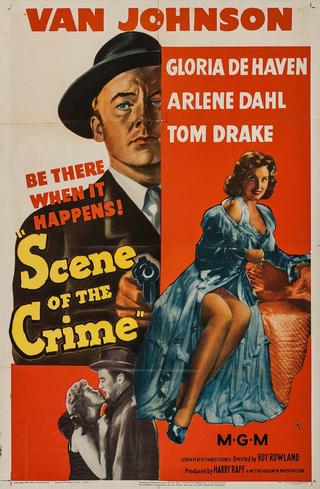
It’s arguable that, at its peak, RKO was the studio that appeared most comfortable producing films noir. If, on the other hand, you were to ask which of the majors was the one whose aesthetic felt least suited to that characteristically bleak style of moviemaking, the chances are MGM would come out on top. Everything changes though, and by the tail  end of the 1940s MGM was moving towards a different style, and as Dore Schary the former head of production at the aforementioned RKO took up the reins he brought a flavor of his previous home with him. Scene of the Crime (1949) is an entertaining piece of work from this transitional period for the studio, a superficially soft-boiled noir that boasts some surprising toughness just below the surface.

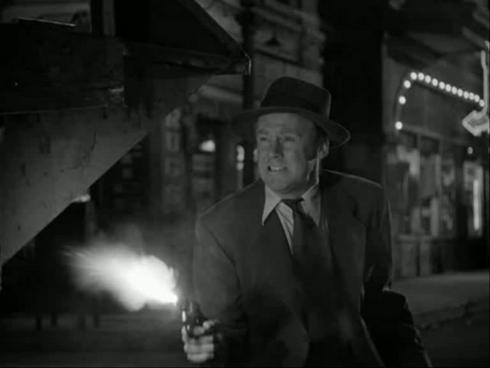
The 1950s would see film noir focus on organized crime with increasing regularity but nothing happens with a flash and puff of smoke. It was a gradual process and the drift away from the compromised individual as protagonist to wider society and its institutions wasn’t so much dramatic as stealthy. An urban street at night (or a backlot representation of one anyway) is a typical noir motif, as is the crash of gunfire, the lurch and fall of a fatally wounded body, the words of a gunman rapped out as abruptly and tersely as the bark of his revolver, and the snarling motor of the getaway car. And all that’s left is the torn remains of a man clinging to the sidewalk. The man in question was a cop, a detective in the wrong place at the wrong time, but with an unexplained and bulky roll of bills in his pocket. Questions naturally arise, not only with respect the identity of the killer but the source of the cash too. The answers to those questions will be ferreted out by Mike Conovan (Van Johnson), a somewhat stereotypical detective with a somewhat unusual  private life; he’s married to a glamorous ex-model (Arlene Dahl) and gets to hobnob with the smart set when he’s not combing the gutter for suspects. He’s one of those cops who’s wedded to the job as much as he is to his wife and she’s not that happy about the whole deal. So there’s this background tension simmering away, the domestic pressures adding a layer of conflict, but it’s a tension of the MacGuffin variety, of much more concern to the characters than it is to the viewer. Still, there is tension to engage us, the painstaking progress of the investigation, the careful fitting together of the disparate pieces as a picture slowly forms before our eyes, one that’s neatly embroidered by the presence of a quirky snitch (Norman Lloyd) and a seductive stripper (Gloria De Haven).
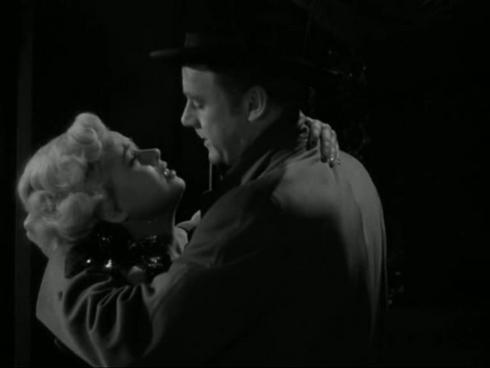
Earlier this year, I wrote about another Roy Rowland directed film noir Rogue Cop (which ended up being not only the most commented piece of the year but of all time on this site) and noted how the visuals had grown brighter and starker than had been the case earlier in the classic cycle. There’s a touch of that in Scene of the Crime but Rowland and cinematographer Paul Vogel still mix in the more traditional look from time to time, a stakeout with a flickering neon sign outside the window springs to mind, and then there’s that toughness I alluded to at the beginning. While the ultimate fate of Norman Lloyd’s memorable stool pigeon isn’t shown explicitly, it is described and it is grim. There’s a hard edged fist fight with one of the prime suspects, the climactic shoot out that ends up brutally and painfully, and of course there’s also a delightfully sour and cynical double cross which adds some spice to one of the more significant plot strands.I don’t know how much of this is derived from the original source material but I do know that screenwriter Charles Schnee was no slouch and was responsible for turning out some extraordinarily good scripts (They Live by Night, The Furies, Born to Be Bad, Westward the Women, The Bad and the Beautiful, Two Weeks in Another Town) in his relatively short life. In the final analysis though, there will be those who will say Scene of the Crime is essentially film noir lite, pointing to the lack of grit in the lead’s home life and the upbeat ending. I’ll not dispute any of that, but I will say that none of it troubles me much as I’m not especially keen on any extra helping of nihilism at the end of this particular year.

I don’t suppose Van Johnson would be anyone’s first pick for a noir lead, but he was nothing if not versatile and I have to say I’ve always found him very watchable in a range of movies from Brigadoon through to The Caine Mutiny. Given the nature of his role in Scene of the Crime, he’s actually a pretty good piece of casting. He’s very comfortable in the society scenes and equally convincing doing his dogged detective routine or slugging it out with hoodlums. I reckon Arlene Dahl got a bit of raw deal with this one though. Her part is barely developed and she’s not given much opportunity to do anything other than look glamorous or vexed, or both. I was watching her in No Questions Asked the other week and I feel she had something more to get her teeth into in that one. In a year that has seen us lose some big names from the golden age of cinema it’s kind of comforting to watch Ms Dahl share screen time with Norman Lloyd and think they’re both still around at 95 and 106 respectively. There’s very good support from an enigmatic Gloria De Haven, as well as solid and dependable work from John McIntire, Leon Ames, Anthony Caruso and Jerome Cowan among others.
Scene of the Crime can be found as part of the Warner Archive and looks quite good. The movie may not have the diamond heart of the more revered films noir but it is an engaging little picture that won’t disappoint either. Check it out if you can.

This will be the last post of  2020 for me, an odd year for sure. It’s been undeniably tragic for some, challenging for all, and yet it should be remembered that adversity ultimately breeds strength and positivity. From a purely selfish perspective, I have to say that one of the bright spots has come from seeing the site grow in popularity as never before. None of that would be possible without the marvelous contributions of all the knowledgeable and enthusiastic visitors it has been my pleasure to play host to. So let me say thank you to all of you, and may you all enjoy a happy, healthy and fulfilling New Year in 2021.

Mogambo

Doing the right thing – a trite phrase in some respects, and yet it also goes straight to the heart of the personal dilemmas which form the basis of and indeed drive so many dramatic works. Ultimately, what does it mean to “do the right thing”, or to “go noble” as one of the characters in Mogambo (1953) puts it? Isn’t this just one aspect of our human condition, that perennial struggle for primacy between head and heart? Of course there’s an argument to be made that neither head nor heart can act entirely independently, and perhaps the way this movie resolves the internal conflicts which confront its characters is a reflection of that.

The notion of the fish out of water is a useful and much used dramatic device and whole movies have been hung on this particular peg. Nevertheless, it can be a tiresome conceit if the filmmaker decides to rely on it alone. John Ford was nothing if not a great artist and therefore had the wisdom to know that while this could act as a hook initially, far more substantial morsels were necessary to build a story around. So it is that Eloise Kelly (Ava Gardner) is introduced, turning up in the East African bush where the sass and sex appeal of Manhattan are of, let’s say, limited effect. It appears she has been stood up in style by a high class date, and the philosophical way she accepts this suggests that she’s no stranger to such setbacks. Stranded in an alien environment, with no way out till the next boat arrives in a week’s time, she decides to make the best of it. Making the best of it includes trying to find something useful to do and hopefully avoiding the censure of her grudging host, game trapper Vic Marswell (Clark Gable). Nature has a habit of taking its course in even the most civilized and sophisticated of settings so it ought to come as no surprise when wilder climes hurry that process along a little. To cut to the chase, Kelly and Marswell embark on a brief affair, but only one of them is looking any further at this stage. When the supply boat arrives it brings a couple of green innocents on a scientific expedition, and signals an abrupt end to Kelly’s dreams. The young couple are the Nordleys, Donald (Donald Sinden) and his wife Linda (Grace Kelly), and it won’t be long before Marswell’s eye is roving once more. However, it would be a dull and disappointing business if that’s all there were to it; either the tides of the river or maybe the more persuasive tides of fate see the old steamboat run aground and an unexpected reunion effected.

The consensus view on remakes seems to be that they are rarely a patch on the originals. Whether or not one subscribes to that approach, it’s generally advisable to assess everything on its own merits. Mogambo is a reworking of the 1932 movie Red Dust, which also featured a young Clark Gable in the lead. Even though it’s been many years since I viewed the original I feel secure in my view that Ford’s retread is by far the better film. Of course the fact that it’s Ford’s hand guiding it makes all the difference. His little quiet touches, his grace notes, are everywhere; from the resigned drop of Gardner’s head as she watches Gable walk off to greet his new clients, to the way Gable himself contemplates his smouldering cigarette as his own chances dwindle correspondingly. There is too the seamless blending of landscape and environment into the narrative, with key moments played out against the backdrop of moonlit lakes and waterfalls. Mogambo was made in the middle of a run of movies for Ford where this professed “director of westerns” avoided the genre with which his name has been so closely linked. From Rio Grande in 1950 until The Searchers in 1956 he didn’t touch westerns, but there remains something of the spirit of that genre on show here. Ford was always drawn to the intimacy of frontier living, the  minutiae of existence of those living on the edge of civilization, particularly in the Cavalry trilogy. Mogambo recreates some of that in the comfortable and companionable remoteness of Marswell’s lodge, while the beauty and hazards of the wilderness become apparent as the safari gets underway. And underpinning it all is the threat to existential connectedness, the essential symbiosis that links everything, which is posed by the arrival of the civilized Nordleys; this is quietly underscored by the frustration felt by Gable when he finds himself forced to kill animals on two separate occasions in order to save the lives of these two interlopers.

In addition to Ford’s motifs and sensibility, a more mature and experienced Gable adds another dimension to the movie. There is that gruff individualism that he so often traded on but it’s tempered somewhat by his playing a man who has lived too long in isolation, detached from emotional connections and therefore able to bond freely only on the most superficial levels. Still, those extra years add depth to his portrayal, the passage of time, or his awareness of it at least, seem to give a greater urgency to his character’s hunger, that knowledge of the need to grasp whatever opportunities come his way before it’s too late. In fact, as the story unfolds it is possible to read the internal conflict he’s experiencing, that head and heart business again, where he’s forever trying to balance some yearning for fulfillment against his personal code of ethics. In so doing, he runs the risk of losing the greater prize.

When all is said and done, the movie really belongs to Ava Gardner. Gable was top billed and, as I’ve said, he does excellent work, but the screen genuinely sparkles whenever Gardner is there. She is the main driver of events and acts as the emotional core. It’s a superb performance by an actress at the very top of her game and the height of her allure – I’ve been delving into that purple patch she struck in the mid 1950s after having recently enjoyed a rewatch of The Sun Also Rises. This was her third time playing opposite Gable, after The Hucksters and the extremely disappointing Lone Star, and it’s far and away the best of their collaborations. Her role played to her strengths, her earthy free-spirited sensuality is always to the fore, but also presented her with more subtle challenges. An example of this is the way she gets across very clearly the illusory nature of her free and easy demeanor. There’s a beautifully telling moment just after she embarks on the steamer where she’s pacing back and forth on the deck in front of a cage containing a captured leopard, the animal inside mirroring her moves. It’s evident that Gardner is trapped too, confined in life by the limited choices available to her. Despite this, she remains the most positive aspect of the movie, representing Gable’s chance for redemption and fulfillment – she is the siren whose song doesn’t lure a man to his doom but instead leads him toward salvation.

Grace Kelly had just come off High Noon but her biggest and most famous roles were still ahead of her. Her character is immature, a girl playing at being a woman, self-centered and plagued by indecision. Kelly nails the breathlessness and deception but is limited somewhat by the one dimensional nature of the role. Donald Sinden has the rather thankless part of the cuckold but does elicit sympathy due to his forthrightness and inherent dignity. Further support is provided by Philip Stainton as Gable’s plummy-voiced friend, Eric Pohlmann as a lazy and vulgar drunk, and a quiet Denis O’Dea, whose wordless confessional scene with Gardner provides another of those delightfully Fordian grace notes.

To the best of my knowledge, Mogambo has still not had a Blu-ray release. The old DVD has been around for many years now and is pretty solid, though this is the kind of movie which could look spectacular with a bit of a cleanup and a HD upgrade. It may not rank among John Ford’s more celebrated films but it’s long been a favorite of mine and one I am always keen to recommend.

A Bullet Is Waiting

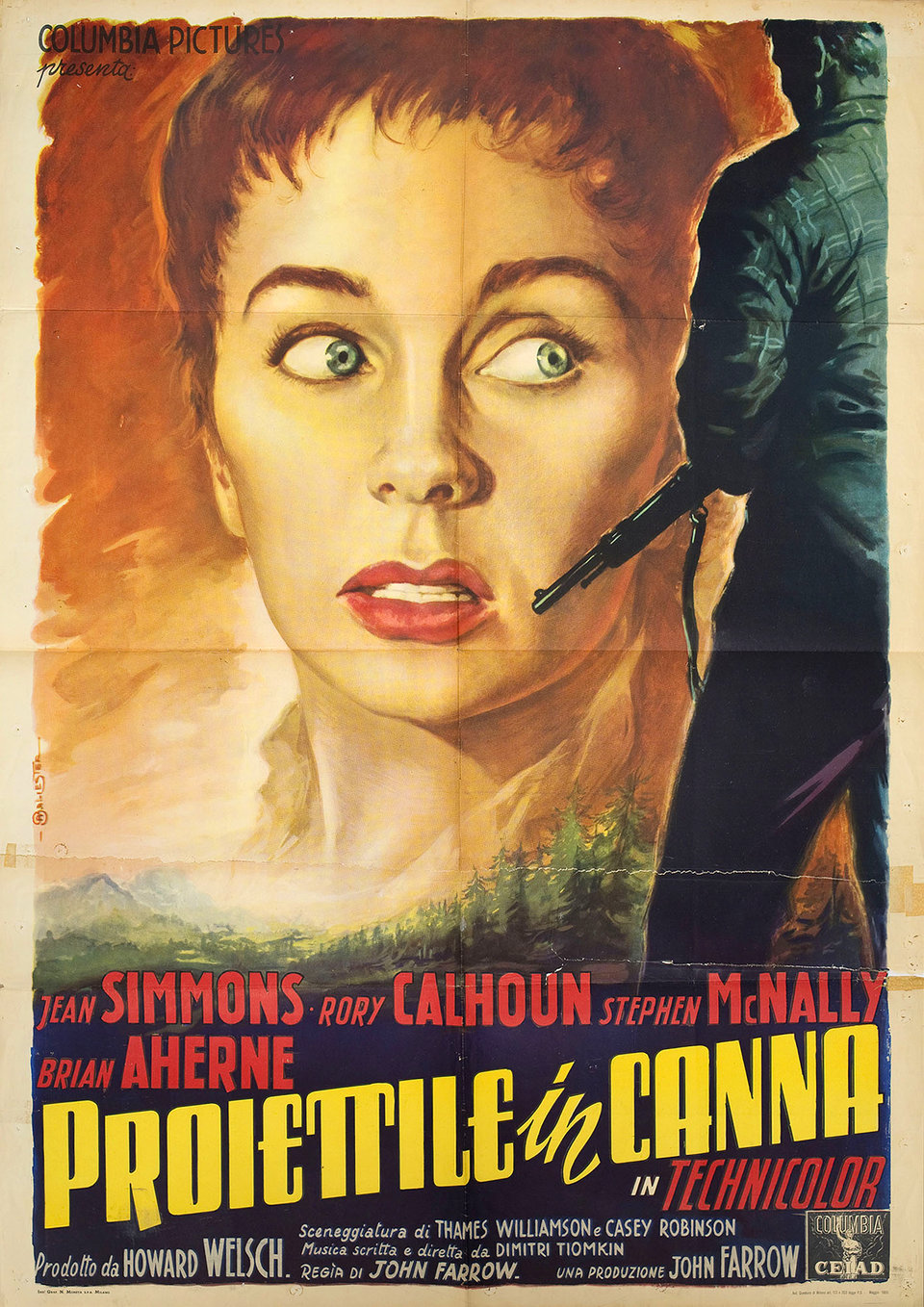
I’ve spoken of the importance of titles before, and I do like to see a punchy and enticing one used. A Bullet Is Waiting (1954) has a lot going for it: it promises suspense, danger and action, it raises questions in one’s mind and attracts the attention. Is it perhaps more than a little misleading though? In a sense it’s not, as it does allude to a very real fear motivating one of the leads. On the other hand, I know that when I first heard of it I had mental images of a western or a noir-shaded thriller. Yet that’s not really what ends up presented on the screen as it’s essentially a rustic melodrama with action/thriller elements backing up a tale of romance and renewal.

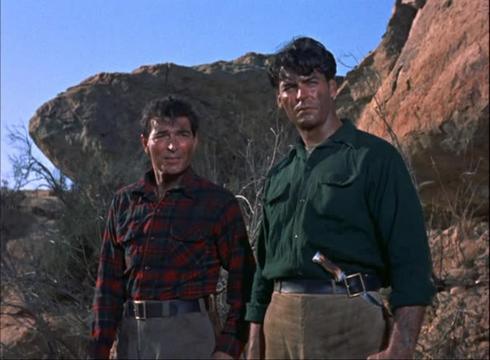
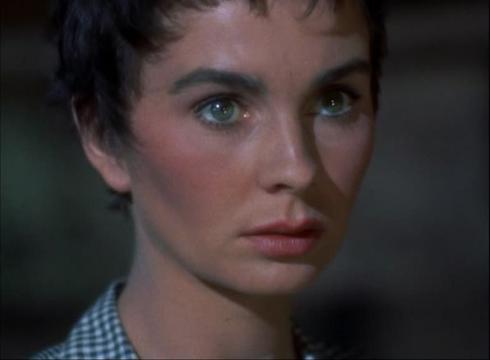
Openings that fling the viewer unapologetically into the very heart of the story can be hugely effective, and that’s what occurs with A Bullet Is Waiting. The first image is of boiling, surging waters, waves driven relentlessly by their own turmoil onto hard and unyielding rocks; this, backed by a characteristically muscular and dominant Dimitri Tiomkin score, signals an affair of heightened passions. As the camera moves around the detached wheel of a plane is visible at the edge of the swirling tide, and the tracking shot back inland reveals more wreckage and debris littering the shore, seguing gradually into footprints gouged frantically in the sand. And then, at the crest of a hillock, two figures loom into view struggling against and pummeling each other in desperation. They are Ed Stone (Rory Calhoun) and Frank Munson (Stephen McNally), fugitive and pursuer respectively, quite literally locked in combat since they are shackled together at this point. Stone gains the upper hand, releases himself and sets off alone. It’s a temporary separation though and these two antagonists are soon to be reunited when they stumble  onto private property. Cally Canham (Jean Simmons) is a young woman who has been living an isolated existence with only her reclusive father (Brian Aherne), and her loyal sheepdog, for company. With her father away for a few days, neither Cally nor the two survivors of the plane wreck particularly want to be holed up together in her cabin. However, a prolonged and dramatic storm leads to flooding that cuts off all possible escape routes, and forces these disparate characters to contemplate those timeless adversaries: retribution or redemption. By the time Cally’s father returns a number of truths will have been laid bare and paths chosen.

Now this is by no means a perfect movie, there are weaknesses which I’ll address later, but it has quite a lot going for it. Director John Farrow starts out with that wonderfully cinematic opening sequence I’ve spoken about and manages to steer a fairly even course throughout, avoiding the trap of letting it get too talky, even when the plot drifts toward some philosophical musing. That philosophy – espoused on screen by Aherne and represented by his withdrawal from a modern world he sees as increasingly dominated by confusion and conflict – is actually dealt with more subtly within the framework of the plot.  Personally, I see it as a variation on the classic redemption theme by focusing on the restorative powers of nature. From the primal power of the storm to Franz Planer’s beautiful photography of the pastoral scenes, and on to the soothing effect of the sheepdog and the lamb on the frayed emotions of the characters, the influence of nature and its ability to effect renewal is never far below the surface.

As I noted though, there are weaknesses here, which ought to be mentioned. Firstly, I see the redemptive strand having  a dual focus, on the characters of both Calhoun and McNally, the need for its application to the latter emerging only gradually. By the end this is seen to have been achieved, but in one case it was never in serious doubt anyway whereas in the other something is lost, in my view at least, by the abruptness with which it occurs. Any picture that embraces the concept of redemption and/or renewal is always welcome with me but I have to say I prefer it when the road which leads there feels a little longer, or when the battle is harder fought; in A Bullet Is Waiting it, and indeed the ending itself, arrives with something approaching alacrity. I’ve talked a lot about both Calhoun and McNally on this site in the past so I’ll simply say that both men turn in typically strong work, with the former’s innate likeability and the latter’s knack for tapping into ambiguity to the fore. Brian Aherne’s presence is felt from early on through his influence on his daughter’s thinking and character but he only makes an appearance in the final third. He brings a lovely sense of quiet authority and civility to his role. I liked him in Hitchcock’s I Confess and I must try to feature some more of his work in due course.

However, the real star of A Bullet Is Waiting is Jean Simmons. She had a good deal of range, her deranged beauty in Angel Face remains a remarkable piece of screen acting and contrasts with the delicate innocence she displays here. Her slow awakening and realization of the possibilities existing outside her cloistered existence is well done; the image of her sitting in her modest bedroom, leafing through her book on ballet, the little toy ballerina turning pirouettes within its own  protective yet restrictive space, as she tries to find some common ground with Calhoun’s roughneck is just impossibly charming.

A Bullet Is Waiting was put out as a manufactured on demand DVD in the US by Sony and it’s also available in a number of European editions. Generally, the image is pleasing with Planer’s Technicolor cinematography looking particularly fine. I see that the movie is categorized as a film noir by both IMDb and Wikipedia but, even as one who tends toward an inclusive interpretation, I don’t feel that it should be applied in this case. All told, despite a somewhat rushed ending, I found this to be an enjoyable and rewarding watch. It’s one I’ll be returning to.

The Sun Also Rises

Adaptation, moving from one medium to another, has been a feature of moviemaking since the earliest days, and it’s always been fraught with difficulties. Shifting a theatrical production from the stage to the screen ought to be a reasonably smooth procedure, after all drama is drama, right? Well, not always. What captivates in the theater can all too easily appear static and restrictive on the screen. Yet this is as nothing compared to the potential pitfalls of the literary adaptation, and the more famous or well-regarded the source material, the greater the chance of a negative reaction. This is understandable – authors decry the debasement of their work, the simplifications imposed, and readers express dismay at the excision of cherished passages or, worse yet, casting decisions that make a nonsense of the images they’ve been carrying around in their minds. In short, a screenwriter with a  book to adapt can be forgiven for seeing himself (or herself) on a hiding to nothing. The Sun Also Rises (1957) is based on what might well be Hemingway’s best book and it doesn’t seem to have made too many people happy. The author reportedly derided it and the screenwriter Peter Viertel disliked it. I’m not really sure what the critical consensus is but I know I always enjoyed the movie. If the book was about dreams and desires that were doomed to failure, flirtations and affairs that could only ever be imitations of what the protagonists wanted or needed, a paean to the beauty and tragedy of what can never be, then I reckon the movie, because of rather than in spite of all its flaws, might just be as good an adaptation as anyone could ever hope to make.

The Lost Generation: Hemingway and Fitzgerald, Paris, art, passion and a massive collective hangover after years of pointless slaughter seguing into a decade of apparent aimlessness, where creativity was the only antidote available to a creeping despair. Jake Barnes (Tyrone Power) is a product of all this, surrounded by artists and assorted dilettantes, wunderkinds and wasters. He is in some ways the most directionless of them all, a newspaperman who never returned home after the war and probably never will. The scars of conflict run deep in his case, rendering him impotent and thus consumed by apathy and resignation. He’s an observer of the hedonism and excess, central to it all by acquaintance yet peripheral by necessity. It’s through his eyes that the viewer sees the story unfold: first in the Parisian nightspots where he reacquaints himself with the aristocratic Lady Brett Ashley (Ava Gardner) – in his words, a drunk and a drifter – and just about tolerates the painfully self-aware Robert Cohn (Mel Ferrer); and then later in Pamplona for the fiesta, where Brett’s fiancé the dissipated Mike Campbell (Errol Flynn) meets up with them all. The whole thing amounts to a journey of discovery, where a group of desperate people are gradually force to confront the reality that, through ill-fortune or maybe just the vagaries of fate, none of them can ever hope to capture the love or personal fulfillment they yearn for. Yes, the sun will rise on another day but it’s a chill dawn that signals a world moving further away from their grasp.

The entire second act is played out during the height of the fiesta, with Mexican locations doubling for Pamplona. As the relationships become ever more tangled and the jealousies, flirtations and frustrations grow in intensity to match the progress of the fiesta the one constant in the background holding the group together is the Corrida. Hemingway was fascinated by bullfighting, writing Death in the Afternoon to address his passion for it. My own take on that aspect is that it was fueled, as were so many of his themes and concerns, by the reaction to those wartime years that left the characters of The Sun Also Rises adrift in the world. Much is made of the nobility and honesty of man confronting the overwhelming power of nature head on, of its spectacle and theatricality. It feels like an attempt to juxtapose this grand theater of death with the mindless mass slaughter he had experienced. It is as though his attitude to living and, maybe even more important in his case, dying is shaped by it; there appears to be a need to find some order and formality to it all and thus achieve some spiritual accommodation with himself and perhaps with the world in general.

As I said above, Hemingway expressed dissatisfaction with the adaptation, much to producer Darryl F Zanuck’s disgust, although it’s been suggested he may not even have seen it. Screenwriter Peter Viertel wasn’t happy with how it all turned out either, complaining about the decision to shoot in Mexico rather than Spain. Frankly, I don’t think that makes a lot of difference to the finished movie and it certainly isn’t something this viewer would count as a weakness. He also seems to have had some issues with the casting, but he’s not alone in that and it’s something I’ll come to later. Are there changes to what Hemingway had put down on paper thirty years before? Yes of course, but again my own feeling is that these aren’t of a magnitude to trouble me, and I think it’s necessary to come to terms with the fact that a shift to a different medium is always going to result in changes for a range of practical reasons. What’s important is to respect and appreciate a work on its own terms, not in relation to where it came from, not what we the audience feel it should be, not even what the original creator wanted. Ultimately, one can only evaluate the worth of a piece of art on the basis of what it is.

Henry King’s direction is as assured as ever, transitioning smoothly from  scene to scene and on into each distinct act. The CinemaScope image is well used by him in the scenes illustrating the crowded and bustling nature of the fiesta but what’s critical is his ability to maintain the required sense of intimacy when the main players interact – the bar and bistro scenes, the pivotal bedroom scenes where everyone retreats for rest but where personal revelations are made and souls are frequently bared, and of course the two key moments with Brett and Jake sharing the back seats of cars. Those are the moments where King’s lens brings the focus onto the principals, where they and their jumble of emotions dominate that big screen to the exclusion of all else.

As for the casting, I’ve seen comments before to the effect that the movie was miscast with a central group who were too old for the parts they were playing. This is undeniable and some of them look very shopworn indeed, although again I’ve never considered it a drawback. It’s been many years now since I read Hemingway’s novel but I do recall thinking that here were a collection of people whose youth had been stripped away by the horrors of combat, who had been forcibly aged beyond their years. Tyrone Power and Errol Flynn do look tired but their characters have been badly bruised by life so that’s not an issue as far as I’m concerned.

Power gets across the introversion, bitterness and only half concealed impatience of Jake, his surface affability appearing thin and brittle at times. Ava Gardner is fine too as the unfulfilled beauty, a woman who ought to have it all but who has fallen foul of a piece of rotten ill-fortune by loving the one man who cannot satisfy her needs. The substitutes she flits restlessly around are a disappointing selection: Mel Ferrer’s emotional immaturity and self-absorption is easy to despise and Errol Flynn’s decayed swashbuckler can only ever be a temporary  distraction. And it’s a superb performance by Flynn, a brutally honest portrayal of self-destruction. The sparkle is still there and the charm too but there’s a desperate sense of regret that can’t fail to touch one and I doubt the screen has ever seen a finer display of ragged dignity. Eddie Albert provides a happy-go-lucky prop for Flynn, and Juliette Greco, who just recently left us, is impressively insouciant in a small part. It seems that few people were keen on Robert Evans as the bullfighter who captivates Gardner, prompting Zanuck’s famous “the kid stays in the picture” remark. To be honest, I don’t think he adds a lot – he does have a certain gauche quality that is partially endearing but I’m not sure there’s the kind of magnetism about him that would give rise to an obsession in a character like Brett.

The Sun Also Rises has always looked strong on DVD; I had the old UK disc for many years and thought it looked fine but I was tempted to pick up the the Blu-ray over the summer when I noticed it going cheap.  Unsurprisingly, it looks even better in high definition and there are some nice supplements to add value, including a commentary track, an audio interview with Henry King,  a featurette on the making of the movie with contributions from Peter Viertel among others, and one on Hemingway adaptions in general.  All in all then, I feel that despite the reservations some have expressed regarding casting choices, locations, and changes from the original text, that the movie holds up well. If there are imperfections, and I’m not sure some of those are as damaging as they’re alleged to be, then that’s perhaps appropriate for a film about characters who are themselves less than perfect.

Distant Drums

How does one get the measure of a filmmaker? I guess received wisdom has it that a viewing of their best works is the ideal way to go about it; this assertion appears to be self-evident and it’s not one I’m not going to dispute. However, I can’t help wondering if there’s not something be gained from an examination of what might be thought of as their mediocre efforts as well. It just occurred to me as I was watching Distant Drums (1951) that Raoul Walsh’s strengths as a director were still on display despite the fact the movie in question was very much a routine affair. In fact, a great deal of what makes this film worthwhile derives from the skill of the man ultimately calling the shots.

Distant Drums is one of only a handful of movies that use the conflict with the Seminole in Florida as a backdrop. I use the word backdrop because that is very much the case here, with no examination whatsoever of that conflict taking place. In narrative terms it merely serves as a frame on which to hang a straightforward story of pursuit and danger. In brief, the Seminole are being armed by gunrunners operating out of an old Spanish fort and this supply needs to be cut off if the army is to be successful in subduing them. To this end, a young naval officer (Richard Webb) is sent to the island retreat of the reclusive Captain Wyatt (Gary Cooper) to accompany him and his small force and assist them during the essential lake crossing en route to their target. While the initial assault on the fort is a success the return to the prearranged rendezvous proves problematic. Wyatt and his party,  now supplemented by a rescued hostage (Mari Aldon) and her maid, are forced to abandon their original plan and instead plunge into the steamy, crocodile infested Everglades.

If one takes the movie as an uncomplicated adventure,  Distant Drums works just fine. There is no shortage of incident, the action scenes are frequent and absorbing, and there is enough suspense generated at key moments to quicken the pulse. The assault on the fort is a grand bit of work, shot and cut together with a fine eye for the geography of the building and never drifting into the type of muddle a complex set piece such as this always flirts dangerously with. And this leads me to Raoul Walsh. He was one of the great directors, in my opinion, a man of boundless skill and possessed of the kind of practical artistry that allowed him to tackle even the most unpromising and prosaic projects with the same dedicated flair as one would expect were he making a prestige picture. It’s sometimes said that Walsh was the consummate action director, but it’s maybe more accurate to think of him as a master of drive and motion. His movies always appear to move effortlessly forward, smoothly shifting gears and bringing the audience along for the ride even when the journey itself hasn’t all that much to offer. This is what I was alluding to at the beginning, how the capabilities of a director like Walsh remain apparent despite the limitations of the material he was handling.

I can’t fault Walsh’s direction, and neither the gorgeous location cinematography of Sidney Hickox nor the score by Max Steiner disappoint. So where is the film lacking? Surprisingly, I think the responsibility has to be laid at the door of of the writers. I say it’s surprising because the name of Niven Busch on the credits generally has me expecting a bit more depth; perhaps some  probing into character, some heightened emotion, or even a hint of twisted psychology. Yet none of that is present, and in the end we know little more about any of the characters than we did at the outset. I certainly haven’t seen all of the movies Busch provided a screenplay for but of those I have (mainly his later pictures) I think it’s fair to say that Distant Drums is easily the least interesting. For what it’s worth, I have another of this writer’s scripted movies in mind for a future write up – and no, it’s not Duel in the Sun before anyone asks.

The thing about great movie stars is how even unremarkable films gain by their presence. There are those who dislike or are unconvinced by Gary Cooper’s style, and that’s of course fine, but I’d have thought his place among cinema’s pantheon is undisputed. Sure he’s laconic and his work is understated but he commands the screen whenever he’s present and dares anyone to look away. Still, I feel the script let him down somewhat. Next to nothing is made of the potential suggested by his character’s late wife or their mixed race son. The danger the latter is exposed to at the end and the effect on Cooper is worth noting but it never feels like it’s center stage. Mari Aldon makes for an attractive co-star and the romance which develops is gentle and light. This may well have been her most substantial role, certainly of what I’ve seen. However, I’ll remember her more for her small part as the world weary companion of Warren Steven’s abusive and uptight producer in the superior The Barefoot Contessa. Richard Webb has probably the most thankless role of all, the point of view figure who introduces the whole thing and then ends up relegated to merely tagging along. Had there been some more serious rivalry with Cooper’s character injected then it might have added another layer of interest. The support is provided by Arthur Hunnicutt playing one of his patented frontier types and the seemingly ubiquitous Ray Teal as a discontented soldier.

Distant Drums is one of those productions that depends heavily on its visuals as a result of the lush cinematography in Florida. This is one of the movie’s principal attractions and needs to be shown off to its best advantage. The Blu-ray and DVD released by Olive Films some years ago does highlight this aspect most satisfactorily, even if it offers no supplementary material. I may sound as though I dislike the movie, but that’s not true. It remains serviceable, attractive and entertaining. That said, it feels like an opportunity was missed, that the talent involved wasn’t exploited as it might have been. Nevertheless, it helps cement, in my mind anyway, an appreciation of the apparently effortless skills of Raoul Walsh.

Ruby Gentry

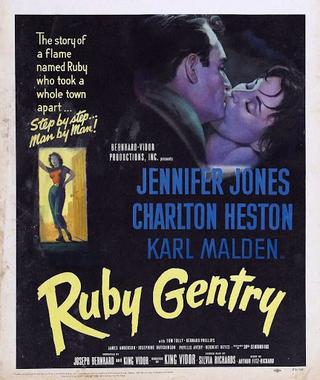
Incompatibility, or the absence of harmony, is what Ruby Gentry (1952) is all about. It’s a tale of love and ambition, and the friction generated by attempting to marry those two emotional opponents. Underpinning all that is the downbeat assertion that it is futile for one to try to escape the bonds of the past, that the future has already been mapped by circumstance or one’s  forebears, or perhaps some unseen guiding hand. This fatalistic view, one approaching the idea of predestination, tilts the movie in the direction of film noir; I think it is deserving of the noir label although I do acknowledge that there are those who will claim it is debatable whether it really belongs in that nebulous category.

Dr Saul Manfred (Barney Phillips) is the man from whose  point of view the story is seen. He’s our narrator, a kind of everyman guide taking us through the varied and tangled relationships at the heart of the affair rather than one of those pompously stentorian “voices of authority” that sometimes lecture the audience at the beginning of a film noir. His is a much more thoughtful and sensitive description of events and people, a reflection of the character himself and also of the personal stake he had in its development, at least at the start. He tells of Ruby (Jennifer Jones), and it’s one of those classic parables detailing the rise and fall not only of the title  character but of all those who were part of her life, and indeed one might even say of the rise and fall of the stuffy and socially suffocating community they all inhabit. Ruby is introduced as a swampland tomboy, an impoverished temptress in tight sweaters and torn jeans, as skillful with a rifle as she is careless with the hearts she captures. Simultaneously skittish and coquettish, she has spent time fostered in the well-to-do household of local big shot Jim Gentry (Karl Malden) and it’s whispered among the more mean-spirited in town that she has acquired ideas above her station. This is clear from her romance with Boake Tackman (Charlton Heston), a returning jock from a patrician background and a head full of big plans. The rigid social order is disapproving and Tackman hasn’t the moral courage to rise above this, so Ruby is drawn back into the world of the recently widowed Jim Gentry. Thus a complex web of ambition and desire is spun around a set of people who all think they know what they want but have no clear idea of how to get it, or to hold onto what they do manage to grab.

King Vidor’s  direction (working from a script by Silvia Richards) is beautifully controlled, pacy and rarely extravagant yet lush in its depiction of the steamy swamp where the climactic scene is played out and also in the richly detailed interiors, especially the house occupied by Ruby and her family. He uses space well to convey mood, the joyous and liberating race along the beach and through the surf in Tackman’s car perfectly captures the early exuberance of Ruby and her love, and then the cramped room which she shares with Jim and the doctor for the failed party after her marriage encapsulates the narrow and restrictive world she finds herself in. In the creation and presentation of these varied moods Russell Harlan’s cinematography is all one could ask for and no less than one would expect from such an artist in the manipulation of light. Ultimately, the movie works as a condemnation of unfettered ambition, where each of the main characters systematically destroys everything they care for in the pursuit of the unattainable. It is this, alongside the sour judgemental snobbery of a blinkered society, which stymies the only pure feelings on show – love is either thwarted or left unfulfilled and atrophied.

Jennifer Jones as the title character does succeed in drawing in the viewer, her allure is clear from her first appearance and the reunion with Heston on the porch in the dark and by torchlight gives a foretaste of the tumultuous nature of their relationship. Her efforts to fuse her love and her hunger to climb the social ladder is apparent from early on and the slow realization that she can only achieve the latter at the expense of the former is painful to see but convincingly portrayed by Jones. In the final analysis, hers is not an attractive character, the vindictiveness (though understandable) adds coldness and her attempts time and again to net Heston detract from her somewhat.

That latter aspect is amplified when it comes to the marriage to Malden’s besotted millionaire. His motives are the most straightforward and honest of the lead trio and he consequently earns a good deal of sympathy. There is a terrifically affecting moment when he catches his wife out in a foolish betrayal and you can see not only his world crumbling before his eyes but his assessment of himself as a man undergoing a reevaluation as he gazes in frank despondence into the mirror behind the bar of the country club. Heston simply oozes machismo, that powerful screen presence clear from even this relatively early stage in his career. For all the swaggering bravado though his Boake Tackman is a moral coward, a “back-door man” hiding behind his family’s position and reputation. Also deserving of mention is some fine work from Tom Tully, Barney Phillips and, in a disturbingly fanatical turn as the scripture-quoting brother, James Anderson.

Ruby Gentry has had a Blu-ray release in the US from Kino and there are a range of DVDs out there as well. I still have my old UK disc put out by Fremantle many years ago and it presents the movie most satisfactorily, although there are no supplements whatsoever offered. The movie has a strong emotional hook and Vidor’s assured direction, as well as Harlan’s cinematography and Heinz Roemheld’s score, combines effectively with some excellent performances. This may not be a picture you come away from with a particularly positive glow but it does have some depth and the final image, and message, may not be quite as downbeat as it first appears.

Sleep, My Love

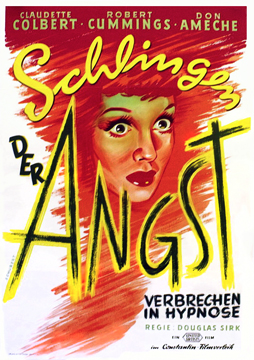
There are a couple of options open should you come across anyone who tries to sell you the idea that the impact movies have on culture is negligible. You could think to yourself that this person is mistaken or misguided, and leave it at that. Alternatively, you can attempt to set them straight. Now language and culture are inseparable, their relationship being essentially symbiotic. So, when the movies give us words that become part of everyday language, that ought to bolster the idea of cinema’s cultural significance. Every classic movie fan, and film noir aficionados in particular, will be aware of Gaslight. The story, derived originally from a play, was filmed twice  and the concept underpinning it has become a staple of countless psychological thrillers. In a broader cultural sense, the term gaslighting has entered the language and refers to manipulating others to the point where they start to question to their own judgement, perception and ultimately their sanity. All of which brings me to Sleep, My Love (1948), an undeniably stylish entry in this sub-genre.

Alison Courtland (Claudette Colbert) is a wealthy woman from an elegant, patrician background. She’s not the type of person one would normally think of as likely to awaken in the dead of night aboard a train speeding towards an unknown destination. Nevertheless, that’s the first view we get of her, panicked, frantic and screaming blue murder in confusion. Her husband (Don Ameche), concerned to find her missing and nursing an apparent gunshot wound to his arm, has called in the police. It seems that this isn’t the first time the lady in question has disappeared but no harm has been done and she’s soon on a flight back home to New York. On the way she makes the acquaintance of another well-to-do type, Bruce Elcott (Robert Cummings) who is just home from China. I don’t believe I’m revealing too much here if I get right to the point and say that Alison is being maneuvered into an increasingly vulnerable position by her smooth but calculating husband. This becomes clear quite early on, and I feel  it constitutes maybe the biggest weakness of the picture. To my mind, the writing gives away too much too soon. It’s not merely a question of the viewer being deprived of surprises, but rather the fact that this “lay it all before you” approach robs the movie of much of its suspense and accompanying tension. While these are not the only elements in movies of this type, they are important and effectively negating them at an early stage means that viewers are left with little more than a sense of curiosity over how the hero will eventually triumph.

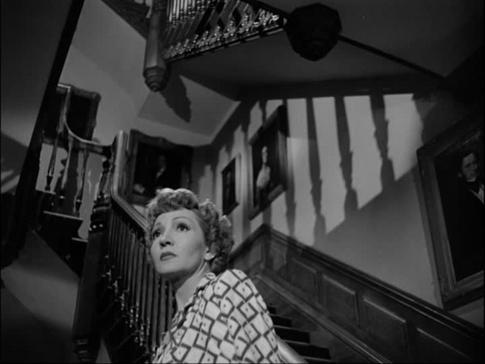
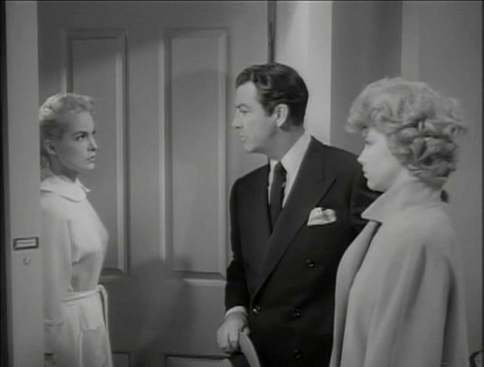
That’s not to say there is no tension or suspense in the movie; individual sequences such as the drug-induced suicide attempt are very well executed. This is where the skill of the director comes into play. Douglas Sirk, along with cinematographer Joseph Valentine, draws full value from the interior of the Courtland home, the staircase featuring prominently. As seen above, it’s essentially pinning Claudette Colbert in place with the shadows cast by the balustrade creating bars to imprison her in her own home, the weight of her own noble heritage bearing down on her and precluding, as though it were an affront to good taste, any consideration that her husband might be plotting against her. This noir imagery is sprinkled throughout the movie, Venetian blinds often replacing the vertical lines with horizontal ones but the impression of individuals trapped by circumstance remains.

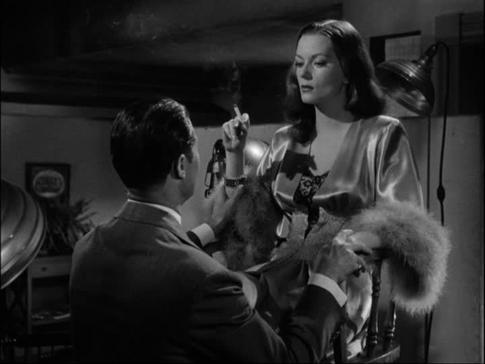
The visuals, as one might expect, are among the greatest strengths of the picture. Sirk’s films are always good to look at, and of course mise en scene  is a term often used whenever his name comes up; he goes in for a lot of sharply tilted angles here, from those vulnerable shots from below to the more remote ones gazing down with a cynical detachment. These altered perspectives are very much to the fore in the studio of Vernay (George Coulouris). Overlooking the sidewalk and street,  here the crooked photographer makes his plans for his partnership with Courtland and his model Daphne (Hazel Brooks) perches higher still on her pedestal and mulls an entirely different partnership. This is all nicely set up to highlight her disdainful superiority, and she quite literally spends the whole movie looking down on everyone.

Claudette Colbert got top billing and she was still a major star at the time. It’s her show really, and she is fine as the increasingly rattled woman who can’t seem to convince anyone she’s not hallucinating. There’s a little sequence around the halfway point where she attends a wedding of a Chinese couple in the company of Cummings and she comes across well here – unaffected and openly appreciative of the opportunity to mingle among a different crowd to her usual acquaintances. It’s beautifully played as she rambles on about how different we all are and her simple take on what makes some people happy and others unhappy, a common feature of Sirk’s films. She gets across the sweetness of her character naturally and even her slight tipsiness by the end of the evening is quite credible – I’ve lost count of the number of actors who overcook it when asked to portray drunkenness on screen.

Robert Cummings is an actor who divides opinion and I’ve heard more than a few people say they find him a poor lead in general. However, I’ve never had any issues with him – I liked him in his movies for Hitchcock (Saboteur & Dial M for Murder) and I think Anthony Mann coaxed a solid performance from him in The Black Book. Frankly, I think his charm is a neat contrast to the polished insincerity and moral weakness of Ameche. Hazel Brooks is a striking presence – physically stunning, sexy and insolent, she is visibly contemptuous or everybody and everything around her. Yet her performance has an odd feel to it, her delivery of her lines sounding stiff and forced to me. Coulouris is an engaging villain, a strange combination of suave and clumsy, menacing and simultaneously the butt of Brooks’ barbs. In minor roles Keye Luke is entertaining as Cummings’ pal and Raymond Burr is welcome but underused as a skeptical detective.

Olive Films in the US released a very attractive edition of Sleep, My Love some years ago on both Blu-ray and DVD. The movie looks clean and sharp and Sirk’s visual style is highlighted most effectively. The script, on the other hand, is just OK. The gaslighting theme will be a familiar one to many viewers and I would have preferred it if a little more ambiguity had been injected, or at least a little more information had been held back, in order to build some added suspense. As it stands,  the audience is forever a step or two ahead of the characters, which I’m not convinced is the best approach to take. On the whole, however, I have a positive feeling about the movie. It’s not perhaps full-on Sirk but there is  plenty of greed and thwarted desire, with characters living out lives that barely hint at the reality simmering below the surface. This alongside the visuals and a handful of attractive performances are enough to overcome other deficiencies in the script for this viewer.

Deported

Time for another guest post, once again courtesy of Gordon Gates. It’s a classic era film noir, so it slots right into his comfort zone. Seeing as it’s a Universal-International property, albeit yet another of the elusive ones, it probably belongs in the comfort zone of a few regular visitors here too.

There are many directors who are held in high esteem by fans of film noir, and of cinema in general. These include: Billy Wilder, Fritz Lang, Phil Karlson, John Huston, Jules Dassin, Jacques Tourneur, Anthony Mann and of course, Robert Siodmak. Siodmak hit the ground running in 1944 with a string of nine successful films noir starting with Phantom Lady. This was followed by Christmas Holiday, The Suspect, The Strange Affair of Uncle Harry, The Spiral Staircase, The Killers, The Dark Mirror, Cry of the City, Criss Cross and The File on Thelma Jordan. The 11th noir wasn’t so successful, this was 1950’s Deported, shot on location in Italy.

A ship docks in Naples and starts off-loading cargo and one man, Victor Mario Sparducci. Sparducci is played by Jeff Chandler, who is a mobster going by the name, Vic Smith. Chandler has just finished a 5 year prison bit for a $100,000 robbery. The cash was never recovered by the Police. Chandler, after he finished his term, was escorted to the docks and deported back to the old country. This is before he can grab the $100,000.

Chandler is barely off the docks in Naples when he runs into the pretty, Marina Berti. Berti invites Chandler to her rooms for a drink and a cuddle, which our man Jeff is all too happy to accept. This of course does not go as Chandler had expected. Waiting for him at Berti’s place is fellow mobster, Richard Rober. Rober has followed Chandler from the States. He is not amused that he never got his cut of the $100,000 holdup the two had arranged.

Some less than friendly words and fists are exchanged over the financial situation, with Rober being laid out. Chandler informs Rober that he intends to keep the whole take. “I did five years for that money, so as far as I’m concerned, it is mine.” Chandler then tells Rober to stay away, or he will kill him.

Chandler then heads for the small village his family had left when he was a child. He hides out with his uncle, Silvio Mincioti, while he plans a way to get his cash over to him from the States. Chandler soon hooks up with the village’s black market boss, Carlo Rizzo. He figures he will need Rizzo’s help once he comes up with a plan to retrieve his cash.

While all this is going on, Chandler finds time to romance local beauty, Marta Toren. Toren is a wealthy widow who spends her time doing charity work for the local poor. Toren soon falls for the rather rough around the edges Chandler.

This all happens in the first 20 minutes. The film then loses steam and becomes a travelogue for the next 30 plus minutes. This seemed to be a regular problem with American films being made overseas at the time. There really is no on screen sparks between Chandler and Toren. Their scenes together are more or less dead time. The film however, does catch fire again in the last 10 minutes.

Chandler has found the perfect way to get his cash from the States. He cables the person in the States holding his money, to buy 100 grand worth of food and medical supplies. These he has shipped to Italy to be given to the village. The trick here is that Chandler intends to hi-jack the items, then, sell them on the black market for 5 times the cost.

The viewer of course know there is going to be a falling out with Chandler and the black market types. There is also the added complication that Rober is back in play. The mandatory guns are produced and some well done violence ensues.

Also in the film is Claude Dauphin and if you look close and you will spot bit players Tito Vuolo and Vito Scotti.
The director of photography is Oscar winner, William H. Daniels. His noir work includes, Brute Force, Lured, The Naked City, Illegal Entry, Abandoned, Winchester ’73, Woman in Hiding and Forbidden. He also did the last reviewed film here by Colin, Foxfire.
The screenplay was by one time Oscar nominated Robert Buckner. Buckner also produced the film.
Considering all the talent involved is this film, it does not hit the mark. There are parts here that are quite well handled, but the quick start and the finish are not quite enough to save the film from at best, just being average. It suffers from a tad too much dead time. For a Siodmak film, I found it rather disappointing.
(INFO) All three of the leads died before their time with Toren going at 31, Rober at 42 and Chandler at 43.
The only means of viewing the movie at the moment appears to be online.
EDIT August 2021: Kino have announced a Blu-ray release for this movie in November 2021.
Gordon Gates

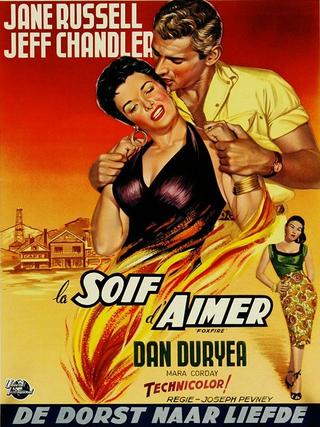
Foxfire

On the outside looking in doesn’t do anybody any good.

That one casual line in Foxfire (1955), spoken by one of the most hard done by and neglected characters in the movie as it happens, goes a long way towards catching the spirit and flavor of the entire picture. In a sense, all of the characters are outsiders in their individual worlds, some by chance and others by choice or design. This is a strong theme, one many of us will be able to identify with at some point in our lives and thus a solid bedrock on which to construct this story which I’d say is three parts melodrama and one part modern western. That part picks up on and weaves into the blend perhaps one of the more interesting, challenging and progressive thematic threads to be found in the fabric of the 1950s western, the clash of cultures which was inevitable in a new land and the dramatic tension growing out of that.

A desert highway, one of those arrow straight and seemingly endless thoroughfares that we viewers have traveled many times. Our companion on this occasion is a lone woman, Amanda Lawrence (Jane Russell), speeding along until she gets a flat tire. With no help available, she sets off on foot, burdened with what look like the assorted fripperies of a shopping expedition. There can’t be any doubt that this chic and carefully coiffed lady is very much an outsider in the primal landscape, a refugee from 5th Avenue cast adrift in the dust and heat of the southwest. Then out of that shimmering haze comes a jeep carrying two men – miner Jonathan Dartland (Jeff Chandler) and doctor Hugh Slater (Dan Duryea) – and we’re off. Amanda is clearly taken with Dartland and he’s at least interested in her.  What follows is a love story but it’s not a smooth one, and I think it’s questionable in the end what all of the protagonists are in love with. In fact, despite the relatively neat conclusion, those questions are only partly answered and I feel there’s a suggestion that they will rear their heads again.

As far as I can see, the characters are being pulled in different directions partly by their disparate backgrounds and partly by their status as outsiders. Beginning with Dartland, or Dart as everyone refers to him. We learn very early on that he is half Apache, with a mother who has returned to the reservation and wholly integrated herself back into tribal life after the death of her husband. He is forced to endure some bigoted and prejudiced attitudes – including one thoughtless gaffe on the part of Amanda before she learns about his heritage – but tends to brush them aside. He insists it means nothing to him but a couple of understated moments call this into question – the brief flash of hurt in his eyes when Amanda makes that crack about Indians, and then later the diffidence and self-consciousness he displays when entering the club for their first date, not to mention the haste with which he beats his retreat.

For all Dart’s claims of not being affected by his background, he’s very much aware that he is outside looking in. And he cannot fully break with his past; he avoids talking about his mother’s people, keeps his memories quite literally locked away and reacts with petulant sensitivity to their discovery. Nevertheless, the tone of his relationships, especially with Amanda is dictated by his upbringing, his instinctive prioritizing of self-reliance as well as his resorting to the physical as opposed to the emotional act of love when confronted with conflict. As I mentioned  above, I’m unsure whether he’s confident what he’s in love with – his wife or his ambition, and that siren song of kith and kin holds a powerful attraction.

What of Amanda? Is she any less an outsider? A socialite on vacation drawn to something attractive, and she does refer to Dart time and again as pretty in a neat subversion of traditional objectification. She labors hard to adapt to the harsh conditions of the mining town and also has to deal with the whispers of her own past tempting her to throw it all up in favor of the ease and plenty she was accustomed to. Again, does she really know what she wants – the rugged ideal of her imagination or the the reserved figure of reality?

You can always tell a script has depth when it adds meat to the bones of the supporting characters ; this one is from the pen of Ketti Frings, who had already written a few very good films noir as well as another Joseph Pevney / Jeff Chandler picture Because of You, and I’m keen to track that one down now. Dan Duryea’s boozy doctor could have been a mere caricature, a sidekick with a bottle who bumbles in the background. However, the character isn’t written with such broad strokes, there are layers present which are only gradually uncovered. He doesn’t truly belong either, another blow in from another world, a drunk as a result of personal trauma and casting around for a means to escape his circumstances. Duryea excelled at playing heels and it’s therefore not much of a surprise when his cunning and manipulative side rises to the surface. The one who arguably suffers this most, albeit with almost superhuman stoicism, is his nurse/lover played by Mara Corday. Like Dart, she is half Apache yet the barriers separating her from white society are even more entrenched. There’s something both outrageous and touching about her quiet patience and devotion to a man who habitually neglects her to the point of naked disrespect. Then there’s that wedding scene, where she is looking in in every sense, relegated to a place outside in the company of hookers and other undesirables. She is in a very real way a peripheral figure and is assigned only a limited amount of screen time, but her presence and its effect on the viewer is significant. Somehow, the casual acceptance (by herself as well as by the other characters, and perhaps even more so on her own part) of her regular social exclusion and the flippant exploitation of her affections do as much to highlight prejudice as some of the more direct and overt references involving  Dart.

I’ve watched and featured a number of Joseph Pevney movies this year and Foxfire is probably the most enjoyable one so far. I appreciated the understated way the drama unfolds and this is particularly true of the key scenes. The film has that appealing look that is so characteristic of Universal-International productions and William Daniels’ Technicolor cinematography honestly is quite breathtaking at times. The setting matters too, it feels entirely appropriate in this case that everything revolves around a mining settlement in the Arizona desert. The location offers a tangible link to the classic western and then there is that sense of the ephemeral, of a place hastily built amid a permanent wasteland – Chandler’s character dreams of making it a lasting settlement but there’s that nagging doubt again, as in his personal affairs, over how sure the foundations will be. Somehow the raw purity of the scorched backdrop offers a contrast to the transitory desires, ambitions, jealousies and angst of this group of people, none of whom appear to genuinely belong.

As for availability, there is a Blu-ray which has been released in the US and I understand it offers a fine presentation of the movie. Sadly, I’m Region B only when it comes to Blu-ray so I had to find other options. There has been a DVD release in Italy that is hard to fault as far as the picture quality is concerned. It might be standard definition but the 2.00:1 widescreen image is sharp as a pin, clean and colorful. Sure there are better melodramas to be found and the theme here may not have the kind of universal resonance that typically adds greatness. Nevertheless, this is a good movie, and it mostly worked for me, raising a number of issues I could relate to as well as providing an hour and a half of polished, solid entertainment. My recommendation is that anyone able to access this title should check it out.

Rogue Cop

Patterns, connections, trends and interdependence. These are things which draw my attention in general, and in cinema in particular. I’d like to think that visitors to this site have noticed this from time to time, and I’d be even more pleased if I’d managed to pique the interest of some by following up on certain threads that suggest themselves to me. Redemption is the one theme that I guess stands out from the crowd of other ideas, and it’s certainly the driving force behind Rogue Cop (1954), which I want to focus on today. I’d also like to touch on what I feel is a defining feature running thorough 1950s cinema as a whole and maybe then cast an eye over the shape and texture of noir at that time. So yes, it ought to be clear enough that I’m setting myself  a nice uncomplicated and unambitious task with this one…

Rogue Cop opens in an understated and matter-of-fact manner, with the credits running over a series of background images of cops going about their daily business in the city, making and taking calls, driving squad cars and all seguing into a nighttime scene where the sirens scream and the neon flickers. Throughout this it remains everyday, mundane and routine, even as a showgirl drifts out of the theater where she’s been working and makes her way to a penny arcade. Even there the drug deal she’s intent on completing is nothing out of the ordinary, nor indeed is the casual filleting of her pusher by a competitor. So there you have it, life and death played out as just another unremarkable event in an overlit and gaudy locale – the whole process as cheap and throwaway as the scene of the crime itself.

Yet, in plot terms, this is more than just another statistic to write up in the records. Chance, that old staple of any self-respecting film noir, steps in and sees to it that the killer who is coolly departing should bump into a young patrolman. This man on the beat is Eddie Kelvaney (Steve Forrest) and while he doesn’t make a pinch he does get a good enough look at the knife man to be able to make an identification. Had he not been there at that moment, or had another less ethical man been pounding that particular pavement, the tale would have meandered off in a different direction.  But he was there and the fates would also have it that his older brother Chris (Robert Taylor) is a detective with a lot of shady contacts, with the healthy bank balance and unhealthy reputation that brings. Pressure will be brought to bear on Chris to ensure Eddie toes the line and forgets who he saw and where he saw him. Were it only about Chris himself, this would not be a problem; however, Eddie is an idealist and a man who holds firm to the principles of decency his late father lived by, and which his brother professes to regard with contempt. What follows is that age old contest, the battle for the soul of a man with temptation taking place in an urban wasteland with winking lights as opposed to the deserts of antiquity.

Rogue Cop was adapted from a novel by William P McGivern, the man who provided the source material for Fritz Lang’s punishing examination of corruption and abusive relationships The Big Heat. Similar to Lang’s movie the noir quotient of this production stems as much, and probably more, from the theme as it does from the visuals. While John Seitz shoots the whole thing beautifully and earned himself an Oscar nomination for cinematography, it’s not got that painted shadows look that the term film noir so often conjures up. It’s got a brighter appearance in general and director Roy Rowland aims for the kind of pared down and uncluttered visual simplicity that Lang had been working on.

Is it possible then that the look here was a reflection of the thematic shift taking place within film noir itself? Noir in the 1940s felt as though it concerned itself primarily with disenchantment and compromised morality on a personal, and thus more intimate, level. Moving into the next decade saw a cleaner and simpler aesthetic gain prominence, which might suggest that thematically it was drifting towards a more sharply defined ethical conundrum. The focus was increasingly on decay in institutional terms, and the ethical deficiencies in broader society. A good deal of the action is situated in flash night clubs and swish apartments, well-lit and with the type of surface gloss that is deceptive – a store-bought glamor that seeks to blind us to the real cheapness, the shabby abuse and exploitation lurking behind it all.

There are those who will tell you a film noir has to have a femme fatale. Personally, I feel she is a common or typical feature but not an essential one, although I do think a strong and pivotal female role in general is vital. Rogue Cop offers two such parts – Janet Leigh’s jaded entertainer desperate to escape the sins of the past and, giving a terrific performance, Anne Francis’ boozy moll who suffers grievously for a moment’s tactlessness. These two are key to the development of the plot and in determining the path Taylor’s dirty cop will follow.

Taylor is, right from the beginning, a man trying to save himself, a man hungry for redemption, even if he doesn’t realize it till later. The fact remains though that the itch is there, the mask of cynicism barely disguising the intensity of his concern over his brother’s welfare. He’s only a short step away from acknowledging his desire to find a way out – and that tipping point is achieved first by the fate of his brother, later intensified by the treatment of Francis, and finally confirmed by the constancy of Leigh. It’s this spiritual quest that lends weight to the whole movie and lifts it above a mere run-of-the-mill critique of corruption. All of which had me wondering why exactly this theme of redemption is to be seen all through 1950s cinema. I’ve often written about it here in relation to the western, where it found perhaps its truest expression, but it transcended genre and is almost ubiquitous. Was it a reaction, albeit a delayed one,  to the war years? And did it climax at or around the end of the decade? My feeling is that it had – with the closing of the classic noir cycle and the gradual winding down of the golden age of westerns. Still, this is just a feeling on my part and others may be able to offer a more definitive answer.

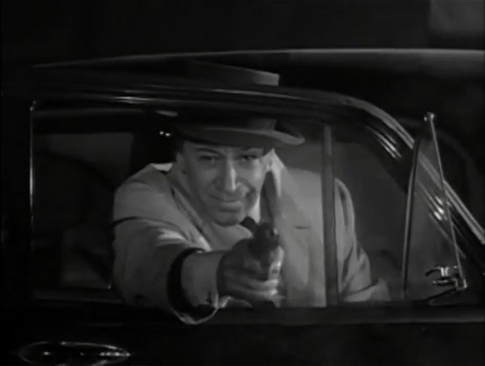
Of course Rogue Cop, being released in 1954, wasn’t coming at the end of any cycle. In fact, it signaled a return for at least one person to bigger pictures than had been the case for a while. That person was George Raft, one of the early stars of the gangster movie whose star slowly faded through the 1940s. I’ve heard it said – although I’d be happy to be corrected on this if anybody knows different – that Raft at the height of his fame was very choosy about his roles and became very cautious about the image he was projecting on screen. Essentially, he was said to be turning down anything that involved a persona which was less than squeaky clean, something which always struck me as a singularly petty and counterproductive approach. As the chief villain here, Raft is very good indeed, full of malice and vindictiveness. Watching him get this across so successfully had me thinking about the secret of getting under the skin of a villain, of making or becoming a bad man on screen. That demands both self-confidence and humility, it requires that an actor be big enough in his soul to be comfortable playing someone genuinely small and mean of spirit. In short, it needs courage.

Unfortunately, Rogue Cop remains on the missing list as far as official releases on disc are concerned. It is easy enough to watch online in passable condition but it deserves to be available commercially. Whatever is holding that up, it’s not the quality of the movie itself. This is a superb 50s film noir with first rate performances all round from an excellent cast, and a solid script which offers plenty of food for thought while simultaneously raising a number of interesting questions.