Rope of Sand

“Consider the diamond itself for instance. Carbon, soot, chemically speaking. And yet the hardest of all matters. So hard, in fact, that whatever it touches must suffer: glass, steel, the human soul.”

Peter Lorre uses that line, or a variation thereof, something like three times throughout Rope of Sand (1949). It’s not a bad line and has an air of wistfulness about it, and it’s tempting to wonder whether the filmmakers were hoping that this echoing might encapsulate the spirit of the movie. In a way it does, but probably not as originally envisaged. In essence, Rope of Sand is a simple story, one incorporating revenge, justice and a treasure hunt. Yet for all its simplicity, it feels somewhat repetitious, stretching its material more than is necessary and losing some of the inherent tautness in the process.

In brief, the plot revolves around Mike Davis (Burt Lancaster), a disgraced hunter who has fallen foul of the mining authorities after stumbling through (I presume, although it’s never explicitly referred to as such) the Namib desert in pursuit of a client who recklessly felt he could sneak out some diamonds. The result is the death of the client as well as a beating and torture for Davis, supplemented by the loss of his license. That ought to be enough to ensure any man would give the place a wide berth in future, but Davis is driven in true noir style by both a thirst for revenge and some sort of justice or recompense – he doesn’t appear certain himself as to which one holds the strongest allure. Up against him is the local commandant, the sadistic Vogel (Paul Henreid), and his debonair boss Martingale (Claude Rains). The latter wants to lay his hands on the diamonds Davis left behind just as much as the aggrieved hunter does. To that end he flies in a Frenchwoman of questionable reputation (Corinne Calvet) with the aim of coaxing the location from Davis, and then delights in the added bonus of seeing the new arrival add another layer to the antagonism between Vogel and Davis.

Walter Doniger’s script contains a fair bit of toing and froing, plans made and dropped, schemes attempted and foiled, and retribution handed out. There are dark mutterings amid exotic surroundings, interspersed with a smattering of witticisms as dry and abrasive as the South African sand. Past events are alluded to over hard liquor and a haze of cigarette smoke, then rather unnecessarily clarified via a flashback sequence that serves to simply slow everything down. And all the while the tone is shifting in tandem with the dunes of the surrounding wasteland, louche charm rubbing shoulders uncomfortably with instances of truly grim brutality.

On the other hand, these Hal Wallis productions tend to have a very grand look, a real cinematic sheen that is hard to resist. William Dieterle’s mise-en-scène and Charles Lang’s wonderful lighting combine to present some genuinely sumptuous shots and on occasion it approaches expressionism – the silhouetted figure atop a dune, the torture of Lancaster. Visually, the whole production is quite splendid. As for Franz Waxman’s score, I again found portions of it jarred and almost swallowed up the action on screen instead of complementing and supporting it.

Burt Lancaster is said to have disliked the movie intensely but his work on screen reflects none of that. It’s yet another variation on his, by that stage, patented studies in tough vulnerability and the type of thing he could practically sleepwalk through. Maybe it wasn’t much of a stretch for him dramatically but he turned in a credible piece of work all the same. Paul Henreid ‘s interpretation of an irredeemable sadist is powerful and intimidating, saved from becoming totally one-dimensional by the actor’s ability to hint at an awareness of his own failings. Claude Rains is all silken malice, a puppeteer whose viciousness only appears more palatable than that of Henreid due to the sheen of elegance and sophistication he wraps it up in. The only woman in the story is Corinne Calvet, hired by Rains to act as a siren and finding herself gradully falling victim to the  subterfuge and betrayals. Sam Jaffe’s alcoholic medic is underused and Peter Lorre as a lowlife fixer going by the glorious name of Toady drifts in and out of proceedings like some sweat-stained Falstaff.

Olive Films released Rope of Sand on both DVD and Blu-ray in the US but I’m not sure about availability elsewhere. It sports a terrific cast and Dieterle’s visual nous is never in question. I’d say it is sporadically entertaining, but the script allows the plot to drift too much in places and the tone lurches a little too freely – the smart dialogue and the harsh physical violence form an uneasy mix with this viewer.

That brings me to the end of this brief exploration of the cinema of William Dieterle which I have undertaken over the course of this month. I did toy with the idea of keeping it going a little longer but I have a hunch a triple bill such as this is sufficient for the present as too much of a good thing can be counterproductive. Nevertheless, I will certainly return to the director’s work as it represents a rich vein for movie fans.

The Accused

Film noir never seems to go out of fashion. Sure it has seen its box office power ebb and flow somewhat since its heyday in the 1940s and 1950s but movie fans keep coming back to it and if the number of articles, books and releases are anything to go by, its popularity remains strong. Is there then some paradox at work that sees something retaining popularity when at heart it relies on dark and/or pessimistic themes? Is it the cautionary tale aspect of it all that draws viewers, that vicarious thrill which comes from seeing others experience the dangers? Or is it the fact that noir is not so much dependent on the depiction (and the exploitation) of bad luck as on poor decisions? I feel it’s difficult to actively enjoy or take pleasure in witnessing bad luck, even the fictitious variety. However, looking at characters making poor or unwise choices is a different matter, not requiring one to indulge in something as distasteful as schadenfreude. The Accused (1949) is a classic film noir where the lead finds herself drawn into a typically dark vortex by her poor judgement and questionable decision making.

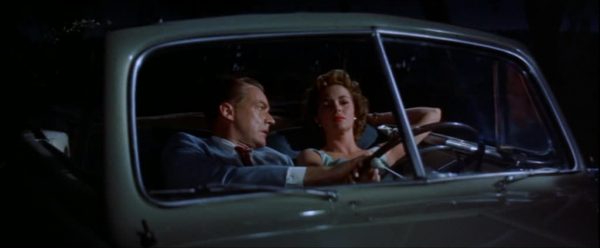
In characteristically noir style The Accused opens with a sense of urgent desperation. A woman is trying to put some distance between herself and what looks like something ugly. She is Wilma Tuttle (Loretta Young), a psychology professor, and after she stumbles guiltily along the highway, cadges a ride from a helpful truck driver and finally makes it back to her apartment, we learn via a brief flashback sequence about those bad decisions. Disoriented, disheveled and distraught, she mumbles to herself how her life has crumbled in less than twenty-four hours, and the image dissolves, pulling us back into the past. A provocative student Bill Perry (Douglas Dick) has developed something more than a crush on the professor yet instead of sticking to her guns professionally and passing the matter on to the dean she not only accepts a ride home from this guy (she’d missed her bus), but ends up sharing a meal with him and then a detour to the cliffs above the ocean. Here Perry assaults her and, in an effort to defend herself, Wilma Tuttle bludgeons her assailant to death. Those rotten choices keep on coming: rather than do the sensible thing and report the incident, she tries to cover it up, to fake a fall and subsequent drowning, and of course make it look as though she’d never been near the spot in question. At first, it seems she may get away with it, the inquest returns a verdict of accidental death after all. However, Perry’s dissatisfied guardian San Fracisco lawyer Warren Ford (Robert Cummings) has his doubts, as does the doggedly persistent Lieutenant Dorgan (Wendell Corey). While the net of suspicion draws inexorably tighter, Wilma allows her attraction to Ford to develop into a full-on romance, a situation requiring more delicate decisions to be taken by all concerned.

Having generally enjoyed Red Mountain, I find I’m on a bit of a William Dieterle kick just now. I liked his handling of the western setting but I think it’s fair to say that The Accused, with its dark melodama and a script by Ketti Frings (Foxfire) represented more comfortable territory. The pacing is well judged, hooking the viewer right away and adding developments and complications in sufficient numbers and at appropriate intervals to keep the tension simmering without allowing it to boil over or become unnecessarily confusing. In terms of visuals, Milton Krasner’s cinematography switches smoothly between the brighly lit outdoor scenes where all feels well and the characters are correspondingly open and moodily rendered interiors where ambiguity makes its home. There is also a strong emphasis on mirrors and reflections throughout; this particular motif shows up time and again and alludes to the differing images presented by the characters – the faces they present to the world and those they present to themselves. As a result, there is a constant sense of duality and even duplicity as none of the principals fully reveal themselves to others.

Apparently, The Accused was originally planned as a vehicle for Barbara Stanwyck. Now, anyone who has spent any time browsing this site will know that I hold Stanwyck in the highest regard, I’ve always liked her work and admire her versatility. However, the role of Wilma Tuttle called for someone who could convincingly portray a woman whose judgement is almost perpetually in question, whose vulnerability will constantly overide her intelligence. I can’t see Stanwyck pulling that off successfully, there was forever a sense of resourcefulness just beneath the surface that would have made it a tough sell. In contrast, Loretta Young had that doe-eyed trustfulness about her, so somehow it doesn’t feel like such a leap to see her repeatedly taking the wrong turn.

Robert Cummings gets the slick likeability of his part across well. He’s smooth and polished, sure of himself and solid enough to provide an emotional crutch for Young. He comes into his own particularly in the third act when, in the wake of a well staged and shot boxing bout which reveals much, he confronts and accepts the truth and really grows in stature. Wendell Corey’s cop is fine too. There’s a trace of cynicism which feels right for a man in his position and he also does  good line in self-awareness, a smidgen of doomed romanticism sharing space with a barely concealed dissatisfaction with the kind of things his job forces him to do. In support Douglas Dick is creepily effective as the victim, while Sam Jaffe is just about what you expect a forensic scientist ought to look and behave like. Finally, both Sara Allgood and Mickey Knox make brief but very welcome appearances.

The Accused was released in the US as part of the Universal Vault MOD prorgram, and it can be found in various European countries too, looking OK but showing room for improvement.  I understand it’s due a Blu-ray upgrade via Kino in the near future so that might be worth bearing in mind. This is the kind of noir melodrama I generally respond to, it’s well cast, stylishly directed and smartly written. What’s not to like?

Red Mountain

One of the reasons I started this site many years ago was the opportunity it afforded me to write on and maybe draw some attention to movies (many of which happened to be westerns) that appeared to  have slipped between the cracks and drifted into relative obscurity. That wasn’t the only reason of course, but it was certainly a signficant one. Over time I’ve tried to broaden my base and mix up my content in a way that pleases me and, I hope, engages and attracts a wide range of visitors. Red Mountain (1951) could be seen as a return to my blogging roots in a sense as it is the type of movie I had in mind at the outset, a western with a big name star and directed by a well regarded filmmaker, with some equally impressive names among the crew, but one which rarely gets mentioned.

This is a fanciful tale, one likely to drive the history buffs crazy as it plays fast and loose with historical facts. However, we’re talking about movies here, where artistic license should be granted and where minor matters such as accuracy and fidelity to the known facts are of no more than incidental interest. It opens well, with a faceless killer shooting down an assayer in the town of Broken Bow, the assailant recognizable only by the spurs on his boots. It would seem likely at this stage that we would see a tale focusing on the hunt for this anonymous gunman, and that does appear to be the direction we’re headed in, not least when an innocent man is accused and a vengeful posse summoned. That innocent man is Lane Waldron (Arthur Kennedy), one on whom suspicion is heaped not only because he had been seen in the vicinity but largely because he was once a soldier of the Confederacy and these are the dying days of the Civil War. The townsmen all regard him as a potential traitor and are only too willing to set out with the aim of lynching this interloper. Indeed he comes within a hair’s breadth of this fate but is spared when Brett Sherwood (Alan Ladd) breaks up the party and rescues the happless Waldron. Sherwood is the real killer of the assayer – this is only confirmed right at the end of the movie but it’s acknowledged quite early on in proceedings – and his feelings of guilt and responsibility for Waldron, and later some stronger feelings for the latter’s woman Chris (Lizabeth Scott), drive the plot. All of this is intensified when the infamous Quantrill (John Ireland) comes on the scene. The notorious guerilla leader is in the process of stirring up unrest among the Indian tribes, starting with the Utes, with the aim of opening a new front in the west, one with the potential to derail the Union march towards victory.

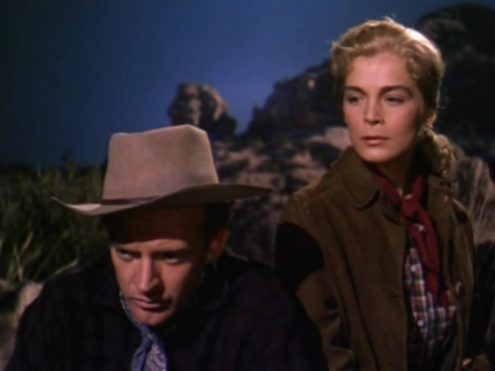
One doesn’t think of German director William Dieterle as a natural for  westerns. That said, there’s no earthly reason why we should exclude someone like this – the beauty of the western as a genre is its malleability and the kind of inclusiveness it bred among filmmakers where so many diverse types were able to make strong and successful contributions. That Old West setting was the ideal backdrop for so many tales, a largely untouched landscape invested with enough opportunity and presenting so many physial and ethical challenges that almost any human drama was enhanced when it played out there. Dieterle (who apparently was replaced for a time by an uncredited John Farrow due to ill health) uses the New Mexico locations well, presenting a similar view to that pioneered by John Ford with the vast and imposing natural features framing the conflicts dramatically and simultaneously suggesting their relative lack of consequence in the grand scheme – those towering hills and cliffs and endless horizons prevail and gaze impassively on the petty squabbles acted out in the their shadows and dwarfed by their permanence. Charles Lang’s cinematography makes the most of the natural beauty and is equally effective in the numerous night time shots. The driving and powerful (perhaps occasionally overpowering) score by Franz Waxman adds urgency and also complements some of the grimmer moments in the film.

Red Mountain was the third western for Alan Ladd, following on successfully from Whispering Smith and Branded and paving the way for his signature role in the timeless Shane. While I’m not entirely convinced by some of the writing and characterization in this film, I can’t say that any of that affects the quality of the performances. Ladd’s star was still in the ascendency at this point and he was tremendously good at tapping into the growing uncertainty of his character; there’s a touch of ambiguity there too but it’s the burgeoning sense of unease at the path chosen, the war raging within his own soul, which impresses most.

In contrast, Lizabeth Scott’s career had already peaked and  a few years later any chance of reviving it would be torpedoed by the disgraceful actions of Confidential magazine. She handles her part as the embittered victim of Quantrill’s razing of Lawrence, Kansas with assurance. She is sometimes regarded as a film noir actress first and foremost, and she has some stellar credits in that genre to back that view up, but her work in this film and Silver Lode is just fine as far as I am concerned. Arthur Kennedy fades a little as the story develops, a strong start sees him squaring off against Ladd but his character’s injury sees him sidelined to some extent and the writing I mentioned above does him no favors. John Ireland’s Quantrill offers an interesting study in fanaticism. I particularly appreciated the actors physicality here, using a kind of stiff discomfort to great effect, suggesting a man aware of his own unhinged nature and struggling with some moral straitjacket of his own design. There are also welcome if limited supporting roles for Whit Bissell, Neville Brand and Jeff Corey.

I’m not sure if Red Mountain has received an official release anywhere, which is a pity as the movie has a good deal to recommend it. It represents a strong entry in the filmography of Alan Ladd as he was building his credentials as a western hero and it also adds another layer to the Hollywood work of William Dieterle. Frankly, it’s the kind of film that would look just dandy on Blu-ray if it were given a bit of a clean up. I’d like to think that might happen one day.

Seven Thunders

Referring to a film as a war movie probably brings to mind images of large set piece combat scenes, of pitched battles raging across the screen with intensity. Seven Thunders (1957) is a war movie and although it does feature an impressively destructive climactic set piece it is really a story (in truth a series of interlocking and interwoven tales) which is played out against, and given added urgency due to, the backdrop of war and occupation. It combines elements of a thriller, drama, and romance and ultimately ties together all the apparently disparate strands. As such, like all genre pictures, it is able to draw in and blend that which one might more readily associate with a different genre. That said, it perhaps tries to cast its net too far and too wide.

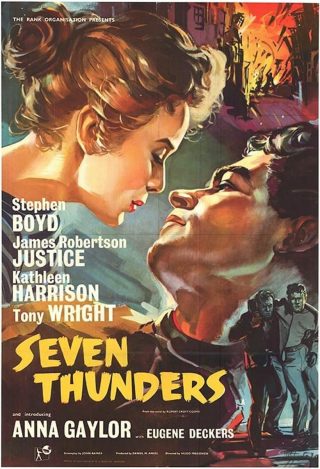
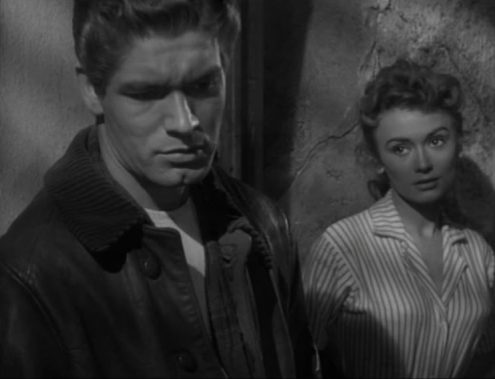
And speaking of casting nets, the opening scene by the dockside in the port of Marseille during the Nazi occupation sees a fishing vessel deposit its latest catch. Along with the bounty yielded by the Mediterranean is a pair of escaped Allied prisoners of war on the latest leg of their journey, having escaped from prison camps in Italy. Dave (Stephen Boyd) and Jim (Tony Wright) are taken to a safe house, somewhere to lie low till they can be shunted further along the line. The principal narrative thread is the experience of these two men, with particular focus on Dave and the street smart  young French girl (Anna Gaylor) he finds himself reluctantly falling in love with. Running parallel to this is the matter of Doctor Martout (James Robertson Justice), on the surface a man who is dedicated to aiding the flight of large numbers of refugees and otherwise doomed individuals, but in reality a cold and utterly ruthless serial murderer. Eventually, these two plot strands converge as the relentless Nazi pressure contrives to force the increasingly restless Jim to seek an alternative means of exiting a neighborhood that is soon to be razed to the ground. As these plotlines creep toward their dramatic confluence, other characters and tales spin out of and around them, adding more layers of both tragedy and comedy. There is the impoverished  intermediary (Eugene Deckers) who unwittingly sends victims to the psychopathic Martout and then finds his own life touched by an unspeakable loss. There is the young Wehrmacht soldier whose lack of lack of judgement, self-confidence and self-control brings about that loss. There is then the Englishwoman (Kathleen Harrison) who provides some much needed comic relief, not least when it is discovered that breaking through her wardrobe leads not to a magical land such as C S Lewis might have imagined but instead to a bordello. So, there is no shortage of incident as events build toward an exciting and satisfying conclusion.

All told, I don’t feel Seven Thunders ranks as one of Hugo Fregonese’s more successful pictures, although there is much to enjoy and appreciate in it and the director does some characteristically strong work. The main story is a compelling one and Fregonese gets the most out of the burgeoning romance between Boyd and Gaylor, capturing the immediacy of wartime relationships and gaining credibility both from the performances and the Marseille locations. On the other hand, the Martout sub-plot feels largely unnecessary – it’s neither poorly executed nor uninteresting, but it feels a little undeveloped in itself and also nudges the principal story aside on occasion. If it’s purpose is to add extra tension to the climax, I’m not sure that is necessary. In terms of linking elements together, the Martout strand fleshes out Eugene Deckers role and that in turn affords greater significance to the shocking and tragic business involving the Wehrmacht soldier. Still, I’d have thought those aspects could have been blended in by  some other means. I guess my criticism would be directed at the writing then as opposed to the direction. That writing derives from a novel by Rupert Croft-Cooke, someone whose work I’m more familiar with under his Leo Bruce pseudonym. Leo Bruce wrote some witty detective fiction and those lighter moments I mentioned involving Kathleen Harrison recall this.

Stephen Boyd was on the cusp of real stardom when Seven Thunders was made. He had recently had a memorable part in the fine thriller The Man Who Never Was and was about to get another good role in Henry King’s The Bravados, as well as prominent parts in some glossy melodramas in Hollywood. Overshadowing all this though would be the plum role as Messala in Wyler’s Ben-Hur. He handles the action scenes very competently, including a rooftop fight with a snooping German and the final escape from the city that is collapsing around his ears. The romantic relationship with Anna Gaylor works well too, there’s a sweetness to it and some chemistry between the players. Tony Wright, who had been cast in the early Hammer picture Bad Blonde / The Flanagan Boy opposite Barbara Payton and then portrayed the villain in Tiger in the Smoke, has less to do but carries it off satisfactorily. I tend to think of James Robertson Justice as primarily a comic actor, for the simple reason that those were the parts I first saw him in. However, he did plenty of dramatic work and I think there is something startlingly effective about seeing actors one associates with lighter work portraying out and out evil characters. I know I got a definite chill from seeing him calmly informing one of his victims of the fate which awaits him.

Kathleen Harrison had a long career, and a long life too, playing some wonderful eccentrics and brings both humor and believability to her turn as the woman who has made a life for herself in the French port. As the proprietress of the adjoining bordello, former dancer Katherine Kath nails the world weariness of her character and seasons it with a dash of knowing levity. In other supporting parts, Eugene Deckers has about his creased features that careworn seediness that is a close cousin to despair and, along with Rosalie Crutchley as his downtrodden wife, deals sensitively and effectively with some of the most touching and heartrending moments in the movie.

There is a UK DVD of Seven Thunders available; while the image is generally clean and attractive I’m not sure about the aspect ratio of the presentation, it may be open matte but I think it looks a little cramped at the sides in some shots. In the final analysis, I would rate this as a movie that works well for the most part despite the fact the script attempts to pack in more story than is strictly necessary.

A Double Life

Hollywood’s penchant for picking away at the veneer of its own glamorous facade to steal a furtive glance at the preening, grasping and backstabbing that lies beneath has been noted before. It tends to be fascinating, to this viewer at least, to watch people indulge in this type of cathartic soul-baring. A Double Life (1947) offers a variation on this theme, inviting us not only backstage on Broadway to peer behind the greasepaint of the performers, but drawing us deep into the soul and psyche of that master of duality, the actor. And in this case, it’s a journey into darkness indeed.

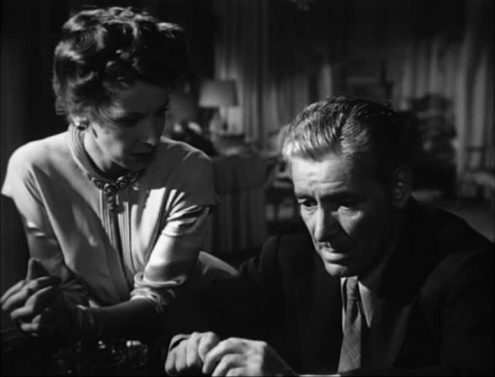
How does one go about describing a man, catching the essence of the person concisely? There are people who seem to be the epitome of simplicity itself, engendering responses from those around them to the effect that he’s a great guy, or perhaps not such a great guy. Sometimes there is a general consensus on this point. Then again, many a man is a much more complex proposition, a walking cocktail of positive and negative characteristics where the question of whether or not he’s a right guy is wholly dependent  on the opinions and experiences of the person one happens to ask. Anthony John (Ronald Colman) is an actor and is also an example of the complexity I referred to. The sense of the dual nature of man is apparent right from the beginning in both visual and narrative terms. He is first presented in the lobby of the theater where his latest successful play is running and he is caught in a brief pose in front of a portrait of himself, looking over his own shoulder in a sense, and this is then reinforced as he strolls through the city on his way to see his agent, provoking varying reactions from the individuals he encounters, some of whom sing his praises while others are somewhat less flattering.

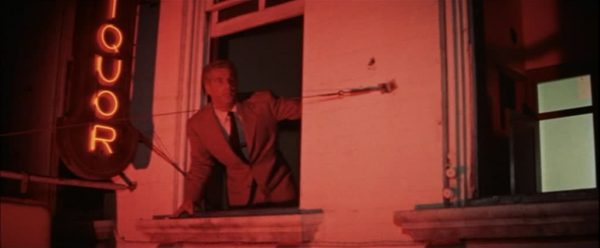
He is about to be offered the role of Othello, one he has shied away from in the past but the allure is to prove too powerful to resist on this occasion. His ex-wife Brita (Signe Hasso) is to play the part of Desdemona, and all of this prompts hesitation and trepidation. This legally estranged couple remain close, Anthony is still in love and Brita, though more cautious and reluctant to expose herself to hurt, clearly retains feelings too. Obviously, there is the potential for two people working together under such circumstances to get swept along, or even carried away, by their passions. Initially, Anthony busies himself with rehearsals and a casual fling with a smitten waitress (Shelley Winters) but as the success of the production grows and the run is extended he  finds himself drawn more and more to Brita. All well and good, but the fact is this man is known to be an actor who throws himself body and soul into his characters and that’s not good news when he starts to suspect Brita of being in love with press agent Bill Friend (Edmond O’Brien). Slowly, he finds himself identifying more and more with the murderous jealousy of the man he has been portraying night after night on stage.

Frankly, I don’t readily associate George Cukor with films noir, although he did make a few movies which to a greater or lesser extent drifted in that direction, such as A Woman’s Face, Keeper of the Flame and Gaslight. However, A Double Life heads determinedly down those half-lit byways of the human psyche, aided enormously by the rich, shadow-laden cinematography of Milton Krasner. While there is no shortage of talent among the principal players the quality of those behind the camera is every bit as impressive and the presence of such depth and experience adds immeasurably to the finished picture. Besides Cukor and Krasner, the writing of Ruth Gordon and Garson Kanin, the lush scoring of Miklós Rózsa, and the editing of future director Robert Parrish all contribute to what is an undoubtedly classy production.

Ronald Colman won the Best Actor Oscar, as well as a Golden Globe, for his work in A Double Life, which I feel was well deserved. It’s a complex and challenging role, and it’s to Colman’s great credit that he embraces its inherent melodrama and plays it with resolute conviction and the type of sensitivity that is vital in retaining the sympathy of the viewer. After all, he is breathing life into a character who in less capable hands could so easily alienate the audience. I’m reminded of something I once read by the critic Ian Cameron in relation to the viewer’s identification or sympathy with noir protagonists. As I recall, he spoke about both the comfort and discomfort this can provoke in the audience. We get drawn in by those characters for whom we can feel some affinity, those whose positive qualities are clear to see and are more than simply cardboard heroes or villains. Still, when they are at best ambiguous or at worst outright criminals then there is an undeniable sense of discomfort on our part too; we don’t really want to find ourselves sympathizing or identifying with such types, and when we have been manipulated into that position the duality that characterizes the better, or more nuanced, films noir becomes apparent. As viewers, our comfort and discomfort (and perhaps the ethical no man’s land in between) is a reflection of the movies’ blending of light and dark, of its frequent sallies into the murky grey areas of moral ambivalence.

A Double Life has a tight core cast with Colman obviously remaining the focal point of it all. Signe Hasso gets across the conflicted feelings of her character effectively and brings the audience along with her. Her continued love for he ex is apparent as are the reservations she has about allowing those now dormant emotions to be awakened. The delicate balance of such contrasting desires can be tricky to convey successfully but Hasso remains convincing throughout, this emotional tightrope walk as well as her portrayal of Desdemona in the drama within the onscreen drama acting as another example of the ever present theme of duality.

Shelley Winters turns in another solid performance as the earthy and ultimately tragic waitress. It’s not a big part in terms of screen time but it is pivotal and Winters handles it well. I know that in the past I wasn’t so taken with her work but with some recent viewings I find I’m increasingly impressed. Edmond O’Brien makes yet another appearance in yet another noir. He is good enough here, but it has to be said the part doesn’t offer him as much as some others he was doing around this time. Still, what he does is fine and his presence is always welcome.

A Double Life has been given a Blu-ray release in the US by Olive, but I’ve been making do with my old DVD so far. This is a beautifully shot movie that oozes the noir visual aesthetic while the tragic conflict at the heart of the story anchors it firmly in the choppy waters of dark melodrama. This is a very polished production and one which I find repays repeated viewings.

Some Came Running

Some Came Running (1958) is quite simply a great movie. It’s a study of fear and frustration in small town America in the post-war years. Every main character is scared or insecure in one way or another, scared and insecure within themselves, wary and mistrustful of their strengths and weaknesses, and frequently unaware of or unclear about the difference.  Essentially, everybody we encounter wants what he or she cannot have, all except one. That one person appears to be the greatest dreamer of the lot, and yet it’s the purity of that dream that means it stands more chance of being realized than all the other castles in the sky combined.

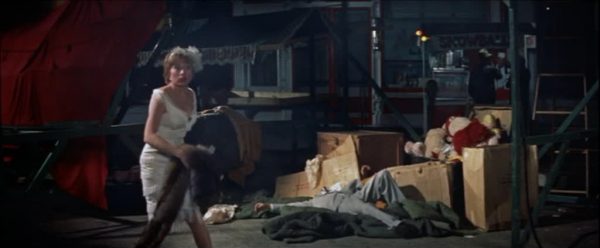
Homecomings ought to be happy affairs, a chance to strengthen bonds and reacquaint oneself with family and friends, but as Elmer Bernstein’s frantic and vaguely discordant score plays over the credits, there’s no suggestion of joy ahead. We’re riding a bus, and the view through the windows is of countryside dipping and rolling down towards the town of Parkman, Indiana. There’s a touch of symbolism in that shot, the physical descent mirrors the spiritual one the protagonist is on, the process of stepping down from his emotionally and intellectually detached position to confront and reconnect with his past (indeed with himself) before he earns the right to ascend once more. It’s a practically deserted bus too and you get the impression that Parkman isn’t the kind of town people are in a hurry to reach, quite the opposite in fact. Slumped by the window and sleeping off what must have been a heavy night is Dave Hirsh (Frank Sinatra), a demobbed soldier back in his home town for no better reason than the fact his friends told the driver to drop him there. The only other passenger is Ginny (Shirley MacLaine), a “hostess” from Chicago who has followed Dave. While others naturally impact on the development of the story, it is these two who form the dramatic axis at the heart of the tale. He’s what might be described as a lapsed writer, a man who has lost his spark somewhere along the line and has traded his talent for a sour mix of whiskey and cynicism. And yet he hasn’t completely resigned himself to idle contemplation of the shot glass, as evidenced by the fact he still carries around his last manuscript, one he appears to regard with fond dissatisfaction.

Dave Hirsh is the man through whose eyes we follow the majority of events, watching his struggle with his art, with his friends and relations, and of course with himself. While he acts as our point of reference, it’s through his interaction with Ginny above all that we gain the broader perspective that adds depth. The growth and development of the character of Dave is propelled mainly by the presence and actions of Ginny, even if she is not always aware of the pivotal position she occupies.

“I don’t understand you neither, but that don’t mean I don’t like you. I love you! But I don’t understand you. Now what’s the matter with that?”

When we first encounter him, he is quite literally in a dark place, deflated, directionless and drunk. By the end of the movie, while there’s grief and sorrow on show, he’s returned to the light by having rediscovered everything that matters – he has recaptured his spirit, and that is reflected both in his renewed awareness of his artistic worth and his  recovered self-esteem as a human being who now understands he is capable and deserving of love.

What then of Ginny? Well, if Dave’s moment of truth, the bittersweet dawning of realization, comes late in proceedings, much of the impetus has derived from the presence of Ginny. Dave has spent an inordinate amount of time kidding himself that his salvation lies with the bookish and frigid Gwen (Martha Hyer). However, this is an illusion fed by his desire to escape the carefully constructed edifice of hypocrisy as represented by his brother Frank (Arthur Kennedy) and the grand soulless house he inhabits with his disaffected wife (Leora Dana) on the one hand, and the creative wasteland he’s found himself wandering through for years on the other. Gwen is incapable of loving anyone or anything real, at least in a physical sense. She resides in a house steeped in learning, a place where culture is a staple to the point that books proliferate and are to be found even in the kitchen, offering sustenance to the mind. Yet Gwen worships a kind of chaste and empty conception of art, one where the artist is a detached and essentially impotent figure, rendering art itself barren in the process. Juxtaposed with the emotional vacuum presented by Gwen is the simple, inarticulate tenderness of Ginny, the type of honesty that defines humility, and therefore selfless love. There’s a pathetically beautiful scene played out in an empty classroom just before the movie’s climax, that lays bare the contrasting characters of the two women – Gwen buttoned into her suffocating propriety, with just a hint of spite peeking out, while Ginny is a gushing mess of devotion and rouge. It is hard to imagine anyone essaying the vulnerability, warmth and utter lack of pretension or guile more successfully than Shirley MacLaine.

This shopworn ingenue who displays more nobility and emotional candor than anyone else is portrayed as a semi-comic figure throughout, with her ever present fur piece struggling to achieve some uneasy sophistication alongside the hopelessly immature handbag. Then right at the end, the mask is reversed to become the embodiment of tragedy. It seems fitting that this plays out as a Technicolor (Metrocolor, for the sake of accuracy) symphony, showcasing the intense and hypnotic use of color by Minnelli. In fact this sequence is shot, as indeed are a number of key passages, like a cinematic ballet; figures drift from light into darkness according to the ebb and flow of emotion, alternately cloaked in shadow and bathed in rich, vibrant hues, dancing around the flame of Minnelli’s camera.

If aspects of the movie are visually (by the way, cinematographer  William H Daniels’ contribution should not be underestimated) and rhythmically reminiscent of a musical, this is perhaps to be expected given the involvement of Minnelli, Sinatra and Dean Martin. Sinatra was at the height of his powers at this stage; he had a series of strong performances in some fine movies behind him – his screen work beginning with another James Jones adaptation From Here to Eternity and continuing up to the underrated A Hole in the Head for Capra constitutes a remarkable run – and his recordings for Capitol during these years are just sublime.

There is a lifetime of full-blooded living coloring Sinatra’s performance as Dave Hirsh and it feels as though this inspired those around him to travel that extra mile too. Dean Martin could be a lazy actor, falling back on that easygoing charm and his drawling drunkard shtick all too readily. Sure there is some of that in his Bama Dillert, but he brings a shading to the role that elevates it. He’s every bit as much a victim of the insecurity which runs rampant among the characters as anyone else – after all, isn’t the gambler, with his affectedly casual love affair with lady luck, the very epitome of uncertainty? What stands out most of course are the stubbornness and loyalty (two traits which aren’t all that far removed when you think about it) which define him. His pig-headed refusal to consider any change to his behavior, even when faced with the loss of a friendship and the threat to his health and life, feels credible in his hands. And the hat business is treated almost as a running gag, right up to the last shot of the movie, where it suddenly transforms into something deeply touching.

Like MacLaine and Hyer, Arthur Kennedy was nominated for an Oscar for his work on the movie – none of them won but it has to be said there was pretty stiff competition that year. Recently, I looked at Impulse, a relatively obscure British thriller, from a few years earlier and which saw Kennedy falling prey to middle-aged dissatisfaction. The part of Frank Hirsh offered the opportunity for further exploration of that theme. It’s a strong piece of work in truth, the calculating suspicion he feels at the beginning is slathered over inexpertly with fake bonhomie and unctuousness, none of which stands much chance of deceiving anyone for long. That dust dry laugh and back-slapping hospitality is just as much of a front as the image of familial harmony he works so hard to project. Yet, when it all comes crashing down in the aftermath of an ill-advised evening with Nancy Gates, there’s a sense of wistfulness about the whole affair. It is to Minnelli’s and the film’s credit that neither Gates nor Kennedy are explicitly judged or condemned; that mature generosity of spirit is admirable.

Warner Brothers released Some Came Running years ago in a box set of Sinatra movies. The CinemaScope image looks fine, and there’s a 20 minute feature on the movie as a supplement. Still, I have to wonder why a film of this quality hasn’t yet made it to Blu-ray since Minnelli’s mise-en-scène and use of color and shadow would surely look spectacular in high definition. Hopefully, this omission will be addressed sooner or later. The movie itself remains a great favorite of mine, and has been ever since I first viewed it many years ago. So, let me just end as I began by stating that this is simply a great piece of cinema, and I recommend it without reservation.

Moonfleet

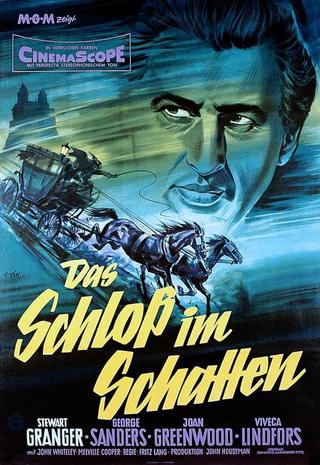
Recognizing the familiar in the atypical; that sounds like the kind of triumphant banality commonly attached to a piece of cod sociological theorizing. In fact, it’s just my own clumsy way of pointing out how even the apparently uncharacteristic works of great filmmakers are frequently nothing of the sort. When one has in mind Fritz Lang’s time in Hollywood it’s tempting to think of film noir and leave it at that. However, that would be not only a mistake but a disservice to a man whose mastery of cinema meant that genre labels represented no limit, but instead offered extended opportunities to tackle the themes which interested him. Moonfleet (1955), despite its smugglers and 18th century trappings, is recognizably a Lang film and features elements that crop up all through his  work.

Young John Mohune (Jon Whiteley) is an orphan, on his way to the village of Moonfleet on the Dorset coast to look up the man his mother told him to find after she had passed. With a lowering sky and a deserted road, the atmosphere is already vaguely threatening and a tumbledown churchyard watched over by a stone angel heighten that feeling. When a claw-like hand is suddenly thrust from below the ground, well we’re veering into the realms of a Gothic nightmare. That sense is hardly dispelled when the youngster awakens in a local tavern to see a gallery of grotesques gazing down on him. Nevertheless,  he’s a phlegmatic type and unfazed by the experience, which is just as well as he’s about to witness a flogging and a shooting, carried out by the man he’s been traveling to see. Jeremy Fox (Stewart Granger) is an ambiguous character, a man of some means but clearly a rogue too. It’s apparent that Fox and the boy’s mother had been close but it’s also plain that he’s reluctant to have responsibility for the child’s welfare thrust upon him. The lad is a determined sort though, neither intimidated by the violence all around nor the dissipated and bawdy company his new guardian regularly keeps. As the trappings of a horror movie ebb and flow like the tide itself, the adventurous elements of the story gradually dominate, with the prospect of lost treasure being recovered, and all the romance that promises. While the characters hunt for a fabulous diamond, the fact is both Fox and young Mohune are mining for a different kind of treasure, the former slowly coming to the realization that he might just have a chance of regaining some semblance of the honor he’d thought forfeit and the latter, well his treasure is the boundless optimism of youth and a simple faith in the the notion of friendship.

A colorful CinemaScope adventure with swashbuckling elements is unlikely to be the first mental image conjured up with the mention of a Fritz Lang film. Nevertheless, as I said above, Lang wasn’t a servant of any particular genre. He even made a number of westerns – Western Union, The Return of Frank James, Rancho Notorious – with varying degrees of success and all of those were at the very least interesting and bore signs of the director’s stamp. His films frequently deal with concepts of justice, of an uneasy relationship between morality and hypocrisy, where ambiguity resides on the periphery of society and the facade of respectability is ever at risk of slipping and revealing something altogether less savory underneath. Moonfleet weaves all of this into the fabric of its narrative and the heavy reliance on sets and the studio backlot suit the director better; with Robert Planck’s cinematography casting brooding shadows, Lang creates some wonderfully atmospheric tableaux in the church, the cemetery and the crypt below, where the monuments to the past watch impassively over the  intrigues of the present, all punctuated by the rich score of Miklos Rozsa.

Moonfleet is a movie with what I would term a deep cast, meaning there is an abundance of well known and instantly recognizable performers right down the list. Despite that, the focus remains firmly on Stewart Granger and Jon Whiteley at all times. Granger had a real flair for playing characters who had a dismal opinion of themselves, if not outright villains then heroes (or perhaps even anti-heroes) burdened with doubt and locked into a lifetime of regret. His Jeremy Fox quite literally carries the scars of a thwarted love, and there is the sense of some distant guilt hanging heavy on his conscience. His courtship of villainy and vice feels more like a self-imposed punishment than an indulgence. His potential redeemer comes in the form of Whiteley, who it is strongly hinted but never explicitly confirmed may be his own son. It’s not so much the innocent adoration but perhaps more the steadfast belief of the boy that imbues the man with the moral courage he thought he had squandered. There is something both moving and uplifting about the coda that brings the movie to a close, where Whiteley throws open the gate to his ancestral home, opening up the path to a better future and asserting in response to the doubts cast by the parson whether his guardian will ever return, not with boldness but with a simplicity borne of conviction: “He’s my friend.”

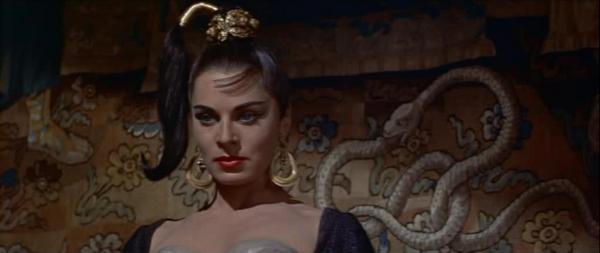
As for the rest of the cast, the majority play types of varying degrees of worthlessness. George Sanders could take on the part of a cad  with his eyes closed, his debauched and decaying aristocrat, purring with honeyed ennui plots and schemes in vain. His faithless wife is portrayed in her trademark slinky style by Joan Greenwood, a woman who will be forever associated with the role of Sibella in Kind Hearts and Coronets in this viewer’s mind. The striking Viveca Lindfors is a venomous blend of the pitiful and the malignant as Fox’s spurned mistress, beautifully framed with a serpent as companion in the image above, although I feel she’s underused. To some extent, the same could said of Melville Cooper, John Hoyt, Dan Seymour, Jack Elam and, in his final screen role, the unforgettable Skelton Knaggs.  Sean McClory fares better as the dissatisfied innkeeper/smuggler and gets to shine in one of the movie’s big set pieces – the face-off with Granger, where he swings a cruel looking halberd, must have been something to behold projected on the big screen.

Moonfleet has been released on Blu-ray by Warner Brothers but, for now at least, I’m still reliant on my old French DVD. It’s been a while since I last watched anything by Lang, which is odd as he has always been one of my favorite directors, and I’ve had it in mind to feature this title for some time. I believe it hasn’t the greatest reputation among Lang’s works but I like it a lot. It has mood and atmosphere, chills and adventure sharing screen space with tried and tested themes of the director, and what’s even more  important, there’s a positivity and buoyancy at its core that I cannot fail but respond to.

Blowing Wild

“You’ll never get away from me. I’ll never let you go. I’ll say you helped me. I’ll say I killed him and you helped me. I don’t care if they hang me just so they hang you, too!”

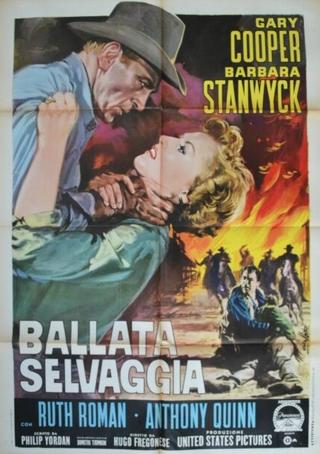
That sample of dialogue comes near the end of Blowing Wild (1953), during the climax and just before a no holds barred shootout. It is pure unashamed melodrama, as indeed is the entire movie. It came up in the comments section of a piece I wrote back last autumn and provoked the expression of a number of markedly contrasting opinions. At that point, I hadn’t seen the movie but my fondness for the stars and director not to mention the polarized views it prompted meant I was going to have to do something about that. It took a bit of time for me to get around to it (why break the habit of a lifetime, I suppose) but I have to say I’m delighted that I did – I had a wonderful time with it. Sure, as I said, the melodramatic aspects are dialed up as far as they can go and the emotions on display are raw and unrestrained. And I think that’s precisely what I liked about it, the fact that the director and cast wholeheartedly embrace the burning passions it depicts.

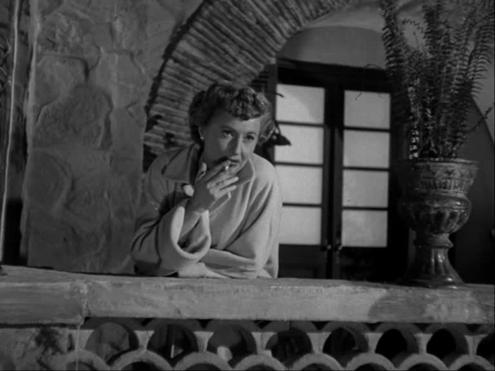
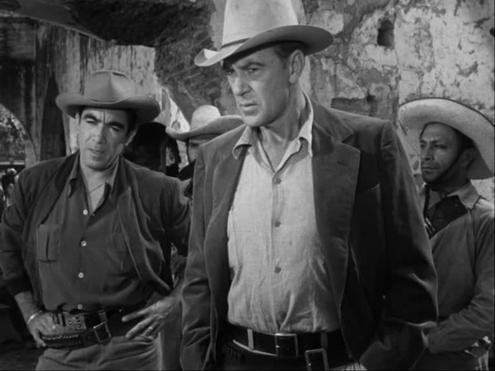
The credits roll to the accompaniment of Dimitri Tiomkin and Frankie Laine’s soaring and swooping theme song and the camera tracks the progress of a group of heavily armed bandits picking their way through locations that film fans will recognize from countless westerns, from Garden of Evil through The Wild Bunch. The screen caption tells us it’s “South America” but we know it’s Mexico. Jeff Dawson (Gary Cooper) and his partner Dutch Peterson (Ward Bond) are wildcatting, drilling for oil and about to lose their shirts. The fact is they are lucky not to lose more as those bandits led by El Gavilan (Juan Garcia), channeling Alfonso Bedoya in The Treasure of the Sierra Madre, demand payment of the money the two oilmen don’t have before laying waste to the derrick and campsite. Our two hapless prospectors find themselves suddenly destitute and desperate to find some means of buying their fare back to the States, desperate enough to agree to haul a load of nitroglycerine back through the badlands they just vacated. When payment for this is withheld by Ian MacDonald’s smooth chancer – shades of To Have and Have Not creeping in here – the only way out seems to be taking a job with an old friend. Now why would anyone be reluctant, no make that downright hostile, to accept an offer from a friend? Well, that friend is Paco (Anthony Quinn) and the problem really relates to his wife Marina (Barbara Stanwyck). We first encounter her primping and sneering like a cat in heat in an already smouldering atmosphere, and it’s apparent to all, except the smitten Paco, that she and Jeff have what might be delicately referred to as a past. I’ll leave it at that for now; I reckon most people reading this can guess where the story is headed, and the real pleasure to be had is observing the emotional temperature get ratcheted up remorselessly.

While I have not seen all of Hugo Fregonese’s films – to be honest, I’ve really only seen a fraction of his output – I can confidently say that I’ve yet to meet one I didn’t like, and some of them are quite wonderful. Saddle Tramp is very good while Apache Drums, The Raid, and Harry Black and the Tiger are all excellent. Blowing Wild is all about love, loyalty, passion and betrayal, and every one of those elements is given an extensive workout in Philip Yordan’s script. Some will say it’s overdone, that the seasoning is too rich and the blend is too heavy. I have to disagree though. When I think of passion I think of the Greek πάθος, from which it is derived, and all the full-bodied and full-blooded longing and suffering it implies. One cannot portray something so primal and powerful with subtlety or delicacy, it needs to be given full rein, and Fregonese’s movie certainly does just that.

As for the casting, Cooper looks worn and a little beat up as he so often did in the 50s, but it’s a good look for him, complementing that characteristic halting delivery of his and making him seem a little more human. His Jeff Dawson is a stoic creation, a solid man of principal with most of the edges smoothed down by the hard experience of just living, yet still vital and still hungry. Whether his hunger relates to the black gold he’s drilling for or the two women vying for his attention is eventually resolved, but not before all have had a chance to flirt with him. The focus is mainly on Stanwyck, a woman who looks as though she’s got what she wanted, but it’s clear enough that this is only what she thought she wanted. Her realization that she has actually succeeded only in deceiving herself lies at the heart of her obsessive pursuit of Cooper. Love has become twisted into fixation and all the destructiveness that follows in its wake. The age of these two works in their favor as well, in my view anyway. Cooper was in his early 50s, but looking older, and Stanwyck in her mid-40s when Blowing Wild was made. To me, this lends a touch of urgency that would be missing had a younger pair been cast in these roles, and it amounts to an added layer to appreciate.

Ruth Roman seems to have been a bit short-changed in her part. It’s a key role and one that you would expect to offer more, but her character is ill-defined and frequently sidelined. This isn’t a criticism of Roman, who plays the part well, but the way her character is written. Anthony Quinn is as large as ever; it’s a typical performance in some respects with all the bravado and heart you tend to associate with the man, but touchingly and admirably vulnerable too. When Paco acknowledges his own fears and powerlessness (are we to read into that some allusion to a different type of impotence?) we are treated to one of those moments of honesty that are always welcome. Ward Bond’s sympathetic sidekick is fine too but the second half of the movie sees him off screen for long stretches as he recuperates in hospital from a gunshot wound.

As for availability, Blowing Wild was released  some years ago by Olive Films and the picture quality is very strong, crisp and clean with only one very brief sequence early on looking a bit rough. I don’t believe the film is that well thought of and it probably has more detractors than supporters. However, I’m happy to place myself in the latter category and I certainly recommend it to those who enjoy their melodrama bold and brazen. With that, I’ll sign off and leave you with Frankie Laine’s rendering of the theme song:

Impulse

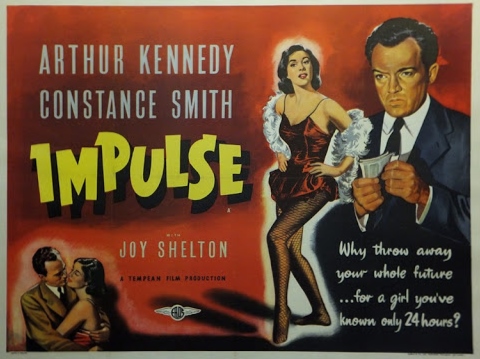
Billy Wilder made The Seven Year Itch in 1955. Twelve months before that, Cy Endfield’s Impulse had a moody Arthur Kennedy longing to scratch the 8 year variety in the UK – perhaps things developed at a more measured pace in Britain in those days, even dissatisfaction. That said, there’s nothing especially slow-moving about the film itself and it has that generally attractive vibe that I find in a lot of Tempean productions.

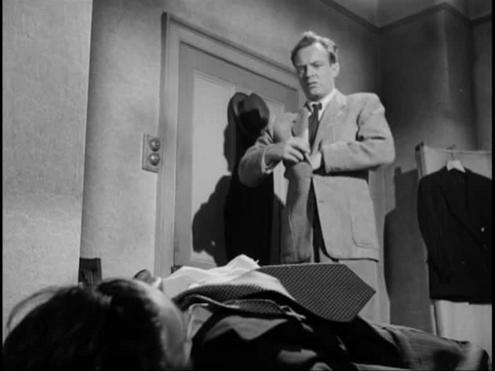
It all begins with a suitcase, that simple object that signals the beginning or end of a journey, hinting at romance and the tantalizing  promise of escape too. Here though any escape alluded to is of a slightly darker hue. Pretty much everybody in the movie is looking for an out, even those who only gradually come to realize it. Alan Curtis (Arthur Kennedy) is one of those types, an American who hasn’t made it back to the States after the war and has instead married an English girl (Joy Shelton) and settled down to a quiet life in the Shires. The trouble for our unlikely estate agent is that it’s become just a little too quiet, too ordered and altogether too predictable. His wife is off on a trip to town and even the car ride with her to the station reveals the restlessness that’s gnawing away at him; this is a man yearning for a taste of excitement once again, and such men are only a step or two away from trouble. Well that trouble will find him soon enough, a stormy night, a breakdown on a lonely stretch of road, and a glamorous woman in need of assistance is all it takes. That woman is Lila (Constance Smith), a night club chanteuse and the person who will not only lift Curtis out of the rut he’s been grouching about but send him spiraling into a nightmarish world of stolen gems, racketeers and sudden death.

They say you ought to be careful what you wish for, well we all know the punchline to that one I guess. In a way that’s slightly reminiscent of Edward G Robinson’s bored professor in The Woman in the Window, Arthur Kennedy sees an apparently innocent flirtation lead to all kinds of unexpected and potentially ruinous consequences. The idea of an essentially average type stumbling into an increasingly dangerous and bewildering set of circumstances, with  salvation forever near yet forever dancing back into the shadows with a provocatively ironic laugh every time the poor sap is on the point of grasping hold of it, is such an archetypally noir setup. The screenplay is by director Cy Endfield (although the on screen credit reads Charles de Lautour) and Lawrence Huntington (The Upturned Glass), and the protagonist’s lurch into a twilight world is plausible enough, although noir purists may feel they drop the ball at the end. Personally, I’m not troubled by that aspect and prefer to look at the whole thing as an ethical fable, a warning for the curious if you like, where where it isn’t necessary to take matters to full on Scarlet Street extremes.

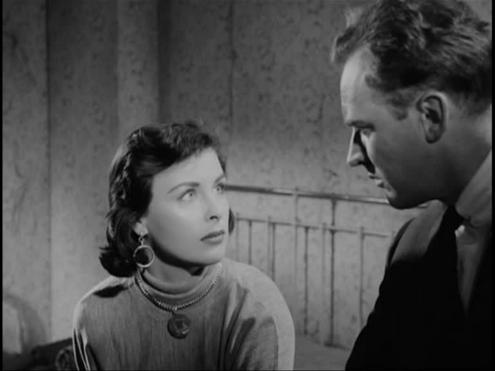
Constance Smith’s career was heading towards an abrupt halt at this stage, and indeed her life would take on a distinctly noir shading in the years to come, but none of that is in evidence on the screen. She turns in a good performance as the singer with secrets, and it’s easy to believe in anyone succumbing to her appeal; it’s a confident piece of work, combining humor, sexiness and just a hint of desperation at a couple of key moments. Kennedy is fine too and taps into a nice line in disenchantment, and he’s capable of grit and toughness when the script requires. The focus remains firmly on the two leads, which is fine as it lends a touch of intimacy to the story. Jack Allen provides solid support as Kennedy’s business partner and friend. Joy Shelton doesn’t get a lot to do, which is a pity as I think a little more development of her character might have added a layer of complexity to the drama. Cyril Chamberlain will be an immediately recognizable face to anyone familiar with British films of this era and he pops up here as a persistent henchman. I don’t think I’m straying too far into spoiler territory here if I say that the main villain is played, with suitable oiliness, by James Carney. Impulse was his last role and it appears he died the following year from gunshot wounds (if IMDb is to be believed) but I’ve not been able to learn anything else beyond that.

Impulse probably isn’t the most readily available title, in all honesty. It can be found in Renown’s Crime Collection Vol.2, and it’s in fairly good shape overall – I imagine it pops up from time to time in the UK on TPTV so that’s maybe another option. I have a bit of a soft spot for the output of Robert S Baker and Monty Berman’s Tempean Films, an outfit which may not have produced any especially great movies,  but made a lot of entertaining ones nonetheless. The sheer number of crime/noir movies made in Britain in the post-war years is staggering and while some of them are eminently forgettable, there are plenty offering a good deal of viewing pleasure, either in spite or because of their modesty. Impulse is relatively obscure but well worth a look for fans of the director or the stars.

A Left and a Right

The fight game, with its allusions to glory and honor taking a ringside seat with corruption and manipulation, has often been featured in films noir, either peripherally or as a central plot element. Today, guest poster Gordon Gates focuses on a couple of boxing movies that don’t get talked about so much.

A double bill of boxing programmers with early Robert Ryan, Scott Brady and Richard Denning performances:
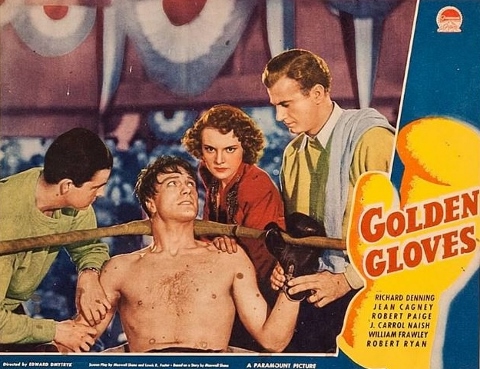
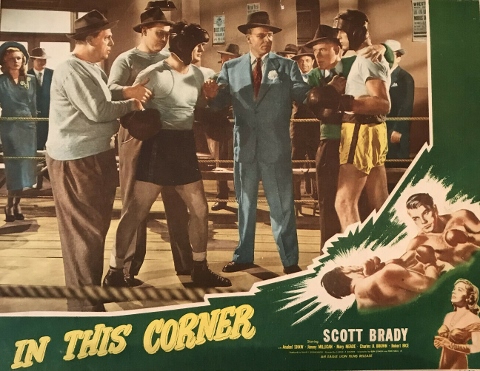
Golden Gloves (1940) & In This Corner (1948)
These two boxing films are early examples of what would become top flight noir films such as Champion, The Set-Up and The Harder They Fall.

First up is Golden Gloves from 1940

Richard Denning is an up and coming amateur boxer who makes a couple of bucks on the side, boxing for small time racketeer, J. Carrol Naish. Naish runs a string of boxing clubs that holds mismatched fights to packed crowds. “The people want knock-outs. So that is what i give them.” Robert Paige plays a newspaperman out to expose the racket which of course annoys Naish no end.

Paige arranges an amateur boxing tournament with straight up matches and proper refs, doctors etc. When George Ernest, the kid brother of Denning’s fiancée, Jeanne Cagney, is killed in one of Naish’s mismatches, Denning decides to join Paige and clean up the sport. Naish has other plans, and decides to wreck Paige’s next event by planting a ringer, Robert Ryan. (Ryan’s second credited role) Ryan’s job is to win the amateur event and then tell the papers he is really a pro.

This of course would destroy Paige’s attempt at cleaning up the sport. Naish now murders a boxer who threatens to spill the beans to the press. There is plenty of double dealing and knives to the back going on in this one. Edward Brophy, who plays a crooked manager, is a complete hoot to watch. Needless to say the last fight becomes a bout between Denning and the ringer, Ryan.

Denning manages to pull off a win to save the day while Naish and his gang are grabbed by John Law for the murder.

While I’m not saying this is an actual noir, there are plenty of flashes throughout the film. The cast and crew here would go on to be featured in many film noir.

The film was directed by Edward Dmytryk with help from an uncredited, Felix Feist. Dmytryk of course went on to helm the noirs Murder, My Sweet, Cornered, Crossfire, Obsession and The Sniper. Feist also dabbled in film noir with The Devil Thumbs a Ride, The Threat, The Man Who Cheated Himself, Tomorrow Is Another Day, The Basketball Fix and This Woman Is Dangerous included in his resume.

The D of P was Henry Sharp who lensed Ministry of Fear, The Glass Alibi, High Tide and Guilty.

The film was written by noir regulars Maxwell Shane, Fear in the Night, The Naked Street, The Glass Wall and Lewis R. Foster, who did Crashout and Manhandled.


Next up on the bill is In This Corner from 1948.
This one has Scott Brady in his third film and first lead, as a just out of the Navy scrapper who wants to become a pro boxer. He tells his girl, Anabel Shaw, that he is off to join an old Navy vet who manages a boxing club. Brady tells her that once he makes his fame and fortune, they can get married etc.

Brady finds the old vet has not managed a fighter in years and the club is just an old rooming house with himself as the only boxer. Brady sticks it out and is soon hired as a sparring partner at a club owned by a mobbed up manager, James Millican. Brady is soon signed to a contract by Millican after he decks a ranked fighter during a sparring bout.

Brady KO’s his first opponent and is soon moving up with 9 straight wins. His girl Shaw joins him and life looks good. That is till Millican informs him he is to take a dive in the next weekend’s fight. Millican’s mob is placing a large wager at long odds on Brady’s opponent, and his assistance is required. Brady is more than a little annoyed at this idea and tells Millican to get stuffed. Brady intends to win and to hell with the mob! Of course the mob has a back-up plan. They stick a punch-drunk boxer one step away from the morgue in with Brady to spar with. The boxer, Johnny Indrisano, goes down in a heap at the first punch and is hauled off to the hospital. It is the night of the fight, and Brady is getting ready to enter the ring when a telegram is delivered. It states that Indrisano has died from Brady’s punch to the head.

Needless to say this news throws Brady’s game off and he is savagely thrashed, just like the mob wanted. He asks for a re-match in 3 weeks and gets it. He trains hard but the death of Indrisano eats at him. The day of the fight, Brady sends Shaw off to see about helping out the dead boxer’s family. Imagine the surprise when Shaw finds no record of Indrisano’s death.

She digs deeper and discovers the whole thing was a mob ploy to upset Brady. She hunts down the quite alive Indrisano who is being stashed at Millican’s country house. Of course while all this is going on, Brady is again being pummeled in the ring. Shaw, the police and the just rescued Indrisano get to the arena just in time for Brady to rebound for a KO. Millican is grabbed up by the cops and the film is wrapped in just under an hour.

The director was Charles F. Riesner, whose claim to fame was Buster Keaton’s Steamboat Bill Jr and the Marx Brothers’ The Big Store. The D of P was Guy Roe who worked on noir such as, Railroaded, Behind Locked Doors, Trapped and Armored Car Robbery. The story is by Fred Niblo Jr who worked on Convicted, The Incident, The Bodyguard and The Wagons Roll at Night.

Ex-pug Johnny Indrisano sported a 64-9-4 record as a pro and beat several world champs during his career. He then became a character actor and a trainer for boxing films. He has bit parts in 99 River Street, Johnny Angel, The Bodyguard, Knock on Any Door, Tension, Borderline, Force of Evil, The Set-Up and about a dozen more noirs and numerous TV shows.

Nifty little low renter that is better than I make it sound.

——————————————————————————————————

Gordon Gates