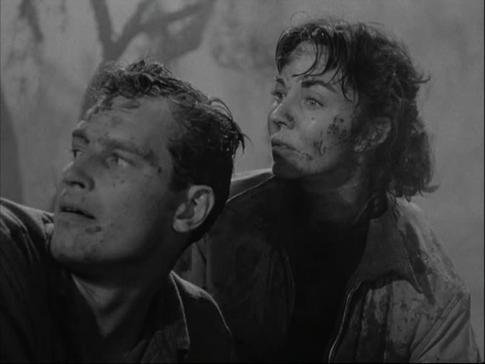
Mogambo

Doing the right thing – a trite phrase in some respects, and yet it also goes straight to the heart of the personal dilemmas which form the basis of and indeed drive so many dramatic works. Ultimately, what does it mean to “do the right thing”, or to “go noble” as one of the characters in Mogambo (1953) puts it? Isn’t this just one aspect of our human condition, that perennial struggle for primacy between head and heart? Of course there’s an argument to be made that neither head nor heart can act entirely independently, and perhaps the way this movie resolves the internal conflicts which confront its characters is a reflection of that.

The notion of the fish out of water is a useful and much used dramatic device and whole movies have been hung on this particular peg. Nevertheless, it can be a tiresome conceit if the filmmaker decides to rely on it alone. John Ford was nothing if not a great artist and therefore had the wisdom to know that while this could act as a hook initially, far more substantial morsels were necessary to build a story around. So it is that Eloise Kelly (Ava Gardner) is introduced, turning up in the East African bush where the sass and sex appeal of Manhattan are of, let’s say, limited effect. It appears she has been stood up in style by a high class date, and the philosophical way she accepts this suggests that she’s no stranger to such setbacks. Stranded in an alien environment, with no way out till the next boat arrives in a week’s time, she decides to make the best of it. Making the best of it includes trying to find something useful to do and hopefully avoiding the censure of her grudging host, game trapper Vic Marswell (Clark Gable). Nature has a habit of taking its course in even the most civilized and sophisticated of settings so it ought to come as no surprise when wilder climes hurry that process along a little. To cut to the chase, Kelly and Marswell embark on a brief affair, but only one of them is looking any further at this stage. When the supply boat arrives it brings a couple of green innocents on a scientific expedition, and signals an abrupt end to Kelly’s dreams. The young couple are the Nordleys, Donald (Donald Sinden) and his wife Linda (Grace Kelly), and it won’t be long before Marswell’s eye is roving once more. However, it would be a dull and disappointing business if that’s all there were to it; either the tides of the river or maybe the more persuasive tides of fate see the old steamboat run aground and an unexpected reunion effected.

The consensus view on remakes seems to be that they are rarely a patch on the originals. Whether or not one subscribes to that approach, it’s generally advisable to assess everything on its own merits. Mogambo is a reworking of the 1932 movie Red Dust, which also featured a young Clark Gable in the lead. Even though it’s been many years since I viewed the original I feel secure in my view that Ford’s retread is by far the better film. Of course the fact that it’s Ford’s hand guiding it makes all the difference. His little quiet touches, his grace notes, are everywhere; from the resigned drop of Gardner’s head as she watches Gable walk off to greet his new clients, to the way Gable himself contemplates his smouldering cigarette as his own chances dwindle correspondingly. There is too the seamless blending of landscape and environment into the narrative, with key moments played out against the backdrop of moonlit lakes and waterfalls. Mogambo was made in the middle of a run of movies for Ford where this professed “director of westerns” avoided the genre with which his name has been so closely linked. From Rio Grande in 1950 until The Searchers in 1956 he didn’t touch westerns, but there remains something of the spirit of that genre on show here. Ford was always drawn to the intimacy of frontier living, the  minutiae of existence of those living on the edge of civilization, particularly in the Cavalry trilogy. Mogambo recreates some of that in the comfortable and companionable remoteness of Marswell’s lodge, while the beauty and hazards of the wilderness become apparent as the safari gets underway. And underpinning it all is the threat to existential connectedness, the essential symbiosis that links everything, which is posed by the arrival of the civilized Nordleys; this is quietly underscored by the frustration felt by Gable when he finds himself forced to kill animals on two separate occasions in order to save the lives of these two interlopers.

In addition to Ford’s motifs and sensibility, a more mature and experienced Gable adds another dimension to the movie. There is that gruff individualism that he so often traded on but it’s tempered somewhat by his playing a man who has lived too long in isolation, detached from emotional connections and therefore able to bond freely only on the most superficial levels. Still, those extra years add depth to his portrayal, the passage of time, or his awareness of it at least, seem to give a greater urgency to his character’s hunger, that knowledge of the need to grasp whatever opportunities come his way before it’s too late. In fact, as the story unfolds it is possible to read the internal conflict he’s experiencing, that head and heart business again, where he’s forever trying to balance some yearning for fulfillment against his personal code of ethics. In so doing, he runs the risk of losing the greater prize.

When all is said and done, the movie really belongs to Ava Gardner. Gable was top billed and, as I’ve said, he does excellent work, but the screen genuinely sparkles whenever Gardner is there. She is the main driver of events and acts as the emotional core. It’s a superb performance by an actress at the very top of her game and the height of her allure – I’ve been delving into that purple patch she struck in the mid 1950s after having recently enjoyed a rewatch of The Sun Also Rises. This was her third time playing opposite Gable, after The Hucksters and the extremely disappointing Lone Star, and it’s far and away the best of their collaborations. Her role played to her strengths, her earthy free-spirited sensuality is always to the fore, but also presented her with more subtle challenges. An example of this is the way she gets across very clearly the illusory nature of her free and easy demeanor. There’s a beautifully telling moment just after she embarks on the steamer where she’s pacing back and forth on the deck in front of a cage containing a captured leopard, the animal inside mirroring her moves. It’s evident that Gardner is trapped too, confined in life by the limited choices available to her. Despite this, she remains the most positive aspect of the movie, representing Gable’s chance for redemption and fulfillment – she is the siren whose song doesn’t lure a man to his doom but instead leads him toward salvation.

Grace Kelly had just come off High Noon but her biggest and most famous roles were still ahead of her. Her character is immature, a girl playing at being a woman, self-centered and plagued by indecision. Kelly nails the breathlessness and deception but is limited somewhat by the one dimensional nature of the role. Donald Sinden has the rather thankless part of the cuckold but does elicit sympathy due to his forthrightness and inherent dignity. Further support is provided by Philip Stainton as Gable’s plummy-voiced friend, Eric Pohlmann as a lazy and vulgar drunk, and a quiet Denis O’Dea, whose wordless confessional scene with Gardner provides another of those delightfully Fordian grace notes.

To the best of my knowledge, Mogambo has still not had a Blu-ray release. The old DVD has been around for many years now and is pretty solid, though this is the kind of movie which could look spectacular with a bit of a cleanup and a HD upgrade. It may not rank among John Ford’s more celebrated films but it’s long been a favorite of mine and one I am always keen to recommend.
A Bullet Is Waiting

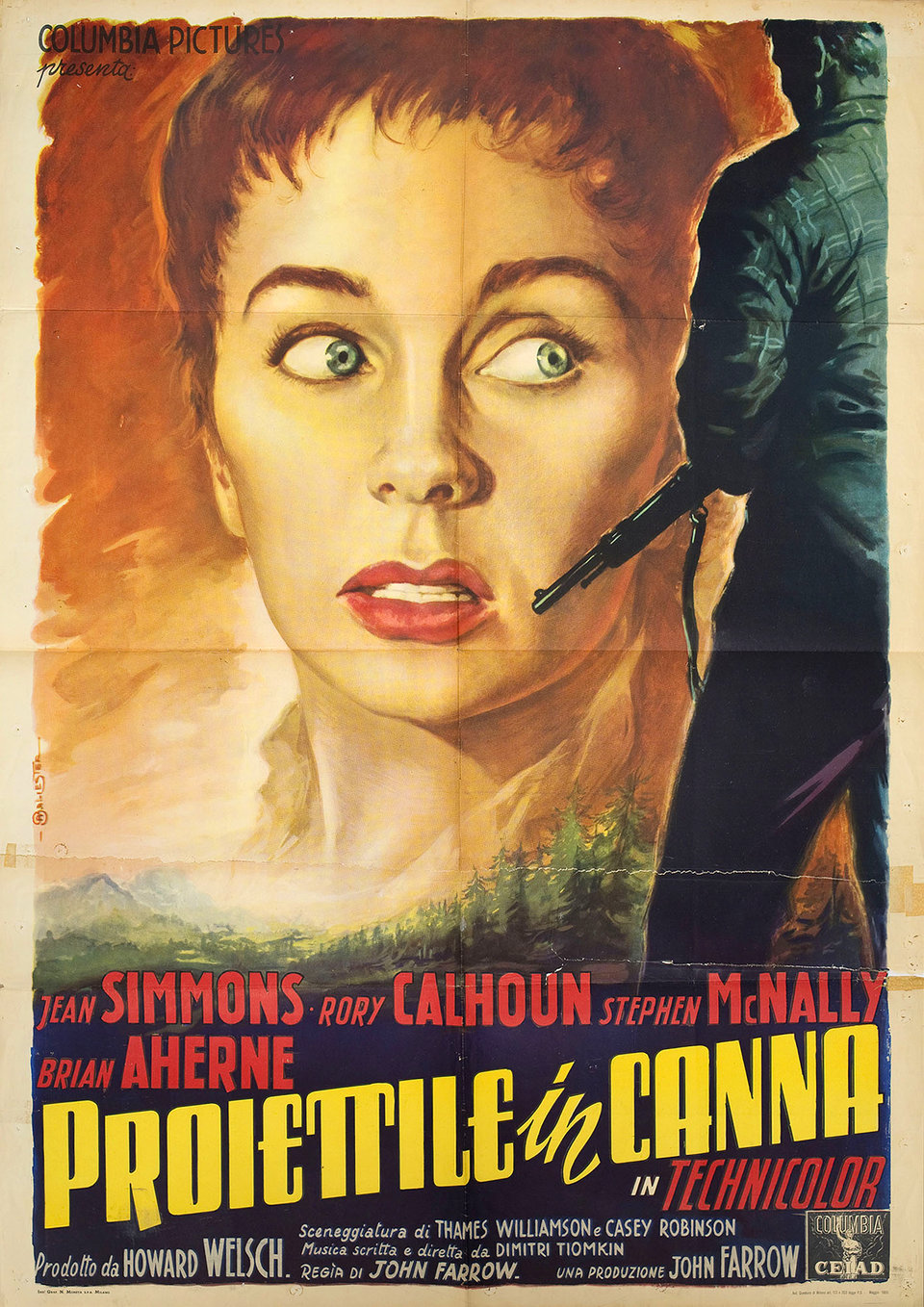
I’ve spoken of the importance of titles before, and I do like to see a punchy and enticing one used. A Bullet Is Waiting (1954) has a lot going for it: it promises suspense, danger and action, it raises questions in one’s mind and attracts the attention. Is it perhaps more than a little misleading though? In a sense it’s not, as it does allude to a very real fear motivating one of the leads. On the other hand, I know that when I first heard of it I had mental images of a western or a noir-shaded thriller. Yet that’s not really what ends up presented on the screen as it’s essentially a rustic melodrama with action/thriller elements backing up a tale of romance and renewal.

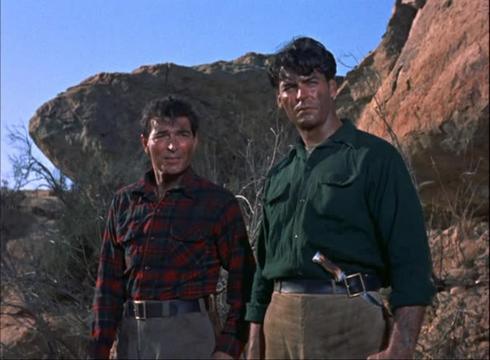
Openings that fling the viewer unapologetically into the very heart of the story can be hugely effective, and that’s what occurs with A Bullet Is Waiting. The first image is of boiling, surging waters, waves driven relentlessly by their own turmoil onto hard and unyielding rocks; this, backed by a characteristically muscular and dominant Dimitri Tiomkin score, signals an affair of heightened passions. As the camera moves around the detached wheel of a plane is visible at the edge of the swirling tide, and the tracking shot back inland reveals more wreckage and debris littering the shore, seguing gradually into footprints gouged frantically in the sand. And then, at the crest of a hillock, two figures loom into view struggling against and pummeling each other in desperation. They are Ed Stone (Rory Calhoun) and Frank Munson (Stephen McNally), fugitive and pursuer respectively, quite literally locked in combat since they are shackled together at this point. Stone gains the upper hand, releases himself and sets off alone. It’s a temporary separation though and these two antagonists are soon to be reunited when they stumble  onto private property. Cally Canham (Jean Simmons) is a young woman who has been living an isolated existence with only her reclusive father (Brian Aherne), and her loyal sheepdog, for company. With her father away for a few days, neither Cally nor the two survivors of the plane wreck particularly want to be holed up together in her cabin. However, a prolonged and dramatic storm leads to flooding that cuts off all possible escape routes, and forces these disparate characters to contemplate those timeless adversaries: retribution or redemption. By the time Cally’s father returns a number of truths will have been laid bare and paths chosen.

Now this is by no means a perfect movie, there are weaknesses which I’ll address later, but it has quite a lot going for it. Director John Farrow starts out with that wonderfully cinematic opening sequence I’ve spoken about and manages to steer a fairly even course throughout, avoiding the trap of letting it get too talky, even when the plot drifts toward some philosophical musing. That philosophy – espoused on screen by Aherne and represented by his withdrawal from a modern world he sees as increasingly dominated by confusion and conflict – is actually dealt with more subtly within the framework of the plot.  Personally, I see it as a variation on the classic redemption theme by focusing on the restorative powers of nature. From the primal power of the storm to Franz Planer’s beautiful photography of the pastoral scenes, and on to the soothing effect of the sheepdog and the lamb on the frayed emotions of the characters, the influence of nature and its ability to effect renewal is never far below the surface.

As I noted though, there are weaknesses here, which ought to be mentioned. Firstly, I see the redemptive strand having  a dual focus, on the characters of both Calhoun and McNally, the need for its application to the latter emerging only gradually. By the end this is seen to have been achieved, but in one case it was never in serious doubt anyway whereas in the other something is lost, in my view at least, by the abruptness with which it occurs. Any picture that embraces the concept of redemption and/or renewal is always welcome with me but I have to say I prefer it when the road which leads there feels a little longer, or when the battle is harder fought; in A Bullet Is Waiting it, and indeed the ending itself, arrives with something approaching alacrity. I’ve talked a lot about both Calhoun and McNally on this site in the past so I’ll simply say that both men turn in typically strong work, with the former’s innate likeability and the latter’s knack for tapping into ambiguity to the fore. Brian Aherne’s presence is felt from early on through his influence on his daughter’s thinking and character but he only makes an appearance in the final third. He brings a lovely sense of quiet authority and civility to his role. I liked him in Hitchcock’s I Confess and I must try to feature some more of his work in due course.

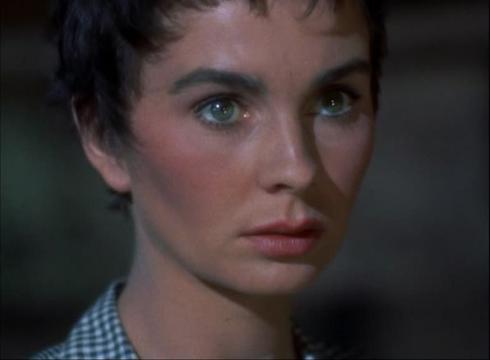
However, the real star of A Bullet Is Waiting is Jean Simmons. She had a good deal of range, her deranged beauty in Angel Face remains a remarkable piece of screen acting and contrasts with the delicate innocence she displays here. Her slow awakening and realization of the possibilities existing outside her cloistered existence is well done; the image of her sitting in her modest bedroom, leafing through her book on ballet, the little toy ballerina turning pirouettes within its own  protective yet restrictive space, as she tries to find some common ground with Calhoun’s roughneck is just impossibly charming.

A Bullet Is Waiting was put out as a manufactured on demand DVD in the US by Sony and it’s also available in a number of European editions. Generally, the image is pleasing with Planer’s Technicolor cinematography looking particularly fine. I see that the movie is categorized as a film noir by both IMDb and Wikipedia but, even as one who tends toward an inclusive interpretation, I don’t feel that it should be applied in this case. All told, despite a somewhat rushed ending, I found this to be an enjoyable and rewarding watch. It’s one I’ll be returning to.

Rogues’ Regiment

With a variety of matters vying for my time and attention these days, I’m grateful to have this opportunity to put up a piece on another of those relative rarities that Gordon Gates thrives on. So, read on…

Rogues’ Regiment (1948) is one of a number of post WW2 noir dealing with escaped Nazi war criminals. Notorious, Cornered and The Stranger would be several of the more well known.
In this one, Dick Powell is an army intelligence agent on his way to French Indo-China. He is on the trail of a high-ranking SS officer who had escaped the roundup at the end of the war. The trail leads Powell to the French Foreign Legion camp in Saigon. (The French used large numbers of ex-German soldiers in their war with the Viet-Cong).
Powell’s main problem is that there are no known photos of the man he wants. He joins the Legion himself in order to try and identify the swine. Said swine, Stephen McNally, is very careful about his identity and bumps off everyone he thinks is a danger.
Helping Powell out on his case is French Secret Service agent, Marta Toren. Toren poses as a singer in a cabaret frequented by off duty Legion members of the German type. Of course Powell and Toren are soon drawn to each other.
Also in the mix here is Vincent Price as an antique dealer who supplements his income with a little gun running for the Viet-Cong. Philip Ahn and Richard Loo play Viet Cong types who are buying said weaponry from Mister Price.
McNally, who picked Saigon and the Legion thinking it would be the least likely spot to be recognized, finds the opposite true. One of his ex-staff officers, Henry Rowland from Dachau concentration camp happens to be in the same unit. While out on patrol the men become involved in a fire-fight with the Viet-Cong and McNally applies a few rounds to the man’s back. Problem solved.
Not quite it seems. Old Vincent has tumbled to McNally’s identity and figures a bit of blackmail is in order. He knows McNally has a large cache of jewels and gold taken from his camp victims. Price wants most of it. McNally agrees as long as Price can supply him with a passport and some American dollars so he can leave the country.
Both of course plan to double cross the other when the deal is completed. Powell and Toren who have been one step behind finally clue in and quickly pick up their pursuit. The meeting between  Price and McNally needless to say has turned ever so bloody. Who wins?
The director here is Robert Florey. His work included Meet Boston Blackie, Dangerously They Live, The Beast With Five Fingers, Danger Signal, The Crooked Way, and the very under-rated The Face Behind the Mask. He was also the helmsman on hundreds of television episodes.
Screenplay was by one time Oscar nominee, Robert Buckner. He did the story or screenplays for Deported, A Prize of Gold, Yankee Doodle Dandy, Santa Fe Trail, Virginia City, Dodge City and Love Me Tender.
Powell and Toren are okay with their roles, But it is McNally here as the Nazi louse, and Price as the blackmailing snake in the grass who steal the show.
Toren, who died at age 31, managed to work the film noir  Deported, Mystery Submarine, Spy Hunt, Illegal Entry, One Way Street, Paris Assignment and Sirocco into her 4 year Hollywood career. The d of p was Maury Gertsman whose noir included Blonde Alibi, Inside Job, Singapore, One Way Street, The Glass Web and Johnny Stool Pigeon.
Well worth a watch if you can find it. Needless to say it is another UNIVERSAL-INTERNATIONAL Release.
Gordon Gates

The Sun Also Rises

Adaptation, moving from one medium to another, has been a feature of moviemaking since the earliest days, and it’s always been fraught with difficulties. Shifting a theatrical production from the stage to the screen ought to be a reasonably smooth procedure, after all drama is drama, right? Well, not always. What captivates in the theater can all too easily appear static and restrictive on the screen. Yet this is as nothing compared to the potential pitfalls of the literary adaptation, and the more famous or well-regarded the source material, the greater the chance of a negative reaction. This is understandable – authors decry the debasement of their work, the simplifications imposed, and readers express dismay at the excision of cherished passages or, worse yet, casting decisions that make a nonsense of the images they’ve been carrying around in their minds. In short, a screenwriter with a  book to adapt can be forgiven for seeing himself (or herself) on a hiding to nothing. The Sun Also Rises (1957) is based on what might well be Hemingway’s best book and it doesn’t seem to have made too many people happy. The author reportedly derided it and the screenwriter Peter Viertel disliked it. I’m not really sure what the critical consensus is but I know I always enjoyed the movie. If the book was about dreams and desires that were doomed to failure, flirtations and affairs that could only ever be imitations of what the protagonists wanted or needed, a paean to the beauty and tragedy of what can never be, then I reckon the movie, because of rather than in spite of all its flaws, might just be as good an adaptation as anyone could ever hope to make.

The Lost Generation: Hemingway and Fitzgerald, Paris, art, passion and a massive collective hangover after years of pointless slaughter seguing into a decade of apparent aimlessness, where creativity was the only antidote available to a creeping despair. Jake Barnes (Tyrone Power) is a product of all this, surrounded by artists and assorted dilettantes, wunderkinds and wasters. He is in some ways the most directionless of them all, a newspaperman who never returned home after the war and probably never will. The scars of conflict run deep in his case, rendering him impotent and thus consumed by apathy and resignation. He’s an observer of the hedonism and excess, central to it all by acquaintance yet peripheral by necessity. It’s through his eyes that the viewer sees the story unfold: first in the Parisian nightspots where he reacquaints himself with the aristocratic Lady Brett Ashley (Ava Gardner) – in his words, a drunk and a drifter – and just about tolerates the painfully self-aware Robert Cohn (Mel Ferrer); and then later in Pamplona for the fiesta, where Brett’s fiancé the dissipated Mike Campbell (Errol Flynn) meets up with them all. The whole thing amounts to a journey of discovery, where a group of desperate people are gradually force to confront the reality that, through ill-fortune or maybe just the vagaries of fate, none of them can ever hope to capture the love or personal fulfillment they yearn for. Yes, the sun will rise on another day but it’s a chill dawn that signals a world moving further away from their grasp.

The entire second act is played out during the height of the fiesta, with Mexican locations doubling for Pamplona. As the relationships become ever more tangled and the jealousies, flirtations and frustrations grow in intensity to match the progress of the fiesta the one constant in the background holding the group together is the Corrida. Hemingway was fascinated by bullfighting, writing Death in the Afternoon to address his passion for it. My own take on that aspect is that it was fueled, as were so many of his themes and concerns, by the reaction to those wartime years that left the characters of The Sun Also Rises adrift in the world. Much is made of the nobility and honesty of man confronting the overwhelming power of nature head on, of its spectacle and theatricality. It feels like an attempt to juxtapose this grand theater of death with the mindless mass slaughter he had experienced. It is as though his attitude to living and, maybe even more important in his case, dying is shaped by it; there appears to be a need to find some order and formality to it all and thus achieve some spiritual accommodation with himself and perhaps with the world in general.

As I said above, Hemingway expressed dissatisfaction with the adaptation, much to producer Darryl F Zanuck’s disgust, although it’s been suggested he may not even have seen it. Screenwriter Peter Viertel wasn’t happy with how it all turned out either, complaining about the decision to shoot in Mexico rather than Spain. Frankly, I don’t think that makes a lot of difference to the finished movie and it certainly isn’t something this viewer would count as a weakness. He also seems to have had some issues with the casting, but he’s not alone in that and it’s something I’ll come to later. Are there changes to what Hemingway had put down on paper thirty years before? Yes of course, but again my own feeling is that these aren’t of a magnitude to trouble me, and I think it’s necessary to come to terms with the fact that a shift to a different medium is always going to result in changes for a range of practical reasons. What’s important is to respect and appreciate a work on its own terms, not in relation to where it came from, not what we the audience feel it should be, not even what the original creator wanted. Ultimately, one can only evaluate the worth of a piece of art on the basis of what it is.

Henry King’s direction is as assured as ever, transitioning smoothly from  scene to scene and on into each distinct act. The CinemaScope image is well used by him in the scenes illustrating the crowded and bustling nature of the fiesta but what’s critical is his ability to maintain the required sense of intimacy when the main players interact – the bar and bistro scenes, the pivotal bedroom scenes where everyone retreats for rest but where personal revelations are made and souls are frequently bared, and of course the two key moments with Brett and Jake sharing the back seats of cars. Those are the moments where King’s lens brings the focus onto the principals, where they and their jumble of emotions dominate that big screen to the exclusion of all else.

As for the casting, I’ve seen comments before to the effect that the movie was miscast with a central group who were too old for the parts they were playing. This is undeniable and some of them look very shopworn indeed, although again I’ve never considered it a drawback. It’s been many years now since I read Hemingway’s novel but I do recall thinking that here were a collection of people whose youth had been stripped away by the horrors of combat, who had been forcibly aged beyond their years. Tyrone Power and Errol Flynn do look tired but their characters have been badly bruised by life so that’s not an issue as far as I’m concerned.

Power gets across the introversion, bitterness and only half concealed impatience of Jake, his surface affability appearing thin and brittle at times. Ava Gardner is fine too as the unfulfilled beauty, a woman who ought to have it all but who has fallen foul of a piece of rotten ill-fortune by loving the one man who cannot satisfy her needs. The substitutes she flits restlessly around are a disappointing selection: Mel Ferrer’s emotional immaturity and self-absorption is easy to despise and Errol Flynn’s decayed swashbuckler can only ever be a temporary  distraction. And it’s a superb performance by Flynn, a brutally honest portrayal of self-destruction. The sparkle is still there and the charm too but there’s a desperate sense of regret that can’t fail to touch one and I doubt the screen has ever seen a finer display of ragged dignity. Eddie Albert provides a happy-go-lucky prop for Flynn, and Juliette Greco, who just recently left us, is impressively insouciant in a small part. It seems that few people were keen on Robert Evans as the bullfighter who captivates Gardner, prompting Zanuck’s famous “the kid stays in the picture” remark. To be honest, I don’t think he adds a lot – he does have a certain gauche quality that is partially endearing but I’m not sure there’s the kind of magnetism about him that would give rise to an obsession in a character like Brett.

The Sun Also Rises has always looked strong on DVD; I had the old UK disc for many years and thought it looked fine but I was tempted to pick up the the Blu-ray over the summer when I noticed it going cheap.  Unsurprisingly, it looks even better in high definition and there are some nice supplements to add value, including a commentary track, an audio interview with Henry King,  a featurette on the making of the movie with contributions from Peter Viertel among others, and one on Hemingway adaptions in general.  All in all then, I feel that despite the reservations some have expressed regarding casting choices, locations, and changes from the original text, that the movie holds up well. If there are imperfections, and I’m not sure some of those are as damaging as they’re alleged to be, then that’s perhaps appropriate for a film about characters who are themselves less than perfect.

Moss Rose

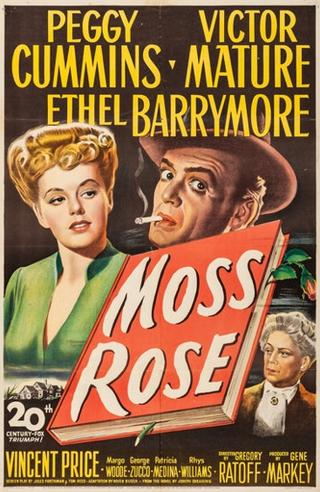
Call a movie contrived and it immediately conjures up images of some wholly unrealistic scenario, something the hardheaded among us will insist gravely could never come to pass. And thus, with wisdom intact, we dismiss it and move on to something more credible and by inference something altogether better. Perhaps the years are encouraging me to be more contrary but I find I’m increasingly at a loss to understand why a lack of realism in any form of artistic expression  – and I’ve yet to hear a convincing answer offered as why those two concepts need to be forced into an uncomfortable marriage anyway – has to be regarded as “a bad thing” and avoided at all costs. The Gothic romance is one of those areas where the contrived situation is commonly found, and that seems to be even more apparent in the 1940s variety which frequently flirted with film noir. Moss Rose (1947) is one such movie, a murder mystery requiring the viewer to resolutely suspend disbelief and take some unlikely behavior at face value.

Edwardian London: Hansom cabs clatter over slick cobbles while tendrils of fog curl themselves seductively around softly glowing gas lamps, and our narrator breathlessly begins her tale. Belle Adair (Peggy Cummins) – it’s her stage name but it’s the one we first encounter her under so I’ll continue to use it here – is a young chorus girl who tells of a mysterious stranger she’s often spotted slipping in and out of the shadows next to the boarding house she occupies along with a number of other performers. She assumes it’s the latest conquest of one of her friends. When that same friend then turns up drugged and strangled in her room Belle is convinced the killer must be that same man and the fact she actually saw him scurrying guiltily from the scene of the crime appears to seal it. With persistence, considerable brass and a sprinkling of luck, she manages to trace the man to one of the better hotels in town. He turns out to be one Michael Drego (Victor Mature), a wealthy gent who just happens to be on the verge of wedding a well-bred beauty. To go into further details would I feel spoil it for anyone unfamiliar with the movie so I’ll confine myself to saying that Belle strikes an odd bargain with Drego, one which falls a step short of blackmail but which is every bit as risky.

Director Gregory Ratoff seems to have been one of those effortless all-rounders who could be found in classic era Hollywood, a director, actor, writer and producer. Aside from Moss Rose, I’ve only seen a couple of his movies (Intermezzo and The Corsican Brothers) and both of  those quite some time ago, although I have a copy of Black Magic with Orson Welles somewhere. Everything about his handling of the movie feels very smooth and confident, his camera seems to enjoy drinking in the rich details of the elaborate Fox sets and the melodrama at the heart of the story is fully embraced. That story is an adaptation of a Joseph Shearing novel and the script is at least partly due to Niven Busch, who was responsible for the last entry on this site Distant Drums. While that was a  somewhat flat affair, Moss Rose has a little more of the kind of off-kilter psychology one often comes across in scripts by Busch. While this doesn’t have the depth or power of some of his best writing, there is that trademark motif of a dark and disturbing past reaching out spectral fingers to toy with passions in the present.

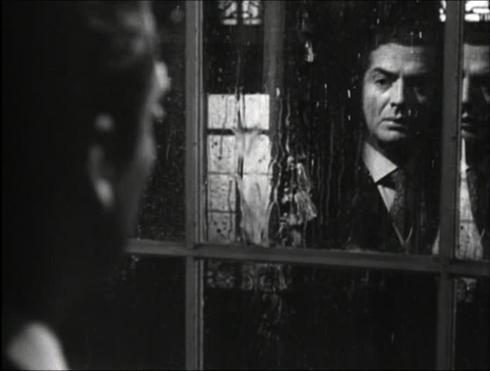
Victor Mature took the lead in a role which was a fine fit for him, the soulful, tortured look he found so easily had served him well in many a film noir and he exploits it here to good advantage. We’re used to seeing him as a heroic figure, perhaps a pressured and hunted one but a sympathetic character nonetheless. His casting in Moss Rose as the chief suspect subverts those expectations and teases the viewer, and Ratoff’s careful shot selection, with the help of cameraman Joseph MacDonald, emphasizes this. Peggy Cummins, in her first Hollywood production, is another good pick as the vulgar ingenue straining to sample the dream she’s nurtured since her impoverished childhood. There is something touching about the frank idiocy of it and the peril she’s willing to expose herself to, although I guess it’s this aspect which those who pine for greater realism will find least appealing.

Among the many pleasures of watching movies from the major studios in this era is the depth and quality of the supporting casts. Vincent Price’s silken charm was a boon to every production he appeared in and at this stage in his career, before he’d earned the right to have the whole show to himself, my only regret is that he’s not on screen longer. The deceptively effete, flower loving, detective he plays in Moss Rose is a neat turn, and disguises the character’s cool, steely intelligence. Rhys Williams as his poker faced subordinate is the ideal foil and they make for an entertaining team every time they appear. If you had to pick one actress to project an otherworldly quality, then Ethel Barrymore would have to be among the strongest contenders. That fey persona, as of one only paying the occasional flying visit to the rest of us, is to the fore again here. Patricia Medina and Margo Woode add to the background glamor, and it has to be said that any house boasting George Zucco as the butler  should be automatically viewed with suspicion.

Moss Rose came out on DVD some years ago as part of the Fox MOD line and subsequently popped up in Europe. The copy I viewed is in reasonably good condition, perhaps the contrast is a little too harsh here and there but it looked solid enough overall. I enjoy these gaslight Gothic thrillers with a hint of noir in the background but I acknowledge they may not be everyone’s bag. As I said at the start, stories such as this have a tendency to rely heavily on contrived situations and that can present a problem for some viewers. If, on the other hand, you’re happy to take the movie on its own terms, there is a great deal of pleasure to be had viewing Moss Rose.

Distant Drums

How does one get the measure of a filmmaker? I guess received wisdom has it that a viewing of their best works is the ideal way to go about it; this assertion appears to be self-evident and it’s not one I’m not going to dispute. However, I can’t help wondering if there’s not something be gained from an examination of what might be thought of as their mediocre efforts as well. It just occurred to me as I was watching Distant Drums (1951) that Raoul Walsh’s strengths as a director were still on display despite the fact the movie in question was very much a routine affair. In fact, a great deal of what makes this film worthwhile derives from the skill of the man ultimately calling the shots.

Distant Drums is one of only a handful of movies that use the conflict with the Seminole in Florida as a backdrop. I use the word backdrop because that is very much the case here, with no examination whatsoever of that conflict taking place. In narrative terms it merely serves as a frame on which to hang a straightforward story of pursuit and danger. In brief, the Seminole are being armed by gunrunners operating out of an old Spanish fort and this supply needs to be cut off if the army is to be successful in subduing them. To this end, a young naval officer (Richard Webb) is sent to the island retreat of the reclusive Captain Wyatt (Gary Cooper) to accompany him and his small force and assist them during the essential lake crossing en route to their target. While the initial assault on the fort is a success the return to the prearranged rendezvous proves problematic. Wyatt and his party,  now supplemented by a rescued hostage (Mari Aldon) and her maid, are forced to abandon their original plan and instead plunge into the steamy, crocodile infested Everglades.

If one takes the movie as an uncomplicated adventure,  Distant Drums works just fine. There is no shortage of incident, the action scenes are frequent and absorbing, and there is enough suspense generated at key moments to quicken the pulse. The assault on the fort is a grand bit of work, shot and cut together with a fine eye for the geography of the building and never drifting into the type of muddle a complex set piece such as this always flirts dangerously with. And this leads me to Raoul Walsh. He was one of the great directors, in my opinion, a man of boundless skill and possessed of the kind of practical artistry that allowed him to tackle even the most unpromising and prosaic projects with the same dedicated flair as one would expect were he making a prestige picture. It’s sometimes said that Walsh was the consummate action director, but it’s maybe more accurate to think of him as a master of drive and motion. His movies always appear to move effortlessly forward, smoothly shifting gears and bringing the audience along for the ride even when the journey itself hasn’t all that much to offer. This is what I was alluding to at the beginning, how the capabilities of a director like Walsh remain apparent despite the limitations of the material he was handling.

I can’t fault Walsh’s direction, and neither the gorgeous location cinematography of Sidney Hickox nor the score by Max Steiner disappoint. So where is the film lacking? Surprisingly, I think the responsibility has to be laid at the door of of the writers. I say it’s surprising because the name of Niven Busch on the credits generally has me expecting a bit more depth; perhaps some  probing into character, some heightened emotion, or even a hint of twisted psychology. Yet none of that is present, and in the end we know little more about any of the characters than we did at the outset. I certainly haven’t seen all of the movies Busch provided a screenplay for but of those I have (mainly his later pictures) I think it’s fair to say that Distant Drums is easily the least interesting. For what it’s worth, I have another of this writer’s scripted movies in mind for a future write up – and no, it’s not Duel in the Sun before anyone asks.

The thing about great movie stars is how even unremarkable films gain by their presence. There are those who dislike or are unconvinced by Gary Cooper’s style, and that’s of course fine, but I’d have thought his place among cinema’s pantheon is undisputed. Sure he’s laconic and his work is understated but he commands the screen whenever he’s present and dares anyone to look away. Still, I feel the script let him down somewhat. Next to nothing is made of the potential suggested by his character’s late wife or their mixed race son. The danger the latter is exposed to at the end and the effect on Cooper is worth noting but it never feels like it’s center stage. Mari Aldon makes for an attractive co-star and the romance which develops is gentle and light. This may well have been her most substantial role, certainly of what I’ve seen. However, I’ll remember her more for her small part as the world weary companion of Warren Steven’s abusive and uptight producer in the superior The Barefoot Contessa. Richard Webb has probably the most thankless role of all, the point of view figure who introduces the whole thing and then ends up relegated to merely tagging along. Had there been some more serious rivalry with Cooper’s character injected then it might have added another layer of interest. The support is provided by Arthur Hunnicutt playing one of his patented frontier types and the seemingly ubiquitous Ray Teal as a discontented soldier.

Distant Drums is one of those productions that depends heavily on its visuals as a result of the lush cinematography in Florida. This is one of the movie’s principal attractions and needs to be shown off to its best advantage. The Blu-ray and DVD released by Olive Films some years ago does highlight this aspect most satisfactorily, even if it offers no supplementary material. I may sound as though I dislike the movie, but that’s not true. It remains serviceable, attractive and entertaining. That said, it feels like an opportunity was missed, that the talent involved wasn’t exploited as it might have been. Nevertheless, it helps cement, in my mind anyway, an appreciation of the apparently effortless skills of Raoul Walsh.

Ruby Gentry

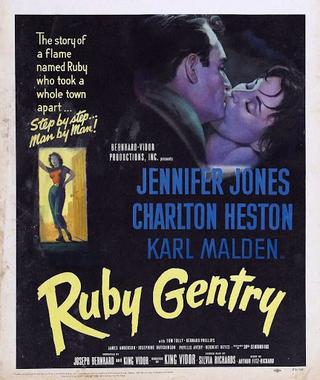
Incompatibility, or the absence of harmony, is what Ruby Gentry (1952) is all about. It’s a tale of love and ambition, and the friction generated by attempting to marry those two emotional opponents. Underpinning all that is the downbeat assertion that it is futile for one to try to escape the bonds of the past, that the future has already been mapped by circumstance or one’s  forebears, or perhaps some unseen guiding hand. This fatalistic view, one approaching the idea of predestination, tilts the movie in the direction of film noir; I think it is deserving of the noir label although I do acknowledge that there are those who will claim it is debatable whether it really belongs in that nebulous category.

Dr Saul Manfred (Barney Phillips) is the man from whose  point of view the story is seen. He’s our narrator, a kind of everyman guide taking us through the varied and tangled relationships at the heart of the affair rather than one of those pompously stentorian “voices of authority” that sometimes lecture the audience at the beginning of a film noir. His is a much more thoughtful and sensitive description of events and people, a reflection of the character himself and also of the personal stake he had in its development, at least at the start. He tells of Ruby (Jennifer Jones), and it’s one of those classic parables detailing the rise and fall not only of the title  character but of all those who were part of her life, and indeed one might even say of the rise and fall of the stuffy and socially suffocating community they all inhabit. Ruby is introduced as a swampland tomboy, an impoverished temptress in tight sweaters and torn jeans, as skillful with a rifle as she is careless with the hearts she captures. Simultaneously skittish and coquettish, she has spent time fostered in the well-to-do household of local big shot Jim Gentry (Karl Malden) and it’s whispered among the more mean-spirited in town that she has acquired ideas above her station. This is clear from her romance with Boake Tackman (Charlton Heston), a returning jock from a patrician background and a head full of big plans. The rigid social order is disapproving and Tackman hasn’t the moral courage to rise above this, so Ruby is drawn back into the world of the recently widowed Jim Gentry. Thus a complex web of ambition and desire is spun around a set of people who all think they know what they want but have no clear idea of how to get it, or to hold onto what they do manage to grab.

King Vidor’s  direction (working from a script by Silvia Richards) is beautifully controlled, pacy and rarely extravagant yet lush in its depiction of the steamy swamp where the climactic scene is played out and also in the richly detailed interiors, especially the house occupied by Ruby and her family. He uses space well to convey mood, the joyous and liberating race along the beach and through the surf in Tackman’s car perfectly captures the early exuberance of Ruby and her love, and then the cramped room which she shares with Jim and the doctor for the failed party after her marriage encapsulates the narrow and restrictive world she finds herself in. In the creation and presentation of these varied moods Russell Harlan’s cinematography is all one could ask for and no less than one would expect from such an artist in the manipulation of light. Ultimately, the movie works as a condemnation of unfettered ambition, where each of the main characters systematically destroys everything they care for in the pursuit of the unattainable. It is this, alongside the sour judgemental snobbery of a blinkered society, which stymies the only pure feelings on show – love is either thwarted or left unfulfilled and atrophied.

Jennifer Jones as the title character does succeed in drawing in the viewer, her allure is clear from her first appearance and the reunion with Heston on the porch in the dark and by torchlight gives a foretaste of the tumultuous nature of their relationship. Her efforts to fuse her love and her hunger to climb the social ladder is apparent from early on and the slow realization that she can only achieve the latter at the expense of the former is painful to see but convincingly portrayed by Jones. In the final analysis, hers is not an attractive character, the vindictiveness (though understandable) adds coldness and her attempts time and again to net Heston detract from her somewhat.

That latter aspect is amplified when it comes to the marriage to Malden’s besotted millionaire. His motives are the most straightforward and honest of the lead trio and he consequently earns a good deal of sympathy. There is a terrifically affecting moment when he catches his wife out in a foolish betrayal and you can see not only his world crumbling before his eyes but his assessment of himself as a man undergoing a reevaluation as he gazes in frank despondence into the mirror behind the bar of the country club. Heston simply oozes machismo, that powerful screen presence clear from even this relatively early stage in his career. For all the swaggering bravado though his Boake Tackman is a moral coward, a “back-door man” hiding behind his family’s position and reputation. Also deserving of mention is some fine work from Tom Tully, Barney Phillips and, in a disturbingly fanatical turn as the scripture-quoting brother, James Anderson.

Ruby Gentry has had a Blu-ray release in the US from Kino and there are a range of DVDs out there as well. I still have my old UK disc put out by Fremantle many years ago and it presents the movie most satisfactorily, although there are no supplements whatsoever offered. The movie has a strong emotional hook and Vidor’s assured direction, as well as Harlan’s cinematography and Heinz Roemheld’s score, combines effectively with some excellent performances. This may not be a picture you come away from with a particularly positive glow but it does have some depth and the final image, and message, may not be quite as downbeat as it first appears.

Coroner Creek

Revenge is a dish best served cold, or so the saying goes. Perhaps the truth is that it’s no dish at all, just an unappetizing craving arising out of wounded emotions. If anything, the coldness, or let’s at least say coolness, that inevitably arrives with the passage of time leads to a more satisfactory reckoning. Coroner Creek (1948) is what is commonly termed a revenge western, that is a story driven by the desire to settle a score and, as with the better examples of this variation on a genre, questions the desirability of this outcome and the effect on the protagonist.

A stagecoach being pursued by a band of whooping Apaches across the sun-baked badlands. That’s something of a cliché in the genre and it’s how Coroner Creek opens. While it may be a familiar and well-worn situation it’s still a dramatic one and does offer the twist of having the Apache raiders seen to be in the employ of a white man, one who remains unidentified as he methodically goes about shooting those within the stage, shooting all but one woman. Here we have the motivation for our protagonist Chris Danning (Randolph Scott) – although this isn’t explicitly stated till later in proceedings it is obvious enough from the start and I doubt if it constitutes a major spoiler. Nor does the identity of the man who Danning has determined to track down and kill. He pieces together enough information from a wounded Apache to allow him to set out across the arid southwest with an idea of who his quarry is. His path eventually leads to the town of Coroner Creek and the local strongman Younger Miles (George Macready). Danning’s game plan is to needle, snipe and provoke Miles into a reaction, to pick away relentlessly at his armor and tease threads from the cloak of respectability he has surrounded himself with. The brutalizing effect this is having on all concerned is made shocking clear on a number of occasions yet there is also a small flicker of hope amid all this darkness, one borne by the calm and steadfast hotel owner Kate Hardison (Marguerite Chapman).

Coroner Creek, adapted from a Luke Short novel, has a strong spiritual element running through it. This is natural enough for a story dealing with a moral issue such as the quest for revenge. It’s Marguerite Chapman’s character who represents this spirituality most obviously, her religious faith (though never piety or sanctimony) is clear to see and her concern for Danning runs deeper than a simple attraction. The movie never shies away from portraying the dehumanizing power of vengeance and it’s the willingness to confront this that raises it above average. Director Ray Enright (Flaming Feather) does some of his best work in this picture and, alongside cinematographer Fred Jackman Jr, shoots from a range of angles and uses the light and shadow to great effect.

Did you ever get hit with a bullet? It’s like a hunk of iron ripping and tearing into you. It sets you on fire inside. Sometimes you don’t die right away. You just bleed and hurt for a long time.

Those lines are spoken by one of the characters late on, just before he gets to experience the truth of his own words in a scene that is memorable for its unflinching cruelty. In fact for a movie made in the late 1940s Coroner Creek is remarkably graphic. There is a sequence around the middle which involves the mutilation of two of the characters’ gun hands. This is mean enough in itself but the fact they act as bookends for a truly bruising encounter between Scott and Forrest Tucker (rehearsing for a similarly tough brawl a couple of years later in The Nevadan) adds to the shock value. However, it’s important to understand that none of this is gratuitous, it’s not put on screen simply to provide some cheap thrill. The picture is nothing if not frank, and it openly acknowledges the effects of violence on the characters, both physically and psychologically.

Scott naturally dominates the movie and continues on that path he’d chosen in the post-WWII years (although arguably it was a journey begun even earlier in the likes of Lang’s Western Union), a path which would trace the development and gradual maturing of his western persona. There are moments of gentleness and humor where his patrician charm shines through but these are overshadowed by the darker, driven side of his character, looking ahead to the obsessive quality he would then hone to perfection in collaboration with Boetticher. Marguerite Chapman, as noted above, helps to temper this somewhat and her benign influence is not to be underestimated. The other significant female part belongs to Sally Eilers, in one of her last roles here and working for ex-husband and producer Harry Joe Brown.  Her contribution is big enough yet it feels slightly truncated at the same time, as though it ought to have had a bit more depth than is ultimately the case. I’m left wondering if certain plot strands weren’t trimmed or curtailed, and there are a few instances of clumsy editing too.

Scott tended to do well when it came to villains to face off against and actors such as Richard Boone and Lee Marvin helped him raise his own game. George Macready (did he ever play a good guy?) is the bad man on this occasion and he is as cold and manipulative as one would expect. That carefully modulated voice, disconcertingly prim and menacing, is well used. He is strongly supported by Forrest Tucker; simultaneously amiable and rotten, he uses his physical presence to excellent effect. Alongside these two Douglas Fowley is shifty up until his spectacular demise while Joe Sawyer is wonderfully contemptible as the blowhard whom Scott threatens in a most chilling way – another of those hard-edged little scenes in a hard little movie. Of the others in the cast, Edgar Buchanan and Wallace Ford turn in the kind of carefully judged performances that make them a pleasure to watch.

Coroner Creek made its appearance on DVD  in the US some years ago in a Sony/TCM collection of Randolph Scott westerns . The movie was shot in Cinecolor, with the limitations of that process, and is variable in appearance. At times the image looks very strong and then weakens noticeably. All told though, I’d say it looks quite acceptable. The film shares disc space with John Sturges’ The Walking Hills and has a handful of supplements such as galleries and a short filmed intro by Ben Mankiewicz. I would place the movie among Scott’s more enjoyable and interesting efforts, and it should easily satisfy any fan of the star’s work.

Manuela

Movies which play out for the most part in confined spaces typically generate tension, the limited options available to the characters mirrored by their spatial restrictions. Another layer is added when the dramatic space involved is to be found on a vehicle, a train or a ship for instance. When this occurs the concept of a journey is naturally woven into the fabric of the drama. A journey is generally of interest in itself, even when approached on the simplest and most literal of terms, and that interest rises if it can be viewed as a metaphor for the characters’ progress through life. It is this spiritual or emotional journey which resides at the heart of Manuela (1957), a modest, self-contained and deeply satisfying work directed by Guy Hamilton in the years before Hollywood and the James Bond movies beckoned.

There’s nothing like a death to focus the mind on life, and that’s essentially what happens as this movies opens. The story is one of a ship and more particularly the master of that vessel. That opening has him setting off to lay his chief engineer to rest in the South American port where he has docked. The ship is a beaten up tramp freighter and its equally weathered and weary captain is James Prothero (Trevor Howard). He’s seen to be drifting into a dissatisfied and increasingly drunken middle age, commenting at one point on how the passage of the years has not only crept up on him but also caught him unawares, leaving him with that unwelcome sense that there is more time behind him than there is lying ahead. Yet despite his conviction that he’s teetering on the brink of a bitter autumn, events are about to take a wholly unexpected turn, one which will see him enjoying something of a late spring instead. Taking advantage  of the amorous and expansive nature of Maltese crew member Mario (Pedro Armendariz), a beautiful half English girl Manuela (Elsa Martinelli) inveigles her way on board as a stowaway. Her presence seems set to cause friction and does so initially but it’s her longer term effect on the jaded captain that drives the drama. As he experiences a renewed appetite for life, he becomes distracted from his duties, switching his attention to the course he’d like to see his life following as opposed to the potentially hazardous one his vessel is in the process of navigating.

Guy Hamilton appears to have been a very polished man and that cool, worldly sophistication shows through in his movies. After serving an apprenticeship as assistant director under the likes of John Huston and Carol Reed, Hamilton went on to take charge of a number of well made British dramas including an adaptation of Priestley’s An Inspector Calls as well as The Intruder, a little known gem with Jack Hawkins. In Manuela everything revolves around priorities, or perhaps it’s more accurate to say the recognition of what they are; that and the fact it’s never too late to reassess and realign those priorities. While there is some very moody imagery via Otto Heller’s cinematography and a few quite dark moments, the overall tone of the movie is uplifting and optimistic. The story was filmed with two different endings – it’s an adaptation of a novel by William Woods, although not having read that I can’t say which one is more faithful to the source – and without going into details and spoilers I’ll just state that I vastly prefer the one used as the default for this release.

“… suddenly tonight, I saw myself growing old. And I didn’t like it. When you’re young you see the good days all ahead of you. Then suddenly you get older and catch sight of them behind you and wonder how in the devil’s name they got there.”

Trevor Howard had the lived in appearance that oozes character, his was a face and manner made for mature drama. The arc traced throughout this picture by Prothero is achieved skillfully and artfully. The bitterness and resignation of the first act is a brittle veneer that cracks completely with the arrival of the girl. What is revealed is a soul not yet aged irreversibly but hungry to taste hope once again. Of course for this kind of reawakening to make any sense, or have any credibility, it’s vital to have the right person providing the impetus. A young Elsa Martinelli easily fits that bill, exuding attraction and a frank charm. While those two are at the heart of the drama it’s also important to acknowledge the contribution of Pedro Armendariz. His role is a complex one, a figure of ebullience and menace too, a dangerous romantic with a dark side and generous heart, a braggart who is simultaneously a confessor. In support we get a number of familiar faces and talented figures from British cinema. Donald Pleasence has a sizeable role as a repressed and ultimately mean-spirited officer, one of those professional and spiritual zealots he excelled at playing. Other notables are Jack MacGowran, Warren Mitchell and Roger Delgado.

Blind buying movies can be a bit of a gamble and there’s no doubt that it doesn’t always pay off. However, an interesting cast and/or crew as well as an eye-catching piece of poster art will often get this viewer’s attention. Manuela was one of those blind buys when it showed up at a knockdown price in one of Network’s regular sales a few years ago. From a purely technical standpoint, it’s a terrific looking DVD with a sharp, smooth 1.66:1 image. I liked the fact the disc offered the alternative ending as an bonus feature. Apparently, different endings were used for the UK and overseas releases (according to IMDb at any rate) and I’m unsure which one is the default on the DVD – the UK one, presumably. This was a movie I viewed with absolutely no prior knowledge and consequently no particular expectations. Admittedly, there are a few inconsistencies in the script and some loose ends which are left untied. Nevertheless, I found it all a highly enjoyable experience and it’s a title I’m happy to recommend.
Edit: The movie was released in the US under the alternative title Stowaway Girl.

A Night of 50’s Television with Edmond O’Brien

Time for another piece from the pen of Gordon Gates. This one is diversion into an area I don’t tend to cover myself, mainly due to the fact I’m not so well informed about it. Gordon, on the other hand, is very much on his home ground writing about the early years of broadcast television, a field where he has an enviable depth of knowledge.
Most people think of early television as an endless string of comedy, western and detective shows. There was however another genre that populated the airwaves.This was the anthology series. These shows, such as Alcoa Theater, Schlitz Playhouse, Ford Theater, Robert Montgomery Presents, Climax, General Electric Theater, Studio One, Stage 7, Lux Video Theater and so on were extremely popular, Some of these series ran for over a decade and produced hundreds of episodes each.The format was stand alone stories that had a drama one week, a western next, a horror then a noir etc. As movie making slowed in the 50’s, many top flight actors, directors and cinematographers etc switched to television.More than a few Oscar types ended up on the small screen.Here is a small example of just one actor’s work. I asked all if they were fans of Edmond O’Brien and everyone answered in the affirmative. Here we go.
A Night of 50’s  Television with Edmond O’Brien.
Here are three different episodes from three different series all starring Mister O’Brien. The episodes are all film noir tinged.
First up is from LUX VIDEO THEATER: To Have and Have Not (1957)
No need to retell the story as we all know it. I will just describe the changes from the 1944 film. The two leads are played by Edmond O’Brien in the Bogart role and Beverly Garland filling in for Bacall. O’Brien plays the role with a far more violent and menacing edge than the laid back “leave me out it” style Bogart used in the film. Beverly Garland likewise turns it up and does her part as if she is just a step away from being a tramp. This really causes the sparks to fly when the two are in the clinches. One would swear they were going to drop their linen any second. There is some real chemistry here. John Qualen does a straight up copy of the Walter Brennan role and does not stand out at all. Dan Seymour reprises his role from the film as the slimy head of the Vichy Secret Police. Frances Bergen does the role played by Polly Moran while Lyle Talbot plays the American fisherman. Though there is no Hoagy Carmichael, we do have Sir Lancelot belting out a calypso tune. Lancelot had a small role in the 44 film but most will recall him from Brute Force. He was the soulful singer of the cell block in that film. The rest of the cast is Ken Terrell, Richard Flato, Edward Barrier and Jean De Val. Jean Yarbrough directs. Given the confines of television at the time, this production works very well. There is the odd short-cut. For example, we only get to see the cast going to, or from the boat. None of these short cuts hurt the story and in fact speed up the action. This is one of the best bits I’ve ever seen Garland in. A top flight TV noir.
Second up is from SUSPICION: Death Watch  (1958) – This one has 3 Oscar winners involved.

Janice Rule plays a live-in nanny who witnesses her employer shot to death by a mob boss. She soon regrets that she agreed to testify for the Police after she gets several death threats, and a bullet through her car window. The police soon have her put away in protective custody. The detective in charge is your buddy and mine, Edmond O’Brien. O’Brien moves Rule to the 10th floor of a big hotel and puts together a crack team of detectives to look after her. As the trial date draws near, Rule becomes convinced that the mobster behind the murder, Phil Donati, will get her. O’Brien does what he can to calm the woman including having the windows covered in case of a sniper. Two days before the trial O’Brien hears from an informant that a hit has been arranged. The hitter? He is told it will be one of his own squad. Which one could it be? O’Brien has known them all for years. He approaches the D.A. and his Captain with the info. Change the detectives with others from a diff squad is their suggestion. O’Brien decides instead to go with the same crew and see if he can flush out the traitor. He assembles the detectives and tells them what he has heard. O’Brien figures that they will now keep a watch on each other. This he hopes will give him the time he needs to catch the turncoat. The next day, Edward Binns, the senior detective, is approached by O’Brien. “I need to trust someone and you are it”. He tells Binns that he suspects one of the police women on the squad. O’Brien wants Binns to sit in with her while he steps out to make a private phone call. O’Brien steps out followed shortly by the police woman who needs to “powder her nose”. Binns pulls his gun and enters Rule’s room and walks up to her. He begins to level the gun when O’Brien pops out of the shadows and lets him have it. It seems O’Brien had let himself in through a hallway door. “How did you know”? whispers Binns. O’Brien responds. “You were the only one on the detail not to report the bribe attempt the mob made to all the rest.” Binns is hauled away and Rule is safe to testify.

The rest of the cast include, Jeanne Bates, Clark Howat, Horace McMahon and Mary Gregory. Actor and sometimes director Ray Milland helmed this well paced episode. The d of p was 6 time nominated and 2 time Oscar winner, Ray Rennahan. The story was by John Hawkins who wrote Crime Wave, The Killer is Loose and The Shadow on the Window.

To finish off the evening we go with an episode of STAGE 7: Debt of Honor (1955)

Edmond O’Brien and Charles Bronson are the stars in this episode. The episode is based on the Cornell Woolrich novel, I.O.U. One Life.

Our man O’Brien is a cop with a perfect life. He has a loving wife, a young daughter and a nice home in the burbs. He has even received a nice promotion at work. His job? He is now a lieutenant with the force. He decides that a night out with the family in the town is in order. They are involved in a car wreck which results in them crashing off the road and into a lake. The wife, Kasey Rogers, gets out, O’Brien is thrown out but knocked unconscious. The daughter, Wendy Winkelman, is still trapped in the slowly sinking car. A passing motorist, Charles Bronson, dives into the water and pulls the child to safety. A somewhat groggy O’Brien comes to and thanks Bronson. He tells Charlie that he is forever in his debt. Bronson jumps in his car and drives off before O’Brien can get his name. A year goes by and O’Brien is now a Captain. He is in charge of a unit assigned to hunt down a killer. O’Brien looks at the suspect’s mug shot and recognizes Bronson. What to do? To avoid being involved, he puts his aide, Steve Pendleton, in charge and heads home.
“Good thing the wife and daughter are out of town” O’Brien thinks to himself. A couple of hours later and there is a knock at the door. Standing in the doorway is Bronson who has come to ask O’Brien to honor his “debt”. There is some great back and forth as the two men discuss the “debt”. Bronson says, “I gave you your daughter’s life! Now I want mine!” “I’m a cop you fool! I can’t do what you ask”! answers O’Brien. O’Brien finally tells Bronson he can stay the night but if Bronson is there in the morning, he is taking him in.

The episode is directed by Lewis R. Foster whose work included the noir Crashout and Manhandled. The episode was photographed by one of noir’s best, George Diskant. His work included Desperate, Riff-Raff, They Live By Night, Port of New York, On Dangerous Ground, A Woman’s Secret, Kansas City Confidential, Between Midnight and Dawn and The Narrow Margin. What more could a person ask for, O’Brien and Bronson in a Cornell Woolrich penned story. A real top flight time-waster!!!!

——————————————————————————————————

Gordon Gates